2019 International Conference on Computational Modeling, Simulation and Optimization (CMSO 2019) ISBN: 978-1-60595-659-6
Mobile Edge Computing Task Placement Strategy Based on NSGA-II
Fang-qin XU
1,*and Zhi-min ZHU
21College of Information Technology, Shanghai JianQiao University, 201306, Shanghai, China
2School of Computer Science and Technology, Donghua University, 201620, Shanghai, China
*Corresponding author
Keywords: Mobile Edge Calculation, Task offload strategy, NSGA-II.
Abstract. With the proliferation of smart terminal devices, the traditional centralized service model has been unable to quickly handle the explosive growth of business data. The maturity of 5G networks has led to the accelerated development of edge computing technology and the emergence of mobile edge computing technology, which can effectively solve the problems of network delay and load balancing in edge computing. This paper first proposes the use of genetic algorithm to solve the task unloading problem in multi-service nodes and mobile terminal tasks in large-scale heterogeneous MECs. Then, combined with the actual use environment of MEC, the algorithm is improved by NSGA-II, and finally through edge calculation simulation. The platform iFogSim and the dataset Google Cluster Trace experiment with task mode issues. The simulation results show that the task unloading strategy based on NSGA-II algorithm has better effect on load balancing and service delay than the original genetic algorithm, and has strong practical application value.
Introduction
With the rapid development of mobile communication technology and the massive popularization of intelligent terminal devices, more and more mobile phones, tablets, gateways, sensors and other devices[1] can obtain remote services through the Internet. According to the Cisco Visual Network Index (Cisco VNI) forecast: From 2016 to 2021, mobile data traffic will grow at a compound annual growth rate of 46%. By 2021, traffic will reach 48.3 EB per month. [2] Therefore, with the increase of data generated by mobile devices and IoT devices, the traditional cloud data center-centric operation mode can no longer meet the needs of users. First, for delay-sensitive applications, such as online games, virtual reality, video communication, etc., the delay caused by the relative distance between the user and the data center and the processing power of the data center will greatly reduce the user experience. [3] On the other hand, due to data interaction. Need to be carried out in the core network, so it will put a lot of pressure on the network load. Compared to the limitations of cloud computing services, mobile edge computing can provide services on an open platform that integrates network, computing, storage, and application core capabilities on the side close to the physical entity or data source. It is a task that can get faster response. And processing. To put it simply, the core idea of MEC is to edge and localize computing resources and cache resources to reduce network latency and ease bandwidth pressure, and to meet the computing power requirements due to the increase of mobile terminal devices. The disadvantage of extended cloud computing platform transmission.
the actual environment of MEC, and uses NSGA-II to optimize the task unloading strategy and improve resource utilization.
NSGA-II Algorithm
The non-dominated sorting genetic algorithm (NSGA-II) with elite strategy is a multi-objective genetic algorithm, which reduces the complexity of the non-dominated genetic algorithm. It has a fast running speed and a good convergence of the solution set. It is a multi-objective solution. One of the best algorithms for optimizing problems. [7]
[image:2.595.176.419.320.600.2]The flow chart of NAGA-II is shown in Figure 1. The specific calculation process is as follows: (1)Let t=1, randomly generate population Pt with population size N, and perform fast non-dominated sorting for all individuals in Pt; (2)The fitness is assigned to individuals according to the sorting order. The higher the ranking level, the smaller the fitness of the allocation. After the crossover and mutation, the progeny population Qt is generated;(3)Mixing the parent population with the child population to produce Rt; (4)Perform fast non-dominated sorting on Rt, calculate the crowding distance, and select the best performing N individuals to form a new parent population Rt+1;(5)If the condition is met, the loop terminates and the optimal strategy is output. If not, proceed to step (2) again.
Figure 1. The flow chart of NAGA-II.
NSGA-II has two key algorithms, which are non-dominated fast sort algorithm and the algorithm congestion. The specific steps of the fast non-dominated sorting algorithm are as follows.
① Depositing the number np of individuals in the population that dominates the individual p into the set F1;② Saving the individual dictated by each individual i in F1 to the collection Si; ③ Traverse each individual l in Si and execute nl=nl-1. Saving the individual with nl=0 to the set Q;
④ With the individuals in F1 as the first non-dominated layer and the set Q as the current set, steps 2-4 are performed again until all individuals are ranked.
② The crowded distance of the i-th individual is a value that sums the difference between all objective function values of the i+1th and i-th individuals.
After the fast non-dominated sorting and the congestion degree calculation, the rank irank and the congestion rank id of each individual's fast non-dominated sorting are obtained. Then, according to the principle that the irank ascending order is re-crowded, the actual ranking of each individual is obtained. [8]
Modeling of Task Unloading Strategy for Multi-performance Indicators
The task placement strategy for mobile edge computing is a multi-objective planning problem that needs to take into account load balancing issues, service latency issues, network usage issues, and energy consumption issues when placing tasks. This paper takes load balancing problem and service delay problem as examples to discuss the performance problem of NSGA-II in solving the problem of moving edge computing task placement. The computing devices in the mobile edge calculation are denoted herein as (D, E, TM). D represents the data center and E represents the set of edge servers. The m edge servers in the network are represented by E={e1, e2, ..., em}. TM denotes a terminal device and denotes n terminal devices in the network with T={tm1, tm2, ..., tmn}. It is assumed that each terminal device can only issue one task at a time and sub-tasks after the task is split are represented by a five-tuple as TASK={Cinij, Coutij, Wupij, Wdownij, Rij}. Subscripts i and j represent the jth subtask of the i-th task; Cin represents the amount of input data; Cout represents the amount of output data; Wup represents the bandwidth required for uploading; Wdown represents the bandwidth required for downloading; R represents the computing resources required for the calculation .
Load balancing is one of the important means to realize the effective use of various resources in the network. It is mainly to achieve the most efficient resource utilization, maximize throughput, minimize response time and avoid overload. This article uses the following formula to perform load balancing calculations for all devices. [9]
L(i) represents the resource integrated load of the i-th computing device; t is the number of indicators used by a single computing device to calculate the overall load value; Ux is the weight of the xth indicator; Lx is the usage of the indicator. Avg calculates the load mean of all computing devices; LB is its standard deviation, which measures the degree of dispersion of the load on each computing device.
{
L(i) = ∑𝑡𝑥=1𝑈𝑥∗ 𝐿𝑥
𝑎𝑣𝑔 =∑𝑚+𝑛+1𝑖=1 𝐿(𝑖) 𝑚+𝑛+1
𝐿𝐵 = √∑𝑚+𝑛+1𝑖=1 (𝐿(𝑖)−𝑎𝑣𝑔)2 𝑚+𝑛+1
(1)
The service delay refers to the time of the first subtask of a service from the time sent by the terminal to the time when the terminal accepts the result of the last subtask of the task. Its calculation formula is as follows.
SD = 𝑡𝑖𝑚𝑒𝑅𝑒𝑛𝑑− 𝑡𝑖𝑚𝑒𝑆𝑡𝑎𝑟𝑡 (2) timeRend is the receiving time of the last task, and timeStart is the sending time of the first task.
Simulation
and several mobile terminal devices. It is stipulated that each terminal device can only issue one task at a time.
In order to simulate the placement process after the terminal task is split into several sub-tasks, this paper uses the existing project VRGame in iFogSim and modified it to build a virtual reality game. Virtual reality games are sensitive to service latency and therefore require a high level of task placement strategies. At the same time, the amount of calculation is also large, which can better reflect the performance of the two strategies. [10]
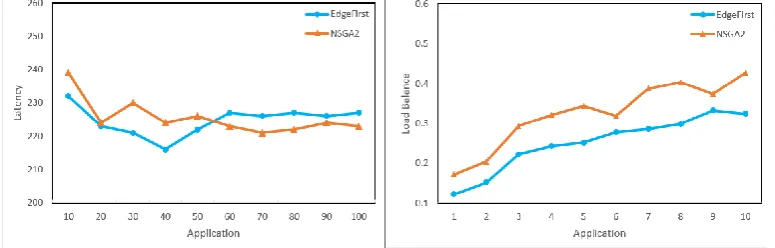
Analysis of Results. In order to verify the performance difference between the edge server priority placement strategy and the NSGA-II based task placement strategy in the same environment, this paper uses two strategies to place experiments on 100 applications. The experimental results are shown in the following Figure 2. In terms of load balancing, the task placement strategy based on NSGA-II is better able to determine the current load of each server through the algorithm and assign tasks to servers with lower load. Therefore, its performance in load balancing performance is better than EdgeFirst. In terms of task latency, when the task is small, the NSGA-II-based strategy requires more time to calculate the optimal strategy, so it does not perform better than EdgeFirst's strategy. As the number of tasks increases, EdgeFirst does not assign tasks well, which may lead to congestion. NSGA-II can better allocate subtasks, and its performance will not cause higher delays as the number of tasks increases.
Conclusion
This paper first proposes to use NSGA-II to solve the problem of task placement with multi-service nodes and multi-tasking in MEC. Then through the iFogSim simulation platform, the experiment compares the performance of the edge server priority placement strategy and the NSGA-II optimization based placement strategy in terms of load balancing and service delay. According to the comparison results, the placement strategy based on NSGA-II optimization is greatly improved in terms of load balancing, and the service delay cannot be maintained with increasing the workload.
Acknowledgement
[image:4.595.105.493.570.694.2]This thesis is one of the achievements of the construction of the innovation base for the employment of college graduates funded by the Shanghai Municipal Education Commission, the extra-curricular practice base project of the Internet of Things Engineering. I would like to express my sincere gratitude. I also thank Shanghai Jianqiao College and colleagues who provide help and support at work.
Figure 2. The NSGA-II experimental results compared with the EdgeFirst.
References
[2] Li Zishu, Xie Renchao, Sun Li, Huang Wei. A Review of Mobile Edge Computation[J]. Telecommunications Science, 2018, 34(01): 87-101.
[3] Meng Chenrong. Research on Data Center Service Resource Scheduling Mechanism for Edge Computing[D]. Beijing University of Posts and Telecommunications, 2018.
[4] Wu Yunwei, Dai Jing. Research on Edge Computing Platform and Interface Scheme for 5G[J]. Design Technology of Posts and Telecommunications, 2017(03): 10-14.
[5] Jiao Jie. Task Collaborative Scheduling Strategy in Mobile Edge Computing (MEC) [D]. University of Electronic Science and Technology of China, 2018.
[6] Xie Renchao, Lian Xiaofei, Jia Qingmin, Huang Wei, Liu Yunjie. A Review of Mobile Edge Computing Placement Technology[J]. Journal on Communications, 2018, 39(11): 138-155.
[7] Daniela Moniz, João Pedro, Nuno Horta, João Pires. Multi-objective framework for cost-effective OTN switch placement using NSGA-II with embedded domain knowledge[J]. Applied Soft Computing Journal, 2019, 83.
[8] Wu Xiaoping, Duan Xianwei, Du Pengcheng, Dai Shenglan, Zhang Zhiyong. Multi-objective optimization of high-speed railway sound barrier based on NSGA-II algorithm[J]. Journal of Railway Science and Engineering, 2019, 16(06): 1369-1374.
[9] Haifeng Lu, Chunhua Gu, Fei Luo, Weichao Ding, Xinping Liu, Optimization of lightweight task offloading strategy for mobile edge computing based on deep reinforcement learning, Future Generation Computer Systems, 2019.
[10] Cheng Jun. Research on MPI cluster communication algorithm in multi-cluster environment [D]. Jilin University, 2013.
[11] Yu Bo, Li Qingjian, Wang Wei. Research and Application of Real-time Communication Cluster Load Balancing Strategy[J]. Computer Systems, 2019, 28(05): 167-172.