2017 International Conference on Mathematics, Modelling and Simulation Technologies and Applications (MMSTA 2017) ISBN: 978-1-60595-530-8
Application of the H-P version Finite Element Method in
Analysis of Hydraulic Structures
Jian-ming ZHANG
*, Da-wei ZHANG and Yang-chun LU
Department of Engineering Mechanics, Kunming University of Science and Technology, Kunming, 650500, P.R. China
*Corresponding author
Keywords: H-P version, Finite element method, Application, Hydraulic structures.
Abstract. In this paper, we consider the application of the h-p versionfinite element method in analysis of hydraulic structures by using the FEM computational software StressCheck of American ESRD (Engineering Software Research and Development) company as the computational tool. We choose a three dimensional concrete gravity dam as the computational model and compute the maximum displacement and the first principal stress of the concrete gravity dam. The results show that the h-p version finite element method is effective and reliable in analysis of hydraulic structures for the model chosen, and we obtained faster convergence rate, higher precision and smaller error by using the h-p version finite element method than by using p-version and h-version finite element method.
Introduction
According to the structure of finite element solutions, there are three approaches of the finite element method: the h-version, the p-version and the h-p version. In the h-version, the degree p of the elements is fixed at a low level and the accuracy is achieved by properly refining the mesh. In the p-version, the mesh is fixed and the degree p of polynomials is increased uniformly or selectively to achieve the accuracy. The h-p version is the combination of the h-version and p-version, namely, refine meshes and increase polynomial degrees simultaneously and selectively (or uniformly) in order to achieve higher accuracy. The p-version and h-p version finite element methods are new developments of finite element method. It is well known that the one and two dimensional p and h-p version finite element methods (FEM) have made great progress in past three decades [1-9], and have been widely used in scientific and engineering fields. In recent years, the convergence of three dimensional p and h-p version finite element methods (FEM) have been established [10-15] and applied successfully in the different engineering fields. But in analysis of hydraulic structures, researchers only obtained a few results by using the p-version finite element method [16-19], application of the h-p version finite element method is much less.
In next section, we will choose a three dimensional concrete gravity dam as our computational model and compute its maximum displacement and the first principal stress by using StressCheck which is based the p and h-p finite element method.
Model
Figure 1. Model of three dimensional concrete gravity dam.
Numerical Results
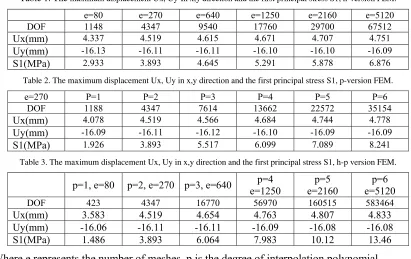
[image:2.612.98.509.422.681.2]In this section, we adopted hexahedral elements to compute the maximum displacement in x and y direction and the first principal stress S1 of the three dimensional concrete gravity dam under basic load combination (water pressure, sediment pressure, self-weight and uplift pressure) and compared the results with the results obtained by the h-version and p-version finite element method. We obtained the maximum displacement Ux, Uy in x, y direction and the first principal stress of the concrete gravity dam at the dam heel when the number e of hexahedral meshes are 80, 270, 640, 1250, 2160, 5120, separately. The numerical results of the maximum displacement Ux, Uy in x, y direction and the first principal stress of the three dimensional concrete gravity dam at the dam heel are shown separately in the Table 1,Table 2 and Table 3 corresponding to the h-version, p-version and h-p version finite element method:
Table 1. The maximum displacement Ux, Uy in x,y direction and the first principal stress S1, h-version FEM.
e=80 e=270 e=640 e=1250 e=2160 e=5120
DOF 1148 4347 9540 17760 29700 67512
Ux(mm) 4.337 4.519 4.615 4.671 4.707 4.751
Uy(mm) -16.13 -16.11 -16.11 -16.10 -16.10 -16.09
S1(MPa) 2.933 3.893 4.645 5.291 5.878 6.876
Table 2. The maximum displacement Ux, Uy in x,y direction and the first principal stress S1, p-version FEM.
e=270 P=1 P=2 P=3 P=4 P=5 P=6
DOF 1188 4347 7614 13662 22572 35154
Ux(mm) 4.078 4.519 4.566 4.684 4.744 4.778
Uy(mm) -16.09 -16.11 -16.12 -16.10 -16.09 -16.09
S1(MPa) 1.926 3.893 5.517 6.099 7.089 8.241
Table 3. The maximum displacement Ux, Uy in x,y direction and the first principal stress S1, h-p version FEM.
p=1, e=80 p=2, e=270 p=3, e=640 e=1250p=4 e=2160p=5 e=5120p=6
DOF 423 4347 16770 56970 160515 583464
Ux(mm) 3.583 4.519 4.654 4.763 4.807 4.833
Uy(mm) -16.06 -16.11 -16.11 -16.09 -16.08 -16.08
S1(MPa) 1.486 3.893 6.064 7.983 10.12 13.46
Where e represents the number of meshes, p is the degree of interpolation polynomial, DOF: Degrees of Freedom.
Relative errors in energy norm||e||E,R in the p-version and h-p version are shown as follows in Fig.
Figure 2. Relative error ||e||E,R in the p-version between energy norm and degrees of freedom.
Figure 3. Relative error ||e||E,R in the h-p version between energy norm and degrees of freedom.
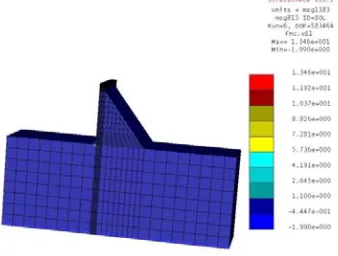
The mesh division, the computation results of maximum displacement Ux, Uy in x, y direction, the first principal stress of the three dimensional concrete gravity dam at the dam heel when e=5120 (the number of meshes) in StressCheck are shown in Fig. 4 and Fig. 5 :
Figure 4. Meshes, maximum displacement Ux, Uy in x, y direction.
[image:3.612.119.504.414.546.2] [image:3.612.221.390.573.701.2]Conclusion
In this paper, we studied the application of the h-p version finite element method in analysis of the hydraulic structures, we compute numerically the maximum displacement and the first principal stress of a three dimensional concrete gravity dam by using the FEM computational software StressCheck, compare with the computational results of p-version finite element method and h-version finite element method. The numerical results show that the h-p finite element method has the following advantages: less meshes, faster convergence rate, higher precision and smaller error. Therefore, the application of the h-p version finite element method in analysis of hydraulic structures is effective and practicable. Furthermore, the h-p version finite element method can be applied in dynamic analysis of hydraulic structures in future work.
Acknowledgements
This research was financially supported by the National Science Foundation of China under Grant 11261026, and the authors thank for the support of the National Science Foundation of China for the work.
References
[1] I. Babuška, M.B. Szabó and N. Katz, The p-version of the finite element method, SIAM J. Numer Anal.(1981), 515-545.
[2] I. Babuška, A. Craig, J. Mandel and J. Pitkaranta, Efficient preconditioning for the p version finite element method in two dimensions, SIAM J. Numer. Anal., 28(1991), pp. 624-661.
[3] I. Babuška, M. Suri, The h-p version of the finite element method with quasi-uniform meshes, RAIRO Model. Math. Anal. Numer., 21(1987), pp. 199-238.
[4] I. Babuška, M. Suri, The optimal convergence rate of the p-version of the finite element method, SIAM J. Numer Anal. 24 (1991), pp. 750-776.
[5] M.B. Szabó, I. Babuška, Finite element analysis, John Wiley and Sons, Inc., 1991.
[6] W. Gui, I. Babuška, The h, p and h-p versions of the finite element method in 1 dimension, Numer. Math. 49 (1986), pp. 577-612.
[7] B.Q. Guo and W. Cao, A preconditioner for the h-p version of the finite element method in two dimensions, Numer. Math., Vol. 75 (1996), pp. 59-77.
[8] B.Q. Guo, W. Cao, An additive Schwarz method for the h-p version of the finite element method in two dimensions, SIAM J. Sci. Comput. 18(1997), pp. 1267-1288.
[9] C. Schwab, p- and hp- Finite Element Methods, Oxford Science Publication, 1998.
[10] B.Q. Guo, Approximation theory for the p-version of the finite element method in three dimensions, Part 1: Approximabilities of singular functions in the framework of the Jacobi-weighted Besov and Sobolev spaces, SIAM J. Numer. Anal. 44 (2006), pp. 246-269.
[11] B.Q. Guo, Approximation theory of the p-version of the finite element method in three dimensions, Part 2: Convergence of the p-version of FEM, SIAM J. Numer. Anal. 47 (2009), pp. 2578-2611.
[14] R. Munoz-Sola, Polynomial liftings on a tetrahedron and applications to the h-p version of the finite element method in three dimensions, SIAM J. Numer. Anal. 34 (1997), pp. 282-314.
[15] J.M. Zhang, Y. He and X. Qi, The convergence of the h-p version of the finite element method with quasi-uniform meshes in three dimensions. AIP Conference Proceedings 1648, 050010 (2015). [16] Z. Cheng, S.H. Chen, 3-D hierarchical FEM analysis for hydraulic structure. Journal of Hydraulic Engineering, 12 (1999), pp.53-58.
[17] S.H. Chen, Z. Cheng, Study on p-version adaptive finite element method for analysis of hydraulic structure. Journal of Hydraulic Engineering, 11(2001), pp. 62-69.
[18] W.P. Fei, S.H. Chen, 3-D p-version elasto-viscoplastic adaptive FEM model for hydraulic structures. Journal of Hydraulic Engineering, 3(2005), pp. 86-92.