AN EMPIRICAL STUDY ON DIFFERENTIATION OF SELF AND ITS DIMENSIONS
V. Rajeswari
Head, Dept. of Education, Mother Teresa Women’s University, Kodaikanal. &
Jessy Jacob
Research Scholar, Guidance and Counseling, Mother Teresa Women’s University, Kodaikanal.
This study aimed at the analysis of the differentiation of self and its dimensions. The
Differentiation of Self Inventory was administered to 544 spouses selected for the study. Results
showed that most of the spouses have only average level of differentiation of self. And further
the results supported the importance of ‘I position’ in determining one’s differentiation of self.
Key words:-
Bowen theory, Differentiation of self, I position.Introduction
The theory on differentiation of self is first espoused by Murray Bowen (1978). Differentiation of self is the key concept of Bowen Family theory and Family therapy. Of the various constructs that composed in Bowen theory, differentiation of self is the personality variable plays a most crucial and critical role in the development of maturity and in the attainment of psychological health.
Differentiation of self is the degree to which one is able to balance ‘emotional and intellectual’ functioning and ‘intimacy and autonomy’ in relationships (Bowen 1978). On an intra-psychic level, differentiation refers to the ability to distinguish thoughts from feelings and choose between being guided by one’s intellect or one’s emotions when circumstances dictate. The spouses with high differentiation of self are Flexible, adaptable, and better able to cope with the stress. And they co-operates equally well on both emotional and rational levels, while
maintaining a measure of autonomy within their intimate relationships. In contrast, poorly
differentiated persons tend to be more emotionally reactive (Kerr & Bowen, 1998), finding it difficult to remain calm in response to the emotionality of others. They tend to make decisions on the basis of what ‘feels right’. In short, they are trapped in an emotional world.
On an interpersonal level, differentiation of self refers to the ability to experience intimacy and independent from others. Highly differentiated persons are capable of taking ‘I position’ in their relationships, maintaining a clearly defined sense of self and thoughtfully adhering to personal convictions when pressured by others to do otherwise (Bowen 1978). Highly differentiated individuals do satisfactory communication with their families of origin and establish healthy married life and being an effective problem solvers and best leaders.
METHOD
The method adopted for the study is as follows:
Objectives of the study
1. To find out whether there is any similarity in differentiation of self and its dimensions between husbands and wives as life partners.
2. To find out the inter-relationship among the dimensions of differentiation of self 3. To suggests ways and means to achieve differentiation of self.
Hypotheses
1. There is significant relationship between dimensions of differentiation of self.
2. There is significant difference between Husbands and Wives with regard to differentiation of self and its dimensions.
Research Design
The design of the study is descriptive and diagnostic.
Locale and Sample of the Study
The spouses belong to Syrian Catholic Community at Central Travancore in Kerala State is considered as the sample of the study. The Syrian Catholic Church of Central Travancore are divided in to 9 dioceses. For the study 18 parishes are selected from the 6 dioceses using Purposive Sampling Technique, where the investigator exercises her discretion in the matter of selection.
The Differentiation of Self Inventory (DSI; Skowron 1998, Revised; 2003) is one relatively new self-report measure of differentiation derived from Bowen theory, developed to assess emotional functioning, intimacy, and autonomy in interpersonal relationships. Its subscales are designed to assess interpersonal (i.e., fusion and emotional cut-off) and intrapsychic dimensions of differentiation problems (i.e., emotional reactivity and difficulty taking an “I” position). Differentiation of Self Inventory (Revised) of Elizabeth Skowron and Thomas A. Schmitt (2003) is well modified scale to Bowen Family Therapy. The DSI -R is a 46- item self report measure that focuses on adults, their significant relationships, and current
relations with family of origin. Participants rating items using a 6-point, Likert-type scale, ranging from 1 (not at all true of me) to 6 (very true of me). The DSI contains four subscales: Emotional Reactivity (ER), “I” Position (IP), Emotional Cut-off (EC), and Fusion with Others (FO). The 11-item ER scale assessed the tendency to respond to environmental stimuli on the basis of autonomic emotional responses, emotional flooding, or liability. Scores are reversed so that higher scores reflect less emotional reactivity or greater differentiation of self. The 11- item IP scale contains items that reflect a clearly defined sense of self and the ability to thoughtfully adhere to one’s convictions even when pressured to do otherwise. Higher scores indicate an ability to take an “I-” position or greater differentiation of self. The 12-item EC scale consists of items reflecting fears of intimacy or engulfment in relationships, and the accompanying
behavioural defences against those fears. Higher scores indicate less emotional cut-off, or greater differentiation. The 12-item FO scale in its original form reflects emotional over involvement with significant others and over identification with one’s parents— taking in parental values, beliefs and expectations without question. Higher scores indicate less fusion or greater
differentiation of self. The scale for Differentiation of Self expressed along the six point scale, the scoring scheme adopted for the scale is as follows. For positive statement the scoring was 6,5,4,3,2, and 1, and for the negative statements, the scoring was 1,2,3,4,5 and 6. Since it as a standardized foreign tool, a study is conducted to know the Reliability. Statistical analysis -Cronbach's Alpha - is done. Value of Cronbach’s Alpha for ‘Differentiation of Self inventory’ of Elizabeth Skowron is found 0.822. So inventory is reliable at 82% level. Hence it is used to collect the data from spouses.
Statistical Tools and Method
1. Correlation is used to know the relationship between the variables
2. t test is used to find out the difference between husbands and wives with regard to differentiation of self and its dimensions.
RESULTS AND DISCUSSIONS
Level of differentiation of self of spouses
Variables High (>M+σ)
Average Between (>M+σ and <M-σ)
Low (< M-σ) Total
No. of
Spouses %
No. of
Spouses %
No. of
Spouses %
No. of
Spouses % Differentiation
of Self
93 17.10 363 66.72 88 16.18 544 100
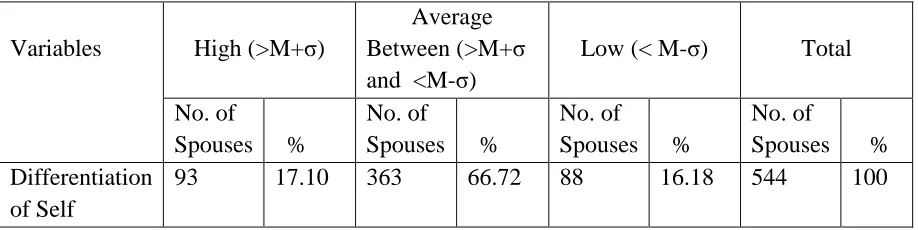
To find out the levels of Differentiation of Self, among Spouses, the investigator found out the mean and standard deviation of the differentiation of self in the form of conventional method. In the conventional procedure, σ distance from mean M is used. According to the values of the scores obtained the spouses are classified in to three groups high, if the scores obtained are greater than (M+σ), low if the scores obtained are less than (M-σ) and average if the scores obtained are in between (M+σ) and (M-σ).
The table 1 shows the level of Differentiation of Self of spouses. The spouses in Central Travancore have average levels of differentiation of self (66.72 %), 17 % of them have high levels of differentiation of self and 16.28 % have low levels of differentiation of self. That is, 83% of spouses do fall under average and low level of differentiation of self.
[image:4.595.82.541.105.220.2]Inter Correlation of Dimensions of Differentiation of Self
Table 2: Correlation between Dimensions of Differentiation of Self
Variables of DSI
Emotional cut-off
Emotional Reactivity
Fusion with
Others I Position
Emotional cut-off
1 0.478** 0.116** -0.031
Emotional Reactivity -
1 0.218** 0.057
Fusion with Others
- - 1 -0.345**
I Position
Note: ** Denotes the correlation is significant at the 0.01 level
The co-efficient of correlation between emotional cut-off and emotional reactivity is 0.478, which indicates 47 % positive relationship between emotional cut-off and emotional reactivity is significant at 1% level. The co-efficient of correlation between emotional cut-off and fusion with others is 0.116, which indicates 11.6 % positive relationship exists between emotional cut-off and fusion with others and is significant at 1% level. The co-efficient of correlation between emotional reactivity and fusion with others is 0.218, which indicates 21.8% positive relationship exists between fusion with others and emotional reactivity and is significant at 1% level. Since it is a positive correlation, the relationship between emotional cut-off, emotional reactivity and fusion with others shows considerable dependence of variables on one another. The increase in one variable results in corresponding increase in other variable. The increase in emotional cut-off will result in the corresponding increase in the emotional reactivity and fusion with others; the increase in emotional reactivity will result in the corresponding increase in the emotional cut-off and fusion with others; and the increase in fusion with others will result in the corresponding increase in the emotional reactivity and emotional cut off.
The co-efficient of correlation between fusion with others and I position is -0.345, which indicates 34.5 % negative relationship between fusion with others and I position and is
significant at 1% level. Since it is a negative correlation, the relationship shows considerable dependence of variables on one another. The increase in one variable results in corresponding decrease in other variable. The increase in I position will result in the corresponding decrease in the Fusion with others. The co-efficient of correlation between I Position and Emotional Cut-off is -0.031, which indicates 3.1% negative relationship between I Position and Emotional Cut-off and is not significant at 5% level. The co-efficient of correlation between Emotional Reactivity and I Position is 0.057, which indicates 5.7% positive relationship between Emotional Reactivity and I Position and is not significant at 5% level.
From the above results, it is clear that there is significant negative relationship between I position and fusion with others and fusion with others show significant positive relationship between fusion with others and emotional cut off. Hence it can be inferred that increase in I position, will result in decrease in fusion with others and hence decrease in emotional reactivity and emotional cut-off, which will increase the differentiation of self.
[image:5.595.63.537.662.776.2]Difference between Male and Female Spouses in Differentiation of Self
Table 3: Student t test for Significant Difference between Male and Female Spouses with Respect to Differentiation of Self and its Dimensions
Dimensions of Differentiation of Self
Gender
t value P value
Husband Wife
Mean SD Mean SD
Emotional
Reactivity 39.92 7.09 37.97 6.36 3.381 0.001**
Fusion with Others
22.85 5.90 22.33 5.78
1.050
0.294
I Position
45.45 7.84 45.46 7.51
0.011
0.991
Overall
Differentiation of Self
156.84 15.74 152.60 15.37 3.183 0.002**
Note: ** Denotes significant at 1% level
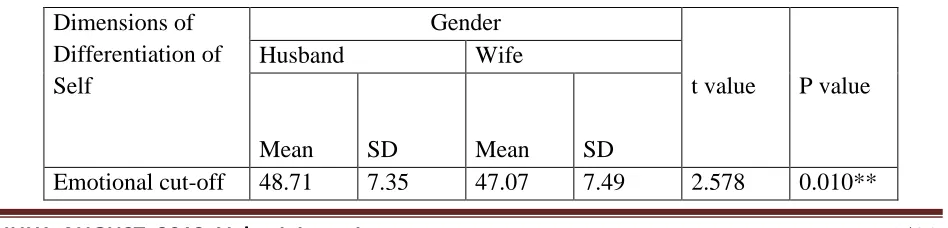
Since P value for the dimensions emotional cut off, emotional reactivity and for overall differentiation of self inventory is greater than 0.01, the null hypothesis rejected at 1% level of significance. Hence it can be concluded that, there is significant difference between husbands and wives with respect to overall differentiation of self inventory, emotional cut off and emotional reactivity. Based on average score of, male spouses have higher scores in emotional cut off, emotional reactivity and hence have higher differentiation of self, than their counterpart and it is significant at 1% level.
Since P value for the dimensions fusion with others and I position is greater than 0.05 the null hypothesis accepted at 5% level of significance. Hence it can be concluded that there is no difference between husbands and wives for their fusion with others and I position. Based on average score, there is only a slight difference between them in the case of dimensions, fusion with others and I position. So it can be inferred that, husbands and wives have poor ‘I Position’ and consequently ‘Emotionally fused with others’.
Regarding dimensions of differentiation of self, the husbands and wives do differ significantly in emotional cut off and emotional reactivity. The higher level of husbands in the mean score of emotional cut off and emotional reactivity indicates that the husbands are good in emotional cut off and emotional reaction than their counterparts. But in the case of fusion with others and I position the husbands and wives do not differ. So, it is inferred that, majority of the spouses are emotionally fused. Therefore, it can be concluded that ‘fusion with others’ is the great hindrance to the differentiation of self of the spouses under study. From the correlation analysis, a negative interrelationship is found between ‘I position’ and ‘fusion with others’. Therefore it can be concluded that low level of ‘I position’ is the cause of high level of ‘fusion with others’ and vice versa.
CONCLUSION
The results indicate the interrelationship of the dimensions of differentiation of self and level and
relationship between dimensions suggests the importance of ‘I position’ in the differentiation
process. The husbands show significantly higher level in the differentiation of self.
REFERENCES
1. Murray Bowen M.D. (1985), Family Therapy in Clinical Practices, NewJersy, Jason Aronson. ISBN: 1-56821-011-6
2. Peter Titelman. (1987), The Therapist’s own Family – Toward the Differentiation of Self, New Jersy,JasonAronson.ISBN: 0-87668-921-7
3. Micheal. E .Kerr, Murray Bowen. (1988), Family Evaluation, New York, W.W.Norton& company. ISBN: 0-393-70056-9