ISSN: 1992-8645 www.jatit.org E-ISSN: 1817-3195
FACE CLASSIFICATION USING WIDROW-HOFF
LEARNING PARALLEL LINEAR COLLABORATIVE
DISCRIMINANT REGRESSION (WH-PLCDRC)
1VISHWANATH P., 2Dr. V M VISWANATHA
1
NIMS University, Jaipur(Rajasthan), Electronics and Communication Engineering 2
S L N College of Engineering, Raichur, Electronics and Communication Engineering
E-mail: [email protected], [email protected]
ABSTRACT
Learning based face classification technique is proposed in this paper to improve Xiaochao Qu’s linear collaborative discriminant regression classification (LCDRC). The LCDRC helps to find out a discriminant subspace by increasing collaborative between-class reconstruction error and decreasing the within-class reconstruction error simultaneously. With the aim of proposing the further improvement of the accuracy of probe image classification by minimizing the value of WCRC with the aid of our proposed methodology. Proposed methodology used parallel process to find an optimal projection matrix with the aid of the LCDRC method (arm A) & implement Widrow-Hoff learning method into the LCDRC (arm B). Both arms A & arm B are varying with the calculation of WCRC & arm A returns the current value of WCRC & arm B derives the future value of WCRC. Then, the optimal projection matrix is derived by the proposed methodology after the selection of suitable value of WCRC derived from the arm A & arm B method.
Keywords: Face Classification, Linear Collaborative Discriminant Regression, Reconstruction Error,
Widrow-Hoff Learning.
1. INTRODUCTION
Biometric authentication has gotten a great deal of interest recently is due to the wide range of applications information security & access control. Face recognition system [1] is one of the methods for biometric authentication to identify from face images. The automatic face recognition system (FRS) can find the faces from still or video streams, which have been performed by the classifiers [2]. Research is focused to improve the ability of FRS
by concentrating on the representation
methodology, as a consequence, some algorithms are developed such as Sparse Representation
Classification (SRC) [3], Collaborative
Representation Classification (CRC) [4] & Linear Regression Classification (LRC) [5]. SRC & CRC convert the test images to the linear representation by utilizing every training images. The image classification is carried out by the calculation of a representation error of each class. Alternatively, the LRC makes the classification of the test images on the basis of an assumption of the face images fitting to the similar class in the particular space. With the help of the linear regression, the test face picture is arranged into a class. In the last couple of years,
numerous upgrades to SRC, CRC & LRC have been proposed [6–11] [12].
Face recognition systems are known not basically reliant on complex learning strategies. Be that as it may, any endeavor at recognition in such a high dimensional space is powerless against an assortment of issues regularly alluded to as the course of dimensionality. Since the images are converted into low-dimensional vectors in the face space at the stage of face extraction. The primary goal is to discover such a basis function for this transformation which could noticeably speak to faces in the face space. Various methodologies for dimension reduction have been accounted in the literature such as Principle Component Analysis (PCA) [13], [14], Linear Discriminant Analysis (LDA) [15], & Independent Component Analysis (ICA) [5] [16], [17], [18]. With the help of
dimension reduction methodology, the
classification algorithm extracts the efficient features to make the better classification accuracy. The selected dimension reduced feature makes the classification algorithm become fast & accurate manner.
ISSN: 1992-8645 www.jatit.org E-ISSN: 1817-3195
another that may reduce the general performance of the face recognition system. Even though, selected feature of LDA does not fundamentally ensure a better performance of LRC for example, it is ideal to develop a dimension reduction system that is suitable for the classifier which will be utilized. According to the classification rule generated by the LRC, LDRC [2] selects low dimensional features that support to LRC for better fast & accurate. LRC utilizes the Fisher criterion to learn a discriminant subspace. The fisher criterion is fraction between the between-class reconstruction error (BCRE) over the within-class reconstruction error (WCRE) is maximized [12].
2. LITERATURE REVIEW
S. M. Huang & J. F. Yang [2] presented linear regression classification methodology with the help of class-specific representation where it
was distinguished by Between-Class
Reconstruction Error (BCRE) & Within-Class Reconstruction Error (WCRE) to discover a discriminant subspace by increasing the value of BCRE & decreasing the value of WCRE simultaneously. Main drawbacks of the LDRC was maximization of the overall BCRE was simply dominated by some large class-specific BCRE. This thing makes the subsequent LRC incorrect.
Xiaochao Qu et al [12] have presented a method for face recognition named as Linear
Collaborative Discriminant Regression
Classification (LCDRC). This method enhanced Huang’s LDRC algorithm. Additionally, this
research paper adopted a better BCRE
measurement that was achieved by utilizing the collaborative representation rather than class-specific representation. The main drawback of LCDRC was that it was used the single linear regression model which was consisting of one predictor that leads to anomalous results in accuracy.
Xiaochao Qu et al [18] have presented an
enhanced discriminant linear regression
classification (EDLRC) algorithm to further improve the discriminant power of LDRC. They haven't used all those classes for calculating BCRE rather than they have only considered about the classes with small reconstruction error. Through maximizing the construction error of the true class’s similar classes, their EDLRC increased the discriminatory power of LDRC. Their experiment
showed that EDLRC performed better than LRC & LDRC for ORL & AR database.
Yan-li Liu et al [19] presented a linear regression based method by generating an extended set for a probe image. They produced the low dimension features for a probe. Additionally, they created virtual samples through summing up randomness into down sampling. The next phase was to classify the probe through utilizing canonical correlation analysis.
3. PROPOSED METHODOLOGY
The LRC algorithm is improved by a LDRC algorithm which is done by using the Fisher criterion. The LDRC used to increase the proportion of the BCRE over the WCRE to discover an optimum projection matrix (U) for the LRC. There are some drawbacks in LDRC. The problem is the maximization of the overall BCRE is easily interrupt by some large class-specific between-class reconstruction errors. In the past, LDRC was improved by the LCDRC with the aid of collaborative representation as a replacement for class-specific representation to obtain better BCRE
measurement. The LCDRC utilized the
collaborative between-class reconstruction error (CBCRE) rather than BCRE. The obtained CBCRE was smaller than each class-specific between-class reconstruction error. The maximizing of CBCRE tends to better separate the WCRE & the small class-specific BCRE than conventional BCRE. The problem in the LCDRC is to improve the BCRE with the collaborative method, which is not used much for the WCRE. In LCDRC, the classification error happens when the true class & false class have similar small reconstruction errors. In this paper, we have planned to improve the LCDRC with our proposed methodology that can help to reduce the WCRC into as small as possible. After that WCRC is used to calculate CBCRE that helps to classify the analysis of the image accurately.
Figure 1 represents the overall block
diagram of the proposed WH-PLCDRC
ISSN: 1992-8645 www.jatit.org E-ISSN: 1817-3195
[image:3.612.93.297.139.355.2]Subsequently face image is classified in the class that has the minimum reconstruction error.
Figure 1: Block Diagram of proposed WH-PLCDRC
LDRC finds the optimal projection matrix “U” by minimizing the value of WCRC & increase the value of LCDRC. The optimal projection matrix “U” helps to increase the reconstruction error of false class & decrease the reconstruction error of true class, thus the discriminating ability of LDRC is better than the LRC. However, LDRC does not distinguish the similar classes & the dissimilar classes. So, all of those classes’ reconstruction errors are maximized. The main objective of this research is to improve the accuracy of probe image classification by minimizing the value of WCRC with the help of our proposed methodology. Proposed methodology used parallel process to find an optimal projection matrix with the help of the LCDRC method (arm A) & implement Widrow-Hoff learning method into the LCDRC (arm B). Both arms A & arm B are varying with the calculation of WCRC. At the time, when arm A returns the current value of WCRC then arm B derives the future value of WCRC. After that, the optimal projection matrix is derived by the proposed methodology after the selection of suitable value of WCRC derived from the arm A & arm B method.
3.1 Linear Collaborative Discriminant
Regression Classification (LDRC) by arm A
We denote the training face images of the
ith class as m ni
i
X
∈
ℜ
× . Each column ofi
X
Error! Bookmark not defined.is adimensional face image of class i in which there are
i
n
training face images, &
1
≤
i
≥
c
where c isthe total number of classes.
Consider y is the probe face image that can
be represented using
X
i according toi i
X
y =
α
, where1
≤
i
≥
c
(1)1
×
ℜ
∈
nii
α
is the regression parameters;i
α
can be calculated using the least-squareestimation as,
(
X X)
X T yi i T i i
1
ˆ = −
α , 1≤ i ≥ c (2)
The reconstruction of y by each class can be obtained as,
(
X X)
X y Hy XX
y T i
i i T i i i i
i= = =
−1 ˆ
ˆ α ,1≤i≥c (3)
Where
H
iis called hat matrix that mapsy
intoy
ˆ
the reconstruction error of each class iscalculated as
2 2
ˆi
i y y
e = −
, ….
1≤ i ≥ c (4)LRC then assigns the y to the class that has the smallest reconstruction error
Consider the all training image matrix
[
]
m nc X X X
X = 1, 2,..., ∈ℜ × where
[
]
ii
n m in i i
i x x x
X = 1, 2,... ∈ℜ × , where m is the
dimension of each training face image,
n
iis thenumber of training face image from class
i
, &∑
=
= c
i i n n
1
. Consider the subspace projection
matrix to be learned is m d
U ∈ℜ × &
d
<
m
.Each
x
ij could be mapped to the learned subspaceby T ij
ij U x
y = , where 1≤ j ≤ ni. The entire
training face image matrix is thus mapped as
d m TX U
ISSN: 1992-8645 www.jatit.org E-ISSN: 1817-3195 i n d i T
i U X
Y = ∈ℜ × (5)
2 ~
i i
i Y Y
e = − (6)
∑ ∑
= = − = c i n j er ij ij i y y n CBCRE 1 1 2 2 int ˆ 1,
∑ ∑
= = − = c i n j ra ij ij armA i y y n WCRE 1 1 2 2 int ˆ1 (7)
where er
ij er ij er
ij Y
yˆint = int αint &
er ij er ij ra ij Y
yint int int
ˆ = α . The value of represents
er ij
Yint the Y with
i
Y eliminated &
Y
ij raint is the
i Y
with
y
ij eliminated. The value of erij int
α
and ra ij intα can be obtained from
(
X X)
X T yi i T i i 1
ˆ = −
α where 1≤ i ≥ c. Notice
that prior to obtaining
U
, the value ofα
in thelearned subspace is unknown to us. However, we
can calculate
α
ˆ
in the original space & useα
ˆ
as anapproximation of
α
. It can be seen from thedifference between CBCRE & BCRE is that
CBCRE uses cross-class collaborative
representation & BCRE uses class-specific
representation from the definition of CBCRE in Equation 7.
According to the relationships between X & Y, CBCRE & WCRE can be rewriter as follows.
∑ ∑
= = − = c i n j er ij er ij T ij T i X U x U CBCRE 1 1 2 2 int int α,
∑∑
= = − = c i n j ra ij ra ij T ij T armA i X U x U WCRE 1 1 2 2 int int α (8)which can be further rewritten as
(
)
(
)
∑∑
= = − − = c i n j T er ij er ij ij T T er ij er ij ij i X x UU X x CBCRE 1 1 int int intint α α
,
(
)
(
)
∑∑
= = − − = c i n j T ra ij ra ij ij T T ra ij ra ij ij armA i X x UU X x WCRE 1 1 int int intint α α
(9)
Notice that both CBCRE & WCRE have
the factor of
1
n
, therefore, it is safe to eliminaten
1
from CBCRE & WCRE simultaneouslywithout affecting the value of the ratio of CBCRE over WCRE. Under some algebraic deduction, CBCRE & WCRE can be written as:
(
)(
)
(
)
∑∑
= = − − = c i n j T er ij er ij ij er ij er ij ij T i U X x X x U tr CBCRE 1 1 int int intint α α
,
(
)(
)
(
)
∑∑
= = − − = c i n j T ra ij ra ij ij ra ij ra ij ij T armA i U X x X x U tr WCRE 1 1 int int intint α α
(10)
Where
tr
( )
⋅
is the trace operator.E
bandw
E
are defined as follows(
) (
)
, 1 1 1 int int int int∑∑
= = − − = c i n j T er ij er ij ij er ij er ij ij b i X x X x nE
α
α
(
) (
)
, 1 1 1 int int int int∑∑
= = − − = c i n j T ra ij ra ij ij ra ij ra ij ij w i X x X x nE
α
α
(11)
Eventually, CBCRE & WCRE can be rewritten as,
(
U
E
U
)
tr
CBCRE
=
T b,
(
U
E
U
)
tr
WCRE
wT
armA
=
(12)3.2 Widrow-Hoff Learning Linear Collaborative Discriminant Regression Classification (LCDRC) by arm B
The basic principle of Linear
Collaborative Discriminant Regression
Classification (LCDRC) in parallel arm B can be simply explained as follows: LCDRC adopts Widrow-Hoff learning rule; it needs a set of given input vectors & their corresponding expected output vectors; each input has a corresponding network output; the projection matrix weights are adjusted as per the difference between the quantities of input & the expected output; making sure the quadratic sum of training error is minimum.
ISSN: 1992-8645 www.jatit.org E-ISSN: 1817-3195
minimum error amount. Since e (w, b) is only dependent upon the projection matrix weights & feature vectors, the minimum error value can be reached by adjusting the weights. The Widrow-Hoff learning rule continuously adjusts the weights by fastest descending. According to the gradient descent, the variation of weight vectors is directly proportionate to the current position’s grad of e (w, b). As for the input point
T i i T i
T y U x x
U e ) ( 2 − − = ∂ ∂ (13) t U U e T T ∂ ∂ − = ∂ ∂
,
T i i T i i i T i T x x U y UU +1 = +η ( − ) (14)
The above two Equation 13 and 14 are the Widrow-Hoff learning rule. They are also called the Minimum Mean Square Error Method. The change of the weights of the Widrow-Hoff learning rule is in direct proportion to the within the class reconstruction error (WCRE) & feature vectors. In this algorithm, it is not needed to get a derivative, so it is quite simple & has the benefits of a high
speed of convergence & a high accuracy. The “
η
i”in the above formula is the learning rate. When the learning rate is higher than the learning & convergence speeds are faster. But when “ŋ” is excessively big then the learning process is unstable & the error is bigger. Therefore, a proper learning rate should be selected. We got equation 15 after substituting equation 14 using equation 5.
i n d i T i
i
U
X
Y
+1=
+1∈
ℜ
×(15)
Eq (7-12) rewritten for arm B,
∑ ∑
= = − = c i n j ra ij ij armB i y y n WCRE 1 1 2 2 int ˆ 1 (16)∑∑
= = + + − = c i n j ra ij ra ij T i ij T i armB i X U x U WCRE 1 1 2 2 int int 1 1α
(17)(
)(
)
(
)
∑∑
= = + + − − = c i n j i T ra ij ra ij ij ra ij ra ij ij T i armB i U X x X x U tr WCRE 1 1 1 int int int int1 α α
(18)
(
) (
)
,
1
1 1 int int int int∑∑
= =−
−
=
c i n j T ra ij ra ij ij ra ij ra ij ij w iX
x
X
x
n
E
α
α
(19)
(
U
E
U
)
tr
WCRE
wT
armB
=
(20)Find effective WCRE Arm value,
= = ≥ = = ≤ = +1 & & i armB armB armA i armA armB armA U U WCRE WCRE WCRE WCRE U U WCRE WCRE WCRE WCRE WCRE (21)
The derivation of CBCRE is same as LCDRC as followed.
To maximize CBCRE & minimize WCRE simultaneously, the maximum margin criterion (MMC) is adopted to maximize the following criterion.
( )
U tr(
CBCRE WCRE)
J
U = −
max (22)
( )
U(
tr(
U(
E E)
U)
)
J w w
T U
U =max −
max (23)
The equation 23 can be solved through deriving the maximum d eigenvalues, based on that eigenvectors are as following
(
Eb − EW)
uk = λkuk, 1≤ k ≥ d (24)k F
k η λ
λ = 1≤ k ≥ d
where
η
F is final learn rate ofWidrow-Hoff method which helps to optimize the Lagrange
multipliers
λ
k.4. EXPERIMENTAL RESULT AND DISCUSSION
4.1 Experiments on ORL, YALE, Extended YALE B
ISSN: 1992-8645 www.jatit.org E-ISSN: 1817-3195
Figure 2: ORL Face Data
The regularization parameter used in CRC is set to 0.001. Thel1 l s [26] package is used in SRC with the tolerance set to 0.01. Before implementing proposed & LCDRC, PCA is also used to reduce the dimension of the face images. MMC [21] is used both in LDRC & LCDRC such that the performance difference comes from BCRE & CBCRE.
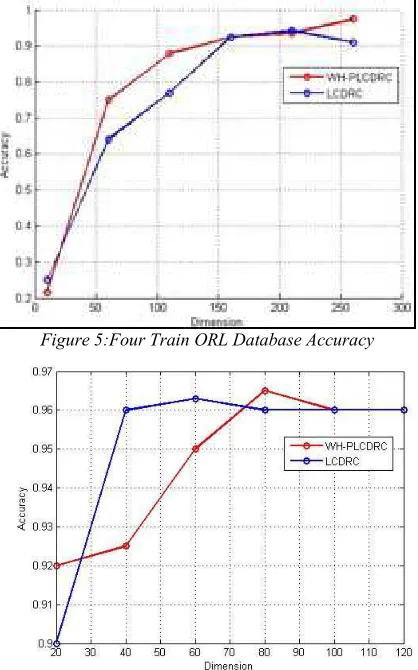
[image:6.612.330.520.84.247.2]The ORL face database contains 400 face images of 40 individuals with 10 face images for each subject. The face images were taken under different light conditions & with different facial expressions. All the face images are cropped to be 32x32 in our experiment. Fig. 3 shows the performance of the proposed & LCDRC methods given two, & four for each class.
Figure 3: Two Train ORL Database Accuracy
[image:6.612.314.523.281.616.2]Figure 4: Three Train ORL Database Accuracy
Figure 5:Four Train ORL Database Accuracy
[image:6.612.91.299.433.593.2]ISSN: 1992-8645 www.jatit.org E-ISSN: 1817-3195
4.2 Experiments on YALE
Figure 7: YALE Face Data
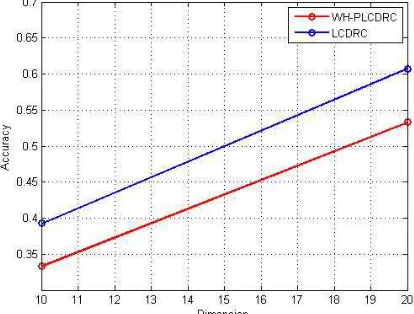
The YALE face database contains 165 faces of 15 individuals. For each individual, there are 11 images under different facial expressions or configurations. All of the face images are cropped into a size of 32x32. The performance comparison of different methods is shown in Fig. 5. WH-PLCDRC has much higher classification accuracy than the other method. For example, the best recognition rates & the corresponding feature dimensions of CRC, SRC, LRC, LDRC, LCDRC, WH-PLCDRC given four training face images for
each class are 70.86%(50), 69.24%(50),
[image:7.612.313.521.73.256.2]61.62%(50), 66.48% (50), 77:05%(30) & 86.6% respectively.
Figure 8: Two Train YALE Database Accuracy
[image:7.612.316.521.290.447.2]Figure 9: Three Train YALE Database Accuracy
[image:7.612.91.298.386.543.2]Figure 10: Four Train YALE Database Accuracy
[image:7.612.317.521.479.640.2]ISSN: 1992-8645 www.jatit.org E-ISSN: 1817-3195
[image:8.612.92.529.34.721.2]4.3 Experiments on Extended YALE B
Figure 12: Extended YALE-B Face Data
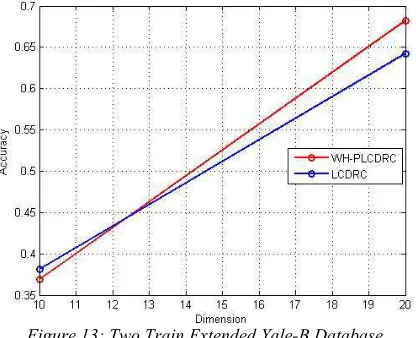
[image:8.612.92.300.398.567.2]The Extended YALE_B face database contains 16128 faces of 11 individuals. For each individual, there are 10 images under different facial expressions or configurations. All of the face images are cropped into a size of 32x32. The performance comparison of different methods is shown in Fig. 7. WH-PLCDRC has much higher classification accuracy than the other method. For example, the best recognition rates & the corresponding feature dimensions of LCDRC, WH-PLCDRC given four training face images for each class are 85.45%(50),88.70%(50) respectively.
Figure 13: Two Train Extended Yale-B Database Accuracy
Figure 14: Three Train Extended Yale-B Database Accuracy
Figure 15: Four Train Extended Yale-B Database Accuracy
ISSN: 1992-8645 www.jatit.org E-ISSN: 1817-3195
Table 1:Performance Evolution Table
Database Two
training
Four training Accuracy Accuracy Proposed
WH-PLCDRC
ORL 0.8968 0.9650
YALE 0.5333 0.8666
YALE-B 0.6820 0.8870
LCDRC
ORL 0.8343 0.9421
YALE 0.3925 0.7603
YALE-B 0.6425 0.8545
5. CONCLUSION
In this research, Widrow-Hoff Learning
Parallel Linear Collaborative Discriminant
Regression presented for Face Classification. Our proposed WH-PLCDRC minimized the values of WCRE that aids to maximize the value BCRE automatically which leads to derive the optimal projection matrix. Extensive experiments conveyed that classification accuracy of our proposed WH-PLCDRC is better than LCDRC than that of LDRC.
REFRENCES:
[1] W. Zhao, R. Chellappa, A. Rosenfeld, and P. J. Phillips, “Face recognition: A literature survey”,
ACM Computer. Surv., Vol. 35, No. 4, 2003, pp. 399-458.
[2] S. M. Huang and J. F. Yang, "Linear Discriminant Regression Classification for Face
Recognition”, IEEE Transactions On Signal
Processing Letters, Vol. 20, No. 1, 2013. [3] J. Wright, A.Y. Yang, A. Ganesh, S.S. Sastry,
and Y. Ma, “Robust face recognition via sparse
representation”, IEEE Trans. Pattern Anal.
Mach. Intell., Vol. 31, 2009, pp. 210-227. [4] D. Zhang, M. Yang, and X. Feng, “Sparse
representation or collaborative representation:
which helps face recognition?”, Proceedings of
IEEE International Conference on Computer Vision (ICCV), 2011, pp. 471-478.
[5] I. Naseem, R. Togneri, and M. Bennamoun,
“Linear regression for face recognition”, IEEE
Transactions on Pattern Analysis and Machine Intelligence, Vol. 32, No. 11, pp. 2106-2112, 2010.
[6] M. Yang, D. Zhang, and J. Yang, “Robust
sparse coding for face recognition”,
Proceedings of IEEE Conference on Computer Vision and Pattern Recognition (CVPR), 2011, pp. 625-632.
[7] R. He, W.-S. Zheng, and B. G. Hu, “Maximum
correntropy criterion for robust face
recognition”, IEEE Trans. Pattern Anal. Mach.
Intell., Vol. 33, 2011, pp. 1561-1576.
[8] X. Tang, G. Feng, and J. Cai, “Weighted group sparse representation for undersampled face
recognition”, Neurocomputing, Vol. 145, 2014,
pp. 402-415.
[9] R. Timofte, and L. Van Gool, “Adaptive and weighted collaborative representations for
image classification”, Pattern Recog. Lett., Vol.
43, 2014, pp. 127-135.
[10] M. Yang, D. Zhang, and S. Wang, “Relaxed
collaborative representation for pattern
classification”, Proceedings of IEEE
Conference on Computer Vision and Pattern Recognition (CVPR), 2012, pp. 2224-2231. [11] Y. Lu, X. Fang, and B. Xie, “Kernel linear
regression for face recognition”, Neural
Comput. Appl., Vol. 24, 2014, pp. 1843-1849. [12] X. Qu, S. Kim, R. Cui, and H. J. Kim, “Linear
collaborative discriminant regression
classification for face recognition”, Journal of
Visual Communication and Image Representation, Vol. 31, 2015, pp. 312-319. [13] M. S. Bartlett, J. R. Movellan, and T. J.
Sejnowski, “Face recognition by independent
component analysis”, IEEE Transactions on
Neural Networks, Vol. 13, No. 6, 2002, pp. 1450-1464.
[14] P. N. Belhumeur, J. P. Hespanha, and D. J.
Kriegman, “Eigenfaces vs. fisherfaces:
Recognition using class specific linear
projection”, IEEE Transactions on Pattern
Analysis and Machine Intelligence, Vol. 19, No. 7, 1997, pp. 711-720.
[15] S. K. Bhattacharyya, and K. Rahul, “Face Recognition by Linear Discriminant Analysis”, International Journal of Communication Network Security, Vol.2, No.2, 2013.
[16] A. M. Martinez, “The ar face database,” CVC
Technical Report, Vol. 24, 1998.
[17] I. Naseem, R. Togneri, and M. Bennamoun, “Face identification using linear regression”,
ISSN: 1992-8645 www.jatit.org E-ISSN: 1817-3195
[18] X. Qu, and H. J. Kim, “Enhanced Discriminant Linear Regression Classification for Face
Recognition”, Proceedings of IEEE Ninth
International Conference on Intelligent Sensors, Sensor Networks and Information Processing (ISSNIP) Symposium on Cognitive Computing in Information Processing, 2014, pp.1-5. [19] Y. L. Liu, D. R. Zhu, D. X. Zhang, and F. Liu,
“A linear regression based face recognition
method by extending probe images”, Optik -