TECHNICAL REVIEW OF THE ASEAN GRID POWER
INTERCONNECTION PROJECTS
1
Z. H. BOHARI, 2M.N.M.NASIR, 3M. F. BAHAROM, 4M. H JALI, 5MF SULAIMA, 6N. BAHARIN 1,2,3,4,5,6
Faculty of Electrical Engineering, Universiti Teknikal Malaysia Melaka
Malacca, Malaysia
E-mail: 1 [email protected]
ABSTRACT
This paper review on the proposed HVDC grid line that connecting west Malaysia to east Malaysia. A High Voltage Direct Current (HVDC) system converts electrical power from AC to DC at the transmitting end and from DC to AC at the receiving end. HVDC is most advantageous for long distances, without intermediate taps, and high amounts of energy, considering investments and losses. A plan for power grid interconnections in Southeast Asia has been elaborated under the support of the Associations of South East Asian Nations (ASEAN). This plan initially included fourteen countries. The project is supported by national power utilities ASEAN. The project is from Johor to Sabah through South China Sea which accumulates distance of 670KM. This paper also describe more detail in term of economic between HVDC system and HVAC System as well as bulk electricity delivery, long-distance transmission and environment.
Keywords: HVDC, Economical Efficiency, Reliability, System Interconnection, Project Cost
1. INTRODUCTION
The world today aiming for a cleaner, sustainable system but there are many factors have to be evaluate that can change the future of energy generation and transmission. Due to large population and environmental restrictions particularly due to forest coverage, Right Of Way (ROW) for the construction of extra high voltage (EHV) transmission lines is becoming more and more difficult. Also, with the development of loads at intermediate locations, at this time long operating lines (above 400 km) are being broken to form new substations in between, it can improving structural stability and other operating parameters of system in addition to enhancement of loading through these lines. HVDC transmission has been applied for more than 50 years. Yet, it has proved that is to be the reliable and valuable transmission medium for electrical energy. It has quite a number of technical and economic advantages comparing with HVAC transmission. Nevertheless, a comprehensive HVDC system planning approach is not commonly reachable in the power utilities, resulting to not taken full advantage of it. Once, HVDC transmission was conceded to be expensive, difficult to integrate in an AC network, require highly skilled personnel to be maintain and operated and also high power losses. In the future,
HVDC technology will be guaranteed to be succeed, because of localised energy production (consequently eradication the need for cross-sea transmission networks), localised controllable efficient distribution still needed for next 500 years. HVDC transmission has become increasingly attractive to energy markets due to salient characteristics in comparing with AC transmission. In recent years, HVDC technology is considered to be as one reasonable planning alternative to increase power grid delivery capability and remove identified bottlenecks of network planning.
The power interconnection projects involve several aspects especially on technical and economic concerns. Financial assessment between HVAC interconnection project and HVDC interconnection project covers the project cost, operation and maintenance cost and as well as life-cycle cost. However, this paper debates only on the economical difference among applying HVDC or HVAC interconnection project. This project is being proposed for the interconnection transmission line between Peninsula Malaysia and West Malaysia.
Referring to (Il Jung and Biletskiy, 2006) the variable cost comprises of few components namely; transmission line construction, right of way (overhead only) and land cost (overhead only) and the evaluation of this cost differs according to the length of the transmission line. Conversely, (Eghlimi, 2008) in their study identified the power loss cost and energy loss cost as part of the variable cost and hence proposed an equation for the variable cost estimation. The equation involves is as stated below;
Power lost cost = loss value (MW) x investment cost for 1kW x (1/0.7)
Energy loss cost = loss value (MW) x energy loss load factor x 8760 x generation and transmission for 1 kW x annual cost of capital depreciation
Evaluation of fixed cost involves the HVDC converting stations construction cost and substation construction cost as discussed in (Eghlimi, 2008). On the other hand, the operation cost is estimated by multiplying the power loss with the electricity rate.
The analysis of economic efficiency among HVDC and HVAC suggested in (Eghlimi, 2008) can be implemented in designing the interconnection project between Peninsula Malaysia and West Malaysia. The authors scrutinised the financial difference between HVAC project cost and HVDC project cost with same parameters comprises of undersea cable of 150 km length, no right of way as well as land cost to be considered and with capacitance of 5000 µF/km. The result shows that the HVAC project costs about $ 2,804 mil whereas HVDC project only consume around $ 1,418 mil with breakeven point of 46 km long and the cost of breakeven point is estimated to be $ 414 mil. Thus, the authors conclude that the HVDC interconnection system is more efficient.
By comparing the above situation with Malaysia HVDC project, it can be decided that the Malaysia HVDC interconnection project that is between Peninsula Malaysia to West Malaysia is profitable. The reasons are because; first, the distance between Johor Bahru (Peninsula Malaysia) to Sarawak (West Malaysia) is approximately 841.9 km, calculating from the straight line/ air distance between those two points. Theoretically said that HVDC transmission line requires more than 500 km of length to be profitable and thus, it is proven that the HVDC project is more cost-effectiveness then HVAC project. Secondly, for a system with
undersea cable, the monopole link is more preferable. For the same parameters and price of the cable per km, the HVAC project requires three cables to link the transmission system between Johor and Sarawak while the HVDC project (monopole link) only requires two cables where one of the cable (undersea cable) act as a return inductor is cost free. Hence, the cable cost of HVDC project is less than HVAC project. As to be the third reason, the AC transmission line demands a substation tower in every 400 km distance. For HVDC transmission line, it necessitates only two towers that is one in Johor while the other one is in Sarawak. Therefore, HVDC project is more profitable in terms of tower installation cost. On the other hand, the cost of semiconductors (the main cost in HVDC stations) has a tendency to be reduced in time. According to (Martander, 2002) the cost of HVDC system is mainly set by the semiconductor cost and HVDC will be cost competitive with HVAC at any transmission distance in the incoming year.
Referring to the above comparison, it is clearly proves that the HVDC interconnection project gives more monetary benefits and it is more appropriate and reliable to be connected between Peninsular Malaysia and West Malaysia.
In this paper will explores the perspective of evaluating the planning for 670 km undersea HVDC cable from East Malaysia (Bakun, Sarawak) to Peninsular Malaysia to be part of ASEAN Power Interconnection Projects or ASEAN GRID.During last three decades, the assessment of potential of the sustainable eco-friendly alternative sources and refinement in technology has taken place to a stage so that economical and reliable power can be produced. Different renewable sources are available at different geographical locations close to loads, therefore, the latest trend is to have distributed or dispersed power system. Examples of such systems are wind-diesel, wind-diesel-micro-hydro-system with or without multiplicity of generation to meet the load demand. These systems are known as hybrid power systems. To have automatic reactive load voltage control SVC device have been considered. The multi-layer feed-forward ANN toolbox of MATLAB 6.5 with the error back-propagation training method is employed.
2. SUMMARY OF CURRENT AVAILABLE
HVDC SYSTEM
project between Iran-Turkey is not compatible from the economic point of view (Eghlimi, 2008). The analysis is done by evaluating the summation of fixed cost and variable cost for both HVDC and HVAC project. The comparison had also done between types of HVDC interconnection namely monopole link, bipolar link and back-to-back link. Both author remarked the bipolar link as the best HVDC configuration to be installed between the two countries with 400 kV and cardinal cable. The back-to-back link with 400 kV has been castoff by a few reasons that are high installation cost and low reliability of the power system. It is also mentioned in the paper that the total cost of the HVDC project is higher by 26% compared to the HVAC. In the event of implementing the HVDC project between Iran-Turkey, the Iran share in total cost will be tripled. Thus, the writer concludes that the HVDC project satisfies the brass-tracks and conditions of a connection line between the two power networks in terms of technical evaluation. However, the HVAC is selected for Iran-Turkey interconnection project based on the cost-effectiveness.
The Sitka-Kake-Petersburg intertie could be built with light HVDC technology which provides an economical and technically superior system as stated by (Karaday G.G., Mike Carson F., SR and Cornelius R., 2001), the analysis is done between AC transmission, DC transmission with a hybrid system, containing AC in the land sections and DC in the longer sea crossing. The research results in high investment in conventional DC system and non-practical AC system. The voltage source converter based DC system is more favourable compared to the others in terms of the technical aspect. However, the authors pick out the hybrid system with voltage source converters because of the financial valuation. By using the data obtained from the manufacturers, the hybrid system differs from the multi-terminal system by 30%. This is because, the reduction of the 69 kV AC conductors does not compensate for the cost of the additional two converters in multi-terminal system.
(Angelo L’Abbate & GianlucaFulli, 2009) in their research paper state that, along with a practical DC test cases on a new Poland-Lithuania interconnection, the VSC-HVDC overhead line option can be more economical that the based on HVAC overhead line complemented by back-to-back station. Though, the underground HVDC line is more approving than the overhead line if the
environmental and social aspect is taken into account.
(H. Zhou, J. Zhang, H. Su & B. Fang., 2009) in their research paper discussed on the life cycle cost of planning and design to ensure the life cycle cost optimization based on the NingDong-ShanDong ± 660 kV HVDC project. It is stated in the paper that the onetime investment cost, operating cost, maintenance cost, failure cost along with waste cost need to be considered for the evaluation of the life cycle cost calculation model. The equation of the life cycle cost is given by;
LCC = + + + + (1)
where,
LCC: the life cycle cost
: one time investment cost, including the design phase of the design, construction stage of the cost of equipment procurement cost, construction installation cost
: operating cost, including equipment loss, operation personnel training costs
: maintenance cost
: failure cost, including outage losses, social influences losses
: waste cost
LCC management is fit for each stages of equipment lifecycle management, but the stages of the design phase, because the focus is on the stage in which over 90% of LCC can be determined.
platform cost is VSC system is lower than in a LCC system.
Referring to research by (Wang S., Zhu J., Trinh L., Pin J., 2008) titled by “Economic Assessment of HVDC Project in Deregulated Energy Markets”, HVDC transmission systems suited and economical for delivering bulk power through long distance. Comparing with HVAC, HVAC consume fewer conductors and does not need intermediate substations and voltage compensation devices. Related to annual capital investment and operational cost becoming lower for HVDC when reaching break even distance (>400km) compare with HVAC. HVDC transmission also minimising the loss and a number of project of HVDC transmission project constructed in china to transmit bulk power from hydro to western hydro generation plants to heavy load centers in the east coast and southern region.
HVDC light transmission has system operational advantages;
• Sharing of spinning reserve
• Emergency power import/export
• Dynamic voltage support
• Fast response to contingencies
In HVDC system, the full controllability enables optimized power sharing parallel AC lines and DC links and controlled inter-area or inter-market power exchanges. These will ensured that ensuing system security and contingency response.
To evaluate economic impact, it is necessary to quantify the plan project will leads to more economic dispatch, eliminating transmission bottlenecks and have economics effect to the consumer. For CAISO (China Power Utility) they have developed Transmission Economic Assessment Methodology (TEAM) for economic assessment. Other method to assess economics benefits is Merchant Transmission Owner (MTO). This method will includes capital cost of line/cable , converts and right of way (ROW), revenue in tariffs, maintenance, line usage and market price, discount rate and so on. If line flow level and market prices can be predicted and give MTO confidence in making investment.
Besides deterministic market conditions, analysis on economics to address uncertainty of future market condition are proved essential. The tool not only quantifies the benefits for market’s entity but
also to calculate probability of benefits.
On the other hand (B. R. Andersen, 2006) in his journal titled “HVDC Transmission – Opportunities and Challenges” elaborate on integration of HVAC system to HVDC system. Recently, with growing concerns on Global Climate Change, many governments encourage of using renewable energy sources through subsidies and preferential price levels within energy market. Interconnection through HVDC between national networks recognised to be essential for mutual support and provide economic access to diverse source of energy. A few links involve considerable transmission distance over land or submarine links. Currently, when electricity considers being cheap, public seems willingly to pay extra cost of mitigation related to environmental issues.
In some cases addition of HVDC cables more economic than HVDC lines;
• Capital cost of station (HVDC converters or HVAC substations, including installation and cost of land)
• Capital cost of land for line (overhead lines requires more than cable route)
• Cost of Consent process (EIA, Consultation, Legal, etc)
• Cost of Delay, including loss of opportunities
• Power losses, both for scheme itself and its impact to AC networks
• Reliability and availability include cost of potential black outs caused by delay in networks strengthening.
• Maintenance and Operation cost
• Auxiliary service benefits,( impact on overall networks transmission capability)
In the past cable links incur higher cost up to 10 times compare with overhead lines. New technology in cable and converter for HVDC proven that HVDC the most economical option. Originally markets for HVDC are relatively small and only few manufacturers providing with the system. With only little project mass production is not available and cost becoming high. Cost will higher than AC substation due to plenty of equipment.
system can self-diagnosis and provide personnel with step by step solution. But rare problem will need specialists. HVDC applying power electronics converter, so this converters will producing harmonics. So additional harmonic filters are needed, the commercialisation of low cost active AC harmonics filters providing adaptable harmonic filtering for HVDC.
Hence in journal titled “Management and Viability of Multi-Terminal HVDC for Offshore Renewable Energy Networking” (NimaMossadegh & Raj K Aggarwal, 2010) do an evaluation on Multi-Terminal Voltage Source Converter High Voltage Direct Current (MT-VSC-HVDC). Among Major limitation found in HVDC;
• High power HVDC breakers are extremely expensive and still in testing phase. Currently using AC breakers for AC side. VSC converters are intelligent breakers where it can change to a non-conductive state instantaneously by a signal.
[image:5.612.84.305.404.730.2]• Converter stations are expensive and conversion loss is high
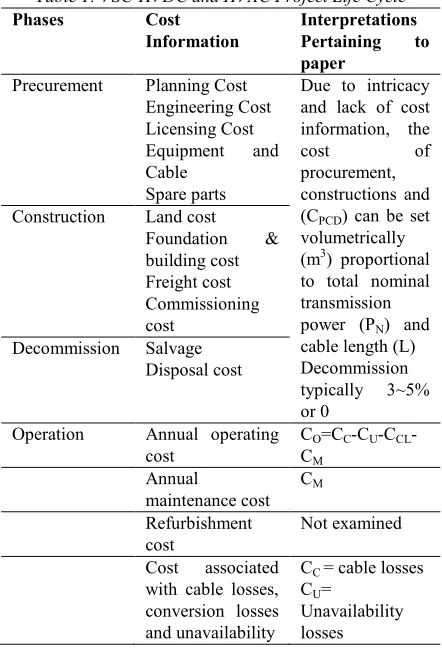
Table 1: VSC-HVDC and HVAC Project Life Cycle
Phases Cost
Information
Interpretations Pertaining to paper
Precurement Planning Cost Engineering Cost Licensing Cost Equipment and Cable
Spare parts
Due to intricacy and lack of cost information, the
cost of
procurement, constructions and (CPCD) can be set volumetrically (m3) proportional to total nominal transmission power (PN) and cable length (L) Decommission typically 3~5% or 0
Construction Land cost Foundation & building cost Freight cost Commissioning cost
Decommission Salvage Disposal cost
Operation Annual operating cost
CO=CC-CU-CCL -CM
Annual
maintenance cost CM
Refurbishment cost
Not examined
Cost associated with cable losses, conversion losses and unavailability
CC = cable losses CU=
Unavailability losses
CCL=converter losses
Tax and
Depreciation
Relatively proportional
Referring to Table 1, feasibility study is complex, due to lack of information and the immense calculation that involved. So factors such as insurance, land lease/purchase, decommissioning/salvaging, procurement and construction will be combining into a factor, CPCD. Noted that cost for multi terminal is higher than single network as in construction and transportation cost. Main focus will be based on main financial variances, “Operational Cost”, over annual production two network topologies, point-to-point HVAC and MT-VSC-HVDC and determine the economical operational point.
Table 2: HVAC & VSC HVDC Costs For A 50 Km Point To Point 300 MW Wind Farm
Item HVAC
VSC-HVDC
Substation (kЄ) 10000 45000
Cable (MЄ/km) 1.5 0.6
CableInstallation (MЄ/km)
0.34 0.215
Offshore substation rig (kЄ)
13000 24000
Offshore land use (kЄ) 50 125
Annual maint (kЄ) 200 650
In Table 2, the figures obtained from a previous typical 50km 300MW point-to-point wind farm study. Information cost on planning, engineering, licensing, spare parts, freight, commissioning and other sundries were not given. So for comparison purposes, an additional and proportional 10% charge shall be added. Because HVDC, in Table 2, does not include for an auxiliary collector station, costs associated with the substation, onshore land use and maintenance, shall be multiplied by a factor of 1.5.
(Chan Ki Kim, Eung-Bo Shin, &Seong-Doo Lee, 2009) explain in this journal “Feasibility Study of HVDC Interconnection between South Korea and North Korea” on cost estimation for HVDC connection between South Korea and North Korea. There are steps to design a scheme to minimize the probability of bipole HVDC outages.
• Use of duplicated/redundant and fail safe control and protection systems.
• Wide-ranging factory testing and Site Acceptance Test of the complete control and protection system under all conceivable operating conditions
• Timely replacement of digital control systems, before the reliability of each system reduce substantially
• Separate the equipment physically for each pole, preferably housing the control and protection equipment in different rooms or buildings
• Availability of a skilled and trained maintenance (specialists) and repair resource, to minimize outage times and the risk of failures caused by maintenance work.
• Minimization of equipment and systems common to the bipoles (pair of same system)
• The use of separate cooling and auxiliary power equipment for the two poles
• Prerequisite of on-line redundancy where possible / economically attractive.
Converter Station Cost
Cost of AC harmonic filters and switchgear will not influenced by the scheme (2 x 1000 MW or 4 x 500 MW poles) but it will effect on the cost of (when using 4 x 500 MW);
• Converter valves by approximately 70% • Converter transformers by approximately 50%
• Control and protection by approximately 70%
• Smoothing reactors by approximately 50% • Dc filters by approximately 70%
• Civil works by approximately 30% • Other equipment by approximately 70%
Low impact related to cost of spares, design engineering, type testing and project management. Overall cost inherent to converter station is about 40%. But if the system being construct gradually stage by stage, it will prevent high cost for the initiation of the project. This method can be
implemented if the demands are not instantaneously increase.
Converter Cost per KW
The cost depends on many factors besides basic rating parameters of power rating, direct voltage and scheme configuration.
Scope of the interconnection project(e.g. turn key or converter equipment only)
• Location of the project
• AC network characteristics at the point of connection (particularly AC voltage level and SCR)
• Competitive status of the market • Power loss capitalization values
• Reliability and Availability requirements • Special control interface requirements • Other constraints presented by the Specification
According to (H. Wang , M.A.Redfern, 2007), HVDC brought advantages including the interconnection of asynchronous networks, economic benefits, long-distance bulk power delivery and environmental benefits. The growth in offshore wind farms and other renewable power stations in Europe in the future will lead to a new power grid and this is expected to be HVDC. The HVDC transmission system, High Voltage Direct Current transmission system, is widely used to transmit long distance bulk power and connect two separate AC systems. The world’s first commercial HVDC application using in a transmission link between Swedish mainland and the island of Gotland was built in 1954 with a rating of 20MW In a HVDC system, electricity is taken from an AC power network, converted to DC in a converter station and transmitted to the receiving point by a transmission line or cable. It is then converted back to AC in another converter station and injected into the receiving AC network. HVDC enables the power flow to be controlled rapidly and accurately, and improves the performance, efficiency and economy of the connected AC networks.
power system. Benefits may produce sufficient value to pay for the transmission line. The reliability of the power system may also be improved if HVDC lines are incorporated into the AC transmission system for frequency control. Transmission would allow less generation to be built and probably result in higher efficiencies and less carbon dioxide.
Referred to (Diego Valenza & Gerri Cipollini, 2005) begins with an introduction on the reasons that lead to the use of HVDC submarine cable links. The main aspects for the choice of direct current are presented as well as the advantages deriving from the utilization of submarine cables. The second part is dedicated to a discussion on the various type of insulation that could be used in power cables and their possible application to HVDC submarine cables Submarine cable technology has been involved in a continuous development allowing power supply Authorities to establish power transmission links where it was technically impossible some years ago, mainly due to long distances or extreme water depths. Many renewable sources around the world will surely incentive the technology of submarine cable links, driving the development toward higher capacities to be transmitted and longer distance to be covered.
The book from (Chan-Ki Kim, Vijay K Sood, Gil-Soo Jang, & Seong-Joo Lim, 2009) state that the advantage of HVDC is no technical limit to the length of a submarine cable connection, no requirement that the linked systems run in synchronism, no increase to the short circuit capacity imposed on AC switchgear, immunity from impedance, phase angle, frequency or voltage fluctuations, preserves independent management of frequency and generator control., improves both the AC system’s stability and, therefore, improves the internal power carrying capacity, by modulation of power in response to frequency, power swing or line rating. An HVDC transmission system can also be used to link renewable energy sources, such as wind power, when it is located far away from the consumer. In any economic assessment of either overall project viability or comparison of competing options, the base capital costs are invariably the most significant items and hence the most important in terms of accuracy. Throughout this exercise, and indeed throughout the process of defining a transmission project, the accuracy of a cost estimate will improve, as the parameters
(technical and commercial) become better known. In recent years, several reviews have been done on the capital costs of HVDC equipment supply.
[image:7.612.333.512.517.701.2]It is very cost effective for a long distance DC power transmission compared to AC power transmission. In case of undersea cables where the intersections of the bold lines are located at a relatively short distance as shown in Figure 1.3, the DC system is much more economical. In Figure 1, (1) illustrates the initial cost for HVAC power transmission and (2) illustrates the initial cost of HVDC power transmission with a bigger initial cost due to a higher valve cost for HVDC transmission. In addition, (3) and (5) represent the cost for transmission line construction in HVAC and HVDC power transmissions, respectively and they demonstrate that HVDC power transmission has a lower cost for transmission line construction. In the case of HVAC power transmission, a shunt capacitor must be installed typically at every 100 km or 200 km because of its electrostatic capacity. In other words, the increase in total cost for power transmission lines is accompanied by additional costs due to shunt capacitors. In the same Figure 1.3, (6) and (7) illustrate losses of HVDC and HVAC systems during power transmission. It is shown that an HVDC system has a smaller loss if the same amount of electric power is delivered. Therefore, HVAC transmission is favorable for distances less than about 450 km and HVDC transmission is favorable for distances exceeding 450 km (Chan Ki Kim, Eung-Bo Shin, &Seong-Doo Lee, 2009).
From (Il Jung and Biletskiy, 2006) proposes an economic analysis of alternatives is performed to find an appropriate transmission line types during planning construction of transmission lines. HVDC has advantages over conventional AC such as no skin effect, no reactance, less corona loss, no voltage drop by inductance and smaller transmission tower, high initial cost of HVDC facilities limits its application to long overhead line sections (400~700km), undersea cable sections or interconnection of power systems with different frequencies (i.e. interconnection of 50Hz and 60Hz systems) where HVDC is sufficiently advantageous to compensate for the high initial cost, or it is the only option because of some technical reasons. The financial model integrates all costs data to calculate overall project cost of HVDC and AC transmissions respectively. The calculation of the power loss through technical analysis is converted into cost and merged into the overall cost. This overall cost is analyzed in two economic analysis methods: breakeven analysis (Angelo L’Abbate & GianlucaFulli, 2009) and sensitivity analysis (H. Zhou, J. Zhang, H. Su & B. Fang., 2009). Following the implementation of the system, a set of project data has been created to test the system. This is prepared as an alternative to actual project data which is not available currently. The alternative is expected to be sufficient to show the operation of the system. From test results, strengths and weaknesses of the system are discussed and the test results on the two transmission line models (short, medium) are compared. The conducted analysis has demonstrated that the developed prototype is a good tool to analyse economic efficiency of HVDC and AC transmissions. Sorts of simulation were performed to check the functionality of the system and their results were mostly in accordance with our expectations prior to the simulations. Beside the four cases that are introduced, extra simulations have been performed to check the influence of other input data. For example, higher transmission voltage decreased power loss at transmission lines. It was observed that simulation results are significantly different between short distance model and medium distance model when the transmission lines have high shunt capacitance. Therefore, it is necessary to use medium distance model for simulation of transmission lines with high shunt capacitance (e.g. undersea cable) (Il Jung and Biletskiy, 2006).
[image:8.612.314.517.82.266.2]3. METHODOLOGY
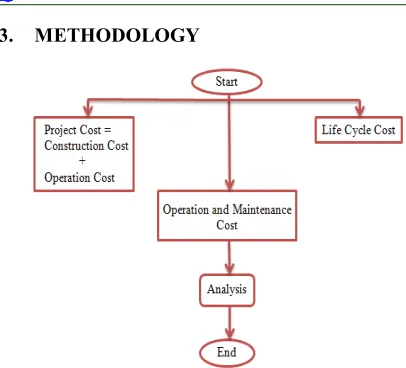
Figure 2. Flow Chart Of Economic Evaluation Of Hvdc Project Versus Hvac Installation
Figure 2 shows the flow chart of economic assessment between HVDC project and HVAC project. The economic evaluation comprises of project cost, life cycle cost and operation and maintenance cost. However, this paper only analyzed the project cost for both HVAC and HVDC interconnection system and the most profitable system to be implemented in the Johor-Sarawak interconnection project.
4. RESULTS & DISCUSSION
The DC transmission has some technical positive features which are lacking in AC transmission. These are mainly due to the fast controllability of power in DC lines through converter control. The advantages are:
1. Full control over power transmitted
2. The ability to enhance transient and small signal stability in associated AC networks
3. Fast control to limit fault currents in DC lines. This makes it feasible to avoid DC breakers in two terminal DC links.
4. No technical limit to the length of a submarine cable connection.
5. No requirement that the linked systems run in synchronism.
6. No increase to the short circuit capacity imposed on AC switchgear.
7. Immunity from impedance, phase angle, frequency or voltage fluctuations.
8. Preserves independent management of frequency and generator control.
capacity, by modulation of power in response to frequency, power swing or line rating.
10. Limiting the transfer of fault current
11. Rigid control over the magnitude and direction of power flow with easy reversibility of power flow.
12. Damping out oscillations and improving the stability margins when embedded in weak AC systems of low short circuit ratio (SCR). The strength of AC systems connected to the terminals of DC Links is measured in terms of short circuit ratio (SCR)
The proposed parts suitable for this specific line are:
[image:9.612.290.518.69.357.2]Monopolar HVDC
Figure 3. Monopolar Hvdc System
This type of HVDC link consists of a single conductor and a return path either through the ground or sea. This method is mostly used for power transmission using cables. Use of this type of system is dictated by the costs of installing the cable. A metallic return path is preferred instead of through the ground when the ground resistance is too high or the underground/undersea metallic components may cause some interference.
[image:9.612.93.287.306.506.2]Bipolar HVDC
Figure 4. Bipolar Hvdc System
It consists of two poles, one positive polarity and the other negative polarity, and with their neutral points grounded. In steady state operation, the current flowing in each pole is the same and hence no current flows in the grounded return. The two poles may be operated separately. If either pole malfunctions, then the other pole can transmit power by itself with ground return. In a bipolar the amount of power transmission is increased by a factor of two compared to the monopole case. This creates fewer harmonics in normal operation as compared to the monopole case. Reverse power flow can be controlled by converting the polarities of the two poles.
Homopolar HVDC System
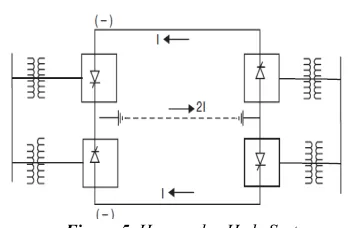
Figure 5. Homopolar Hvdc System
[image:9.612.322.496.563.677.2]fault in one conductor, the whole converter can be connected to a healthy pole and can carry more than half the power (2-pole) by overloading but at the expense of increased line loss. However, this is not possible in a bipolar system due to the use of graded insulation for negative and positive poles. When continuous ground currents are inevitable, homopolar system is preferable. The additional advantage is lower corona loss and radio interference due to negative polarity on the lines.
Because of the desirability of operating a DC link without ground return, bipolar links are most commonly used. Homopolar link has the advantage of reduced insulation costs, but the disadvantages of earth return outweigh the advantages. Incidentally, the corona effects in a DC line are substantially less with negative polarity of the conductor as compared to the positive polarity.
The monopole operation is used in the first stage of the development of a bipolar line, as the investments on converters can be deferred until the growth of load which requires bipolar operation at double the capacity of a monopole link.
From the three of HVDC type, Monopole schemes was selected to apply for undersea cable because sea water can be used as a return conductor, thus minimizing cable costs. With monopolar transmission, the choice of polarity of the energised conductor leads to a degree of control over the corona discharge. In particular, the polarity of the ions emitted can be controlled. Then, less harmonic content in normal operation compared to the bipolar case. This is because in a bipolar the amount of power transmission is increased by a factor of two compared to the monopolar case. Furthermore, it contributes low power rating, primarily with cable transmission.
However, the use of a sea/earth return path leads to questions of corrosion of other metallic objects (pipelines, cable sheaths, etc.), production of chlorine gas and impact on fish populations. Monopole submarine HVDC schemes cause magnetic compass deflections, depending on cable orientations, water depth and current magnitude. In some jurisdictions there are limits to magnetic compass deflections, which may require a return cable alongside the pole cable, or the use of coaxial cable with integral current return, where ratings are appropriate.
5. CONCLUSIONS
As a conclusion, with referring to the above discussion, the HVDC transmission system is more savings compared to the HVAC transmission system, considering on the tower installation cost, cable cost and the semiconductor cost. Thus, the HVDC transmission system with monopole link is proposed to be implemented for the interconnection line between Johor (Peninsular Malaysia) and Sarawak (West Malaysia).
A
CKNOWLEDGEMENTSThe authors like to acknowledge Universiti Teknikal Malaysia Melaka (UTeM) and Ministry of Higher Education, Malaysia for the financial support and providing the resources through RAGS/1/2014/TK06/FKE/B00052 for the research fund.
REFRENCES:
[1] M. Eghlimi, H. Shakouri, “Economic Analysis of Iran-Turkey Power Network interconnection.” 2nd IEEE International Conference on Power and Energy (PEcon 08), 2008.
[2] Karaday G.G., Mike Carson F., SR and Cornelius R..“Feasibility of a DC Intertie for Sitka-Kake-Petersburg Interconnection.” Power Energy Summer meeting, 2001.
[3] L’Abbate A. and GianlucaFulli. “Sustainability analysis of VSC-HVDC in the Liberalised European Power System: A Practical Case.”, IEEE Bucharest Power Tech Conference, Bucharest, Romania, 2009.
[4] Huan Zhou H., Zhang J., Haifeng Su H., and Fang B., “Life Cycle Cost of Planning and Design of ±600 kV DC Transmission Lines.” 8th International Conference on Advances in Power System Control, Operation and Management (APSCOM 2009), 2009.
[5] Martinez de Alegria I., Luis Martin J., Kortabarria I., Andreu J. and Ilbanez Ereno P.. “Transmission Alternatives for Offshore Electrical Power.”Journal on Renewable and Sustainable Energy, vol. 13, pp. 1027-1038, June 2009
[7] Andersen B. R.,“HVDC Transmission – Opportunities and Challenges” Andersen Power Electronics Solution, 2006.
[8]Mossadegh N., Aggarwal R. K.,“Management and Viability of Multi-Terminal HVDC for Offshore Renewable Energy Networking” UPEC 2010.
[9]Mukhopadhyay S.,“Towards Electricity for All” IEEE power and energy magazine, 2007. [10]Kim C. K., Shin E. B., Lee S. D. ,“Feasibility
Study of HVDC Interconnection between South Korea and North Korea” IEEE T&D Asia, 2009.
[10] Wang H., M.A.Redfern, “The Advantages and Disadvantages Of Using HVDC To Interconnect AC Networks”,45th International Universities Power Engineering Conference (UPEC), 2010.
[11] Osborn D., “Potential Value Of HVDC Overlays To Provide a More Reliable and Economical Power System”, Power and Energy Society General Meeting, 2011.
[12] Diego Valenza And Gerri Cipollini, Pirelli CaviS.p.A-Divisione Italia, VialeSarca, 222 20126 Milano, Italy, 2005, IEEE
[13] Chan-Ki Kim, Vijay K Sood, Gil-Soo Jang, Seong-Joo Lim, HVDC Transmission, John Wiley & Sons (Asia) Pte Ltd, 2009 [14] Hae-Il Jung, Student member, IEEE,
YevgenBiletskiy, Member, IEEE, University of New Brunswick, Fredericton, New Brunswick, E3B 5A3, Canada, IEEE Website, 2006 [10]Lazaridis LP. “Economic Comparison of
HVAC and HVDC Solutions for Large Offshore Wind Farms under Special Consideration of Reliability.”Master’s thesis. Royal Institute of Technology, Stockholm, 2005.
[15] Martander O. “DC Grids for Wind Farms.” Master’s thesis. Chalmers University of Technology, Goteborg, Sweden, 2002
[16] Mohd Hafiz Jali, Tarmizi Ahmad Izzuddin, Zul Hasrizal Bohari, Mohamad Fani Sulaima, Hafez Sarkawi, “Predicting EMG Based Elbow Joint Torque Model Using Multiple Input ANN Neurons for Arm Rehabilitation”, 16th International Conference on Computer Modelling and Simulation (UKSim), 2014 UKSim-AMSS, IEEE, pp 189-194, 2014.
[17]MF Sulaima, SN Othman, MH Jali, MS Jamri, MNM Nasir, ZH Bohari, “A 33kV Distribution Network Feeder Reconfiguration by Using REPSO for Voltage Profile Improvement” , International Journal of Applied Engineering Research (IJAER), vol 9(18), pp 4569 - 4582, 2014
[18]Z. H. Bohari, H. S. Azemy, M.H. Jali., M.N.M. Nasir, M.F. Baharom, M.F. Sulaima, “Reliable short term load forecasting using self organizing map (SOM) in deregulated electricity market”, Journal of Theoretical and Applied Information Technology, vol 79(3), pp 3898-394, 2015