R E S E A R C H
Open Access
The International Stroke Trial database
Peter AG Sandercock
1*, Maciej Niewada
2,3, Anna Cz
ł
onkowska
2,3and for
the International Stroke Trial Collaborative Group
Abstract
Background:
We aimed to make individual patient data from the International Stroke Trial (IST), one of the largest
randomised trials ever conducted in acute stroke, available for public use, to facilitate the planning of future trials
and to permit additional secondary analyses.
Methods:
For each randomised patient, we have extracted data on the variables assessed at randomisation, at the
early outcome point (14-days after randomisation or prior discharge) and at 6-months and provide them as an
analysable database.
Results:
The IST dataset includes data on 19 435 patients with acute stroke, with 99% complete follow-up. Over
26.4% patients were aged over 80 years at study entry. Background stroke care was limited and none of the
patients received thrombolytic therapy.
Conclusions:
The IST dataset provides a source of primary data which could be used for planning further trials, for
sample size calculations and for novel secondary analyses. Given the age distribution and nature of the
background treatment given, the data may be of value in planning trials in older patients and in resource-poor
settings.
Background
The International Stroke Trial (IST) was conducted
between 1991 and 1996 (including the pilot phase
between 1991 and 1993). It was a large, prospective,
ran-domised controlled trial, with 100% complete baseline
data and over 99% complete follow-up data. The aim of
the trial was to establish whether early administration of
aspirin, heparin, both or neither influenced the clinical
course of acute ischaemic stroke [1].
Methods
The study had a prospective, randomised, open
treat-ment, blinded outcome (PROBE) design. The inclusion
criteria were: clinical diagnosis of acute ischaemic stroke,
with onset within the previous 48 hours and no clear
indication for, or clear contraindication to, treatment
with aspirin or subcutaneous heparin. Unlike many
stroke trials of that era (and subsequently), the study did
not set an upper age limit. Patients were to have a CT
brain scan to confirm the diagnosis of stroke, and this
was to be done before randomisation if at all possible.
To enter a patient in the study, the clinician telephoned a
central randomisation service (at the Clinical Trial
Service Unit, Oxford) during this telephone call, the
base-line variables were entered and checked, and once
vali-dated, the computer allocated the treatment and the
telephonist then informed the clinician. The patients and
treating clinicians were not blinded to the treatment
given. Early outcome data were collected by the treating
physician who completed a follow-up form at 14 days,
death or hospital discharge (whichever occurred first).
This form recorded data on events in hospital within
14 days, and the doctor
’
s opinion on the final diagnosis
of the initial event that led to randomisation. These
unblinded data, may therefore be subject to some degree
of bias. The primary outcome was the proportion of
patients who were either dead or dependent on other
people for activities of daily living at six months after
randomisation. This outcome was collected by postal
questionnaire mailed directly to the patient, or (in Italy)
by telephone interview of the patient by a trained
researcher, blinded to treatment allocation. The primary
outcome was therefore assessed as far as practicable
-blind to treatment allocation and hence should be free
* Correspondence: [email protected]
1
Department of Clinical Neurosciences, University of Edinburgh, Department of Clinical Neurosciences, Western General Hospital, Edinburgh EH4 2XU, UK Full list of author information is available at the end of the article
from bias. We re-checked the data set for inaccuracies
and inconsistencies and extracted data on the variables
assessed at randomisation, and at the two outcome
assessment points: at 14-days after randomisation, death
or prior hospital discharge (whichever occurred first) and
at 6-months.
Results
Consent for publication of raw data was not obtained
from participants. Consent for participation in the trial
was obtained from all subjects or from an appropriate
proxy, according to the procedures approved by relevant
national and local hospital ethics committees (or
Institu-tional Review Boards [IRB]). These patients were treated
15-20 years ago, and many have died. The dataset (see
additional file 1 - IST_data.csv) is fully anonymous in a
manner that can easily be verified by any user of the
dataset. Patients and hospitals are identified only by an
anonymous code; there are no identifying data such as
name, address or social security numbers; patient age has
been rounded to the nearest whole number. In our view,
publication of the dataset clearly presents no material
risk to confidentiality of study participants.
[image:2.595.303.538.101.683.2]The dataset includes the following baseline data: age,
gender, time from onset to randomisation, presence or
absence of atrial fibrillation (AF), aspirin administration
within 3 days prior to randomisation, systolic blood
pres-sure at randomisation, level of consciousness and
neuro-logical deficit. The deficits were classified as one of the
Oxfordshire Community Stroke Project (OCSP)
cate-gories: total anterior circulation syndrome (TACS),
par-tial anterior circulation syndrome (PACS), posterior
circulation syndrome (POCS) and lacunar syndrome
(LACS). We extracted events within 14 days on: the
occurrence of recurrent stroke, pulmonary embolism,
and death (date and cause of death). At 6 months we
extracted: degree of recovery, place of residence and
cur-rent use of antiplatelet or anticoagulant drugs and death
(date and cause of death). The cause of death was
classi-fied as: due to initial stroke, recurrent ischaemic stroke,
recurrent haemorrhagic stroke, pneumonia, coronary
artery disease, pulmonary embolism, other vascular cause
or a nonvascular cause. Patients were assigned to one of
6 categories according to the place of residence at 6
months following stroke: own home, relatives home,
resi-dential care, nursing home, other hospital departments
or unknown. The variables extracted are listed with a
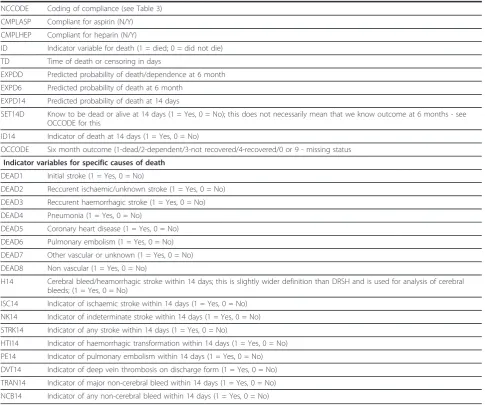
brief description of each in Tables 1, 2 and 3. Nineteen
thousand four hundred and thirty five patients from 467
hospitals in 36 countries were randomised within
Table 1 Country codes used in International Stroke Trial.
Country Code
Albania 43
Argentina 29
Australia 01
Belgium 03
Brazil 42
Bulgaria 04
Canada 05
Chile 06
Czech Republic 07
Denmark 08
Ireland 09
Finland 10
France 11
Georgia 32
Germany 12
Greece 31
Hong Kong 30
Hungary 36
India 37
Indonesia 41
Israel 13
Italy 14
Japan 38
Latvia 39
Malaysia 40
Netherlands 15
New Zealand 16
Norway 17
Poland 18
Portugal 19
Romania 33
Singapore 34
Slovak Republic 44
Slovenia 20
South Africa 21
Spain 22
Sri Lanka 23
Sweden 24
Switzerland 25
Thailand 26
Turkey 35
UK 27
Table 2 Variables names and comments.
Randomisation data
HOSPNUM Hospital number
RDELAY Delay between stroke and randomisation in hours
RCONSC Conscious state at randomisation (F - fully alert, D - drowsy, U - unconscious)
SEX M = male; F = female
AGE Age in years
RSLEEP Symptoms noted on waking (Y/N)
RATRIAL Atrial fibrillation (Y/N); not coded for pilot phase - 984 patients
RCT CT before randomisation (Y/N)
RVISINF Infarct visible on CT (Y/N)
RHEP24 Heparin within 24 hours prior to randomisation (Y/N)
RASP3 Aspirin within 3 days prior to randomisation (Y/N)
RSBP Systolic blood pressure at randomisation (mmHg)
RDEF1 Face deficit (Y/N/C=can’t assess)
RDEF2 Arm/hand deficit (Y/N/C=can’t assess)
RDEF3 Leg/foot deficit (Y/N/C=can’t assess)
RDEF4 Dysphasia (Y/N/C=can’t assess)
RDEF5 Hemianopia (Y/N/C=can’t assess)
RDEF6 Visuospatial disorder (Y/N/C=can’t assess)
RDEF7 Brainstem/cerebellar signs (Y/N/C=can’t assess)
RDEF8 Other deficit (Y/N/C=can’t assess)
STYPE Stroke subtype (TACS/PACS/POCS/LACS/OTH=other)
RDATE Year and month of randomisation (yyyy-mm)
HOURLOCAL Local time - hours (99-missing data) of randomisation
MINLOCAL Local time - minutes (99-missing data) of randomisation
DAYLOCAL Estimate of local day of week; 1 - Sunday, 2-Monday, 3-Tuesday, 4-Wednesday, 5-Thursday, 6-Friday, 7-Saturday
RXASP Trial aspirin allocated (Y/N)
RXHEP Trial heparin allocated (M/L/N). The terminology for the allocated dose of unfractioned heparin changed slightly from the pilot to the main study. Patients were allocated either 12500 units subcutaneously twice daily (coded as H in the pilot and M in the main trial), 5000 units twice daily (coded as L throughout) or to‘avoid heparin’(coded as N throughout).
Data collected on 14 day/discharge form about treatments given in hospital
DASP14 Aspirin given for 14 days or till death or discharge (Y/N/U=unknown)
DASPLT Discharged on long term aspirin (Y/N/U=unknown)
DLH14 Low dose heparin given for 14 days or till death/discharge (Y/N/U=unknown)
DMH14 Medium dose heparin given for 14 days or till death/discharge (Y/N/U=unknown)
DHH14 Medium dose heparin given for 14 days etc in pilot (combine with above; Y/N)
ONDRUG Estimate of time in days on trial treatment
DSCH Non trial subcutaneous heparin (Y/N/U=unknown)
DIVH Non trial intravenous heparin (Y/N/U=unknown)
DAP Non trial antiplatelet drug (Y/N/U=unknown)
DOAC Other anticoagulants (Y/N/U=unknown)
DGORM Glycerol or manitol (Y/N/U=unknown)
DSTER Steroids (Y/N/U=unknown)
DCAA Calcium antagonists (Y/N/U=unknown)
DHAEMD Haemodilution (Y/N/U=unknown)
DCAREND Carotid surgery (Y/N/U=unknown)
DTHROMB Thrombolysis (Y/N/U=unknown)
Table 2 Variables names and comments.
(Continued)
DMAJNCHD Date of above (days elapsed from randomisation)
DMAJNCHX Comment on above
DSIDE Other side effect (Y/N/U=unknown)
DSIDED Date of above (days elapsed from randomisation)
DSIDEX Comment on above
Final diagnosis of initial event
DDIAGISC Ischaemic stroke (Y/N/U=unknown)
DDIAGHA Haemorrhagic stroke (Y/N/U=unknown)
DDIAGUN Indeterminate stroke (Y/N/U=unknown)
DNOSTRK Not a stroke (Y/N/U=unknown)
DNOSTRKX Comment on above
Recurrent stroke within 14 days
DRSISC Ischaemic recurrent stroke (Y/N/U=unknown)
DRSISCD Date of above (days elapsed from randomisation)
DRSH Haemorrhagic stroke (Y/N/U=unknown)
DRSHD Date of above (days elapsed from randomisation)
DRSUNK Unknown type (Y/N/U=unknown)
DRSUNKD Date of above (days elapsed from randomisation)
Other events within 14 days
DPE Pulmonary embolism; (Y/N/U=unknown)
DPED Date of above (days elapsed from randomisation)
DALIVE Discharged alive from hospital (Y/N/U=unknown)
DALIVED Date of above (days elapsed from randomisation)
DPLACE Discharge destination (A-Home/B-Relatives home/C-Residential care/D-Nursing home/E-Other hospital departments/U-Unknown)
DDEAD Dead on discharge form (Y/N/U=unknown)
DDEADD Date of above (days elapsed from randomisation); NOTE: this death is not necessarily within 14 days of randomisation
DDEADC Cause of death (1-Initial stroke/2-Recurrent stroke (ischaemic or unknown)/3-Recurrent stroke (haemorrhagic)/4-Pneumonia/5-Coronary heart disease/6-Pulmonary embolism/7-Other vascular or unknown/8-Non-vascular/0-unknown)
DDEADX Comment on death
Data collected at 6 months
FDEAD Dead at six month follow-up (Y/N/U=unknown)
FLASTD Date of last contact (days elapsed from randomisation)
FDEADD Date of death (days elapsed from randomisation); NOTE: this death is not necessarily within 6 months of randomisation
FDEADC Cause of death (1-Initial stroke/2-Recurrent stroke (ischaemic or unknown)/3-Recurrent stroke (haemorrhagic)/4-Pneumonia/5-Coronary heart disease/6-Pulmonary embolism/7-Other vascular or unknown/8-Non-vascular/0-unknown)
FDEADX Comment on death
FRECOVER Fully recovered at 6 month follow-up (Y/N/U=unknown)
FDENNIS Dependent at 6 month follow-up (Y/N/U=unknown)
FPLACE Place of residance at 6 month follow-up (A-Home/B-Relatives home/C-Residential care/D-Nursing home/E-Other hospital departments/ U-Unknown)
FAP On antiplatelet drugs at six month follow-up (Y/N/U=unknown)
FOAC On oral anticoagulants at six month follow-up (Y/N/U=unknown)
Other data and derived variables
FU1_RECD Date discharge form received (days elapsed from randomisation)
FU2_DONE Date 6 month follow-up done (days elapsed from randomisation)
COUNTRY Abbreviated country code
CNTRYNUM Country code (see Table 1)
48 hours of symptoms onset, of whom 13020 had a CT
before randomisation, 5569 were first scanned after
ran-domisation and 846 were not scanned at all. Five
thou-sand one hundred thirty two (26.4%) were aged over 80
years at study entry. Given that 5569 patients were first
scanned after randomisation, and 846 were not scanned
at all, the
‘
final diagnosis
’
is somewhat imprecise.
How-ever, since the analysis was by intention to treat, all
parti-cipants were retained in the analysis, irrespective of the
final diagnosis. The numbers of patients with each final
diagnosis are given in Table 4. Whilst the
‘
final diagnosis
variable
’
is of some interest, it may be influenced by
events occurring after randomisation, so for any future
analyses, the least biased assessment of the patient
characteristics is that recorded at baseline, before
randomisation.
To restrict analyses to cases of definite ischaemic
stroke, confirmed at the time of trial entry, the variable
denoting whether CT had been performed before entry
(RCT) should = Y and the final diagnosis should also be
ischaemic (DDIAGISC=Y).
Please note that, in the original 1997 Lancet report on
the trial [1], figures two a and two b reported the effects of
allocation to aspirin and to heparin on the primary
out-come, subdivided by various baseline characteristics and
by the final diagnosis. The numbers of patients with each
pathological type of stroke are somewhat different to the
numbers above, because they relate to the number of
patients with complete 6 month follow-up data, whereas
the numbers above relate to all randomised patients.
Anonymisation
As recommended by
Hrynaszkiewicz et al.
[2] we have
[image:5.595.56.542.101.506.2]removed all direct and indirect identifiers from the
data-base. We therefore present patient
’
s age rounded to the
nearest whole number of years. Time of admission to
Table 2 Variables names and comments.
(Continued)
NCCODE Coding of compliance (see Table 3)
CMPLASP Compliant for aspirin (N/Y)
CMPLHEP Compliant for heparin (N/Y)
ID Indicator variable for death (1 = died; 0 = did not die)
TD Time of death or censoring in days
EXPDD Predicted probability of death/dependence at 6 month
EXPD6 Predicted probability of death at 6 month
EXPD14 Predicted probability of death at 14 days
SET14D Know to be dead or alive at 14 days (1 = Yes, 0 = No); this does not necessarily mean that we know outcome at 6 months - see OCCODE for this
ID14 Indicator of death at 14 days (1 = Yes, 0 = No)
OCCODE Six month outcome (1-dead/2-dependent/3-not recovered/4-recovered/0 or 9 - missing status
Indicator variables for specific causes of death
DEAD1 Initial stroke (1 = Yes, 0 = No)
DEAD2 Reccurent ischaemic/unknown stroke (1 = Yes, 0 = No)
DEAD3 Reccurent haemorrhagic stroke (1 = Yes, 0 = No)
DEAD4 Pneumonia (1 = Yes, 0 = No)
DEAD5 Coronary heart disease (1 = Yes, 0 = No)
DEAD6 Pulmonary embolism (1 = Yes, 0 = No)
DEAD7 Other vascular or unknown (1 = Yes, 0 = No)
DEAD8 Non vascular (1 = Yes, 0 = No)
H14 Cerebral bleed/heamorrhagic stroke within 14 days; this is slightly wider definition than DRSH and is used for analysis of cerebral bleeds; (1 = Yes, 0 = No)
ISC14 Indicator of ischaemic stroke within 14 days (1 = Yes, 0 = No)
NK14 Indicator of indeterminate stroke within 14 days (1 = Yes, 0 = No)
STRK14 Indicator of any stroke within 14 days (1 = Yes, 0 = No)
HTI14 Indicator of haemorrhagic transformation within 14 days (1 = Yes, 0 = No)
PE14 Indicator of pulmonary embolism within 14 days (1 = Yes, 0 = No)
DVT14 Indicator of deep vein thrombosis on discharge form (1 = Yes, 0 = No)
TRAN14 Indicator of major non-cerebral bleed within 14 days (1 = Yes, 0 = No)
hospital (a potential identifier) was not recorded. Dates
of events occurring post randomisation have been
con-verted to the number of days from randomisation. The
time variables that were recorded (see below) referred to
time of randomisation in the trial (i.e. the time at which
the system generated the treatment allocation), not time
of admission to hospital, a variable, that in our view
-would not help identify the patient.
Discussion
This large data set, with very complete follow-up,
includes a very broad range of acute stroke patients
with a uniquely large number of very elderly patients,
and so may be useful to researchers planning future
research studies. Users of the dataset should be aware
that the study was conducted at a time when stroke unit
care was not widely available and thrombolytic therapy
was used rarely (and none of the included patients
received it) [3]. Thus, the background stroke care for
the included subjects, while not typical of present-day
acute stroke care [4], is perhaps more typical of current
stroke care in resource poor settings [5]. Given that
the developing world faces a future epidemic of
non-communicable diseases, including stroke [5], these data
may therefore prove particularly valuable for planning
future trials in resource-poor settings. In the developed
world, the proportion of the general population who are
‘
very elderly
’
is rapidly increasing. Older people have
been substantially under-represented in stroke trials to
date [6], so we hope the large number of patients aged
over 80 in this data set could also facilitate planning of
trials in the
‘
older old
’
.
The publication of raw datasets such as the IST
’
s may
offer wholly unanticipated benefits to the wider research
community. For example, the dataset was licensed to an
independent statistical group who used the data to
esti-mate the size and direction of biases introduced when
non-randomised comparisons were made and the
differ-ences between direct and indirect comparisons. This
empirical work led to two important publications on the
topic [7,8]. Such additional benefits, realised long after
the original trial was completed, are a further clear
indi-cation of the value of opening access to such datasets.
Note for users of the data set
The authors ask that any publications arising from the
use of this dataset acknowledges the source of the
data-set, its funding and the collaborative group that
col-lected the data.
Sources of Funding
[image:6.595.55.291.111.456.2]The study was principally funded by the UK Medical
Research Council, the UK Stroke Association, and the
European Union BIOMED-1 program. Limited support
for collaborators
’
meetings and travel was provided by Eli
Lilly, Sterling Winthrop (now Bayer USA), Sanofi, and
Bayer UK. Follow-up in Australia was supported by a
grant from the National Heart Foundation and in Canada
by a Nova Scotia Heart and Stroke Foundation grant.
Czech Republic IST was supported by a grant from the
IGA Ministry of Health. India IST was supported by the
McMaster INCLEN program and the All India Institute of
Medical Sciences. The IST in New Zealand was funded by
the Julius Brendel Trust and the Lottery Grants Board. In
Norway, the IST was supported by the Norwegian Council
on Cardiovascular Disease and Nycomed (for insurance).
Table 3 Provisional categories for non compliance
(NCCODE)
1. Should not have been randomised
2. Refused treatment
3. Initial event not a stroke
4. Haemorrhagic stroke
5. Non compliers
6. Discharged after 14 days
7. Discharged up to 14 days
8. Died prior to receiving the study drug(s)
9. Died after receiving the study drug(s)
10. Recurrent stroke/pulmonary embolism
11. Clinical decision
11a. Suspected abnormality
11b. Withdrawn as dying
11c. Pre-existing condition
11d. Stated abnormal PTT
11e. Stated surgery
11f. Stated atrial fibrillation
12. Administration problem
13. Missed out more than 3 doses
14. Side effect
14a. Refused treatment
14b. Discharged
14c. Administration problem
14d. Clinical decision
14e. Recurrent stroke
14f. Haemorrhagic stroke
Table 4 Final diagnosis of initial event
Number
Ischaemic stroke 17398
Haemorrhagic stroke 599
Definite stroke, pathological type unknown 992
Not a stroke 420
Uncertain diagnosis 26
[image:6.595.57.290.638.731.2]Additional material
Additional file 1: Database with information completed in IST.
Acknowledgements
The chief acknowledgement is to the thousands of stroke patients who joined the IST and to their doctors. The staff of the Neurosciences Trials Unit coordinated the study, and randomization was provided by staff at the Clinical Trial Service Unit in Oxford.
Author details
1
Department of Clinical Neurosciences, University of Edinburgh, Department of Clinical Neurosciences, Western General Hospital, Edinburgh EH4 2XU, UK.
2Department of Clinical and Experimental Pharmacology, Warsaw Medical
University, Poland, Krakowskie Przedmieście 26/28, 00-927 Warsaw, Poland.
32nd Department of Neurology, Institute of Psychiatry and Neurology, 9
Sobieskiego, 02-957 Warsaw, Poland.
Authors’contributions
PS was the Chief Investigator of the IST responsible for the overall design, conduct and presentation of the study results. MN and AC were involved in preparation of database and data dictionary for publication and help to draft the manuscript. All authors read and approved the final manuscript.
Competing interests
The trial was designed, conducted, analyzed, and reported independently of all sponsors. P.S., M.N., A.C. have received honoraria and travel expenses to lecture at conferences and pharmaceutical advisory meetings, but neither holds any consultancy with, or financial interest in, a pharmaceutical company, nor are they aware of any other potential conflict of interest.
Received: 22 September 2010 Accepted: 21 April 2011 Published: 21 April 2011
References
1. Sandercock P, Collins R, Counsell C, Farrell B, Peto R, Slattery J, Warlow C, International Stroke Trial Collaborative Group:The International Stroke Trial (IST): A randomised trial of aspirin, subcutaneous heparin, both, or neither among 19 435 patients with acute ischaemic stroke.Lancet1997, 349:1569-1581.
2. Hrynaszkiewicz I, Norton ML, Vickers AJ, Altman DG:Preparing raw clinical data for publication: guidance for journal editors, authors, and peer reviewers.Trials2010,11:9[http://www.trialsjournal.com/content/11/1/9]. 3. Weir NU, Sandercock P, Lewis SC, Signorini D, Warlow CP, on behalf of the
IST Collaborative Group:Variations between countries in outcome after stroke in the International Stroke Trial (IST).Stroke2001,32:1370-1377. 4. Irwin P, Hoffman A, Lowe D, Pearson M, Rudd AG:Improving clinical
practice in stroke through audit: results of three rounds of National Stroke Audit.J Eval Clin Pract2005,11:306-314.
5. Kengne AP, Anderson CS:The neglected burden of stroke in Sub-Saharan Africa.International Journal of Stroke2006,1:180-190.
6. Sanossian N, Ovbiagele B:Prevention and management of stroke in very elderly patients.Lancet Neurol2009,8:1031-1041.
7. Deeks JJ, Dinnes J, D’Amico RA, Sowden AJ, Sakarovitch C, Song F, Petticrew M, Altman DG:Evaluating non-randomised intervention studies. Health Technology Assessment2003,7:1-173.
8. Glenny AM, Altman DG, Song F, Sakarovitch C, Deeks JJ, D’Amico R, Bradburn M, Eastwood AJ:Indirect comparisons of competing interventions.Health Technology Assessment2005,9:1-148.
doi:10.1186/1745-6215-12-101
Cite this article as:Sandercocket al.:The International Stroke Trial database.Trials201112:101.
Submit your next manuscript to BioMed Central
and take full advantage of:
• Convenient online submission
• Thorough peer review
• No space constraints or color figure charges
• Immediate publication on acceptance
• Inclusion in PubMed, CAS, Scopus and Google Scholar
• Research which is freely available for redistribution