ISSN: 1992-8645 www.jatit.org E-ISSN: 1817-3195
FUZZY LOGIC APPROACH TO IMPROVING STABLE
ELECTION PROTOCOL FOR CLUSTERED
HETEROGENEOUS WIRELESS SENSOR NETWORKS
1BAGHOURI MOSTAFA, 2CHAKKOR SAAD, 3HAJRAOUI ABDERRAHMANE
Department of Physics, University of Abdelmalek Essaâdi, Faculty of Sciences, Tetouan, Morocco E-mail: 1 [email protected], [email protected], [email protected]
ABSTRACT
The wireless sensor network is composed of a set of nodes which energy is limited in terms of computing, storage and communication power. In this network, a few nodes become cluster head which causes the energetic heterogeneity of the network, therefore the behavior of the sensor network becomes very unstable as soon as the life of the first node is elapsed. SEP has proposed the extension of time to network stability before the death of the first node and the reduction of unstable time before the death of the last node. This protocol is based on the election of cluster head by the balance of the probabilities of the remaining energy for each node. In this paper, we propose to improve SEP by fuzzy logic (SEP-FL). We show by simulation in MATLAB that the proposed method increases the stability period and decreases the instability of the sensor network compared with LEACH, LEACH-FL and SEP taking into account the energy level and the distance to the base station. We conclude by studying the parameters of heterogeneity as the protocol proposed (SEP-FL) provides a longer interval of stability for large values of additional energy brought by the more powerful nodes (advanced).
Keywords:WSN, Fuzzy Logic, SEP, Energy, Heterogeneous Clusters, Lifetime.
1. INTRODUCTION
Wireless sensors network consists of small nodes limited in terms of processing, data storage and communication powers. These nodes are deployed in a large area to sensing and sending their measurements data to the base station for the purpose of operating [1]. The design of management and communication protocols in the applications for these networks must consider the optimal energy consumption to extend the lifetime of the network because the replacement of batteries incorporated in the nodes is a very difficult operation once these devices are in place. The important part of energy is consumed in the communication circuit which must be minimized. Many approaches have been developed to reduce energy consumption and to guarantee well balanced distribution of the energy load among nodes of the network. Most solution proposed is the LEACH protocol using cluster heads dynamically elected based on an optimal probability model [2]. One of the drawbacks of this solution is that the nodes of sensor network are equipped with the same amount of energy (homogeneous sensor networks). In this work, we assume that a percentage of the node population is equipped with more energy than the rest of the nodes in the same network
2. RELATED WORK
The energy model for the wireless sensor network with heterogeneous nodes and his setting is described as follows: Assuming the case where a percentage of the population of sensor nodes is equipped with more energy resources than the rest of the nodes. Taking m as the fraction of the total number of nodes n, which are equipped with α times more energy than the others. These powerful nodes are named advanced nodes, and the rest (1-m) x n is named normal nodes. We assume that all nodes are distributed uniformly over the sensor field. We consider architecture of a sensor network that is hierarchically clustered. Moreover, cluster heads are elected in each round and as a result the load is well distributed and balanced among the nodes of the network. The cluster head has to report to the sink and may expend a large quantity of energy, but this happens periodically for each node [2]. The energy model that we use in this study is illustrated in Figure 1:
Fig.1. Radio Energy Consumption Model
In order to achieve an acceptable Signal-to-Noise Ratio (SNR) in transmitting L bits messages over a distance d, the energy expended by the radio is given by equation (1):
(1)
Where Eelec is the energy dissipated per bit to run
the transmitter or the receiver circuit [2].
The optimal construction of clusters is very important because it is equivalent to the setting of the optimal probability for a node to become a cluster head.
To evaluate the performance of clustering protocols, we define some metrics:
A. Stability Period: is the time interval from the start of network operation until the death of the first sensor node. We also refer to this period as “stable region.”
B. Instability Period: is the time interval from the death of the first node until the death of the last sensor node. We also refer to this period as “unstable region.”
The protocol SEP improves the stable region of the clustering hierarchy process using the characteristic parameters of heterogeneity, namely the fraction of advanced nodes (m) and the additional energy factor between advanced and normal nodes (α). To increase the stable region, SEP attempts to maintain the constraint of well balanced energy consumption. Advanced nodes have to become cluster heads more often than the normal nodes.
The new heterogeneous setting (with advanced and normal nodes) has no effect on the spatial density of the network [2].
On the other hand, the total energy of the system changes. Suppose that E0 is the initial energy of
each normal sensor. The energy of each advanced node is then E0 .(1+ α). The total (initial) energy of
the new heterogeneous setting is equal to:
So, the total energy of the system is increased by a factor of 1+ α.m
3. PROPOSED APPROACH
This section describe the new method that we propose to improve the stable and unstable region of SEP by calculating the chance of each node to become cluster-head, unlike to SEP protocol that takes this parameter to elect CH as a random value, which causes the disadvantage of poor balancing energy in the network. To solve this problem, our approach (The SEP-FL Fuzzy logic approach to improve Stable Election Protocol for clustered heterogeneous WSN) is based on two deterministic criteria: the distance from the base station and the residual energy level of each node type. Our fuzzy system is divided in two Fuzzy Inference Systems (FIS), one for the advanced nodes and the other for the normal nodes. Each system consists of four steps denoted: fuzzifier, inference machine, rule base and defuzzifier, Figure 2 and 3 [5], show the different architectures of this system:
(
)
0 0(
)
0(
)
. 1 . . . . 1 . . 1 .
ISSN: 1992-8645 www.jatit.org E-ISSN: 1817-3195
EnergyNrm (3)
DistToBS (3)
Chance (9) SEP-FL-Nrm
(mamdani)
9 rules
Fig.2. SEP-FL Architecture For Normal Node
EnergyAdv (3)
DistToBS (3)
Chance (9) SEP-FL-Adv
(mamdani)
9 rules
Fig.3. SEP-FL Architecture For Advanced Node
4. OUR FIS PARAMETERS AND RULES
In our proposed model, we use two parameters: energy level and distance to the base station of each non-CHs node.
To study how much they are effecting the lifetime of the network, and to make these parameters more flexible, we divided each linguistic variable that we used to represent these parameters into three levels: low, medium, and high for energy level and Close, medium, and far for the distance to the BS. Moreover, many types of membership functions are available in the MATLAB Fuzzy Logic toolbox [5]. However, we used the Triangle and Trapezoidal membership functions because their degree is more easily determined [6]. Therefore, we chose to use them to present our parameters as illustrated in Figures 4, 5, and 6.
To determine the maximum values for our parameters in our FIS model, we have used equations (3), and (4):
maxenergy=initialenergy (3)
(
)
2( )
2maxdistanceToBS= BSx + BSy (4)
Where,
(
,)
x y
BS BS is the position of the Base
Station on x and y axis respectively.
0 0.05 0.1 0.15 0.2 0.25 0.3 0.35 0.4 0.45 0.5 0
0.2 0.4 0.6 0.8 1
EnergyNrm
D
egr
ee of
m
em
ber
s
hi
p
Low Medium High
Fig.4. Fuzzy Set Of Energy Level
0 10 20 30 40 50 60 70
0 0.2 0.4 0.6 0.8 1
DistToBS
D
egr
ee of
m
em
ber
s
hi
p
Close Medium Far
Fig.5. Fuzzy Set Of Distance To BS
0 10 20 30 40 50 60 70 80 90 100
0 0.2 0.4 0.6 0.8 1
Chance
D
egr
ee of
m
em
ber
s
hi
p
V-w weak L-weak L-m Medium H-m L-S Strong V-S
Fig.6. Fuzzy Set Of Chance Value
Table 1.Fuzzy Inference System IF-THEN Rules
Energy level
Distance to the BS
Chance to become CH
Low Far Very weak
Low Medium Weak
Low Close Litter weak
Medium Far Litter medium
Medium Medium Medium
Medium Close High medium
High Far Litter strong
High Medium Strong
High Close Very strong
5. DETERMINATION OF CLUSTER-HEAD
CHANCE VALUE
To obtain the Chance value, we aggregate the results of each rule. This process is called defuzzification. One of the most popular defuzzification methods is the centroid, which returns the centre of the area under the fuzzy set obtained aggregating conclusions. We use formula (5) to get the value of Chance for i node in r round:
( )
( )
( )
1 1 , n j j j n j ju x x Chance i r
u x =
=
=
∑
∑
(5)Where u(xj) , is a membership function degree of
set j, and xj is the output chance value on x-axis that
intersect with u(xj).
6. OUR ALGORITHM PROTOCOL
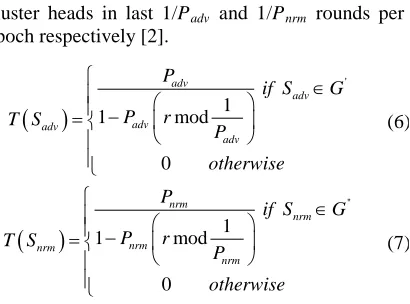
In every round, sensor node (advanced and normal) calculates the chance to become the cluster head using IF-THEN rules which are described in precedent section. After, it selects the maximum of these chances. If the maximum is less than the threshold T(s) (for advanced and for normal nodes) then the node becomes a cluster head and advertises this fact to other nodes around the cluster. The nodes that receive this message calculate the distance between the cluster head and itself and send a join–message to the closest one of the cluster head to form a cluster. Equations (6) and (7) define the T(s) of different type of nodes, where Padv, Pnrm, are the probabilities to become cluster head
for advanced and normal nodes respectively and r
is current round. The G’ and G’’ are the sets of advanced and normal nodes that not elected as
cluster heads in last 1/Padv and 1/Pnrm rounds per
epoch respectively [2].
(
)
' 1 1 mod 0 adv adv adv adv adv Pif S G
P r T S P otherwise ∈ − = (6)
(
)
'' 1 1 mod 0 nrm nrm nrm nrm nrm Pif S G
P r T S P otherwise ∈ − = (7)
7. SIMULATION AND EVALUATION
In this section, we evaluate the performance of our approach in MATLAB [5] in two different scenarios: α=1 and α=3 with 100 nodes are randomly distributed in a 100×100 m2 network. The initial energy of the sensors is E0=0.5 J. The
simulation was performed for 10000 rounds. We use a simplified model showed in figure 1 for the radio hardware energy dissipation. We compare our approach to LEACH [3], LEACH-FL [4] and SEP [2] in Lifetime and Network’s conception energy.
A. Network’s lifetime
Although various definitions have been proposed in the literature, in this paper lifetime is considered as the time when the first node dies. Figure 7 and 9 illustrates the number of alive nodes with respect to the operation of the network in 10000 rounds for different scenarios. It is easy to find out that the proposed approach prolongs the lifetime of the stability period for normal and advanced sensors compared with other algorithms. Our proposed algorithm improves the overall network lifetime about 67.36% and 54 % compared to SEP algorithm results for α=1 and α=3 respectively.
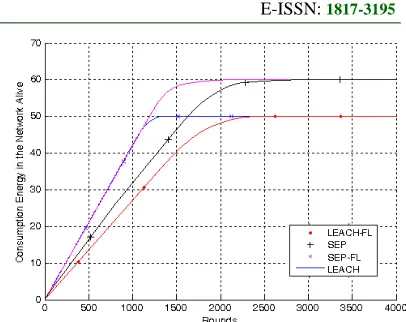
B. Consumption energy in the network
Consumption energy in the network in each round can be a good metric to measure the energy efficiency of the algorithm.
ISSN: 1992-8645 www.jatit.org E-ISSN: 1817-3195
On the other hand, we note that when the value of α increases, the lifetime of the network increases also. We can say that the doping network energy leads to an increase in its operating time.
0 500 1000 1500 2000 2500 3000 3500 4000 0
10 20 30 40 50 60 70 80 90 100
Rounds
A
li
v
e S
ens
or
s
LEACH LEACH-FL SEP SEP-FL
Fig.7. Network Lifetime (Scenarios 1 With Α=3)
0 500 1000 1500 2000 2500 3000 3500 4000 0
10 20 30 40 50 60 70 80 90
Rounds
C
ons
um
pt
ion E
ner
gy
i
n t
he N
et
w
or
k
A
liv
e
LEACH-FL SEP SEP-FL LEACH
Fig. 8. Consumption Energy Of Network (Scenarios 1 With Α=3)
0 500 1000 1500 2000 2500 3000 3500 4000 0
10 20 30 40 50 60 70 80 90 100
Rounds
A
liv
e s
ens
or
s
[image:5.612.93.315.75.701.2]LEACH LEACH-FL SEP SEP-FL
[image:5.612.323.526.77.238.2]Fig.9. Network Lifetime (Scenarios 2 With Α=1)
Fig.10. Consumption Energy Of Network (Scenarios 2 With Α=1)
8. CONCLUSION
Optimizing the energy consumption of heterogeneous wireless sensor network can be realized by using the fuzzy logic. Indeed, our approach shows, by simulation, the improvement of the stability period of the network before the death of the first node since it has two intervals of stability on the first normal nodes, the second related to advanced nodes that increases the lifetime and reduces the consumption of the energy stored in each node.
SEP-FL is more energy efficient in prolonging the network life time using two parameters election fuzzy logic of heterogeneity in networks to evaluate the chance of sensors to become cluster head.
As perspective of this work, we propose to simulate the protocol SEP-FL with a robust software simulation wireless sensor network and the realization of a prototype of a node joining our protocol.
REFRENCES:
[1] F. Akyildiz, W. Su, Y. Sankarasubramaniam and al., “A survey on sensor networks,” IEEE Communications Magazine, vol. 40, no. 8, pp. 102-114, 2002.
[2] G. SMARAGDAKIS, I. MATTA , A. BESTAVROS and al., “ SEP: A Stable Election Protocol for clustered heterogeneous wireless sensor networks ” , Computer Science Department, Boston University.
33rd Hawaii International Conference on System Sciences (HICSS '00), January 2000. [4] G. Ran and al., “Improving on LEACH
Protocol of Wireless Sensor Networks Using Fuzzy Logic”, Journal of Information & Computational Science 7: 3 767–775 (2010) [5] http://www.mathworks.com/ Fuzzy Logic
Toolbox user’s guide