Effectiveness of Self -Esteem Development Programme (SEDP)
Shaheen Ataf Shaikh, Ph. D.
Associate Professor, Department of Education & Training Maulana Azad National Urdu
University.
Self Esteem is an important element in the success of any individual. Education is considered to achieve the goal
of all round development of an individual which ultimately leads to success. In the present research an attempt
has been made to find out, whether we can help children to increase the level of the self – esteem among the
secondary school students. The researcher designed a self esteem development program, which was then
implemented and tested through a one group pre test post-test design. Self esteem levels were tested using Self
esteem test questionnaire designed by Rosenberg and Sorensen. The research proves that self esteem can be
developed among students by providing the appropriate environment and activities.
Key words:- effectiveness, self esteem, program development, secondary school students.
Introduction
Self esteem leads to self confidence and is essential in getting ahead, but it should also
be remembered that self confidence and self esteem grows with success. It has been found
that a child who perceives himself to be able, adequate and a person of worth has more
energy to spend on academic achievements and will use his intelligence to be excellent in all
possible fields. All sspheres of life are governed and influenced by self esteem. There is a
general consensus that there is a close relationship between self-esteem and academic
achievement. Covington(1989) reported that as the level of self-esteem increases, so do
aachievement scores; as self-esteem decreases, achievement scores decline. Furthermore, he
concluded that self-esteem can be modified through direct instruction and that such
instruction can lead to achievement gains. Holly (1987) compiled a summary of some 50
studies and indicated that most supported the idea that self-esteem was more likely the result
than the cause of academic achievement. He did acknowledge that a certain level of
Copyright © 2017, Scholarly Research Journal for Interdisciplinary Studies
academic achievement go hand in hand. They feed each other. As a teacher, it is very
important to know the level of self esteem of the children who are in yourclass.
Importance of Self – Esteem
Self-esteem was primarily focusess on making individuals feel good about themselves.The
only thing to remember about increasing esteem is that telling someone to have high
self-esteem will not help in achieving it. Students end to feel better about themselves if they get to
experience success and are praised for that success that they achieve by people they respect.
“Relationships with parents and relationships with peers are two important sources of social
support that contribute to adolescents' self-esteem” (Harter, 1990; Savin-Williams & Demo,
1983). Rosenberg‟s research has shown, that self esteem is an attitude one has about himself ,
either positive or negative. Self esteem not only enables any individual to aachieve great
heights of success but it also develops the ability of adjustment to the environment. In
studies where self-esteem programs have been introduced into the school setting, it has been
found that such programs can significantly reduce the incidence of anti-social behavior in
schools, as well as reduce vandalism and the incidents of verbal or physical aggression by
40-50%. (Reasoner,1992,Borba,1999)
There is also evidence that high self-esteem can be an effective antidote to depression.
Self-esteem also serves as an effective buffer from the gamut of negative emotions of guilt,
depression, anxiety,shame, and other internal attacks. A major cause of low self-esteem and
depression among adolescents is attributed to the increased stress levels currently found
among teenagers.Helping adolescents learn the way to deal with this anxiety and stress will
enable them to overcome the stress in an effective way and thus effectively nullify the
impact.
Developing an optimistic attitude and outlook towards life isan important quality to
develop in todays students. This means much more than just perceivinga glass as half-full
and not as half empty. It is incorporating the belief that setbacks/failures are normal and can
be surely overcome by an individuals own actions. “Studies of thousands of children show
that those who are pessimistic are much more prone to depression--both in childhood and in
adulthood--than those who are optimistic”. (Rao, 1994). It is therefore required that children
Copyright © 2017, Scholarly Research Journal for Interdisciplinary Studies
Life is full of challenges, successes, failures and surprises and it is self- esteem which
helps one to face these challenges and accept the surprises. Since we do not have any
control whatsoever on the hereditary factors, we need to provide the best and the most
conducive situations for the development of Self Esteem.
Background of the Research
The transitional phase from childhood to adolescence is usually characterised by a need to
establish an identity. Studies have shown that attachment to parents may help in buffering
emotional distress thus facilitating social competence and resulting in enhancing of
self-esteem. Therefore researcher thought of studying effectiveness of Self Esteem development
programme on students .
Need of Research
The main aim of the education system is social, emotional, intellectual growth of the child.
The factors and problems affecting the growth of the personality of the child need to be
studied. If the process of learning is interesting for the child, the outcome is the gain of self
confidence. Thus there is a need to study this relationship between self confidence and
academic achievement. Adolescents have different levels of self-esteem, which areusually
influenced by different factors like gender, ethnicity, and social class. It can also have
internal variations i.e., within an individual.One may have varying levels of self-esteem in
different domains such as social, scholastic, appearance, etc. Studies have found that 1/3 to
1/2 of adolescents have low self-esteem, especially in the early stages of adolescence. The
results of low self-esteem can sometimes be temporary, but in serious cases it can lead to
various psychological problems such as depression, delinquency and even suicide. students
with low self-esteem are more likely to fare very poorly in school.
Importance of the Research
Advanced technology has made the traditional method of teaching out dated . Lot of efforts
are being taken to make the overall teaching-learning process more interesting. This research
will provide suggestions in teaching methods to improve Self-Esteem and thereby the
academic achievements. Self-esteem has been closely related to the socioeconomic status and
to health and health-related behavior. It is important to note that most self-esteem instruments
Copyright © 2017, Scholarly Research Journal for Interdisciplinary Studies
preparing good future citizens of the country. All round development of the child is of utmost
importance. To develop a healthy society we need to have individuals with a sound body
and a sound mind. If a child develops a proper level of self esteem he will excel in any field.
To get an insight into and to understand such problems and help children overcome and get
through the adolescent stage without causing harm to one self or to the society, there is a need
to study how we can develop self –esteem among children and that is what this research aims
to achieve.
Statement of the Problem
To study the Effectiveness of Self - Esteem Development Programme (SEDP) on secondary
school students.
Operational Definitions
Effectiveness :The difference in self esteem levels as shown by pre-test and post-test scores.
Self esteem development program (SEDP) : The program designed by the researcher to
develop self esteem. A belief and a faith in oneself and by instructing in a positive way, self
esteem can be developed. Such deliberate actions will be included in the self esteem
development program.(SEDP).
Objectives of the research
1. To assess the level of self esteem in the IX std. students.
2. To design a self esteem development programme (SEDP) for the IX std. students.
3. To determine the level of self esteem after implementation of self-esteem development
programme (SEDP) IX std. students.
4. To analyse the effect of self esteem development programme (SEDP) on the IX std.
students.
Research Hypothesis
Self esteem levels will increase after implementation of self esteem development program.
Null Hypothesis
There is no significant difference between pre test and post test scores of self esteem
questionnaire.
Copyright © 2017, Scholarly Research Journal for Interdisciplinary Studies
Limitations of the research
The levels of self esteem are determined using responses of students in the inventory
questionnaire.
The effect of I.Q. of the students has not been studied as a variable.
Delimitations of the study :
The present study is delimited to IX class students.
It is restricted to 20 students affiliated to C.B.S.E.
It is restricted only to the study of self esteem.
Assumption:- Self esteem can be developed.
Method of Research
Experimental method of research was used for the study with a single group pre-test post-test
design. Product development research was used in designing of the Self-esteem development
programme (SEDP).
Population of the study
All students studying in Secondary school.
Sample of the study
Twenty students studying in IX std of Utkarsha High School in Pune wereselected by
incidental method.
Data Collection Tools
Pretest and post test was done using Self esteem test questionnaire designed by Rosenberg
and Sorensen.
Self-esteem development programme (SEDP) designed by the researcher and implemented
by the teachers for developing self esteem.
Data Analysis Tools:- Conclusions drawn by t-test from the value of „T‟ score.
Procedure of the research:-Design of the Self-esteem development programme (SEDP) -
After a thorough study of the existing programs keeping in mind the students needs and
Copyright © 2017, Scholarly Research Journal for Interdisciplinary Studies
attitude of teacher, positive feedback, praise and reward, peer support and group work. Expert
opinion and conduct of a pilot study to standardise the program.
Conduct of the pre-test Implementation of the Program:-After seeking the permission from
Principal of the school and concerned parents the implementation began.
1. For all the concerned teachers the program and the purpose of the program was described
and explained.They were instructed to follow and observe the following suggestions as far as
possible with all the children deliberately.
Think positively about every child and act positively with them.
Monitor those children who have low self- esteem and make them mingle with students
who are optimistic, positive and active.
Find out areas where children with low self-esteem can help others and ask them to help
others.
See that everybody is in happy mood as much time as possible.
Give positive remarks in oral and written whenever possible.
Praise even the smallest good work done by children.
2. For children :Every day a good thought was given by children in the assembly. Each one
was given a chance.A group talk was organized and children were told indirectly to --- Be
active and enthusiastic. Act and speak as if you are confident.
Conduct of the Post-test
Findings:- The pre-test and post-test scores of students were collected and analysed.
Fig:1 Graph showing comparison between Pre-test and Post-test scores of self esteem
of individual students:
Copyright © 2017, Scholarly Research Journal for Interdisciplinary Studies
Series1 shows the pretest scores and series 2 shows the post test scores of the students on
self esteem. The graph shows a marked improvement in self esteem levels of students after
implementation of the Self-esteem development programme (SEDP).Scores of the pre test on
self esteem ranged between 11 to 43.Scores of the post test on self esteem ranged between 17
[image:7.595.172.457.206.341.2]– 46.
Fig.2:- Mean scores of pretest M1 and post test scores M2 of students.
The mean values of the pretest and post test scores shows that there is significant increase in
self esteem of students after implementation of the Self-esteem development programme
(SEDP).
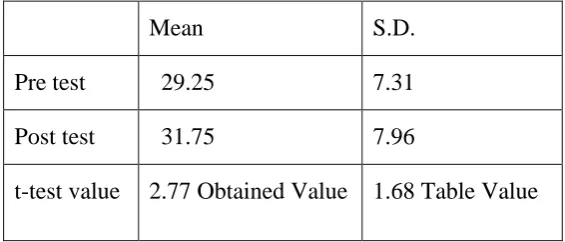
Table 1:- t-test value of the experimental group
Value of 2.77 of the obtained “t” is greater than the table “t” value of 1.68 at 0.1degrees of
freedom.Thus, the null hypothesis is rejected and the research hypothesis, “ Self –esteem
levels will increase after implementation of self esteem development programme ” is
accepted.
Discussion :It is very important to identify the children with low self esteem as well as very
high self esteem.It is equally important to remember that self esteem can be developed with
proper and deliberate attempts.
28 29 30 31 32
M1 M2
Mean S.D.
Pre test 29.25 7.31
Post test 31.75 7.96
[image:7.595.156.439.474.595.2]Copyright © 2017, Scholarly Research Journal for Interdisciplinary Studies
Contribution to knowledge: Research always ends with the discovery of new knowledge or
brings about changes by reopening issues.This research has proved that using self esteem
development programmes every day in school as well as home will definitely improve
performance of children in all fields of studies. A teacher has to be a very keen observer of
children‟s emotions and moods which are going to affect their performance and interest in
studies. This will help them not only shape the young minds in their class rooms but also
effectively build the future generation of their country.
References
Alves-Martins, M., Peixoto, F., Gouveia-Pereira, M., Amaral, V., & Pedro, I. (2002).
SelfEsteem and academic achievement among adolescents. Educational Psychology,
22(1), 51-62.
Bridgeman, B., & Shipman, V.C. (1978). Preschool measures of self-esteem and achievement
motivation as predictors of third-grade achievement. Journal of Educational Psychology,
70(1), 17-28.
Freih, Owayed, E. (2005). Academic achievement and its relationship with anxiety,
self-esteem, optimism, and pessimism in Kuwaiti students. Social Behavior and Personality:
An International Journal, 33(1), 95-103.
Hovington (2010). The Journey Within. Great health Guide, Issue 7.
Knightley, W., & Whitelock, D. (2007). Assessing the self-esteem of female undergraduate
students: An issue of methodology. Educational Studies, 33(2), 217-231.
Morvitz, E., & Motta, R.W. (1992). Predictors of self-esteem: The roles of parent-child
perceptions, achievement, and class placement. Journal of Learning Disabilities, 25(1),
72-80.
Scheirer, M.A., & Kraut, R.E. (1979). Increasing educational achievement via self-concept
change. Review of Educational Research, 49(1), 131-150.
Van Laar, C. (2000). The paradox of low academic achievement but high self-esteem in
African American students: An attribution account. Educational Psychology Review,