ELECTRICAL CHARACTERISTICS OF HUMAN TISSUE IN
THE INTRA-BODY COMMUNICATION WITHIN A LIMITED
FREQUENCY DOMAIN (1MHZ - 10MHZ)
1JIN ZHU, 1,2*SHUANG ZHANG, 2PENG UN MAK , 2SIO HANG PUN, 2MANG I VAI 1
The engineering & technical college of chengdu university of technology, leshan, 614000,china; 2 Biomedicine Department of Electrical and Electronics Engineering,
Faculty of Science and Technology, University of Macau, Macau SAR 999078, China;
ABSTRACT
With development of the current coupling intra-body communication research, it is necessary to increase carrier frequency of communication in the future research to obtain high-speed and stable communication mode. The feature of tissue in human limbs is intensively analyzed with the carrier frequency of 1MHz to 10MHz when the condition of quasi static approximation is tenable. In combination with relevant theories and experimental data, it is concluded that quasi-static coupling of human body is not tenable, which may be used as the theoretical basis for further research of modeling theory.
Keywords: Intra-Body Communication(IBC); Current Coupling; Carrier Frequency; Quasi-Static
Approximation
1. INTRODUCTION
The intra-body communication is a new communication method, which is used to achieve wireless communication between personal electronic devices with body as communication medium [1]. In the communication, the electric field is coupled to the body to implement data communication with human tissue as the communication channel. If an electrical conductor is placed in the electric field, the induced electrostatic charge will be generated on the surface of the conductor; when the electric field varies, quantity of electric charge will change as well. At the moment, physical quantity variation of the electric field is detected to obtain relevant information, which is widely adopted in the electrostatic detection technology [2]. If the information to be sent is modulated to the quasi electrostatic field and coupled to human body, a weak electric field will be produced around the human body [3], a receiver is used to detect variation of the weak electric field, modulate and extract relevant information, then the wireless body area communication will be achieved, which may be applied to medical monitoring, patient nursing and other medical fields.
In 1995, Zimmerman [4] developed the first body area communication system based on the quasi electrostatic field; Partridge [5] discussed effects produced from different earthing conditions and different polar-plate areas. However, transmission rate of the communication system is low, within dozens of Kbps [6][11-15]. On the basis, NTT increased load voltage to 25V to make the communication rate up to 10M. Nonetheless, all above is achieved with human body considered to be a capacitor. The capacitive coupling intra-body communication has a great impact on signal transmission by reason of distance between receiving & sending electrodes and the human body [7], with strong interference from environment. Therefore, it is necessary to pursue a more stable coupling communication means to make up for the shortcoming. In the current coupling intra-body communication, human body is regarded as a communication transmission line, and signal is transmitted in the human body in the form of current.
frequency of less than 1MHz. This greatly hinders market application and further research of the current coupling intra-body commutation. Comparison of Wegmuller’s research results and Hachisuka's shows that increase of frequency is helpful to improvement of communication rate.
It is the carrier frequency that determines communication rate, so it is necessary to study the channel model of human body under high frequency and low voltage. Under frequencies of 1MHz, S.H.PUN[16,17] etc. abstracted the human forearm as a standard cylinder by means of the Maxwell equation and all boundary conditions to establish the channel model of the human forearm. It is proven from experiments that experimental results on the surface of the human forearm are almost consistent with those model calculation results, which shows that the model is somewhat feasible. As the frequency of the inputted current is raised, effect on dielectric property of human tissue is continuously amplified, and the capacitance effect is gradually obvious, which makes the signal transmission process more complicated; for this reason, the conditions omitted in the previous modeling process have to be taken into account, even the quasi-static environment required for PUN’s model will be reconsidered.
Therefore, the electric mechanism of human tissue within the scope of 1MHz to 10MHz will be focused in this paper. Emphasis is laid on the tenable quasi static approximation conditions. Furthermore, in the process of modeling, it is proposed what conditions may be omitted and what conditions must be taken into consideration.
2. QUASI STATIC APPROXIMATION
When some space-time conditions are satisfied, effect of “displacement current” can be left out; this will produce instantaneous relation between the source and the field. At each moment, relation of its source and its field is similar to that of the source of the field of the static field, so the field is also called “approximately stable field”. In general, the following conditions must be met to obtain the approximately stable field.
A. Propagation effect
Within the range of biomedium scale
R
h, the time required to transmit electromagnetic wave from the transmitting electrode to the receiving electrode is expressed with the phase delaye
−ikRh[18]. Because
2 3
(
)
(
)
1
2!
3!
h
ikR h h
h
kR
kR
e
−= −
ikR
−
−
i
(1)If
kR
h
1
,e
−ikRhapproximates to the constant1, amplitude variation and phase delay of the wave in the organism are very small, and the propagation effect may be left out.
Because
max
(1
) 2
kR
= −
i
π ε
f
(2) Wheref
is the carrier frequency,ε ε ε
=
r 0 ,r
ε
is the relative dielectric constant of the conductor, andε
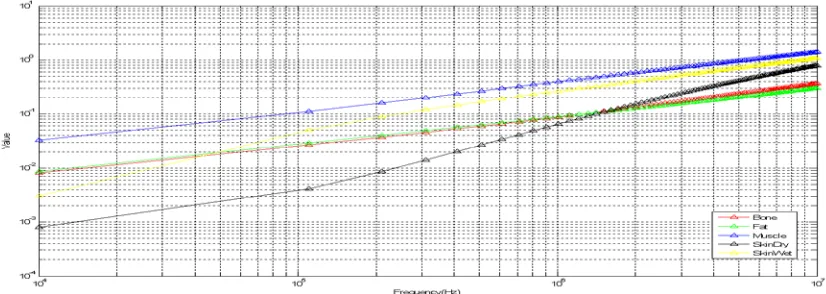
0is the dielectric constant in free space. [image:2.612.109.522.534.681.2]Propagation characteristics of human tissue may be acquired through importing of experimental data, which is illustrated in Figure 1.
Fig. 1 Propagation Characteristics Of Human Tissue On the basis of the above data, it is not difficult
to find that
kR
h
1
(it is considered to meetcarrier frequency is lower than 1MHz. Therefore propagation characteristics of tissue may be ignored. When the carrier frequency rises from 1MHz to 10MHz, the value of
kR
h demonstrates a linear growth trend; when the carrier frequency is 10MHz, the calculatedkR
h value of tissue may no longer meet the condition ofkR
h
1
, even the condition ofkR
h
1
may emerge, so propagation effect at the moment can not be ignored.B. Capacitance effect
There is the conduction current besides the displacement current inside the conductor:
w
E
j
t
ε
→→
∂
=
∂
(3)c
j
σ
E
→ →
=
(4)where
ε ε ε
=
r 0 ,ε
r is the relative dielectric constant of the conductor,ε
0 is the dielectricconstant of free space,
j
w→
and
j
c→
indicate the displacement current and the conduction current respectively, and
σ
is the electric conductivity.If the induced electric field is a harmonic electric field, then
E
E e
0 i tω→ → −
=
, so the following expression may be derived:(
)
w
c c
j
i E
j
E
ε ω
σ
→ →
→ →
−
=
(5)Equation (6) may be obtained through modular arithmetic of Equation (3):
w
c c
j
j
εω
σ
→→
=
(6)Therefore, the condition, which allows the displacement current to be ignored,
is
j
w/
j
c1
→ →
, namely1
cεω
σ
(7)From this, the internal condition which allows the approximately stable field to be tenable may be derived, that is to say, the variation frequency of the electromagnetic field is much less than its own characteristic frequency of the conductor. It is named the capacitance effect inside the conductor.
In combination with the data in [19], the value of
k
may be computed by means of Equation (7), wherec
k
εω
σ
=
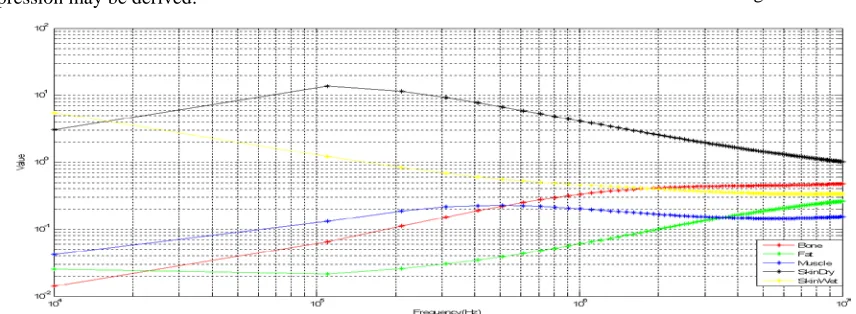
, so current characteristics of partial [image:3.612.101.529.476.633.2]human tissue are obtained as shown in Figure 2.
Fig. 2 Conduction Effect Of Human Tissue It is not difficult to find that capacitance effect of
most human tissue meets the condition of quasi static approximation (when
k
≤
0.1
, namely less than a quantification level, it is considered to meet relevant conditions.) when the carrier frequency is lower than 1MHz, at the moment, the displacementmeets the condition of quasi static approximation in addition to skeleton and fat. For this reason, in later research, the effect of the displacement current upon the entire communication system will have to be taken into account in increasing the carrier frequency.
With increase of the carrier frequency, the capacitance effect becomes more and more obvious, and when the communication frequency rises to a certain value, the capacitance characteristic is dominant over the current characteristic in the whole system. At the moment, the current coupling type will not be suitable for the system any more. Therefore, it is also vital to find out the critical carrier frequency of current coupling.
C. Magnetic induction effect
According to faraday's law, the varying electric field and the varying magnetic field may be excited each other. If the displacement current is ignored (namely the capacitance effect), then the effect of the varying electric field upon the magnetic field is ignored. Obviously, after the two conditions are satisfied, interaction of the electric field and the magnetic field will disappear, which means that they are related to their own corresponding sources, feature of the steady field will be shown and the description method is similar to that of the static field.
As a result, once the capacitance effect is present, the magnetic induction effect will be generated with it.
3. CONCLUSION
On the basis of the existing theory, the quasi-static characteristics of human tissue within the range of 1MHz to 10MHz are analyzed in combination with the existing experimental data, it is concluded that coexistence of the propagation effect, the capacitance effect and the magnetic induction effect must be considered in establishing the theoretical model in the case of the carrier frequency of more than 1MHz. This makes the model more difficult to be established, but it heightens general applicability of the model and provides theoretical basis for theoretical generalization of the current coupling model.
ACKNOWLEDGEMENTS
The work presented in this paper is supported by The Key Fund Project of Sichuan Provincial Department of Education under grant 12ZB192.
REFERENCES
[1] Ashok R L, Agrawal D P. Next-Generation Wearable Networks . IEEE.Computer Society, 2003, 36(11): 31-39.
[2] Bai Yuxian. Journal of Detection and Control, 2002, 24(2): 45-48.
[3] Fujii K, Ishide D, Takahashi M, et al. Electric field distributions generated by a wearable device using simplified whole human body models . Journal of the Institute of Image Information and Television Engineers, 2008, 62(12): 1980-1987.
[4] Zimmerman T G. Personal area networks: Near-field intrabody communication. IBM Systems Journal, 1996, 35(3-4): 609-617.
[5] Partridge K, Dahlquist B, Veiseh A, et al. Empirical measurements of intrabody communication performance under varied physical configurations .Proceedings of the 14th Annual ACM Symposium on User Interface Software and Technology (UIST'01), Orlando, 2001.
[6] Wegmueller M, Oberle M, Felber N, et al. Digital data communication through the human body for biomedical monitoring sensor . World Congress on Medical Physics and Biomedical Engineering, 2007: 608-612.
[7] Hwang J H, Myoung H J, Kang T W, et al. Effects of transmitter's location on the signal loss of the human body communication .Antennas and Propagation Society International Symposium. 2008.
[8] K. Hachisuka, A. Nakata, T. Takeda, et al. Development of wearable intra-body communication devices.Sensors and Actuators A physical,2003, (105).109-115.
[9] K. Hachisuka, A. Nakata, T. Takeda, et al. Development and performance analysis of an intra-body communication device.The 12th International Conference on Solid Slate Sensors, Actuators and Microsystem,2003. 1722-1725.
[10]K. Hachisuka, T. Takeda, Y. Terauchi, et al. Intra-body data transmission for the personal area network.Microsyst. Technol.,2005. 1020-1027.
Medicine and Biology Society , 2006. 2071-2074.
[12]M. S. Wegmueller, M. Oberle, N. Kuster, et al. From Dielectrical Properties of Human Tissue to Intra-Body Communications . Springer Berlin Heidelberg,2007, 2(6):613-617. [13]M. S. Wegmueller, M. Oberle, N. Felber, et al.
Galvanical coupling for data transmission through the human body.Instrumentation and Measurement Technology Conference, 2006
.1686-1689.
[14]M. S. Wegmueller, M. Hediger, T. Kaufmann, et al. Investigation on Coupling Strategies for Wireless Implant Communications. Instrumentation and Measurement Technology Conference,2007.1-4.
[15]M. Wegmueller, A. Lehner, J. Froehlich, et al. Measurement System for the Characterization of the Human Body as a Communication Channel at Low Frequency.IEEE Engineering in Medicine and Biology 27th Annual Conference Shanghai, China,2005. 3502-3505.
[16]Y. M.Gao; S. H. Pun; M.Du; M.I Vai ;P. U. Mak. “Quasi-Static Field Modeling and Validation for Intra-Body Communication (IBC)”. Proceedings of the 3rd International Conference on Bioinformatics and Biomedical Engineering. Beijing, China,pp.1~4, 2009. [17]S. H. Pun;Y. M.Gao; P. U. Mak; M.I Vai ;
M.Du. “Quasi-Static Modeling of Human Limb for Intra-Body Communication (IBC)s With Experiments”. IEEE Transactions on Information Technology in Biomedicine, vol.15,no.6,pp.870~876, 2011.
[18]R. Plonsey, D. Heppner. Considerations of Quasi-stationarity in electrophysiological Bulletin of Mathematical Biophysics, 1967, Vol. 29: 657-664.