APPLICATION OF MULTIMEDIA TECHNOLOGY IN
SITUATIONAL TEACHING OF FOREIGN LANGUAGE
ZHENHUAN ZHANG, FENGYUN ZHAO
Institute of Foreign Languages, Handan College, 056005 Handan, Hebei, China, E-mail: [email protected]
ABSTRACT
By using digital information, such as graphic image and audio as well as vedio, the integration of situational teaching of foreign language and modern multimedia technology enriches the content of foreign language teaching, which provides a rich and colorful environment for English learner. It can stimulate emotional students’ experience and enhance their willings of participating in interacting with classmates by reasonably creating a situation around content of courses in teaching. Based on cognition of teaching method of situational teaching theory, this paper constructs functions to analyze the advantages of multimedia technology in situational teaching of foreign language, thus deduces applied purpose and principle of multimedia technology in situational teaching of foreign language by using the mathematical model to construct thoughts. It provides theory basis and new way of teaching practice for situational teaching of foreign language.
Keywords: Foreign Language, Situational Teaching, Model Building, Analytic Function
1. INTRODUCTION
As an important tool of teach and communication, multimedia information technology promotes the improvement of teaching skills of teachers. With the popularization of modern education, rapid development of teaching level and dramatic changes of teaching methods, traditional teaching idea and limited knowledge cannot meet the require of the teaching situation at present[1,2]. With the development of the information technology, multimedia has been extensively applied in every aspects of social life, work and study, and has a huge impact on all kinds of ways of production and life, the application of multimedia technology in teaching has been paid more attention, especially in situational teaching of foreign language , such as problems exist in multimedia teaching of collage English and its countermeasures of Wang Xuehua and Zheng Yuqi, it underlines the advantages of multimedia teaching by compared with traditional foreign language teaching model, and analyses the problems and countermeasures while teaching by combining with practical operation, it effectively directs the relative problems of situation creation of college foreign language teaching; the review and consideration of multimedia teaching of Zhang Jun, it reflects the problems of multimedia teaching of developing and existing at the present
English teaching, it mainly elaborated multimedia aided teaching that has gradually become the modern teaching means, compared with traditional English teaching, it had great advantages that can effectively promote the English teaching reform; Wang Yuzhen’s modern multimedia in the application of English teaching was mainly aimed at middle school English education analysis of the use of multimedia to create learning situation, the media can be understood as a tool means in teaching, and had the important tool of traditional teaching thought; Wu Yang wrote the university English listening, speaking and teaching based on multimedia resources, which emphasized on the use of multimedia technology for the positive impact on college English listening, speaking and teaching, it was reform and the innovation of English listening, speaking and teaching[3,4]. It can make the university English unity that had positive effect on English listening, speaking and teaching, to offer extremely advantageous new teaching direction.
2. COGNITION OF TEACHING METHODS BASED ON SITUATIONAL TEACHING THEORY
[image:2.612.326.520.314.382.2]
Situational Language Teaching was called Oral Approach at the beginning. It enjoyed warm welcome in UK during the 1950's, with the development of the globalization culture, Situational Language Teaching was heard all over the world. With the continuous development in practice, it can finally be found that the main theory basis of Situational Language Teaching is mainly based on three educational theories, it can be said that it is a organic integration of these three theories, as shown specifically in the following Figure.
Figure 1: Supports Of The Theory Of Situational Teaching
As shown in Figure 1, supports of the theory of the situational teaching are learning theory of constructivism, cognitive theory of the situation, and language theory of structuralism. Integrate plenty of learning resources that emphasized by constructivism and creative situation learning, combine the key element of utterance of structuralism and cognitive theory of the situation, underline the important role of language in
situational education, the perfect organic combination of situational environment and language structuralism treats environment as a vital component of teaching process, it contacts closely with the whole teaching process, analyses the differences of students, thus conducts diversified teaching, meets requirements of students.
[image:2.612.104.297.543.628.2]Situational Language Teaching originated from English teaching at first in China, it is also applied in other subjects, and has different definitions in different subjects. But the core of situational teaching is tightly closed to the content of courses in no matter what subject, creating a situation to help students digest content of courses and deep the effect of learning, so achieving optimization of teaching effect. Situational Language Teaching has following Figures, the below Figure shows the specific organizational process[5].
Figure 2: Organic Process Of Situational Language Teaching
3. ADVANTAGE ANALYSIS OF
MULTIMEDIA TECHNOLOGY IN SITUATIONAL TEACHING OF FOREIGN LANGUAGE
Modern society is the parallel era of economy and information, the continuous development of information technology provides new opportunities for the current education, but also provides a new challenge. In the application of the field of education, modern information technology provides new facilities for English teaching, especially the rapid development of multimedia technology in today. The integration of English teaching and modern multimedia technology brings new reforms for the development of English teaching, practice has proved that the application of multimedia technology can change the traditional English teaching’s learning environment, to promote the current English teaching transformation, teaching subject, teaching content, teaching mode, teaching idea, teaching system etc [6].
English learning. The teaching process of multimedia technology combined with English teaching is not limited to the contents of textbooks, teaching contents also can be enriched, using information media cooperation teaching, and making many departments multimedia technology have become student subject learning and English learning cognitive means. In the process of teaching, the use of teaching coefficient’s complex decision judges the integration fitting degree of English teaching with modern multimedia technology, measuring k variables are explained by the variation in the proportion of total variation after it is fitting multiple regression equation, to represent fitting effect of English teaching and modern multimedia technology. The use of R2 expresses English teaching complex coefficient of determination, which is used to distinguish it from the students' learning outcomes, to judge the coefficient of determination r2. The fitting determination coefficient of English teaching and the modern multimedia technology is defined as follows:
∑
∑
∑
∑
− − − = − −= 22 22
2 12 . ) ( ) ( 1 ) ( ) ( Y Y Y Y Y Y Y Y RY k
(1) In formula (1), the adjusted correlation determination coefficient can effectively stabilize equation’s the number of independent variables on the end fitting effect, the formula of adjusted multiple determination coefficients is [7]:
2 2 12 . 2 2 2 ) ( 12 . 1 ) 1 /( ) ( )] 1 ( /[ ) ( 1 Y k Y adj k Y S S n Y Y k n Y Y R − = − − + − − − =
∑
∑
(2) In formula (2), because the calculation of English teaching and the modern multimedia technology’s fitting determination coefficient only carry out in regression equation, so it must use the regression coefficients to calculate2 12 . k Y
S
and 2 YS
, then to getR
Y2.12k(adj). Namelythe need of unadjusted formula calculates the fitting determination coefficient of English teaching and modern multimedia technology, which is expressed as[8]:
2 2 12 . 2 12 . ) 1 ( ) 1 ( 1 Y k Y k Y S n S k n R − − − − = (3) In formula (3), according to the unadjusted determination coefficient formula (1), it can carry out multiple regression calculation, which is as follows: ) 1 ( 1 1
1 2.12
2
) ( 12
. k adj Y k
Y R
k n
n
R − − −
− − =
(4) In formula (4), multiple correlation coefficients are got by English teaching and modern
multimedia technology that must carry out the square of fitting determination coefficient. In multiple regressions, the covariant relation of inherent independent variables and condition variables appear uncertain situation that may be either positive or negative, the multiple correlation coefficients as a description of the amount of all variables covariant relationship, which can only be taken as.
2 12 . 12
. k Y k
Y
R
R
=
(5) Multiple correlation coefficients can also be used the following formula:
∑ ∑ ∑ ∑ − − + + − + −
= 2 2
2 2 2 1 1 1 12 . ) ( ) ( ) ( Y n Y Y nX Y X b Y nX Y X b Y nX Y X b
RY k k k k
) , , 2 , 1 ( ) ( ) ( 2 2 k j n Y Y n Y X Y X b j j j = − − = ∑ ∑ ∑ ∑ ∑ ∑ (6) In formula (6), its calculation results with calculating the fitting determination coefficient between English teaching and modern multimedia technology, which are the same from the theory, however its calculation process is different, just the mantissa of the regression coefficients would have some access. According to the formula, it can be obtained by the fitting determination coefficient of English teaching and modern multimedia technology, thus to judge the integration fitting degree of English teaching and the modern multimedia technology in the teaching process.
writing ability, translation ability, speaking ability, application ability, learning ability, comprehension ability and writing ability etc. General speaking, the integration of English teaching and modern multimedia technology have brought unlimited vigor and vitality for English teaching, which has an irresistible prospect and great teaching advantage.
[image:4.612.91.295.359.442.2]With the development of social informatization and digitization, the applied range of modern multimedia technology has gradually became extensive, the application of multimedia technology in teaching domain has became mature, traditional education can be complementary with it, and it plays a very important role in daily teaching, makes positive attribution to pushing the development of education career. The carrier of multimedia technology aided teaching is media, while media is the platform of information spreading, and multimedia has its own unique characteristics so the characteristics of multimedia technology aided teaching are showed by the following Figure.
Figure 3: The Characteristics Of Multimedia Technology Aided Teaching
As Figure3 shown, the inherent of media characteristics of multimedia technology aided teaching present diversification teaching, it can stimulate the learning interest of students, improve the efficiency of teaching; and it has a positive impact on foreign language teaching, it can unite listening and speaking of college English, make positive contribution to teaching.
The integration of English teaching and modern multimedia technology can make functionality transition between teacher and student happen, further reflect the subjectivity of students, promote effectively their individuation foreign language learning. The application of practical multimedia technology in situational teaching of foreign language can define the them as two entity function, set multimedia technology as function
ϕ
, situational teaching of foreign language as entity functionΨ
, the application advantages of multimedia technology in foreign language confirm the inner product of the two entity function is projection product, specific analysis is multiplying the relative value of function and then integrating in domain, so the whole expression is:<
ϕ ψ
,
>
= Ω
Ω
∫∫∫
ϕψd(7) Taking the complex number
ϕ
of multimedia technology as function and the complex numberψ
of foreign language as entity function, with the revolution of the way of modern teaching, information technology certainly will be applied in teaching of all sorts of subjects, so one must take a conjugate among the two of the following formula:Ω =
Ω >=
<
∫∫∫
∫∫∫
Ω Ωd
d ϕ ψ
ϕψ ψ
ϕ, * *
(8) In the application of practical teaching link, situational teaching of foreign language based on information technology should absorb the advantages of multimedia teaching and traditional teaching, make good for deficiency, complement each other, to achieve better teaching effect, the norm of multimedia technology as a function can be constructed:
>
<
=
ϕ
ϕ
ϕ
,
(9) The teaching process of combining multimedia technology and foreign language teaching is not limited in the content of teaching material, teaching content can be rich, the information media can be used to assist in teaching, make multimedia technology become an approach of cognition apart from topicality learning and foreign language learning of students. The inner product of multimedia technology as function
ϕ
and situational teaching of foreign language as entity functionψ
is the multiplex, therefore it is calledϕ
andψ
as orthogonality, that is:Γ ⋅ ∇ = Ω ∇ ⋅
∇
∫∫
∫∫∫
Γ Ω
d v u d
v
u )
(
(10)
Γ
is the boundary ofΩ
. Unfold the left side of the equal sign, it can be concluded[9]:Ω Ω Γ
Ω Ω Γ
∫∫∫
u∇vd +∫∫∫
∇ ⋅ ∇u v d =∫∫
u vnd
2 ( ) ( ) ∂
∂ (11)
Γ ∂ ∂ Ω Ω
Γ Ω
Ω
d n u v d u v ud
v
∫∫∫
∫∫
∫∫∫
∇2 + (∇ )⋅(∇ ) =Γ
−
= Ω ∇ −
∇
∫∫
∫∫∫
Γ Ω
d n u v n v u d
u v v u
∂ ∂ ∂ ∂
)
( 2 2
(13) Practice proves that applying multimedia technology can change the learning environment of traditional English teaching, six aspects of transitions need to be paid attention, they are promoting the transition of present foreign language teaching methods, the theme, content, mode, thought and system of teaching. That is multimedia technology aided teaching has gradually became a way of modernization foreign language teaching, and it possesses a large advantage compared with traditional teaching. The integration of foreign teaching and modern multimedia technology is not only a inheritance of traditional teaching method, but also a complement and improvement of resources environment of modern English teaching, it has a wide development space in the domain.
4. THE APPLICATION TARGET AND PRINCIPLE OF MULTIMEDIA TECHNOLOGY IN SITUATIONAL TEACHING OF FOREIGN LANGUAGE
[image:5.612.96.289.481.606.2]The application of multimedia technology in situational teaching of foreign language creates an atmosphere that benefits English learning, mobilizes learning enthusiasm and initiative of students, strengthens the interactivity between English teachers and students[11]. The main application targets of multimedia technology in situational teaching of foreign language are as follows, the following Figure has shown specifically.
Figure 4: The Application Target Of Multimedia technology in foreign language teaching
As shown in Figure4, the application of multimedia technology in situational teaching of foreign language should have the above five targets, multimedia technology is on the basis of the production and development of cognitive theory of the situation, combining modern teaching and the practical problems of relative situation setting up during the process of teaching, aiming at promoting the level of multimedia teaching,
promoting to communicate with students proactively through creating appropriate situation, truly understanding the learning objective law of students.
To construct the architecture of solving teaching problems scientifically and effectively through a serious deep cognition, to pinpoint the way of multimedia teaching and the duty of teachers and endeavor to overcome the elements of multiply influencing teaching efficiency improvement by combining the new task, thought and target of modernization education. Pay more attention to stimulate the interests of learning foreign language of students, suppose the demand
function of interest is
u
=
f
(
x
)
, map the elementx
that influences the stimulation of interest during the class of situational teaching to the elementu
of the class of situational teaching; take the cultivation of ability as a key point of the whole cultivation of teaching, build the demand functionI
=
I u
( )
of ability cultivation, map the elementu
that influences the cultivation of ability during the classes of situational teaching to the elementI
during the classes of situational teaching; take the information processing as the core of foreign language situational class teaching,build the demand function
g
=
Au
of information processing, map the elementu
that influences information processing during situational teaching classes to the element g of situational teaching classes. When the operation which is presented byA
acts on the functionu
,Au
andu
are both belonging to function space; so A is called operator, the interactive element of multimedia technology, the element of analogue function, the element of the level of making teachers' courseware, the element of teaching situation are content with the operator of linear operation law, they are called linear operators[12]:
=
+ = +
1 1 1 1 1
2 1 2 1
, )
( ) (
a Au a u a A
Au Au u u A
(14) Or presented as:
A a u( 1 1+a u2 2)=a Au1 1+a Au2 2,
a
1anda
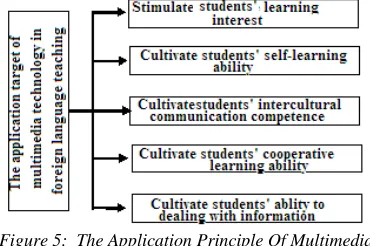
2arsituational teaching of foreign language moves toward to optimization, make progress of new revolution of reaching during teaching links, the following Figure2 shows the specific principles.
Figure 5: The Application Principle Of Multimedia Technology In Situational Teaching Of Foreign
Language
As the Figure5 shown, the application of multimedia technology in situational teaching of foreign language has bi-directional nature, they reflect a relationship of integration, the former expands multimedia technology, is used by foreign language situational education, multimedia technology is need when developing the thinking ability of students during the process of situational teaching of foreign language . It is not only uses multimedia technology as new teaching media in situational teaching of foreign language in practical process of teaching, but also connect information technology with the whole structure of foreign language teaching, integrate all sorts of organic elements, so the six principles which are showed in Figure5 need to be paid attention.
5. CONCLUSION
Combined with practical teaching process, this paper analyzed the characteristics of multimedia technology, constructed the model of informatization teaching through analyzing the pros and cons of multimedia technology in English situational teaching. It also studied the impact and influence of multimedia teaching and the problem of multimedia teaching and its development tendency from the current situation of the development of multimedia. The authors tried to do exploration the problem that use information technology to guide teaching practice and put forward efficient solutions, which is the centres that workers in that field should pay attention to.
ACKNOWLEDGMENTS
The work was supported by research project for teaching reform of higher education in Handan
College, with the project name Application Research on How to Promote Teaching Level of Foreign Language with Modern Educational Technology.
REFERENCES:
[1] Shu-Chiao Tsai, “Developing and integrating courseware for oral presentations into ESP learning contexts”, Computers & Education, Vol. 55, No. 3, 2010, pp. 1245-1258.
[2] Daniel C. Moos, “Elizabeth Marroquin, Multimedia, hypermedia, and hypertext: Motivation considered and reconsidered”,
Computers in Human Behavior, Vol. 26, No. 3, 2010, pp. 265-276.
[3] Aliana Man Wai Leong, Jacky Xi Li, “A study on English teaching improvement based on stakeholders' needs and wants: The case of the Faculty of International Tourism of the Macau University of Science and Technology (MUST)” , Journal of Hospitality, Leisure, Sport & Tourism Education, Vol. 11, No. 1, 2012, pp. 67-78.
[4] Shu Ching Yang, Yen-Fen Huang, “A study of high school English teachers’ behavior, concerns and beliefs in integrating information technology into English instruction”,
Computers in Human Behavior, Vol. 24, No. 3, 2008, pp. 1085-1103.
[5] Ivan Lombardi, “Not-so-Serious Games for Language Learning. Now with 99,9% More Humour on Top ”, Procedia Computer Science, Vol. 15, No. 7, 2012, pp. 148-158.
[6] Yuping Wang, Nian-Shing Chen, Mike Levy, “The design and implementation of a holistic training model for language teacher education in a cyber face-to-face learning environment”,
Computers & Education, Vol. 55, No. 2, 2010, pp. 777-788.
[7] Nilcan Ciftci Ozuorcun, Feride Tabak, “Is M-learning Versus E-M-learning or are They Supporting Each Other?” Procedia - Social and Behavioral Sciences, Vol. 46, 2012, pp. 299-305.
[8] Daniel A. Guttentag, “Virtual reality: Applications and implications for tourism”,
[9] Mengxiang Li, Chuan-Hoo Tan, Hock-Hai Teo, Kwok-Kee Wei, “Effects of product learning aids on the breadth and depth of recall”,
Decision Support Systems, Vol. 53, No. 4, 2012, pp. 793-801.
[10] Gemma Corbalan, Liesbeth Kester, Jeroen J.G. van Merriënboer , Selecting learning tasks: Effects of adaptation and shared control on learning efficiency and task involvement, Contemporary Educational Psychology, Vol.33,No. 4, 2008, pp. 733-756.
[11] anis A. Cannon-Bowers, Clint Bowers, Katelyn Procci, “Optimizing Learning in Surgical Simulations: Guidelines from the Science of Learning and Human Performance”, Surgical Clinics of North America, Vol. 90, No. 3, 2010, pp. 583-603.