380
CROSS LAYER DESIGNS TO OPTIMIZE THE POWER
CONSUMPTION IN WIRELESS SENSOR NETWORKS
1K.LAKSHMISUDHA, 2Dr.C.ARUN
1 Assistant Professor, Department of IT, SIESGST, NaviMumbai, MAHARASTRA
2Professor, Department of ECE,
R.M.K. College of Engineering and Technology,
CHENNAIE-mail: [email protected], [email protected]
ABSTRACT
Wireless sensor networks are characterized by limited resources in terms of memory, computation power, and energy. As WSN nodes are powered by batteries, they have hard energy constraints therefore, efficient use of energy is one of the main design considerations in Wireless sensor networks. Since all layers of protocol architecture influence the energy consumption, exploiting synergies between these layers by a cross layer design will result in an efficient energy utilization of the system. In this paper we have discussed about the importance of Cross Layer Design and the comparative analysis of the various cross Layer Design protocols.
Keywords: Sensor, Energy efficiency, Open system Interconnection(OSI) Model,Cross layer design, delay, network lifetime, Cross Layer Frame work.
1. INTRODUCTION
The Open Systems Interconnection (OSI)
reference model [1] divides the network
architecture into seven well defined logical layers, each layer responsible for some specific task. The real world implementation of the layered approach
including TCP/IP (Transmission Control
Protocol/Internet Protocol) protocol suite and LonTalk protocol [2] shows the importance of layered architectures. Layer-wise functionalities discussed in [3] and the needs to divert from traditional architectures are described as follows.
Physical layer is used to transmit raw bits over wired or wireless channel. It is composed of different hardware modules, for example, a radio in WSNs. Radio is a gateway of sensor node to the external world, and is the main cource of energy utilization. There are several factors which effect the power consumption on the physical layer including modulation scheme, data rate, transmit power, and different modes of operation. In traditional systems, like wireless local area networks, power is not a major issue it is one of the basic limiting factor in the wide spread applicability of WSN applications; therefore, the physical layer needs to be re-considered in the WSN context.
Link layer is composed of medium access and logical link control functionalities [3]. In context of WSNs, at link layer, there are different sources of energy wastage comprising collision, overhearing,
control packet overhead, and idle listening. Such sources of energy wastage do not pose problems in wired networks because of unlimited power supply. These issues require reconsidering the already existing layered protocol architectures.
Main functionalities of network layer include routing of information, topology control, best route determination, and network layer addressing [3]. Routing in low power WSNs has a different characteristic as compared to traditional routing and wireless ad-hoc networks [4]. These characteristics discussed in include: firstly, global addressing and hence classical IP-based routing is not possible because of sheer number of sensor nodes. Even if the number of nodes is not very high, the nodes normally have to know their positions and utilizing position information for routing decisions reduce control packet overhead [5]. Secondly, in most cases, data are sent from different regions towards a sink node while in traditional systems, for example, in wireless ad-hoc networks, the source destination pair may change constantly. And thirdly, presence of redundant data which need to be filtered or aggregated along their path towards the sink node. These issues motivate to divert from traditional architectures. Transport layer functionalities include end-to-end data delivery, acknowledged and unacknowledged services, and flow control.
381 most of the communication is done hop by hop in WSNs, and there is no notion of end-to-end delivery, transport layer may not be required. But for low power sensor networks where encryption algorithms cannot be used for complexity reasons, authentication server services [2] like that of LonTalk protocol may be implemented for security reasons.
Application Layer contains different protocols required by the end user [3]. WSNs are highly application specific1 and require reconsideration in protocol architecture. Because of wide deployment of TCP/IP protocol suite, it is considered as a base for protocol architecture of WSNs which excludes session and presentation layers, therefore, session and presentation layers are not discussed here. Although there is no specific technique available to evaluate specific protocol architecture, the wide deployment and long lasting existence shows the credibility of the architecture as in the case of TCP/IP protocol suite or LonTalk Protocol. It requires that the protocol architecture for WSNs needs to follow layered architecture approach while the new requirements as discussed above require it to divert from traditional approach and go for a cross layer design approach.
2. CROSS LAYER APPROACH
The Cross layer design may be defined as, “the
breaking of OSI hierarchical layers in
communication networks” [8] or “protocol design
by the violation of reference layered
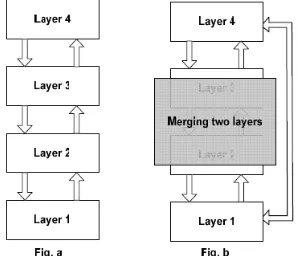
[image:2.595.313.503.379.489.2]communication architecture is cross-layer design with respect to the particular layered architecture” [7]. The breaking of OSI hierarchical layers or the violation of reference architecture includes merging of layers, creation of new interfaces, or providing additional interdependencies between any two layers as shown in Fig. 1.
Figure 1: Example Reference Architecture With Defined Interfaces(Fig A) And Its Violation (Fig B)
[image:2.595.92.241.591.719.2]2.1 Cross Layer Design by Example: First, assume that sensor nodes 1, 2, 3, 4, and sink node are distributed in area “A” and area “B” as shown in Fig. 2. All these nodes are gathering environmental data and sending them to the sink node. Node 1 and 2 can send data directly to the sink node while node 3 and 4 use node 2 as a relay node to send their data. Assume that time-to-death of any of the nodes is the network lifetime. In area “A”, as node 2 sends its own data as well as relays data from node 3 and node 4 towards the sink node, so node 2 will drain its energy earlier, resulting in network lifetime of say T. If network layer of node 4 or node 3 gets to know about the energy level of node 2 frequently for routing decisions, it cannotify link layer to increase the transmit power. In this way, node 2 will not be used as a relay node for node 3 and 4 and would save energy that was supposed to be utilized by node 2 for signal processing and relaying of messages. Node 3 and node 4 would directly send data to the sink node at cost of higher transmit power. In this way, T can be extended by cross layer information exchange between the routing and physical layers. In the second scenario, area “B” assumes that there is temporarily some noise and interference from external sources (e.g.,microwaves).
Figure 2: Example to illustrate cross layer design
In traditional approach, this would result in packet losses and re-transmissions if the signal to noise ratio (SNR) is below a certain threshold value. If node 4 increases it’s transmit power, so that the SNR value is above a certain threshold, packet losses and re-transmissions can be avoided. If application running on node 4 back’s off for some time and does not send data till the noise and interference level is acceptable (based on information from the link layer), it can save energy by avoiding transmissions and re-transmissions. In this way, the application layer based on cross layer information exchange with link layer can extend network lifetime T.
3. POTENTIAL ISSUES WITH CLD
382 Designers create new, non-standard interfaces between OSI layers, merge functionality of multiple layers, and/or jointly calibrate layers. The new interfaces expose internal information or control parameters which were previously not externally accessible, but are required for cross-layer
optimization. For static cross-layer design,
designers utilize known characteristics of the network and layers, and co-calibrate or code sign a set of layers off-line. By their very nature, all of these modifications destroy most of the benefit that the OSI framework provided. As such, designers must make careful decisions as to when, where, and how to implement cross layer designs. The authors of [9] summarize a number of potential issues with CLD.
3.1 Unintended Cross-Layer Interaction: The creation of new interactions between layers can lead to unforeseen dependencies which are not predicted by simulation. While designers make their best effort to vet system functionality through simulation and testing, real-world implementations are often subjected to unforeseen environments.
3.1.1 Stability: Stability of a given communication system is compromised by engaging in CLD. In the case of joint optimization, a given CLD may make changes at one layer based upon feedback from another layer. In effect, this creates a closed-loop feedback system, with all of associated typical design challenges. In communication systems, random variation occurs at the top (Application) and bottom (Physical) layers. Performance of any CLD must be carefully characterized against this system variation, which is often hard to capture, characterize, and simulate.
3.2 Long-term Sustainability: As a general rule, strict architectures with well-defined sub-system responsibilities and interactions lead to robust, modular designs. This is one of the greatest benefits of the OSI model. Each layer can be independently designed, changed or upgraded without any required action for the other layers in the system. The evolution of the internet is a great example of the success of this approach, as suggested in . Clearly, cross-layer design severely impacts the modularity of any system, since layers now depend upon non-standard interfaces with other cross layer optimized layers. Without careful consideration, a change made at any given layer could affect the functionality of any other layer. Additionally, it is not clear which, if any, CLD proposals could be combined to further improve performance.
4. RELATED RESEARCH WORK
A notable work done by Jeffrey Mehlman [10], He defines a methodology for evaluation of cross Layer designs, and applies this methodology to two very different cross-layer design proposals for WSNs . Through this review, they identify the need for a standardized framework for cross-layer design, the basic requirement for a cross-layer framework, and briefly reviews some of the existing cross-layer framework proposals.
To address the issue of cross layer design, it was figured out that there is no specific framework or a standard way which can help in the cross layer design of WSNs. Although researchers have been investing efforts in cross layer design and optimization, but lack of a specific standard which explicitly supports cross layer design make the re-usability of the research effort difficult. WSN protocol architecture with standard interfaces and explicit support for cross layer design is presented by MS. Sajjad Ahmad Madani [11].
The implementation of the framework shows the feasibility and benefits of the concept. The proposed architecture can help achieving the dream of having generic communication protocols for different classes of applications. The major differences and requirements for different routing protocols are based on different criteria’s. For example, some routing protocols may need lower delays, the other may need energy efficiency, some may need to use location information, and some may need to define dominating sets. So the availability of important network parameters (which can also be extended), and the way these parameters are shared can help to develop dynamic or adaptive routing schemes so that they can satisfy requirements of different classes of applications.
The proposed protocol architecture is
implemented in the PAWiS simulation framework. To further study the proposed WSN protocol architecture, a novel table less position based routing scheme (TPR) for wireless container tracking and monitoring application is developed.
The basic properties of this new routing protocol
includes a distributed operation, dead-end
awareness, table less routing, and a mechanism to route on the basis of remaining energy or delay or both. TPR uses cross layer information to improve
energy performance. Per packet energy
383 able to provide a complete picture of the energy performance. The reason for this shortcoming is that energy consumption by running timers is not considered in the evaluation of the routing protocol. Based on the experience learnt during the development of TPR, a novel hierarchical routing protocol, known as grid routing, is developed. Grid routing enhances the energy performance further as it reduces the number of transmissions by data aggregation. The delay analysis for grid routing has not been performed and would be the focus of future enhancements of the protocol.
An Energy-Efficient Access Control Algorithm with Cross-Layer Optimization in Wireless Sensor Networks [12] is invented by Zhi Chen, Shaoqian Li and they have presented a wireless sensor network (WSN) access control algorithm designed to minimize WSN node energy consumption. Based on slotted ALOHA protocol, this algorithm incorporates the power control of physical layer, the transmitting probability of medium access control (MAC) layer, and the automatic re-peat request (ARQ) of link layer. In this algorithm, a cross-layer optimization is preformed to minimizing the energy consuming per bit. Through theory deducing, the transmitting probability and transmitting power level is determined, and the relationship between energy consuming per bit and throughput per node is provided. Analytical results show that the cross-layer algorithm results in a significant energy savings relative to layered design subject to the same throughput per node, and the energy saving is extraordinary in the low throughput region.
Cross-Layer Design for Lifetime Maximization in Interference-Limited Wireless Sensor Networks [13] is invented to consider the problem of computing transmission powers, rates, and link schedule for an energy-constrained wireless network to jointly maximize the network lifetime. For the special case, where they restricted link schedules to TDMA schemes, we obtained the exact optimal transmission scheme as the solution of a mixed integer-convex optimization problem. For the case of general link schedules,They proposed an iterative algorithm to approximate the optimal solution. Each iteration of the algorithm solved a convex optimization problem, where the feasible region was given by a convex subset of the feasible set in the general problem formulation.
The algorithm was found to perform well for the topologies considered in this paper. The numerical studies emphasized the importance of cross layer design for energy-constrained networks, and illustrated the advantages of multihop routing, load
balancing, interference mitigation, and frequency reuse in increasing the network lifetime. Traditional approaches such as TDMA and minimum energy routing were found to perform poorly for certain topologies. Focus on energy efficiency and avoidance of packets collision, a power controlled MAC that is named as cross-layer power alternative MAC (MAC) is proposed [14]. In CLPA-MAC, nodes send packets with two different transmission power levels instead of one fixed value. A power alternative scenario is discussed to help nodes choose appropriate power level to send packets.
For saving energy, avoiding collision and
reducing time delay, routing table based
transmission mechanism is proposed. This cross-layer mechanism leads nodes to discern the available data and utilize the channel reasonably. Relatively, the frame of RTS/CTS/DATA/ACK is designed to adapt the power alternative scenario and cross-layer mechanism. With the simulations, the proposed protocol is evaluated in comparison with S-MAC and PCSMAC from transmission power of nodes to time delay. The performance of CLPA-MAC is verified to be efficient and competent.
An Energy Optimization Approach based on Cross-Layer for Wireless Sensor Networks named as EOA [15], which consider the joint optimal design of the physical, medium access control (MAC), and routing layer. The focus of EOA is on the computation of optimal transmission power, routing, and duty-cycle schedule that optimize the WSNs energy-efficiency. They have first proposed a feedback algorithm that computes the proper transmission power level between nodes. Then, routing protocol can make use of the transmission power as a metric by choosing route with optimal power consumption to forward packets. Finally, the cross-layer routing information is exploited to form a duty-cycle schedule in MAC layer. EOA is validated on a CROSSBOW’s MicaZ mote platform, and evaluated using the TOSSIM simulator, the simulation results show that EOA is an energy-efficient approach and able to achieve significant performance improvement as well.
384 balance between connectivity and energy savings. In this paper they have proposed a cross-layer optimization for MAC protocols that use LPL. This
optimization takes into account high-level
information of the application in order to compute adaptive delays in every sensor along a multihop path, with the goal of adjusting precisely the activity time window of the sensor along the path. They validated their delay-based model by evaluating different scenarios, and we compare it against the LPL model. The simulation results confirm the validity of their approach and demonstrate that a delay-based model can improve the synchronization achieved through the LPL strategy.
In [17], the authors propose a method for optimized data transmission in energy-constrained sensor networks. They begin by developing a model and set of assumptions for the system. Sets of potential optimization objectives and system constraints are defined. First, each of the three layers is individually optimized for three different objectives while the other two are held static. Next, all three layers are jointly optimized for a Time Division Multiple Access (TDMA) network, for cases where interference is and is not allowed. Computational results are compared, which demonstrate the gains achieved by cross-layer design. They focussed on the cross layer design proposals in this paper. The central algorithm iteratively computes rate, power, routing, and scheduling for each node. At the physical layer, rate and power control must be externally controllable. At the MAC layer, the scheduling must be externally controllable, although this action is always performed in TDMA networks.
At the routing layer, the routing tables must be externally programmable. We note that this cross-layer design takes the form of dynamic vertical calibration between the Physical, MAC, and Network layers, where the central controller is responsible for updating the calibration of every node. In [18], the authors propose a CLD scheme for data reporting, which aims to balance application requirements and resources in order to provide an adaptive quality of service (QoS). For this proposal, two different cross-layer methods are utilized. For the routing scheme, new interfaces into the Network layer are required, such that an optimal route to the data sink can be chosen. For the MAC scheme, the application layer is designed to specifically interact with a TDMA MAC, such that slots for a single node-per-block can be chosen.
5. COMPARITIVE ANALYSIS OF THE CROSS LAYER DESIGNS
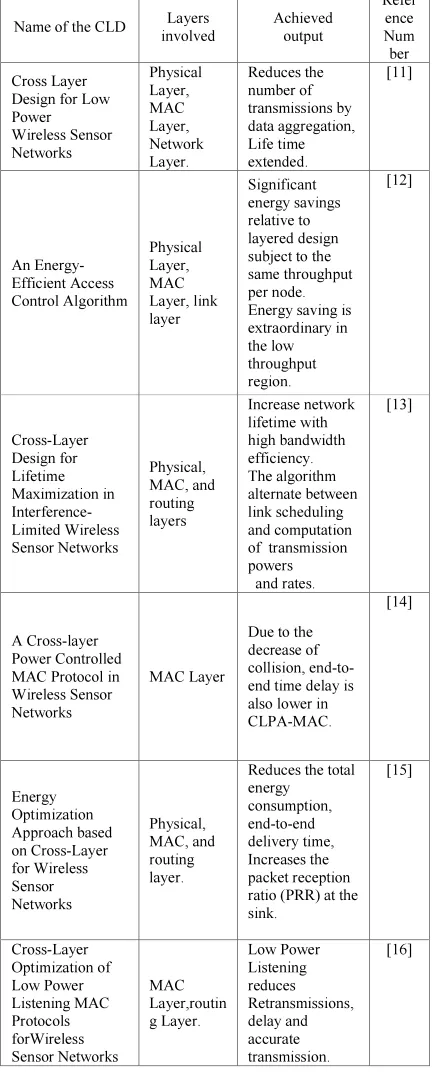
[image:5.595.300.516.213.755.2]In this section we have given the comparative analysis of the cross layer designs.
Table 1: Comparative Analysis Of Cross Layer Designs
Name of the CLD Layers involved Achieved output Refer ence Num ber Cross Layer Design for Low Power Wireless Sensor Networks Physical Layer, MAC Layer, Network Layer. Reduces the number of transmissions by data aggregation, Life time extended. [11] An Energy-Efficient Access Control Algorithm Physical Layer, MAC Layer, link layer Significant energy savings relative to layered design subject to the same throughput per node. Energy saving is extraordinary in the low throughput region. [12] Cross-Layer Design for Lifetime Maximization in Interference-Limited Wireless Sensor Networks Physical, MAC, and routing layers Increase network lifetime with high bandwidth efficiency. The algorithm alternate between link scheduling and computation of transmission powers and rates.
[13]
A Cross-layer Power Controlled MAC Protocol in Wireless Sensor Networks
MAC Layer
Due to the decrease of collision, end-to-end time delay is also lower in CLPA-MAC. [14] Energy Optimization Approach based on Cross-Layer for Wireless Sensor Networks Physical, MAC, and routing layer.
385 Modeling and
optimization of transmission schemes in energy-constrained wireless sensor networks
Physical, MAC, and Network Layer
Iincreases network lifetime to maximize the minimum node lifetime.
[17]
Cross-layer design for adaptive data reporting in wireless sensor networks
MAC and Network Layer
Within the bounds of the delay constraint, a load-balanced tree is constructed and maintained in order to drive longer lifetimes for all nodes involved in inter-cluster communications.
[18]
CONCLUSION:
In this paper we have given the review of Cross Layer Designs to optimize the power in wireless sensor networks. We have considered the parameters like Life time, delay and overall power consumption. We have specified the comparative analysis of different Cross layer designs. All of the reviewed proposals lack enough specification and definition to be considered a “standard.” For the creation of a universal standard, more work and collaboration in this area is required. Since the wireless sensor node, being a microelectronic device, can only be equipped with a limited power source we need to optimize the power. More efforts and research has to be done in this area to invent energy efficient protocols.
REFERENCES:
[1] International standard, ISO/IEC 7498-1,
Information Technology – Open Systems Interconnection – Basic Reference Model: The Basic Model, reprinted 1996-06-15.
[2] Dietmar Loy, Dietmar Dietrich and Hans-Joerg
Schweinzer, “Open Control Networks”,
LonWorks/EIA 709 Technology, Kluwer
Academic Publishers, 2001.
[3] Andrew S. Tanenbaum, “Computer Networks”, fourth edition, Prentice Hall, pp.37-41, 2003.
[4] Al-Karaki J. N. and Kamal A. E., “Routing techniques in wireless sensor networks: a survey”, IEEE Wireless Communications [see also IEEE Personal Communications], Vol.11, Iss.6, Dec. 2004.
[5] I. Stojmenovic and Xu Lin, “Loop-free Hybrid Single-Path/Flooding Routing Algorithms with Guaranteed Delivery for Wireless Networks,” IEEE Trans. Parallel Dist. Sys., vol. 12, no. 10, 2001.
[6] Akyildiz, I. F., Weilian Su, Sankarasubramaniam, Y., and Cayirci E., “A survey on sensor networks”, IEEE Communications Magazine, vol.40, no.8, pp. 102- 114, August, 2002. [7] Vineet Srivastava and Mehul Motani,
“Cross-Layer Design: A Survey and the Road Ahead”, IEEE communication magazine, December 2005.
[8] Liang Song, “Cross Layer Design in Wireless Sensor Networks”, Phd Thesis, Department of
Electrical and Computer Engineering,
University of Toronto, p.2, 2006.
[9] V. Kawadia and P. R. Kumar, “A cautionary perspective on cross layer design,” IEEE
WIRELESS COMMUNICATION
MAGAZINE, vol. 12, pp. 3–11, 2005.
[10] Cross-Layer Design, A Case for
Standardization, Research Project, Jeffrey Mehlman Electrical Engineering Department, Stanford University.
[11] Cross Layer Design for Low Power Wireless
Sensor Networks, MS. Sajjad Ahmad
Madani,Vienna University of Technology,Ph.D Thesis.
[12] Zhi Chen, Shaoqian Li ,An Energy-Efficient Access Control Algorithm with Cross-Layer Optimization in Wireless Sensor Networks ,Wireless Sensor Network, 2010, 2, 168-172 doi:10.4236/wsn.2010.22022y2010.
[13] Rites’ Madan, Shuguang Cui, Sanjay Lall, and Andrea Goldsmith, Cross-Layer Design for Lifetime Maximization inInterference-Limited Wireless Sensor Networks, An intial version of this paper was presented at IEEE INFOCOM in March2005.
[14] Peng Ji, Chengdong Wu, Yunzhou Zhang,
Xiaozhe Wang, “A Cross-layer Power
Controlled MAC Protocol in Wireless Sensor Networks” , Peng Ji, Chengdong Wu, Yunzhou Zhang, Xiaozhe Wang, 978-1-4244-2108-4/08/$25.00 © 2008 IEEE.
386 Based on Cross-Layer for Wireless Sensor
Networks”, JOURNAL OF
COMMUNICATIONS, VOL. 3, NO. 6, NOVEMBER 2008.
[16] Soledad Escolar, Stefano Chessa, Jes´us Carretero,”Cross-Layer Optimization of Low Power Listening MAC Protocols for Wireless
Sensor Networks”, ,
978-1-4577-0681-3/11/$26.00 ©2011 IEEE.
[17] R. Madan, S. Cui, S. Lall, and A. J. Goldsmith, “Modeling and optimization of transmission schemes in energy-constrained wirelesssensor networks,” IEEE/ACM Trans. Netw., vol. 15, no. 6, pp. 1359–1372, 2007.
[18] H. J. Choe, P. Ghosh, and S. K. Das, “Cross-layer design for adaptive data reporting in
wireless sensor networks,” Pervasive
Computing and Communications, IEEE
International Conference on, vol. 0, pp. 1– 6,2009.