442
ENERGY EFFICIENT TWO STAGE CHAIN ROUTING
PROTOCOL (TSCP) FOR WIRELESS SENSOR NETWORKS
*1
HUSAM KAREEM, 2 S.J. HASHIM, 3SHAMALA SUBERAMANIAM, 4ADUWATI SALI
1, 2, 4
Faculty of Engineering, Universiti Putra Malaysia
3Faculty of Computer Science and Information Technology, Universiti Putra Malaysia
4
,
3
2 ,
*1 Mails: -E
ABSTRACT
Wireless sensor nodes are mostly used in extreme environments, especially at remote and hostile areas including battlefield, volcanoes and underwater. Thus, it is difficult to replenish the energy source of the sensor node once it is installed. In order to prolong the lifetime of the nodes, we propose a new routing algorithm that can achieve significant energy conservation in WSNs, known as Two Stage Chain Routing Protocol (TSCP). The main objectives of TSCP is to minimize the total energy consumption, achieve more load balancing and increase the network lifetime with more stability compared with other routing algorithms, for examples Chain-Cluster based Mixed routing (CCM) and Chain-Chain Based Routing Protocol (CCBRP). TSCP algorithm divides the sensor network into multiple chains and work within two stages. The first stage is dividing the nodes to horizontal chains that include all sensor nodes within the same row and the second stage is forming a vertical chain that includes all chain heads. The mechanism for selecting the heads in each row is sequentially chosen with all the heads belong to the same column. In the second stage, the node with maximum residual energy amongst the chain heads will be the main head that functions as a gateway to the base station. Simulation results show that TSCP outperforms CCM and CCBRP in overall energy conservation, network lifetime and stability.
Keywords: Wireless Sensor Network, TSCP, CCM, CCBRP, Chain Protocol
1. INTRODUCTION
Wireless sensor networks include numerous sensor nodes which mainly depend on a limited power supply as an energy source and it is not effortless to recharge or replace when the battery run out [1]. These sensors collect the data from physical environment such as (humidity, temperature, vibration, noise and so on) and send the sensed data to a base station [2]. The main share of energy in WSNs is consumed by data transmission, which is composed of transmitting and receiving the sensed data [3]. The simplest way for data transmission is direct transmission. In the method of direct data transmission, without taking in consideration the locations of the sensor nodes, sensor will sense the data and send it directly to the base station. Therefore, the node which is the farthest from the base station will die very fast because of the far distance between the node and base station and the transmission over a long distance needs more energy [3]. This means that there would be uneven energy consumption among sensor nodes and sensors will die one by one
starting from the farthest node to the base station then the second farthest and so on so forth. As a consequence of the death of some nodes because of the depletion of energy, the network system will be unreliable and not robust.
443 and vertical, and it’s applicable only on the network systems which have sensor nodes deployed in a grid formation with predetermined distance between nodes such as housing area. This algorithm is suitable for WSNs in the utility of gas, electricity or water remotely. The improved algorithm achieves three objectives that include more energy efficiency, better fairness amongst sensor nodes and extended network lifetime.
2. RELATED WORK
A lot of works have been done for improving routing algorithms and one of those algorithms is Power Efficient Gathering in Sensor Information System (PEGASIS) which is chain-based routing protocol. The major idea for PEGASIS is that each node should receive from and send to the closest neighbor and take turn to be the chain head to transmit the sensed data to the base station [4]. It constructs the chain by utilizing the greedy algorithm and gathering the data is done by each node receive the data from the closest neighbor and fuses the data with its own data and then transmit that data to the closest neighbor on the chain [4]. The main advantage of this algorithm is the low energy consumption. However, the delay caused by transmitting the data to all members in the network and gathering it in one node which is the chain head then transmitting it to the base station is the main drawback of this algorithm.
The author in [8] has done an improvement on the greedy algorithm used in PEGASIS. The new algorithm, Distance-based Energy-efficient Routing Protocol (DERP), selects a pre-head to send the data to the sink on behalf of the head if the pre-head is closer to the sink, then when the energy of the pre-head is almost depleted a new pre-head will be selected instead. The advantage of this scheme is to distribute the workload equally amongst the nodes. On the other hand, there is a main drawback, the pre-head will die faster than other nodes and time by time nodes which became pre-head will die one by one. Consequently, the system will be not reliable because many nodes lost near to the sink while the nodes far from the sink still working. Another disadvantage will happen as a result of the death which happened to the nodes near to the sink, the nodes which are far from the sink will consume too much energy to send the data to the sink or to the chain head, and this will speed up the depletion of energy in those nodes (after losing the nodes that were close to the sink). The author in [2] came up with new algorithm which is Balanced Chain-Based
Routing Protocol (BCBRP) by dividing the network into specific numbers of sub-networks. In BCBRP they implement the chain structure to achieve more efficient energy consumption and this protocol work within three stages. The first stage divide the entire network into equal size sub-networks, the second stage is the election of a bridge node for each sub-network and the final stage is the chain construction which done by connecting the sub-networks through the bridge nodes.
self-444 organized manner by taking the advantage of hierarchical routing technique and send the fused data to the cluster head which send it to the base station [6]. The advantage of this algorithm is the fast packet transmission in comparison with others. However it is still has a small drawback which is consuming extra energy in the second stage when they send the data to the head using clustering technique, as we know clustering consume more energy than chain mechanism.
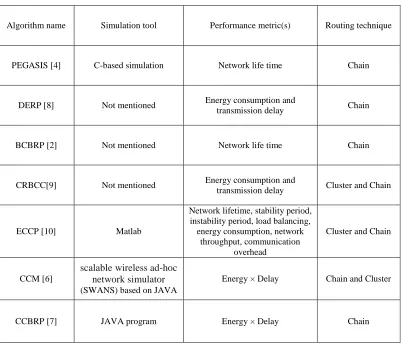
Another improvement has been done based on chain technique when they came up with a chain-chain based routing algorithm (CCBRP) [7], in this protocol they also applied grid distributing to deploy the sensor nodes and they consider the network as an array exactly like CCM but in CCBRP they totally depend on chain routing mechanism to improve the algorithm. They consider each row as chain, this protocol works within two stages. The first stage is forming horizontal chains by considering each row as a chain and selecting chain head randomly to aggregate the data from other chain members based on greedy algorithm. The second stage starts when each chain head has already the diffused data, and then the chain heads will form a vertical chain and randomly select a main head (head of the heads) then send the aggregated data to the chain head then from the chain head to the base station [10]. This was a brief review for the most related work to our proposed algorithm TSCP. The table below is showing more details about the related work and shows also how and what they used to evaluate the functionality of the previous algorithms. At the end of this paper, Table 1 shows the above algorithms with the performance metrics, routing technique and the simulation software that they used to implement the mentioned algorithms.
3. NETWORK MODEL AND ASSUMPTIONS
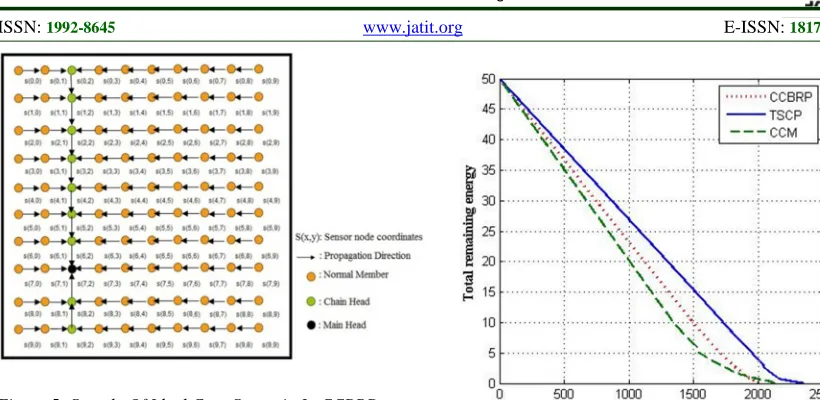
The model would be assumed for our algorithm is square area with specified dimensions to be more compatible with the proposed algorithm TSCP and the sensors in that area are deployed within specific distance between each node and its neighbor as you can see in figure (2), more details are clarified below.
1- 100 × 100 square meters is the area of the model.
2- 100 sensor nodes used and deployed according to pre-determined distance (10-meters between each node and its adjacent neighbours).
3- All the nodes have the ability to transfer data to the base station.
4- Each node in the first stage transfers its data to the closest neighbour which leads to the Chain Head.
5- The packet length k is 2000 bit.
6- At the beginning all nodes are homogenous and have the same energy.
4. TWO STAGE CHAIN
ROUTINGPROTOCOL (TSCP).
This algorithm tries to take the advantages of the previous algorithms and utilize them in one algorithm. Such as the use of (x,y) coordinates to decide which node is the chain head in specific sensing round. In this algorithm we propose that the same model which used in CCBRP and CCM which can be applicable for housing area with rectangular or square shape with pre-determined distance between sensor nodes. This system will work within two stages which are:
4.1 Stage 1 (forming the horizontal chains)
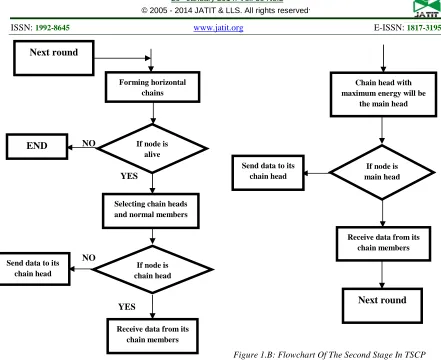
This stage starts when the nodes form the horizontal chains and choose chain head for each chain (each row will consider as a chain), the selection would be based on periodic way. At the same time all heads will be at the same column to decrease the energy consumed as much as possible. The nodes will receive the data from the closest neighbor and fuse the data with its own data then send the fused data to the next neighbor and so on so forth until all data reach the chain head. In our model we have 100 nodes divided into equal number of rows and columns (10 rows, 10 columns). This means that each node will be chain head 1 time only within 10 sensing rounds. The nodes will sense the area and send their data to the chain head using greedy algorithm. Normally after specific period of time, when some nodes consume big share of their energy, they will not be able to act as a chain head then it would be not possible to select a chain head sequentially, in that time we consider the maximum residual energy in each node to select the chain head and avoid data losing. We can see a summarized description for the operation of first stage in the flowchart in figure (1.a).
445 NO
YES
NO
[image:4.612.80.521.54.414.2]YES
Figure 1.a: Flowchart Of The First Stage in TSCP
4.2 Stage 2 (forming the vertical chain)
This stage starts after all the chain heads collect the data from other chain members and now they have to send the collected data to the main head (head of the heads) by using the same way in stage one , which is receiving the data from the closest neighbor and fuse the new data with its own data then forward it to next neighbor and so on so forth until gathering all the data in the main head then it will fuse its data with the collected data and send it to the base station. The chain heads, as we mentioned, all of them within the same column, the selection of the main head is depend on the amount of residual energy in the nodes within the vertical chain, the node with maximum residual energy will be the main head. The flowchart in figure (1.b) shows the operation in stage 2 of TCSP.
Figure 1.B: Flowchart Of The Second Stage In TSCP
Figure 2: Sample Of A Common Case Scenario of TSCP
5. SIMULATION RESULTS AND ANALYSIS The protocol CCBRP has some drawbacks and these drawbacks are: the first one happen in stage (1) consuming too much energy in specific nodes while few energy would be consumed in some other nodes because of the head selection is done randomly without taking in consideration that this random way might choose the same chain head
Forming horizontal chains
Next round
If node is alive
END
Selecting chain heads and normal members
If node is chain head Send data to its
chain head
Receive data from its chain members
Forming vertical chain (contains all chain
heads)
Chain head with maximum energy will be
the main head
If node is main head Send data to its
chain head
Receive data from its chain members
[image:4.612.314.524.436.580.2]446 more than one time while some other nodes might not be chosen, this leads to uneven energy consumption among nodes. The second disadvantage happens in stage 1, the leader selection might happen within nodes are far from each other, and the consumption of the energy, according to equation (1), is mainly depend on the square of the distance between nodes (d2), in this case the consumed energy will increase dramatically.
Table 2: Notations.
symbol Description
Et energy consumed during the transmission
K Size of Data packet
D The fixed distance between each node and its closest neighbor
Ec Energy needed to run the transmitter or the receiver
Ea Energy consumed to run the amplifier Er Energy consumed during the receiving
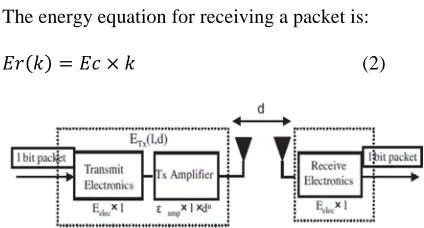
The energy equation for transmitting a packet is:
, ଶ (1)
The energy equation for receiving a packet is:
[image:5.612.89.301.398.512.2](2)
Figure 3: Data Transmission Model In Ideal PEGASIS.
The third drawback happens in stage 2. Since the random selection of the main head node (the head of chain heads), some nodes will be the main head for many times while some others will act as normal chain head even if they have much more energy or they have not been as a main head as much as some other nodes. There must be a procedure for selecting the main head in stage 2 to ensure an even energy consumption among all nodes such as making a loop for periodic leader selection in each round like the method of selecting chain head in stage 1 in CCM or depending on the amount of residual energy like in TSCP algorithm. Because of the above drawbacks the CCRBP protocol would have two contradictory cases of choosing chains heads and main head (the head of
the heads) which are ideal case and worst case. The ideal case would happen when the chains heads selected on the same column then the distance would be the smallest probable distance between chains heads and as a result of this selection the consumed energy would be the least consumed energy in all probable cases because the consumed energy depends mainly on the square of the transmission distance as we mentioned earlier in function (1).
In contrast the worst case would happen when chains heads selected on the margins of the sensed area and each head on the opposite side with its neighbor, then the distance would be the farthest probable distance between chains heads and as a result the energy consumption would increase dramatically to reach the most consumption among all probable cases. Other cases would vary from the ideal case to the worst case and mostly would be the average of the two cases (ideal and worst). Figures (4) and (5) show the ideal and the worst cases respectively for heads selection in stage 1 in CCRBP protocol. In this paper we use 1st order radio transceiver for the simplicity of estimating the energy consumed in transmission and receiving data packets. The energy consumption in this radio transceiver mainly depends on the distance between nodes and the size of data packet.
[image:5.612.315.525.441.595.2]447
Figure 5: Sample Of Ideal Case Scenario In CCBRP
The values of the consumed energy in this model are as follows. The energy needed for running the transmitter or receiver which is E circuitry (Ec) = 50 nJ/bit. The energy needed for running the amplifier which is (Ea) = 100pJ/bit/m2. The value of the energy consumption is directly related to the square of the distance between nodes (d2), we have (k) which refers to the size of data packet, according to the assumption for the size of data packet, k =2000 bits. We applied equations (1) and (2) to calculate the energy consumption for CCM and CCBRP and TSCP algorithms then compare between them using the energy consumption, Load Balancing, Stability Period and Network lifetime metrics.
5.1. Load Balancing
The percentage of the whole residual energy in the network after the first node died is called load balancing. If the network has lower percentage of residual energy it means that it has higher load balancing. Figure (6) shows the residual energy of the network in each sensing round. Table (3) shows the total remaining energy in the network after first node died.
Table 3: Percentage Of Total Residual Energy In The Network After First Node Died.
Routing Protocol Residual Energy percentage after first node died
TSCP 26.8 %
CCM 27.9 %
[image:6.612.92.502.68.268.2]CCBRP 34.1 %
Figure 6: Total Remaining Energy Over Round.
As we can see from figure (6) and table (3), our protocol has better performance than CCM and CCBRP protocols in terms of load balancing.
5.2. Network Lifetime and Stability interval
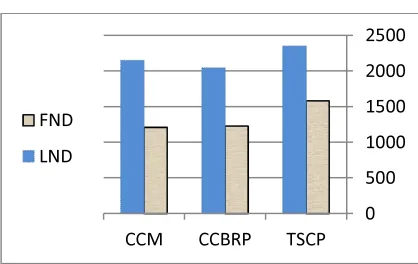
Stability period is defined as the interval of time before the first node died and vice versa for instability period [10]. Although the lifetime of the network is long, without long stable interval, many more information cannot be collected from the sensing field. So that, extending the stability period during the Network lifetime is crucial factor for many applications [11]. Figure (7) shows the number of nodes that stay alive during the simulation time while figure (8) shows the performance comparison of Network lifetime depends on the rounds of first node died (FND) and last node died (LND).
Table 4: Percentage Of Dead Nodes Over Sensing Rounds
Number of nodes
died TSCP CCBRP CCM
1% 1582 1227 1209
10% 1919 1471 1342
50% 2047 1833 1585
100% 2348 2041 2146
[image:6.612.94.319.73.253.2]448 improvement is around 15% and 9% when all nodes died, in comparison with CCBRP and CCM, respectively.
Figure 7: Number Of Alive Nodes During The Sensing Rounds.
Figure 8: Performance Comparison Of Network Lifetime Using FND And LND Metrics.
From figure (7) and figure (8), it can be clearly seen that TSCP has better performance than CCBRP and CCM in terms of Network lifetime and stability interval during the Network lifetime. This behaviors ensure that there is always significant improvement in energy saving and network stability especially for large scale networks.
5.3. Energy consumption
Figure (9) shows the total energy consumed by the sensor nodes during the network lifetime. It is obvious that TSCP consumed less energy in compare with CCBRP and CCM. The reduction in power consumption in TSCP is mainly because of the small transmission distance between nodes, the mechanism of forming the chain in the second stage and using the node with highest residual energy to be the main head of the network.
Figure 9: The Total Energy Consumption Of The Network Per Round.
6. CONCLUSION
In this paper, we explained a TSCP routing algorithm for wireless sensor networks. The algorithm divides the network into number of chains, each chain has a fixed number of nodes similar to other chains. The proposed algorithm works in two stages, in the first stage one node in chain will be chain head and then sequentially all other nodes within the chain will act as a chain head in different rounds. The second stage involves creating a vertical chain, which includes all chain heads then select the node that has the maximum residual energy to be the main head (head of the heads). In this algorithm we could achieve three main objectives which are: more stable interval in network lifetime because the first node died in TSCP after 1582 sensing rounds while the first node died after 1227 and 1209 sensing rounds in CCBRP and CCM, respectively. Secondly, there is a small variation in the time of nodes death, it means that the network will work with the maximum possible number of nodes for longer time in comparison with CCBRP and CCM, i.e. it is more robust. Moreover, we could achieve better fairness amongst sensor nodes then it will lead to better load balancing and extending the network lifetime when the all nodes died after 2348 sensing rounds in TSCP while all nodes died after 2041 and 2146 sensing rounds in CCBRP and CCM respectively. Thus, TSCP enhances the overall network lifetime around 9% and 15% in comparison with CCM and CCBRP, respectively.
0 500 1000 1500 2000 2500
TSCP CCBRP
CCM FND
[image:7.612.91.300.341.473.2]449 REFERENCES
:
[1] Pham, M. L., Kim, D., Yoo, S. E., &Doh, Y. (2005). Power aware chain routing protocol for data gathering in sensor networks. International Journal of Distributed Sensor Networks, 1(2), 253-267.
[2] Ahn, K. S., Kim, D. G., Sim, B. S., Youn, H. Y., & Song, O. (2011, May). Balanced Chain-Based Routing Protocol (BCBRP) for Energy Efficient Wireless Sensor Networks. In Parallel and Distributed Processing with Applications Workshops (ISPAW), 2011 Ninth IEEE International Symposium on (pp. 227-231). [3] Chen, Y. L., & Lin, J. S. (2012). Energy
efficiency analysis of a chain-based scheme via intra-grid for wireless sensor networks. Computer Communications, 35(4), 507-516. [4] Lindsey, S., &Raghavendra, C. S. (2002).
PEGASIS: Power-efficient gathering in sensor information systems. In Aerospace conference proceedings, 2002. IEEE (Vol. 3, pp. 3-1125). [5] Heinzelman, W. R., Chandrakasan, A.,
&Balakrishnan, H. (2000, January). Energy-efficient communication protocol for wireless microsensor networks. In System Sciences, 2000. Proceedings of the 33rd Annual Hawaii International Conference on (pp. 10-pp). [6] Tang, F., You, I., Guo, S., Guo, M., & Ma, Y.
(2012). A chain-cluster based routing algorithm for wireless sensor networks. Journal of intelligent manufacturing, 23(4), 1305-1313. [7] Ali, S. A., &Refaay, S. K. (2011). Chain-Chain Based Routing Protocol. IJCSI International Journal of Computer Science Issues, 8(3), 1694-0814.
[8] Kim, H., Yu, B., Choi, W., Park, M., &Chae, J. (2009, October). Distance Based Pre-cluster Head Selection Scheme for a Chain-Based Protocol. In Computer and Information Technology, 2009. CIT'09. Ninth IEEE International Conference on (Vol. 2, pp. 110-115).
[9] Gengsheng, Z., &Zhengbing, H. (2009, January). Chain Routing Based on Coordinates-Oriented Clustering Strategy in WSNs. In Computer Network and Multimedia Technology, 2009. CNMT 2009. International Symposium on (pp. 1-4).
[10]R. Sheikhpour, S. Jabbehdari and A. khademzadeh, “A Cluster-Chain based Routing
Protocol for Balancing Energy Consumption in Wireless Sensor Networks”, International Journal of Multimedia and Ubiquitous Engineering, vol. 7, no. 2, pp. 1-16, 2012. [11]G. Rashed, H. Kabir and E. Ullah, “WEP: An
450
Table 1: Simulation Software, Performance Metrics And Routing Technique Used In Each Algorithm
Algorithm name Simulation tool Performance metric(s) Routing technique
PEGASIS [4] C-based simulation Network life time Chain
DERP [8] Not mentioned Energy consumption and
transmission delay Chain
BCBRP [2] Not mentioned Network life time Chain
CRBCC[9] Not mentioned Energy consumption and
transmission delay Cluster and Chain
ECCP [10] Matlab
Network lifetime, stability period, instability period, load balancing,
energy consumption, network throughput, communication
overhead
Cluster and Chain
CCM [6]
scalable wireless ad-hoc network simulator
(SWANS) based on JAVA
Energy × Delay Chain and Cluster