ISSN: 1992-8645 www.jatit.org E-ISSN: 1817-3195
67
P-SETS AND ITS APPLICATION IN THE UNKNOWN
INFORMATION IDENTIFICATION
1
XIYAN SUN, 2XIDONG LIU, 3CHENGXIAN FAN
1 Information Technology School of Shandong Institute of Commerce and Technology,
Jinan, 250103, China
2Shool of Energy and Power Engineering of Shandong University, Jinan, 250061, China
E-mail: 1[email protected],2[email protected], 3[email protected]
ABSTRACT
P-sets (Packet sets) is novel mathematics structure and model by introducing the dynamic characteristics into the finite Cantor set X and improving it. P-sets is aset pair composed of internal P-set XF(internal
packet set XF) and outer P-set XF(outer packet set XF), or (XF,XF) is P-sets. Based on P-sets, some
theorems are presented, which are internal-dynamic reasoning and information deleted theorem, outer-dynamic reasoning and information supplemented theorem, internal-outer outer-dynamic reasoning and information deleted-supplemented theorem and so on. By using the results, the application of internal-dynamic reasoning in the unknown information identification is given. P-sets is a novel model and method with good application prospect in the intelligent information system.
Keywords: P-Sets, Dynamic Reasoning, Information Deleted, Information Supplemented
1. INTRODUCTION
With the development of society, all kinds of information needs to be handled immediately, efficiently and correctly. The processing speed and capacity for information are improved greatly by the computer technologies. Besides, the application of computer technologies provides fast and accurate data correction and processing for the development of information technique. While, some mathematical algorithms use provides further guarantee for the rapidity and accuracy of information identification technique [1]. The information set is denoted with X and the attribute (characteristic) set of information is denoted with α. Information set X has the following characteristics: 1. if some attrition is supplemented into the attribute set α, the elements in the information set X will be decreased. 2. if some attributes are deleted from the attribute set α, the elements in the information set X will be added. The characteristic is similar to that of P-sets (packet sets). P-sets is a novel mathematics model put forward in 2008[2, 3], which has been applied in many fields [4-10]. P-sets is obtained by introducing the dynamic characteristic into the limited Cantor set X, so P-sets has dynamic characteristic. P-sets is a set-pair consist of internal
P-set XF and outer P-setXF, or (XF,XF) is
P-sets. P-sets achieves identification purpose by the deletion and supplementary for the attribute.
The main results: using the structure of P-sets, the internal-outer reasoning model is given. Using the theory, the application of P-reasoning in information identification is given.
In order to understand the discussion and accept the results easily in the paper, the structure of P-sets is introduced briefly as the theoretical basis and preliminary knowledge. More concepts and applications see Ref. [4-10].
2. P-sets and Its Structure
Assumption: U is a finite element universe, and V is a finite attribute universe. X is a finite general set (Cantor set) on U, and α is an attribute set on V.
In 2008, the following was proposed in Ref. [2, 3].
Given a set X {x x1
, , ,
2
xq}U , and 1 2{
,
, , }k V
is the attribute set of X. FX is called internal P-set generated by X, which
68 F
X X X (1)
X is called F -element deleted set of X,
moreover
{
|
, ( ) , }X x xX f x u X f F (2)
If the attribute set
F of XF satisfies{ | ( ) , }
F f f F
(3)Where,
V,
, is turned into( )
f
by fF . In application,F
X
. In equation (1), XF {x x1, , ,
2
xp},pq;p q, N
Given a set X {x x1
, , ,
2
xq}U , and1 2
{
,
, , }k V
is the attribute set of X. FX is called outer P-set generated by X, which is
called outer P-set for short, moreover F
X X X (4)
X is called F -element supplemented set of X,
moreover
{
|
, , ( ) , }X u u U u X f u x X fF (5)
if the attribute set
F of XF satisfies{ | ( ) , }
F
i f i i f F
(6)In equation (4), { 1
, , ,
2 } Fr
X x x
x ,qr;q r, N.
The set pair composed of inters P-set XF
and outer P-set F
X is called P-sets generated by set X,
and called P-sets for short, moreover
( F, F)
X X (7)
Where, the general set X is called the ground set of (XF,XF).
By (1)-(3) and (4-6), the following conclusions are achieved.
1 2 1
F F F F
n n
X X X X (8)
1 2 1
F F F F
n n
X X X X (9)
By (8) and (9), equation (10) is got.
{( F, F) | I, J}
i j
X X i j
(10) Equation (10) is the set pair family form of equation (7), or Equation (10) is the general expression of P-sets.
Theorem 1(the first relation theorem between
P-sets and finite general set) P-P-sets (XF,XF) and finite general set X satisfy:
( F, F)
F F
X X X
(11)
Theorem 2 (the second relation theorem between
P - s e t s a n d f i n i t e g e n e r a l s e t ) P - s e t s
{( F, F) | , }
i j
X X iI jJ
and finite general set X s atisfy:
{( F, F) | , }
i j F F
X X iI jJ X
(12) Using the concepts in section 2, section 3 gives:
3. THE DYNAMIC REASONING
GENERATED BY P-SETS
Assumption: In the section, , ,
F F
X X X are
noted as ( ) ,( ),( )x F x x F, or ( )x F XF, ( )x X,
( )F F
x X .
Definition 1 ( ) {x x x1
, , ,
2
x
q} is Called asan information on U, if (x) has the attribute set
, and1 2
{
,
, , }k
(13)Definition 2 ( )x Fk1 is called the internal
dynamic reasoning information generated by( )k
F
x
, which is briefly called internal dynamic reasoning information, if k
F
and k1 F
, ( )k
F
x
,( )k1 F
x
satisfy:
If k k1
F F
, then ( )k1 ( )k
F F
x x
(14)
In (14), if k
F
ISSN: 1992-8645 www.jatit.org E-ISSN: 1817-3195
69 If 1
F
,then ( )1 ( ) F
x x
(15)
1
( )F ( )
x and x
satisfy
1 1 2 1 2
( )F { , , , } { , , , } ( )
p q
x x x x x x x x
,
,
p qN.
Definition 3 ( )k1
F
x
is called the outer dynamic reasoning information generated by( )k
F
x
, and is briefly called outer dynamic reasoning information, if k
F
and k1 F
, ( )k
F
x
,( )k1 F
x
satisfy:
If k1 k
F F
,then ( )k ( )k1
F F
x x
(16)
In (16), if k
F
, then (16) will become:
If 1 F
,then ( )( )1 F
x x
(17)
1
( )x F and ( )x
satisfy
1 2 1 2 1
( ) { , , , } { , , , } ( )F
q p
x x x x x x x x
;
,
q rN.
Definition 4
( ) ,( ) 1
F F
k k
x x
is called the internal dynamic reasoning and outer dynamic reasoning information generated by ( )x , briefly called internal-outer dynamic reasoning information,
if
k , k1
, k1, k
F F F F
, ( )k
F
x
and ( )k1 F x satisfy:
1 1 1 1if , ,
then ( ) ,( ) ( ) ,( )
k k k k
k k k k
F F F F
F F F F
x x x x
(18)
(19) The so called internal-outer dynamic reasoning information families generated by (x), briefly called internal-outer dynamic reasoning information families, and
( ) ,( )k1 k ( ) ,( )k k1 I
F F F F
x x x x k
(19)
where,
k , k1
k1, k
F F F F
denotes 1 k k F F
, k1 k
F F
,k1,2, , n1.
Theorem 3(the theorem of internal-dynamic
reasoning and information deleted) If ( )k1 F
x
is the internal-dynamic reasoning information generated by ( )k
F
x
, there exists information ( )k1 F x to satisfy: 1
( )k
F
x
(20)
Where, ( )k1 F
x
is the information constituted by the information elements xi, which are deleted from
( )k
F
x
in the internal-dynamic reasoning, and 1
( )k
F
x
1 1 2 1 2
( )k ( )k { , , , } { , , , }
F F
q p
x x x x x x x x
1 2
{xp ,xp , , } xq
.
Theorem 4 (the theorem of outer-dynamic reasoning
and information supplemented) If ( )k 1 F
x
is the outer-dynamic reasoning information generated by
( )k
F
x
, there exists information ( )k1 F
x
to satisfy:
1
( )k
F
x
(21)
Where, ( )k1 F
x
is the information constituted by the information elements xj, which are supplemented into ( )k
F
x
in the outer-dynamic
reasoning, and
1 1 1
( )k ( )k ( )k
F F F
x x x
1 2
{ , , , }x x xr
1 2 1 2
{ , , , } {x x xq xq ,xq , , }xr
.
Theorem 5 (the theorem of inter-outer dynamic
reasoning and information deleted- supplemented)
If
( ) ,( )k1 k1
F F
x x
is the internal-outer dynamic
reasoning information generated by
( ) ,( )k k
F F
x x
, then
( ) ,( )k1 k1
F F
x x
( )k ( ) ,( )k1 k ( )k1
F F F F
x x x x
(22)
Here: ( )k1 ( )k ( )k1
F F F
x x x
,
1 1
( )k ( )k ( )k
F F F
x x x
70
4. THE APPLICATION OF P-SETS IN THE
UNKNOWN INFORMATION IDENTIFICATION
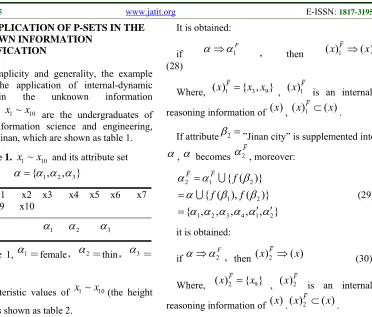
For the simplicity and generality, the example only gives the application of internal-dynamic reasoning in the unknown information identification. x1~x10 are the undergraduates of
[image:4.612.147.519.72.389.2]college of information science and engineering, university of Jinan, which are shown as table 1.
Table 1. x1~x10 and its attribute set
1 2 3
{ , , }
x x1 x2 x3 x4 x5 x6 x7 x8 x9 x10
1
2
3In the table 1,
1=female,
2=thin,
3=twenty years;
The characteristic values of x1~x10(the height
of x1~x10) is shown as table 2.
Table 2. The characteristic values of x1~x10
x x1 x2 x3 x4 x5 x6 x7 x8 x9 x10
y 1.66 1.68 1.70 1.53 1.63 1.58 1.72 1.60 1.69 1.76
The information in table 1 and 2 are denoted with sets (x) and y, respectively.
1 2 3 4 5 6 7 8 9 10
( ) { , , , , , , , , ,x x x x x x x x x x x } (23)
1 2 3 4 5 6 7 8 9 10
( ) { , , , , , , , , , }
{1.66,1.68,1.70,1.53,1.63,1.58, 1.72,1.60,1.69,1.76}
y y y y y y y y y y y
(24)
(x) It has the attribute set , and
1 2 3
{ , , }
(25)It is easy to get:
if
,then ( )x ( )x (26)If attribute
1 ”Shandong province” issupplemented into
,
becomes
1F, moreover:1 { ( )} { ,1 1 2, ,3 4, }1
F
f
(27)It is obtained:
if 1
F
, then ( )1F ( )x x
(28)
Where, ( )x 1F { , }x x3 9 , ( )x 1F is an
internal-reasoning information of ( )x , ( )1 ( ) F
x x .
If attribute
2”Jinan city” is supplemented into
,
becomes 2F
, moreover:2 1 2
1 2
1 2 3 4 1 2
{ ( )} { ( ), ( )}
{ , , , , , }
F F
f
f f
(29)
it is obtained:
if 2 F
,then ( )2F ( )x x (30)
Where, ( )2 { }9 F
x x , ( )x 2F is an
internal-reasoning information of ( )x .( )2 ( ) F
x x .
By the internal-dynamic reasoning, it is known that the students x x3, 9 of Shandong province are
found in (x), and the student x9 of Jinan city,
Shandong province are found in (x), or , using the internal-dynamic reasoning, the internal information ( )1
F
x ,( )x 2F are found in (x), which are
the information unforeknown by people.
5. CONCLUSION
ISSN: 1992-8645 www.jatit.org E-ISSN: 1817-3195
71
REFERENCES
[1] Shen tao, Song Jianshe, Identification technique of laser guided signal code information, Infrared and Laser Engineering, 2009, Vol.38, No.5, 854-858.
[2] Shi Kaiquan, P-sets[J]. Journal of Shandong University (Natural Science), 2008,43(11):
77-84(in Chinese).
[3] Shi Kaiquan, P-Sets and its application [J]. An International Journal Advances in Systems Science and Applications, 2009, 9(2): 209-219. [4] Shi Kaiquan, P-sets and its Applied
Characteristics. Computer Science, 2010, 37(8): 1-8(in Chinese).
[5] Shi Kaiquan, LI Xiuhong, Camouflaged information identification and its application [J]. An International Journal Advances in Systems Science and Applications, 2010, 10(2): 157-167.
[6] Zhang Li, CUI Yuquan, Outer P-sets and data internal recovery[J]. An International Journal Advances in Systems Science and Applications, 2010, 10(2):189-199.
[7] Zhang Li, XIU Ming, SHI Kaiquan, P-sets and applications of internal-outer data circle[J]. Quantitative Logic and Soft Computing, 2010, 1(2):581-592.
[8] LI Yuying, Zhang Li, Shi Kaiquan, Generation and recovery of compressed data and redundant data[J]. Quantitative Logic and Soft Computing, 2010, 1(2):661-672.
[9] Xiu Ming, Shi Kaiquan, ZHANG Li, P-sets and
F -data selection-discovery [J]. Quantitative
Logic and Soft Computing, 2010, 1(2): 791-800.