© 2017, IRJET | Impact Factor value: 5.181 | ISO 9001:2008 Certified Journal | Page 1672
Image Denoising Using Statistical and Non Statistical Method
Ms. Shefali A. Uplenchwar
1, Mrs. P. J. Suryawanshi
2, Ms. S. G. Mungale
31
MTech, Dept. of Electronics Engineering, PCE, Maharashtra, India
2,3Assistant Professor, Dept. of Electronics Engineering, PCE, Maharashtra, India
---***---Abstract -
In various fields and applications use of images is becoming increasingly popular like in field of medical, education etc. Problem that arises after denoising process is the destruction of the image edge structures. For this there are several techniques proposed by other authors for image denoising as well as edge preservations. In this paper, we aim to provide some of those techniques that can be used in image denoising. This paper gives the brief description of noise, types of noise, image denoising, different techniques and their approaches to remove that noise. The aim of this paper is to provide some brief and useful knowledge of denoising techniques for applications using images to provide an ease of selecting the optimal technique according to their needs. In this paper we used statistical and non-statistical method for denoising the image.Key Words: Image Denoising, Gaussian Noise, Salt & Pepper Noise, Poisson Noise, MMSE, PSNR.
1. INTRODUCTION
Visual information transmitted in the form of digital images is becoming a major method of communication in the modern age, but the image obtained after transmission is often corrupted with noise. Noise is the result of errors in image acquisition process that result in pixel values that do not reflect the true intensities of the real scene. The received image needs processing before it can be utilized as an input for decision making. Image denoising involves the manipulation of the image data to produce a visually high quality image. A targeted database refers to a database that contains images relevantto the noisy image only. Different noise models including additive and multiplicative types are used e.g. Gaussian noise, salt and pepper noise and Poisson noise and two types of mixed noise (Gaussian with Salt and Pepper, Poisson with Salt and Pepper, Gaussian with Poisson). Selection of the denoising algorithm is application dependent therefore, it is necessary to have knowledge about the noise present in the image so as to select the appropriate denoising algorithm. The filtering approach has been proved to be the best when the image is corrupted with salt and pepper noise. The scope of the paper is to focus on
noise removal techniques for natural images using statistical and non statistical method.
1.1
TYPES OF NOISE
Gaussian Noise - One of the most occurring noises is Gaussian noise. Principal sources of Gaussian noise arise during acquisition e.g. sensor noise caused by poor illumination and/or high temperature, and/or transmission e.g. electronic circuit noise. Gaussian noise represents statistical noise having probability density function (PDF) equal to that of the normal distribution, which is also known as the Gaussian distribution. In other words, the values that the noise can take on are Gaussian-distributed. The probability density function of a Gaussian random variable is given by:
Where represents the grey level µ the mean value and σ standard deviation. The standard model of this noise is additive, independent at each pixel and independent of the signal intensity, caused primarily by thermal noise. The mean of each distributed elements or pixels of an image that is affected by Gaussian noise is zero. It means that Gaussian noise equally affects each and every pixel of an image.
Original Image Gaussian Noise
© 2017, IRJET | Impact Factor value: 5.181 | ISO 9001:2008 Certified Journal | Page 1673 and bright pixels in dark regions. In salt-and-pepper noise
corresponding value for black pixels is 0 and for white pixels the corresponding value is 1. Hence the image affected by this noise either have extreme low value or have extreme high value for pixels i.e., 0 or 1.Given the probability r (with 0<= r<=1) that a pixel is corrupted, we can introduce salt-and-pepper noise in an image by setting a fraction of r/2 randomly selected pixels to black, and another fraction of r/2 randomly selected pixels to white. This type of noise can be caused by analog-to-digital converter errors, bit errors in transmission, etc. Elimination of salt-and-pepper noise can be done by using dark frame subtraction and interpolating around dark/bright pixels.
Original Image Salt & Pepper Noise
Poisson Noise - This noise is seen due to the statistical nature of electromagnetic waves such as x-rays, visible lights and gamma rays. The x-ray and gamma ray sources emitted number of photons per unit time. These sources are having random fluctuation of photons. Result gathered image has spatial and temporal randomness. In the lighter parts of an image there isa dominant noise from an image sensor which is typically caused by statistical quantum fluctuations, that is, variation in the number of photons sensed at a given exposure level called photon shot noise. Shot noise follows a Poisson distribution, which is somehow similar to Gaussian.
Original Image Poisson Noise
2. PROPOSED METHOD
In this paper we propose to use image denoising by using statistical and non statistical methods. Fig 1. Shows the block diagram of the proposed method.
F
FIG-1: Block Diagram of Proposed Method
As shown in the block diagram first we collect the image and add various noises in that image, then that image is divided into sub blocks then each sub block is given to a statistical processor which find out the parameter for the blocks. This parameter will defer for noisy & non noisy blocks. This difference helps us to identify the block which has noise. These block will replaced with the information or knowledge from neighboring blocks. Our approach will be statistical approach, where we will first evaluate nature of noise by gathering the knowledge from the nearby pixel and then refine the amount of noise present in the image, this will help for denoising of image irrespective on the noise. In this paper we will discuss image denoising by using statistical and non-statistical method. We will use various filters for image denoising by using statistical and non-statistical method.
2.1 NOISE REMOVING
TECHNIQUES FOR
STATISTICAL METHOD
© 2017, IRJET | Impact Factor value: 5.181 | ISO 9001:2008 Certified Journal | Page 1674 filter also follows the moving window principle similar to the
mean filter. A 3*3, 5*5, or 7*7 kernel of the pixels is scanned over pixel matrix of the entire image. For result, window has two conditions are possible if number of noisy pixel is greater than 8 then window is selected else the cycle is repeated until noise is removed.
Adaptive Neighborhood based Weiner Filter - Adaptive neighborhood based wiener filter, selects the original image. Then it checks the image distortion (D). For Gaussian noise window size is 250 multiplied by distortion factor and for Poisson noise it will be 200 multiplied by distortion factor. The distortion factor is calculated as,
Then, take a square matrix M. then it will check the image pixel 0 to 255 and then neighborhood pixel multiplied by M. then result gives to the median filter and it get replace with noisy pixel. The median filter also follows the moving window principle similar to the mean filter. A 3*3, 5*5, or 7*7 kernel of the pixels is scanned over pixel matrix of the entire image. For result, window has two conditions are possible if number of noisy pixel is greater than 8 then window is selected else the cycle is repeated until noise is removed.
2.2 NOISE REMOVING TECHNIQUES FOR
NON-STATISTICAL METHOD
Median Filtering - Median filtering is a simple and powerful non-linear filter which is based on order statics, whose response is based on the ranking of pixel values contained in the filter region. It is easy to implement method of smoothing images. The median filter also follows the moving window principle similar to the mean filter. A 3*3, 5*5, or 7*7 kernel of the pixels is scanned over pixel matrix of the entire image. In this filter, we do not replace the pixel value of the image with the mean of all neighboring pixel values; we replace it with the median value. Median filtering is done by, first sorting all the pixel values from the surrounds neighborhood into numerical order and then replacing the pixel being considered with the middle pixel value.
Adaptive Filtering - Adaptive filtering is performed on the degraded image that contains original image and noise. The mean and variance are the two statistical measures that a local adaptive filter depends with a defined mxn window region. The adaptive filter is more selective than comparable linear filter, preserving edges and other high-frequency parts of an image. The wiener2 function applies a Wiener
filter (a type of linear filter) to an image adaptively, tailoring itself to the local image variance. Where the variance is large, wiener2 performs little smoothing. Where the variance is small, wiener2 performs more smoothing. Another method for removing noise is to evolve the image under a smoothing partial differential equation similar to the heat equation which is called anisotropic diffusion.
Wiener Filtering -The main aim of this technique is to filter out noise that has corrupted the signal. It is kind of statistical approach. For the designing of this filter one should know the spectral properties of the original signal ,the noise and linear time-variant filter whose output should be as close as to the original as possible. The Wiener filter minimizes the mean square error between the estimated random process and the desired process.
3. PERFORMANCE PARAMETER
3.1 Minimum Mean Square Error (MMSE) - In minimum mean square error is an estimation method which minimizes the mean square error (MSE), which is a common measure of estimator quality, of the fitted values of a dependent variable. The term MMSE more specifically refers to estimation with quadratic loss function. In such case, the MMSE estimator is given by the posterior mean of the parameter to be estimated. Since the posterior mean is cumbersome to calculate, the form of the MMSE estimator is usually constrained to be within a certain class of functions. Let x be an nx1 hidden random vector variable, and let y be an mx1 known random vector variable (the measurement or observation), both of them not necessarily of the same dimension. An estimator of x is any function of the measurement y. The estimation error vector is given by
and its mean square error (MSE) is given by the trace of error covariance matrix.
Where the expectation E is taken over both x and y. When x is a scalar variable, the MSE expression simplifies to . Note that MSE can equivalently be defined in other ways, since
© 2017, IRJET | Impact Factor value: 5.181 | ISO 9001:2008 Certified Journal | Page 1675 3.2 Mean Square Error (MSE) - The MSE symbolizes your
cumulative squared mistake relating to the compacted along with the unique image.
Where f represents the matrix data of our original image, g represents the matrix data of our degraded image, m represents the numbers of rows of pixels of the image and i represent the index of that row, n represents the number of columns of the pixels of the image and j represents the index of that column.
3.3 Peak Signal to Noise Ratio (PSNR) - The Peak Signal to Noise Ratio is the value of the noisy image with respect to that of the original image. This ratio is often used as a quality measurement between the original and a compressed image. Higher the PSNR, better the quality of the compressed or reconstructed image.
Here MAXf is the maximum signal value that exists in our
original image.
4. RESULT
As we apply the non- statistical parameter we got the blur image. When we apply the statistical parameter to the noisy image, we got the image similar to the original image. The result of all types of noise such as salt and pepper noise, Gaussian noise, Poisson noise and two types of mixed noise (Gaussian with Salt and Pepper, Poisson with Salt and Pepper, Gaussian with Poisson) as shown in below figures.
Salt & Pepper Noise
Gaussian Noise
Poisson Noise
Salt & Pepper + Gaussian Noise
© 2017, IRJET | Impact Factor value: 5.181 | ISO 9001:2008 Certified Journal | Page 1676 Salt & Pepper + Poisson Noise
Gaussian + Poisson Noise
Salt & Pepper + Gaussian + Poisson Noise
5. OBSERVATIONS
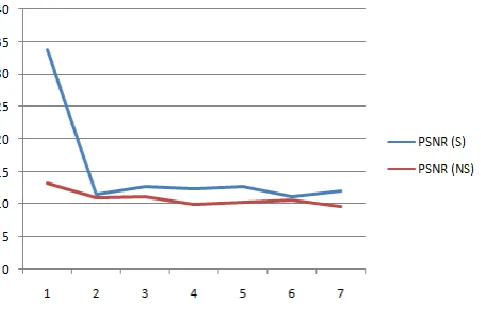
From the result, we observed that by applying non statistical parameter PSNR decreases and MMSE increases and by applying statistical parameter PSNR increases and MMSE decreases.
NOISE
[image:5.595.316.557.540.695.2]TYPE
S NS S NS S NS
Table 1:Comparison of delay, PSNR and MMSE for all types of noise
From the table, we observed that for the image containing salt and pepper noise delay is more in statistical and for Poisson and Gaussian noise delay is more in non statistical.
Chart 1: Peak signal to noise ratio for statistical and non statistical
S&P
0.59s 0.11s 33.76
13.32 21.10 41.17
G
0.01s 1.02s 11.52
10.92 42.58 42.67
P
0.01s 0.01s 12.67
11.19 43.46 43.43
S&P+G
1.55s 0.02s 12.28
9.94
41.63 43.47
S&P+P
0.53s 0.01s 12.63
10.21 43.23 43.76
G+P
0.01s 0.07s 11.12
10.63 42.67 42.78
ALL
NOISE
1.62s 0.01s 12.01
9.58
41.54 43.55
DELAY PSNR MMSE
© 2017, IRJET | Impact Factor value: 5.181 | ISO 9001:2008 Certified Journal | Page 1677
Chart 2: Minimum mean square error for statistical and non statistical
6. CONCLUSION
In this paper, various performance parameters are discussed which are used to compare the effectiveness of filtering techniques. Mostly Peak signal-to-noise ratio parameter is used for measuring the effectiveness of any filter. The higher PSNR gives the better quality of image. Each filter work differently on different types of noises. Median filter works well for Salt and Pepper noise where as wiener filter works well for removing Poisson noise. From both this two method statistical method is better than non statistical method. In non-statistical method, image has less PSNR and more MMSE while in statistical method, it has less MMSE and more PSNR.
REFERENCES
[1] Enming Luo, Student Member, IEEE, Stanley H. Chan,
Member, IEEE, and Truong Q. Nguyen, Fellow, IEEE “Adaptive Image Denoising by Targeted Databases” IEEE Transactions On Image Processing, Vol. 24, No. 7, July 2015.
[2] M.Raghav and S.Raheja “Image Denoising Techniques:
Literature Review” International Journal Of Engineering And Computer Science ISSN:2319-7242 Volume 3 Issue 5 May, 2014 Page No. 5637-5641.
[3] Sukhjinder Kaur “Noise Types and Various Removal
Techniques” International Journal of Advanced Research in Electronics and Communication Engineering (IJARECE) Volume 4, Issue 2, February 2015.
[4] S.Panda and P.Singh “ Study of Image De-noising
Techniques for Facilitating the Process Selection to Determine the Best Suitable Approach for any given image Type” International Journal of Engineering and Innovative Technology (IJEIT) Volume 4, Issue 4, October 2014.
[5] Rohit verma and Jahid ali, “A comparative study of
various types of image noise and efficient noise removal techniques”, International journal of advanced research in computer science and software engineering, volume 3, issue 10 October 2013
[6] Raymond H. Chan, Chung-Wa Ho, and Mila Nikolova,
“Salt- and- pepper noise removal by median- type noise detector and detail preserving regularization”, IEEE
Transaction on image processing, vol. 14, No. 10, October 2005.
BIOGRAPHIES
Ms. Shefali A. Uplenchwar received the B.E degree in Electronics Engg in the year 2015 from RTMNU, Nagpur, India. She is currently doing M.Tech. Degree in (VLSI) from PCE, Nagpur, India. She has published Review Paper On Image Denoising Techniques in IRJET. Her research focuses on the Image Denoising On Targeted Database. Her areas of interest are Switching Theory, Signal Processing and VLSI.
Mrs. Pradnya J. Suryawanshi did her BE (Electronics Engg) and M.Tech (Electronics) in 1998 and 2005 respectively from RTMNU (Nagpur University). Currently, she is working as Assistant Professor in Electronics Engineering Department, Priyadarshini College Of Engineering, Nagpur, Maharashtra, India and have total teaching experience 12 years. She has published 24 research papers in international conferences and journals. She has delivered expert lectures in STTP. She has chaired session as a judge at National Level Technical Paper Presentation. Her research interests have reviewed several research papers of International and National conferences. Also she has chaired sessions at International and National Conferences.