© 2017, IRJET | Impact Factor value: 5.181 | ISO 9001:2008 Certified Journal
| Page 856
Continuous Assessment of Project: One of the best Practice in
Engineering Institutes
1
Vikram A.Mane
1Rupali.R.Jagtap
2Santosh M.Herur
3Basavaraj S.S.
41
Asso.Prof.Department of Electronics and telecommunication, ADCET Ashta, India
2Asst.Prof.Department of Electronics and telecommunication, ADCET Ashta, India
3Asst.Prof.Department of Electronics and telecommunication, ADCET Ashta, India
4Asst.Prof.Department of Electronics and telecommunication, ADCET Ashta, India
Abstract:
Project continuous evaluation andassessment in engineering institute is tedious task. Keeping consolidate report of project and continuous improvement in required skills in the engineering projects is ultimate and necessary goal to develop employability in young budding engineers. Project evaluation method described in this paper is developed by us with our own rubric design. The term work marks and attainment of Program outcomes is carried out by us through calculations and with some formulae designed by us. This process gives complete design development and continuous assessments of program outcomes defined by NBA /ABET which will improve quality of product. This can be a best engineering practice for academic institutes. Keywords: Rubric, outcome based, PO (Program Outcomes)
I. Earlier methods of project evaluations
For engineering Institutes accreditation is needed to improve the quality of education and sustain in the competitive world. Accreditation authorities mainly focus on skill development and continuous assessment of students. ABET is focus on graduate attributes like Engineering knowledge, Problem analysis, Design/development of solutions, Modern tool usage, Environmental sustainability etc which current industries required from academic institutes. For that they have also defined the program outcomes a to k(can be referred on ABET/NBA websites) and minimum one program specific program outcome designed by own program runners. By achieving these outcomes with continuously following well defined process it is possible for any engineering institute to produce engineers with required qualities laid down by ABET. So many practices can be followed which will measure and assess the process of skill development in students.
II. Tools to assess skill
For development of skills and to achieve the program outcomes laid down by NBA, assessment process may include direct assessment tools and indirect assessment tools. Direct assessment tool gives directly and clearer picture of assessment of graduate attributes. It may include class tests, continuously and periodically assessment of skills. But as far as program outcomes a to k is considered it is not possible to capture all outcomes by direct assessment tools. For e.g. program outcome a, b, c, d can be assessed by class tests but how to capture professional ethics by the students through class test?.
For this there are indirect assessment tools like Rubric. By designing the best rubric it is possible to capture every skill and program outcome laid by NBA.
III. Project assessment Process
We are describing here project assessment process designed by ourselves which includes various rubrics to
Table1:Project Calendar
Sr.
No. Particular Tentative date/period Marks
1 Group formation and
technology/area selection June 1
st to 15th June
2016 ---
2 Training on technology and interaction with industry (if needed)
May-June 2016 ---
3 Literature Survey/ problem identification/ Topic selection 1
st July- 15th July 2016 ---
4 Synopsis Preparation 15th July -31st July 2016 ---
5 Synopsis Submission 1st August 2016 ---
6 Seminar (Presentation on Synopsis)
(synopsis and presentation will be evaluated for term-work)
1st August – 15th Sept
2016 40M
7 Poster Presentation Last week Sept216 10M 8 Submission of seminar report 1st week of Oct 2016 ---
9 Term-work calculation (Term work for Semester-VII will be calculated on following basis:
seminar (40 M)+ poster presentation (10M)
16th Sept to 20th Sept
2016 ---
10 Demo-I
(progress report –I and demo will be evaluated for term-work)
11th Jan – 21st Jan 2017 20 M
11 Demo-II
(progress report –I and demo will be evaluated for term-work)
20th Feb to 28th Feb
2017 30M
12 Demo –III(final)
(demo will be evaluated for term-work)
2nd March to 7th March
2017 30 M
13 Final report
submission(10M) and
attendance of
student(10M)(continues contact with guide expected)(Marks will be given by Guide)
21th March to 26th
March 2017
20M
14 Term-work calculation (Term work for Semester-II will be calculated on following basis:
Demo –III (30M) +l Demo II (30M) + Demo I(20 M) Report and attendance(20M)
27th March to 30th
March 2017
100
© 2017, IRJET | Impact Factor value: 5.181 | ISO 9001:2008 Certified Journal
| Page 857
effective manner as it may change life of student if some research comes in the hand of student. Project is one of the activity carried out in undergraduate institutes which includes all the outcomes laid down by NBA/ABET. Perhaps all other courses may return 2- 3 program outcomes from a to k. We have planned to prepare the group of students not more than three before start of their final year. Project guide are visiting Industries to ask for projects and current needs in industries. And also giving chances for students to come up with any such projects which satisfy the societal needs. At the start of semester project calendar we are preparing which includes plan of overall year along with dates. As shown below in Table 1.
Above calendar includes various activities to be carried out by in entire year. This includes finalization of project, Synopsis writing seminar presentation and Poster presentation based on their project. And carrying out demonstration of actual project work periodically in the form of Demo I, Demo II and final Demo III. Finally carrying out consolidate report of overall assessment and attainments of Pos by project co-ordinators. To carry out this process along with project co-ordinator project committee is formed to assess all these activities. After finalising the project the continuous assessment start.
The continuous assessment of project is carried on in the following manner as shown in Table 2.
Table 2: Project Plan for one year Sr.N
o.
Phase Assessm ent Method
Skills Assessmen t Tool
PO mapped Remark
1. Phase-I Semest er-odd
Synopsis Submissi on Seminar Presenta tion
Communication skill, Technical knowledge
Seminar assessment rubric (Team work and Team Member Rubric)
a,g,h,j,f Individ ual and group assessm ent
2. Phase-II Semest er-odd
Poster Prentatio n
Communication skill, Technical knowledge, Presentation skill
Poster Rubric (Team work and Team Member Rubric)
a,g,h,j,f Individ ual and group assessm ent
3. Phase-III Semest er-even
Project
Demo I Communication skill, Technical knowledge,Prese ntation skill
Project Assessmen t Rubric, Oral Communic ation Rubric
a,b,c,d,e,f,g,i, k,l,m group assessm
ent
4. Phase-IV Semest er-even
Project Demo II
Communication skill, Technical knowledge,Prese ntation skill
Project Assessmen t Rubric, Team Work Rubric
a,b,c,d,e,f,g,i, k,l,m
group assessm ent
5. Phase-V Semest er-even
Project
Demo III Communication skill, Technical knowledge,Prese ntation skill
Project Assessmen t Rubric, Team Memebr Rubric
a,b,c,d,e,f,g,i, k,l,m Individual and
group assessm ent
6.
Phase-VI Report Writting Written communication Written Communic ation Rubric
g Individ
ual and group assessm ent
Final PO attainment of entire year is calculated by average of respective Pos of each project which will be useful to find out strength and weaknesses in students.
IV. Seminar (On synopsis) assessment rubric
Phase I starts with synopsis writing and Presentation of seminar at odd semester. For assessing the skills of students in seminars we are assigning two external examiners with project guide. They need to assess the students, concentrating on various questionnaires defined in the rubric. The aim of questioner is toward how we can achieve the program outcomes laid by NBA. The sample of Synopsis rubric is as shown in Table 3 and Table 4 which will capture team work and team member rubric.
Table 3. Team work Rubric
S r. N o.
Assessm insides
Inadeq uate (1)
Avera ge (2)
Admir able (3)
Outsta nding (4)
Sc or e Team work assessment seminar (B1)
1 Topic selection (h, j)
Useful for limited group and not innovat ive
Useful for society but not innova tive
Somew hat innova tive and useful for society
Comple te Innovat ive and useful for society
2. Problem Definitio n (a)
Nearly meet expecta tions
Meets expect ation in some manne r
Extend expect ation in some manne r
Exceeds expecta tion
3 Organiza tion of presenta tion(g)
Hard to follow; sequen ce of inform ation not proper
Most of inform ation presen ted in sequen ce
Inform ation presen ted in sequen ce; easy to follow
Informa tion present ed as interest ing, sequen ce & easy to follow 4 Visual
aids free from errors including grammar . (g)
Nearly meet expecta tions
Meets expect ation in some manne r
Extend expect ation in some manne r
Exceeds expecta tion
5 Literatur e survey (j)
Not standar d referen ces
confer ence paper
Journal s but not standa rd
standar d journal s
© 2017, IRJET | Impact Factor value: 5.181 | ISO 9001:2008 Certified Journal
| Page 858
Table 4. Team Member Rubric
S r . N o .
Assessme nt insides Inadequat
e
(1)
Aver age
(2)
Admi rable
(3)
Outs tand ing
(4)
ROLL NO. And score
Team Member assessment -seminar (A1)
1 Student introduces
self to
audience (g)
Intro duces name only
Intro duces name, class,
Intro duces name, class, along with role in proje ct work
Intro duce s Nam e, Class , alon g with skills and role in proje ct work
2 Effective communic ation (g)
Nearl y meet expec tation s
Meets expec tation in some mann er:
Exten d expec tation in some mann er
Exce eds expe ctati on
3 Is able to give correct answers appropriat
e to
guide/inst ructor/au dience questions( a)
Nearl y meet expec tation s
Meets expec tation in some mann er
Exten d expec tation in some mann er
Exce eds expe ctati on
4 Individual Contributi on
(f)
Contr ibutio n only in docu ment ation
Contr ibutio n in docu ment ation and prese ntatio n prepa ration
Contri butio n in docu ment ation, prese ntatio n, requir emen ts and specif icatio n
Cont ribut ion in over all work
Total (A1)
Above designed rubric calculates the team member skills and Team work skills. Skills assessment in team work rubric is carried out on the scale of 1-4. Based on questionnaires and or level of attainments is assessed in various ways like Topic selection(h, j), Problem Definition, Organization of presentation(g), Visual aids free from errors including grammar(g), Literature survey(j). The quantities written in the bracket represents which outcomes can achieve by observing the content of the synopsis. The team work skills is captured
by these process. Similar to this team member can be assessed by applying team member rubric. Which include the topic of assessment like Student introduces self to audience (g), Effective communication(g), Is he able to give correct answers appropriate to guide/instructor/audience questions(a), Individual Contribution(f) etc. And final attainment of PO and term work marks can be calculated by following way shown in table 5.
Table 5: Term Work Mark Calculation
R o ll N o
A1 (m ax 16 )
A2 (m ax 16 )
A3 (m ax 16 )
B1 (m ax 20 )
B2( max 20)
B3 (m ax 20 )
TOTA L (A1+ B1)* 0.833
TOT AL (A2+ A3+ B2+ B3)* 0.13 8
Mark s out of (40)
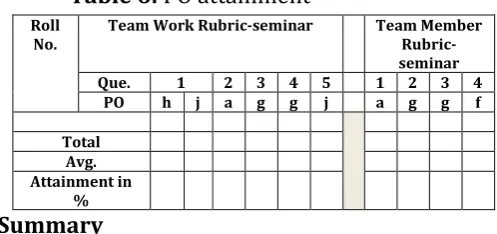
[image:3.595.317.566.438.555.2]In above calculation A1, B1 comes from rubric applied by guide. And A2, B2, and A3, B3 are from same rubric but assessed by another two external examiners excluding project guide. And then by above chart, term work marks and overall po attainment can be calculated by below shown method by observing scale given in above two rubrics. Table 6 shows consolidated PO attainment of one project. And Table 7 shows summary of average PO attained in Table6.
Table 6:
PO attainment
Summary
Table 7. : Average Pos mapped
VI. Project Phase II- Poster assessment rubric
Poster presentation is one of the best activity can be carried out which shows the demonstration skills of students in more visual than synopsis. To assess the different skills of the students, same rubrics defined in Table 3, and 4 can be applied and same process can be followed to calculate term work marks and PO attainments through Posters. And finally overall PO attainment through Poster can be consolidated in similar manner.
Roll No.
Team Work Rubric-seminar Team Member
Rubric-seminar
Que. 1 2 3 4 5 1 2 3 4
PO h j a g g j a g g f
Total Avg. Attainment in
%
PO
a b c d e f g h i j k l m
Attain
ment
(%)
© 2017, IRJET | Impact Factor value: 5.181 | ISO 9001:2008 Certified Journal
| Page 859
V. Project Demonstration I, II and III
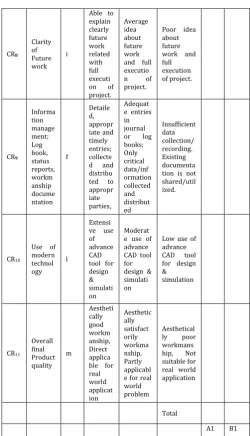
[image:4.595.314.565.55.492.2]Project demonstration is carried out in three phases based. Demo I,II and III. Here it is expected to develop actual hardware and or software and demonstrate it in front of assessment committee. In the demonstration I the student’s skills can be captured by applying Project rubric and oral communication rubric. The said rubrics developed as shown below fig 8,9 and 10.
Table 8. Project Assessment Rubric (V.03)
Crit erio n No. Perfor mance Criteria PO Ma ppe d Excelle nt (4-5) Average
(3-2) Poor (1) Gradin g on scal e 1 to 5 Gui de Grad ing on scale 1 to 5 Exa mine r
CR1 Technical design
a, b, c, e Meets/e xceeds specific ations with efficient design. Meets average specifica tions Meets poor specificatio ns CR2 Percent of Work Comple tion
f 50% 30% 10%
CR3
Explana tion of the results on the work done a, b Approp riate explana tion of results obtaine d and insightf ul conclusi ons
Produce d some results, but struggle d with interpret ation, lack sufficient support for their conclusi ons
Generated few results with little meaningful interpretat ion; conclusion s are absent/wr ong/trivial or unsubstant iated CR4
Level of Underst anding a
80 to
100% 40 60% to 10 to 20%
CR5
Approp riate choice & use of resourc es (compu ters, lab equipm ents etc.) k Innovat ive selectio n of resourc es; Expert use of resourc es
Appropri ate resource s used as was demonst rated in class; Resource s limited to faculty provided material s/tools Inadequate use of suggested resources. CR6 Oral Present ation g Demons tration with good technic al details and commu nication skills. Demonst ration with average technical skills and commun ication. Demonstra tion with poor technical skills and communic ation
CR7
Team Manage ment d
Excelle nt Coordin ation of all team membe rs.
Average Coordina tion of all team member s.
Poor Coordinati on of all team members. CR8 Clarity of Future work i
Able to explain clearly future work related with full executi on of project. Average idea about future work and full executio n of project.
Poor idea about future work and full execution of project. CR9 Informa tion manage ment; Log book, status reports, workm anship docume ntation f Detaile d, appropr iate and timely entries; collecte d and distribu ted to appropr iate parties,
Adequat e entries in journal or log books; Only critical data/inf ormation collected and distribut ed Insufficient data collection/ recording. Existing documenta tion is not shared/util ized.
CR10
Use of modern technol ogy
l
Extensi ve use of advance CAD tool for design & simulati on
Moderat e use of advance CAD tool for design & simulati on
Low use of advance CAD tool for design & simulation CR11 Overall final Product quality m Aestheti cally good workm anship, Direct applica ble for real world applicat ion Aesthetic ally satisfact orily workma nship, Partly applicabl e for real world problem
Aesthetical ly poor workmans hip, Not suitable for real world application
Total
[image:4.595.122.555.58.798.2]A1 B1
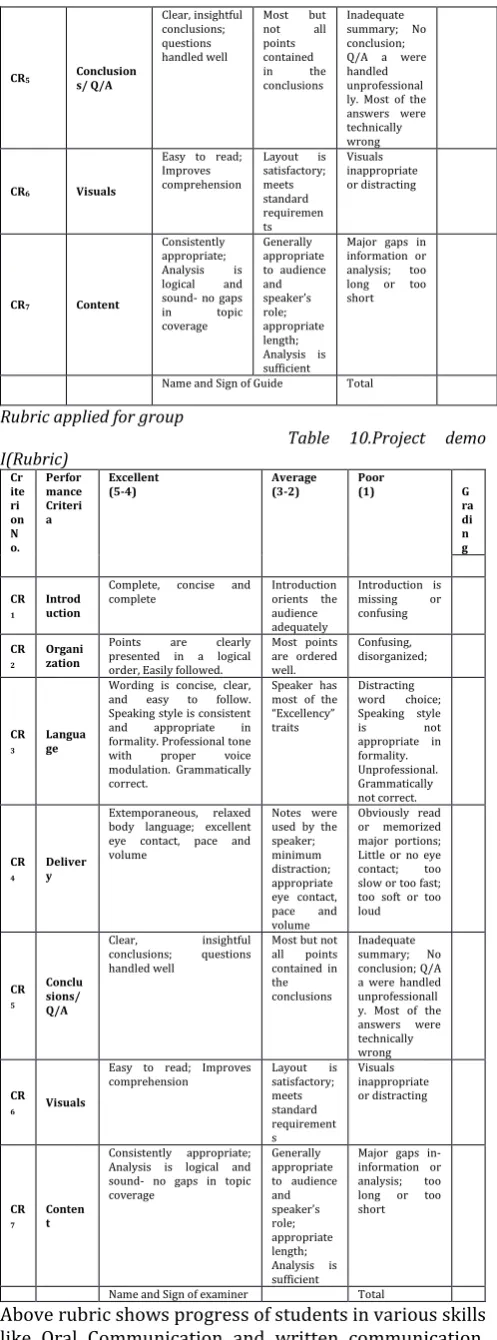
Table 9. Oral Communication Assessment Rubric (V.01) PO Mapping to ‘g’
Criterio
n No. Performance Criteria Excellent (5-4) Average (3-2) Poor (1) Gradin g
CR1 Introduction
Complete, concise and complete
Introductio n orients the audience adequately
Introduction is missing or confusing
CR2 Organization
Points are clearly presented in a logical order, Easily followed.
Most points are ordered well.
Confusing, disorganized;
CR3 Language
Wording is concise, clear, and easy to follow. Speaking style is consistent and appropriate in formality. Professional tone with proper voice modulation. Grammatically correct.
Speaker has most of the “Excellency ” traits
Distracting word choice; Speaking style is not appropriate in formality. Unprofessional .
Grammatically not correct.
CR4 Delivery
Extemporaneo us, relaxed body language; excellent eye contact, pace and volume
Notes were used by the speaker; minimum distraction; appropriate eye contact, pace and volume
© 2017, IRJET | Impact Factor value: 5.181 | ISO 9001:2008 Certified Journal
| Page 860
CR5 Conclusions/ Q/A
Clear, insightful conclusions; questions handled well
Most but not all points contained in the conclusions
Inadequate summary; No conclusion; Q/A a were handled unprofessional ly. Most of the answers were technically wrong
CR6 Visuals
Easy to read; Improves comprehension
Layout is satisfactory; meets standard requiremen ts
Visuals inappropriate or distracting
CR7 Content
Consistently appropriate; Analysis is logical and sound- no gaps in topic coverage
Generally appropriate to audience and speaker’s role; appropriate length; Analysis is sufficient
Major gaps in information or analysis; too long or too short
Name and Sign of Guide Total
Rubric applied for group
Table 10.Project demo I(Rubric)
Cr ite ri on N o.
Perfor mance Criteri a
Excellent
(5-4) Average (3-2) Poor (1) G ra di n g
CR
1
Introd uction
Complete, concise and
complete Introduction orients the audience adequately
Introduction is missing or confusing
CR
2
Organi zation
Points are clearly presented in a logical order, Easily followed.
Most points are ordered well.
Confusing, disorganized;
CR
3
Langua ge
Wording is concise, clear, and easy to follow. Speaking style is consistent and appropriate in formality. Professional tone with proper voice modulation. Grammatically correct.
Speaker has most of the “Excellency” traits
Distracting word choice; Speaking style is not appropriate in formality. Unprofessional. Grammatically not correct.
CR
4
Deliver y
Extemporaneous, relaxed body language; excellent eye contact, pace and volume
Notes were used by the speaker; minimum distraction; appropriate eye contact, pace and volume
Obviously read or memorized major portions; Little or no eye contact; too slow or too fast; too soft or too loud
CR
5
Conclu sions/ Q/A
Clear, insightful conclusions; questions handled well
Most but not all points contained in the conclusions
Inadequate summary; No conclusion; Q/A a were handled unprofessionall y. Most of the answers were technically wrong
CR
6 Visuals
Easy to read; Improves
comprehension Layout satisfactory; is meets standard requirement s
Visuals inappropriate or distracting
CR
7
Conten t
Consistently appropriate; Analysis is logical and sound- no gaps in topic coverage
Generally appropriate to audience and speaker’s role; appropriate length; Analysis is sufficient
Major gaps in- information or analysis; too long or too short
Name and Sign of examiner Total
[image:5.595.36.285.60.731.2]Above rubric shows progress of students in various skills like Oral Communication and written communication. Similar to Demo I , Demo II and can kept by giving some suggestions to student about the limitations of their project. Demo II includes same Project rubric but this time with Team work Rubric shown in Table 11 which will map how they perform in group.
Table 11. Team Work Assessment Rubric (V.01) PO Mapping to ‘d’
Criteri
on No. Performance Criteria Excellent(5-4) Average(3-2) Poor(1) Gradi ng
CR1
Contributions (Quality/manage ment of quality)
All members routinely contribute quality and useful ideas and information; Team evaluates all ideas and uses only the best
Most (but not all) members contribute useful idea & informatio n; The team as a whole adequatel y integrates the ideas presented
Internal conflicts result in team failing to achieve project goals.
CR2
Division of labor (Equality /quantity)
All members make significant contribution s & are accountable to complete assigned tasks
Progress is satisfactor y, but unequal workloads in observed
Serious problems due to unequal workload
CR3
Communication
(within the team) Consistent communicati on throughout the project; Insightful use of real and virtual meetings; Meetings are productive
Adequate number of meetings (real or virtual)
Inadequate meetings and communicati ons
CR4
Professional
Conduct All members team consistently behave in a professional manner(sho w up for meetings prepared and on time, treat other team members with courtesy & respect) & seek outside advise if team is not productive
Team members usually behave in a profession al manner; Do not repeat the same error & accept outside advise if team is not productiv e
Team members frequently fail to behave to behave in a professional manner; Team does not seek outside help.
CR5
Group Discipline Stays focused on task; Finds solutions as problems are encountered. Uses sound principles of inquiry when analyzing problems and seeking solutions
Adequate focus to complete task; some problems are discounte d until a later time
Totally lacks focus; Problems are discounted; Team does not take responsibility for failures of the group
CR6
Group Dynamics Synergy Majority of team members willingly participat e; team functions adequatel y
Every member of team goes in his/her way.
Signature of Guide with
date Total
[image:5.595.316.565.85.703.2]© 2017, IRJET | Impact Factor value: 5.181 | ISO 9001:2008 Certified Journal
| Page 861
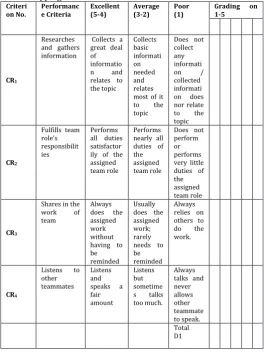
Fig 12.Team Member Assessment Rubric (V.01)
PO Mapping to‘d’
Criteri on No.
Performanc e Criteria
Excellent (5-4)
Average (3-2)
Poor (1)
Grading on 1-5
CR1
Researches and gathers information
Collects a great deal of informatio n and relates to the topic
Collects basic informati on needed and relates most of it to the topic
Does not collect any informati on / collected informati on does nor relate to the topic
CR2
Fulfills team role’s responsibilit ies
Performs all duties satisfactor ily of the assigned team role
Performs nearly all duties of the assigned team role
Does not perform or performs very little duties of the assigned team role
CR3
Shares in the work of team
Always does the assigned work without having to be reminded
Usually does the assigned work; rarely needs to be reminded
Always relies on others to do the work.
CR4
Listens to other teammates
Listens and speaks a fair amount
Listens but sometime s talks too much.
Always talks and never allows other teammate to speak. Total D1
Finally PO attainment by demo I is calculated by method given below in Table 13 for one project group.
Table 13.Summary of Project assessment Demo I
Po
attainment Formula Total
(T)
Use below method for % calculation
% PO Attainme nt
a (Project Rubric by guide CR1+cr3+cr4)+ (Project Rubric by Examiner CR1+cr3+cr4)(Max 30)
3.33*T
b (Project Rubric by guide cr3)+ (Project Rubric by Examiner cr3)(Max10)
10*T
c (Project Rubric by guide cr1)+ (Project Rubric by Examiner cr1)(Max10)
10*T
d (Project Rubric by guide cr7)+ (Project Rubric by Examiner cr7) (Max10)
10*T
e (Project Rubric by guide cr1)+ (Project Rubric by Examiner cr1) (Max10)
10*T
f (Project Rubric by guide cr2+ cr9)+ (Project Rubric by Examiner cr2+cr9) (Max20)
5*T
g (Project Rubric by guide cr6)+ (Project Rubric by Examiner cr6)+(oral Rubric by Guide+ oral Rubric by examiner) (Max80)
1.25*T
i (Project Rubric by guide cr8)+ (Project Rubric by Examiner cr8)(Max10)
10*T
k (Project Rubric by guide cr5)+ (Project Rubric by Examiner cr5) (Max10)
10*T
l (Project Rubric by guide cr10)+ (Project Rubric by Examiner cr10) (Max10)
10*T
m (Project Rubric by guide cr11)+ (Project Rubric by Examiner cr11) (Max10)
10*T
A
Similar method is applied to calculate PO attainment by Demo II and Demo III.
And finally overall PO attainment is calculated by summarizing all Rubrics applied to demo I,demoII and demo III along with seminar and poster PO as shown in Table14.
Table 14.Overall PO attainment PO
attainm ent
Details Assessment for skills Average of all on the scale of 5
%PO Attainm ent
Reamr k
a 1.Seminar for Synopsis Submission 2.Poster Presentation 3.Project Demonstration Review-I 4.Project Demonstration 5.Review-II Project
Demonstration & Final Assessment
Understanding Level Oral communication skills
Technical skills Poster quality Oral communication Team work Technical skills Oral communication Technical skills Team work b
c d e f g h i k l m
Phase-V project assessment is jointly carried out by external and internal examiner appointed by SUK
VII . Results
By applying above said rubric following results we have obtained In year 2014-15
Table15. Consolidate Pos 214-15
PO a b c d e f g h i j k l m
% attai nme nt
7 9. 8 2
7 9. 5 0
8 0 . 0 4
7 8. 0 2
7 8. 6 6
8 1. 4 1
7 8. 2 4
8 5 . 6 9
7 7. 8 4
7 8. 4
9 76.16
7 6. 0 5
8 7. 2 0
Fig 1 consolidate Pos 214-15(graphical)
By applying above same rubrics following results we have obtained In year 2015-16
Table 16 consolidate Pos 215-16
PO a b c d e f g h i j k l m
% atta inm ent
8 7. 5 4
8 8. 9 4
8 7 . 6 4
8 5. 4 7
8 9. 2 1
8 7. 8 2
88. 19
9 2. 4 6
8 6 . 8 6
8 8. 8 8
8 8. 8 6
8 9. 4 1
8 9. 7 9 70
80 90
a b c d e f g h i j k l m
%
PO
m
app
ed
PO met
© 2017, IRJET | Impact Factor value: 5.181 | ISO 9001:2008 Certified Journal
| Page 862
Fig 2. consolidate Pos 215-16(Graphical)
Comparison of results obtained i these two successive years the following discussion can be made
By observing strength and weaknesses in above developed skills it is possible to take corrective action by observing last year data analysis. Above said results are consolidate result of around 100 projects carried out in the institute which is showing improvement in skills of students.
VIII. Conclusion
Preparing Project dairy which includes all these analysis and consolidate report help us to manage engineering project in academic institute. And also for improving the quality of projects.
References:
1. Guidelines of NBA SAR
2. Shivaji University BE( E&TC) Syllabus effective from 2016
Fig 3. Comparison Pos
80 100
a b c d e f g h i j k l m
PO met
Project PO attainment 2015-16
0 50 100
a b c d e f g h i j k l m