© 2017, IRJET | Impact Factor value: 5.181 | ISO 9001:2008 Certified Journal | Page 2845
COMPARISON OF SOIL STRUCTURE INTERACTION FOR REGULAR AND
IRREGULAR BUILDINGS WITH DIFFERING FLOOR LEVELS AND SOIL
STRATUM
Dheekshith K
1, Anusha
2, Babitha B
3,
1,2
Assistant Professor, Department of Civil Engineering, Srinivas School of Engineering, Mangaluru
3
M.Tech Student, Department of Civil Engineering, Srinivas School of Engineering, Mangaluru
---***---Abstract -
In the current work, an effort is done to studythese soil structure interactions when the structure is built on different soil stratums for regular and irregular buildings with various floor levels. In this project, chosen two different soil layers for the analysis and the building is resting on isolated footing with Ground floor, (G+2) and (G+4) regular and irregular building is considered. Equivalent static analysis is carried out in order to study the displacement, Von Mises stress and stresses in X, Y and Z directions developed in the structure.
Key Words:
ANSYS MECHANICAL APDL, SOILSTRUCTURE INTERACTION, REGULAR AND IRREGULAR BUILDING, EQUIVALENT STATIC ANALYSIS
1. INTRODUCTION
The greater part of the civil engineering structure includes some kind of structural component with direct contact with ground. At the point when these exterior forces, for example, seismic effects, act on these systems, neither the structural displacements nor the ground displacements are independent of each other. The method in which the reaction of the earth influences the action of the structure and the action of the structure influence the reaction of the soil is expressed as soil- structure interaction.
It has normally considered that soil-structure interaction beneficially affects on the reaction of structure. Taking into account soil structure interaction makes the structure more flexible and accordingly rising the normal period of the structure compared to the inflexibly supported structure. The conventional overview is suitable only for certain class of structures and soil conditions, for example, light structures in moderately rigid soil. This statement does not constantly hold true. The soil structure interaction can enclose a damaging effect on the structural reaction and neglecting soil structure interaction in the study may direct to dangerous design for both superstructure and groundwork.
The contact between the building, groundwork and soil layer underneath the footing modify the genuine performance of the building significantly acquired by considering the structure alone. Flexibility of soil layer beneath footing reduces generally, hardness of the structure. In the conservative investigation of a building, the base loads are computed without considering soil settlement. The structure is assumed as completely flexible structure in this kind of
study. The stress- strain features of soil layers are accountable for differential settlement. The forces of the structural members may change because of differential settlement. It is essential to consider building frame, base and soil as single important structural unit.
2. BUILDING DESCRIPTION
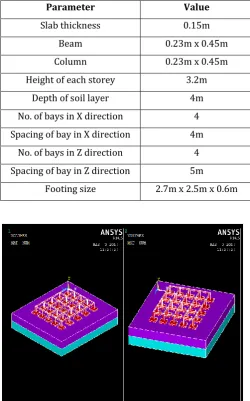
Table -1: Description of RC framed structure
Descript
ion Model-1 Model-2 Model-3 Model-4 Model-5 Model-6
No. of stories Grou nd floor Grou nd floor (G+2
) (G+2) (G+4) (G+4)
Total floor
[image:1.595.303.565.507.667.2]height 3.2m 3.2m 9.6m 9.6m 16m 16m Dimensio n of structure 16m x 20m 16m x 20m 16m x 20m 16m x 20m 16m x 20m 16m x 20m
Table -2: Material Properties of Concrete and Steel
Property Value
Grade of steel (N/mm2) Fe 415
Grade of concrete for all structural
members (N/mm2) M-25
Modulus of elasticity of concrete (kN/m2)
Ec = 5000√fck
= 5000√25 = 25x106
Poisson’s ratio for concrete 0.15
Concrete density 25 kN/m3
Table -3:
Material Properties of soil
Soil Type Modulus of elasticity (kN/m2) Poisson’s ratio
Hard Soil 65x103 0.3
© 2017, IRJET | Impact Factor value: 5.181 | ISO 9001:2008 Certified Journal | Page 2846
Table -4: Geometric Parameters
Parameter Value
Slab thickness 0.15m
Beam 0.23m x 0.45m
Column 0.23m x 0.45m
Height of each storey 3.2m
Depth of soil layer 4m
No. of bays in X direction 4 Spacing of bay in X direction 4m
No. of bays in Z direction 4 Spacing of bay in Z direction 5m
[image:2.595.21.567.77.536.2]Footing size 2.7m x 2.5m x 0.6m
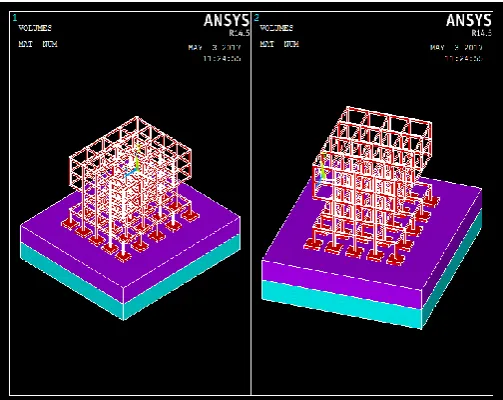
Fig -1: Isometric and oblique view of Model-1
[image:2.595.34.285.96.498.2]
Fig – 2: Isometric and oblique view of Model-2
[image:2.595.309.571.307.494.2]Fig – 3: Isometric and oblique view of Model-3
Fig -4: Isometric and oblique view of Model-4
[image:2.595.214.559.531.726.2] [image:2.595.39.287.531.720.2]© 2017, IRJET | Impact Factor value: 5.181 | ISO 9001:2008 Certified Journal | Page 2847 Fig -6: Isometric and oblique view of Model-6
3. RESULTS AND DISCUSSIONS
Equivalent static analysis is carried out for Ground, (G+2), (G+4) for different soil stratum of depth 4m each and four bays in both X and Z direction. The results obtained are listed below.
3.1 COMPARISON OF DISPLACEMENT VALUES FOR DIFFERENT MODELS
3.1.1 MODEL-1
3.1.2 MODEL-2
Description
Model-1 Regular Ground Floor
Model-2 Irregular Ground Floor
Displacement 2.672mm 2.582mm
© 2017, IRJET | Impact Factor value: 5.181 | ISO 9001:2008 Certified Journal | Page 2848
3.1.4 MODEL-4
Description Model-3 Regular (G+2)
Model-4 Irregular (G+2)
Displacement 7.164mm 6.482mm
3.1.5 MODEL-5
3.1.6 MODEL-6
Description Regular (G+4) Model-5 Irregular Model-6 (G+4) Displacement 12.074mm 27.726mm
3.2 COMPARISON OF VON MISES STRESS FOR DIFFERENT MODELS
3.2.1 MODEL-1
3.2.2 MODEL-2
Description
Model-1 Regular Ground Floor
Model-2 Irregular Ground Floor Von Mises
© 2017, IRJET | Impact Factor value: 5.181 | ISO 9001:2008 Certified Journal | Page 2849
3.2.3 MODEL-3
3.2.4 MODEL-4
Description Regular (G+2) Model-3 Irregular (G+2) Model-4
Von Mises
Stress 5094.96 kN/m2 4473.82 kN/m2
3.2.5 MODEL-5
3.2.6 MODEL-6
Description Regular (G+4) Model-5 Irregular (G+4) Model-6
Von Mises
Stress 8904.97 kN/m2 25207.5 kN/m2
4. CONCLUSIONS
In the investigation of regular and irregular reinforced concrete framed multi-storied structure, following conclusions were listed.
1. It is important to consider the outcome of soil structure interface before construction of any type of structure. The results show that soil structure interface plays a main part in response of structure.
2. Displacement value is more in irregular (G+4) building when compared to regular (G+4) building. But the displacement value is slightly more in regular Ground and (G+2) building when compared with irregular Ground and (G+2) building.
3. Stress values obtained from the analysis is more for irregular buildings when compared to regular buildings.
4. Von Mises stress values is more than regular buildings when compared with irregular buildings.
5. Elastic properties of soil influence the performance of the structure.
6. It is observed that the displacement value enhance as the elevation of the building rises.
© 2017, IRJET | Impact Factor value: 5.181 | ISO 9001:2008 Certified Journal | Page 2850
REFERENCES
[1] Aarlin K Mathew, Sat Kumar Tomer and Lovely K M. “Effect of Soil-Structure Interaction in Seismic Analysis of Framed Structures using ANSYS”. International Journal of Engineering Development and Research. Vol-3 pg.no: 1-9
[2] Ankur Acharya, Mrs. Rashmi Sakalle and Mrs. Nita Rajvaidya. “Linear Soil Structure- Interaction Effect on the Columns of an Unsymmetrical Plane Frame for Different Types of Soil”. Vol-4. pg.no: 48-54
[3] Anushri C and Dr. B Shivakumara Swamy. “Study on Performance of Regular and L-Shape Plan Irregular Building with Dampers, Shear Wall and Infill Wall”. International Research Journal of Engineering and Technology. Vol-3 pg.no: 616-620
[4] Aparna Obulasetti, Mr. V Srinivasa Rao, Mr. K Sundara Kumar. “Seismic Analysis of RC Framed Office Building Considering Soil Structure Interaction”. International Journal for Technological Research in Engineering. Vol-4. pg.no: 624-628
[5] Bhavani Shankar and Dheekshith K. “Comparative Study on Seismic Analysis of Soil Structure Interaction with Various Soil Properties by Varying Floor Levels”. International Research Journal of Engineering and Technology. Vol-3. pg. no: 359-365
[6] Bhavani Shankar and Anusha. “Seismic Analysis of Interlocking Block as Infill Wall”. International Research Journal of Engineering and Technology. Vol-3. pg.no: 506-512
[7] Chaitra H N and Dr. B Shivakumara Swamy “Study on Performance of Regular and Vertically Irregular Structure with Dampers, Shear wall and Infill wall”. International Research Journal of Engineering and Technology .Vol-3 pg.no: 592-596.
[8] Lini M Thomas and Kavitha P E. “Effect of Infill Walls on the Seismic Performance of the Multi-storeyed Buildings”. International Journal of Research in Engineering and Technology. Vol-4 pg.no: 90-96.
[9] Miss Anjali B and Dr. Raji M “Seismic Analysis and Soil Structure Interaction of Multistoried Building with Different Types of Footing”. International Journal of Engineering Research and Technology. Vol-4 pg.no: 820-824.
[10] Mr. Magade S B and Prof. Patankar J P. “Effect of Soil Structure Interaction on the Dynamic Behaviour of Buildings”. IOSR Journal of Mechanical and Civil Engineering. pg.no: 9-14
[11] Priyanka T and Shilpa V B “Seismic Analysis of Unsymmetrical Building with Different Bracing Systems”. International Journal of Research in Engineering and Technology. Vol-5 pg.no: 455-459.
[12] Ravi Kumar C M, Babu Narayan K S, Sujith B V and Venkat Reddy D. “Effect of Irregular Configurations on Seismic Vulnerability of RC Buildings”. Architecture Research 2012. pg.no: 20-26
[13] Ravi Kiran and Sridhar R “Comparative Study of Regular and Vertically Irregular Building under Seismic Loading”. International Journal of Research in Engineering and Technology. Vol-5 pg.no: 141-144.