© 2017, IRJET | Impact Factor value: 5.181 | ISO 9001:2008 Certified Journal
| Page 689
MINIATURIZED CAVITY BACKED SUBSTRATE INTEGRATED
WAVEGUIDE ANTENNA FOR Ku-BAND APPLICATION
NAGENDRA SINGH FAUZDAR, RAJESH KUMAR RAJ
M. Tech Scholar, Dept. of Electronics and Communication Engineering, Government Engineering College, Ajmer
Assistant Professor, Dept. of Electronics and Communication Engineering, Government Engineering College, Ajmer
---***---Abstract - In this work, a low profile wideband substrate integrated waveguide (SIW) cavity-backed (CB) unidirectional antenna design with planar configuration, operating in Ku-band is proposed. The design consists of a rectangular slot in the ground plane, the structure enclosed with closely placed vertical cylinders known as vias. The antenna performance is investigated in terms of gain, radiation pattern, S-parameter, fractional bandwidth, axial ratio and front-to-back ratio and resonance occurs at 14.43 GHz. All the simulations were performed using CST microwave studio software. For the proposed antenna, the impedance bandwidth (S11 < -10 dB) of 0.202 GHz (202 MHz) (1.4%) is achieved with maximum gain (IEEE) of 5.35 dBi, directivity of 6.26 dBi, with unidirectional radiation characteristics and high front to back ratio (FTBR) is 20. A good overall efficiency of 76.9% is attained. This antenna finds its applications mainly in satellite communications such as television transmissions, audio/voice, signal transmissions etc.
Key Words: SIW (substrate integrated waveguide), FTBR
(front-to-back ratio), gain, impedance bandwidth, mm (millimetre)
1. INTRODUCTION
The ever growing demand for speedy and high quality communications systems are the forces compelling researchers to come up with more efficient and better equipments. Fifth-generation (5G) wireless technology is considering Ka-band for high speed data transmission. Also this band is used for satellite communications, VSAT systems, close ranging radars aboard military planes etc. For these millimeter wave (MM) wave transmissions, the best suited structures are waveguides. Thus to eliminate the hindrance of integration of these waveguides with planar structures, substrate integrated waveguides (SIW) are preferred which is having the benefits of both waveguides and microstrip antenna such as low cost, high power handling capacity, ease of fabrication etc.
Substrate integrated waveguides (SIW) are guided structures having holes known vias. It is similar to dielectric
filled waveguide [1-2]. The two conducting plates and vias acts as boundary walls restricting spurious radiations through side walls allowing only modes, blocking propagation of modes, because of discontinuity of magnetic field [3].
With SIW emerging as perfect alternative to non-planar structures, many attempts have been proposed to improve the characteristics of the antenna, however, gain, unidirectional pattern, bandwidth improvement, always remained the challenge.
In this contribution, a novel technique to design a slot antenna is demonstrated. The conventional rectangular slot is etched in ground plane and the antenna radiates in its dominant mode. The slot dimension is set at quarter of the wavelength. Taper feed is preferred for better results and matching as proposed by many authors, to feed the antenna. Although, slot antennas have a drawback of low impedance bandwidth, as here, an impedance bandwidth of 1.4% is accomplished.
2. Design Principle
© 2017, IRJET | Impact Factor value: 5.181 | ISO 9001:2008 Certified Journal
| Page 690
(a)(b)
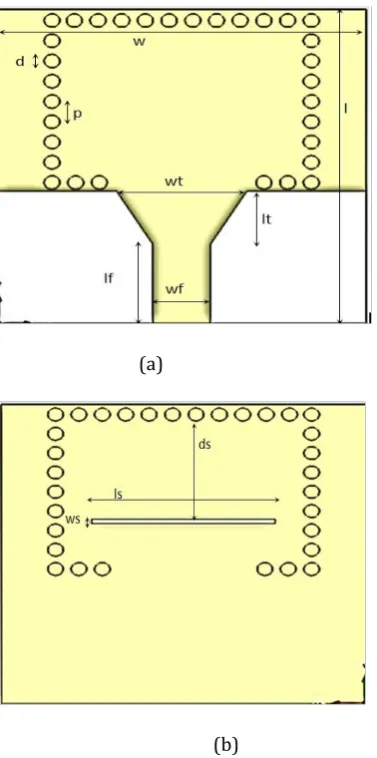
Fig -1: Geometry of the projected aerial (a) Front View (b) Back View
in precious works of authors. First of all, the dimensions of a conventional waveguide are calculated working in Ku-band. Since for a conventional waveguide, lower and higher cutoff frequencies are defined by
=1.25fc (1)
=1.89fc (2)
So, the cutoff frequency of conventional waveguide that would work in required band will be 15.6 GHz. Using this cutoff frequency, the broad wall dimension can thus be calculated as a= (3)
c = speed of light, relative permittivity, cutoff frequency. The cutoff frequency of different modes is given by = (4)
For dominant mode; m=1, n=0 (5)
From here, the designing of the cavity start and the equivalent SIW width can be calculated by dividing “a” with , since now it will behave as a dielectric filled waveguide. So, the width of the SIW equivalent to waveguide will have dimension of (6)
Next the calculations of the distance between the vias walls is done to find out the center-to-center distance which is given as = (7)
Where “d” is the diameter of a via and “p” is the spacing between two adjacent vias. The diameter and the spacing is chosen according to the rules which are given as d p≤2d (8)
0.05 ( (9)
d< /5 (10)
= (11)
= =2a (12)
Where is the cutoff wavelength and is the guided wavelength
[image:2.595.70.259.96.476.2]© 2017, IRJET | Impact Factor value: 5.181 | ISO 9001:2008 Certified Journal
| Page 691
contributions have been proposed. Apart from taper feed,several other techniques such as inset feed, coaxial feed, modified taper feed etc. are prominent. Here, taper feed is preferred as it acts as a transformer which matches the 50 ohm port feed with the impedance of the SIW cavity, whose feed width calculations can be done from [7] as
= (13)
and, the dimensions of the feed at the port end can be approximated as
~0.4 (14)
This implies that the width of the taper at the port end is roughly 0.4 times the opening of the patch [8]. Here, denotes the width at the feed end and is the opening of the patch. W is the distance across of the patch and H is the height of the substrate. The distance end to end of the taper is given by
) n=1,2,3…… (15)
[image:3.595.314.555.152.336.2]The substrate used here is Rogers/RT Duroid 5880 with = 2.2 and tallness of 0.787 mm having loss tangent 0.0009 and the metal thickness is 0.0035mm. All the dimensions of the designed aerial are tabulated in table 1. The length of the slot is taken almost half of the guided wavelength.
Table -1: Parameters of design proposed
d = 0.66 ds = 8.5 h = 0.787 lf =3.9
lt = 2.635
ls = 7.8 p = 1 l = 15.495
wf = 2.42
ws = 0.2 wt = 5.5 w = 15.6
All lengths are in mm.
3. Results
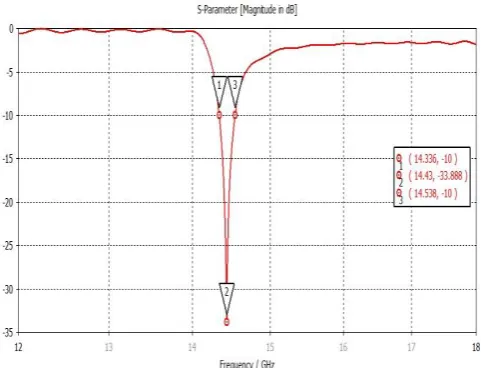
The simulated and measured results are shown here. A appreciable low return loss is reached pointing towards low reflections and good impedance matching. The S-parameter is plotted in figure 2, considering the conductor and dielectric losses. From figure we can see that resonance occurs at single frequency at 14.43 GHz.
The radiation pattern in different cut planes that is E-plane (ϕ = 90°) and H-plane (ϕ = 0°) is shown in figure 3 which shows the unidirectional pattern [9].
Fig -2: Simulated S11 of the proposed antenna.
E-Plane H-Plane
Fig -3: Calculated radiation patterns in different cut planes at 14.43 GHz.
The inference of unidirectional pattern can be verified by the front-to-back ratio which is quite high around 20. The negative sign shows the direction that the radiator radiates backwards or from backside.
[image:3.595.324.542.387.567.2] [image:3.595.65.259.509.619.2]© 2017, IRJET | Impact Factor value: 5.181 | ISO 9001:2008 Certified Journal
| Page 692
compromising gain, and then the latter can be increasedusing arrays and polarizations [10].
Fig -4: Simulated Front-to-back ratio
Fig -5: Simulated Gain
Figure 6(a) shows the axial ratio which shows that the antenna being horizontally polarized whereas figure 6(b) and 6(c) shows the current distribution through the structure and the rectangular slot respectively. It can be seen that the current is evenly distributed throughout the antenna confined within the boundations of the cylindrical vias. The electric field gets cancelled as the direction of the current along the horizontal boundary of the slot is having opposite directions.
(a) (b)
(c)
Fig -6:. Simulated (a) Axial ratio (b) Surface current and (c) Surface current through the slot
(a)
(b)
[image:4.595.318.552.59.345.2] [image:4.595.53.283.137.328.2] [image:4.595.60.278.347.552.2] [image:4.595.311.558.388.745.2]© 2017, IRJET | Impact Factor value: 5.181 | ISO 9001:2008 Certified Journal
| Page 693
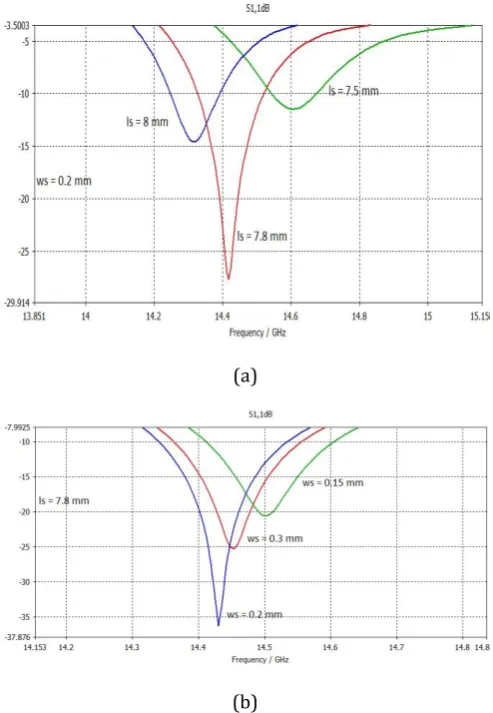
Figure 7 shows the parametric analysis of the variousparameters which are, the length in (a) keeping width constant and the width in (b) keeping length constant and the optimized results are obtained.
4. Conclusion
The antenna is compact in size having dimensions of 15.635 mm X 15.6 mm. The antenna is having unidirectional radiation pattern. Rogers RT/ Duroid 5880 is chosen due to its low property variations and better performance at higher frequencies. Thus a low profile antenna is designed with good performances characteristics radiating in Ku-band which find its applications in satellites systems such TV communications, radar applications etc. The designs comply with all the design rules for the best results to be achieved. The gain and bandwidth of the antenna can further be improved by using arrays.
5. References
[1] Deslandes and K. Wu, “The Substrate Integrated Waveguide (SIW) Concept, Technology and Applications,” 10th International Symposium on Microwave and Optical
Technology, Fukuoka, Japan, Aug. 2005.
[2] F. Xu and K. Wu, “Guided-wave and leakage characteristics of substrate integrated waveguide,” IEEE Trans. Microwave Theory Tech., vol. 53, no. 1, pp. 66–73, Jan. 2005.
[3] Guo Qing Luo, Member, IEEE, Zhi Fang Hu, Lin Xi Dong, and Ling Ling Sun, Senior Member, IEEE, " Planar Slot Antenna Backed by Substrate Integrated Waveguide Cavity "IEEE Antenna and Wireless Propagation Letters , VOL. 7, 2008.
[4] A. Kumar, and S. Raghavan., Wideband slotted substrate integrated waveguide cavity-backed antenna for Ku–band application. Microwave and Optical Technology Letters, 2017, vol. 59, no. 7, p. 1613–1619. DOI: 10.1002/mop.30594.
[5] D. Deslandes and K. Wu, “Design consideration and performance analysis of substrate integrated waveguide components,” 32th European Microwave Conference, vol. 2, Sept. 2002, pp. 881-884.
[6] A. Kumar, and S. Raghavan. "A Review: Substrate Integrated Waveguide Antennas and Arrays." Journal of Telecommunication, Electronic and Computer Engineering (JTEC) 8.5 (2016): 95-104.
[7] Proceedings of the International Conference on Recent Cognizance in Wireless Communication & Image Processing, 2016.
[8] Anja Skrivervik. "Broadband High Gain Small Array Antenna for High Altitude Platforms Applications", 2007 IEEE 18th International Symposium on Personal Indoor and Mobile Radio Communications, 09/2007.
[9] Soumava Mukherjee, Student Member, IEEE, Animesh Biswas, Senior Member, IEEE, and Kumar Vaibhav Srivastava, Senior Member, IEEE " Substrate Integrated Waveguide Cavity-Backed Dumbbell-Shaped Slot Antenna for Dual-Frequency Applications", IEEE, Antenna and Wireless Propagation Letters ,VOL. 14, 2015.