© 2016, IRJET | Impact Factor value: 4.45 | ISO 9001:2008 Certified Journal
| Page 1322
Fuzzy logic controller for synchronous generators in a stand-alone
multi-machine power system
M. B. Elnagar
1,*, G.A. Morsy
2, R.A. Amer
31- Corresponding author: Faculty of Engineering, Electric department, Minoufyia university, Egypt
,[email protected] ,002-010-174-111-09
2- Faculty of Engineering, Electric department, Minoufyia university, Egypt , [email protected].
3- Faculty of Engineering, Electric department, Minoufyia university, Egypt, [email protected].
Abstract— This paper will deal with the design and development of fuzzy logic based controller implemented in synchronous generator excitation system that serves in isolated multi-machine power system. The controller is developed and simulated for a system containing nine generators with two types of prime movers (diesel engine and gas turbine systems) which feeds a variety of linear as well as non-linear loads. MATLAB/ SIMULINK based models are developed for observing steady state as well as dynamic performance for the study system. The simulation results are compared with others obtained for the system equiped with PID controllers. The results illustrate the effectiveness of the fuzzy controller over the PID controller. All the data acquired are from a real working oil production and refinery site.
Keywords: Fuzzy logic, Excitation system, Stand-Alone, Decision making
INTRODUCTION
The existence of remote isolated loads is inevitable due to some industrial needs such as the extraction of minerals, petroleum sites, marine industries and the spread of populace in remote areas. Technical and economic difficulties prevent connecting them to the main grid which forces us to provide for these loads with high quality voltage and frequency.
OIL related industries are often supplied by remote stand-alone power system and usually the generators in these systems are driven by a prime mover (engine-turbine) which operates on the gas delivered from wells directly. Isolated power systems have characteristics significantly different from those found in large-scale power system. These systems often have very large induction motors that require being started direct-on-line. Small stand-alone systems are relatively weak, have low inertia and short-circuit levels, high R/X ratios and are much more affected by dynamic load changes. Load variations, disturbances and unbalances produce higher levels of power quality deviations in these systems [1-3].
The design, transmission, dispatching, operation, and control of such power systems offer many challenging problems. The most important one among them is probably
the stabilization of the power system especially under transient conditions.
SYSTEM CONFIGURATION
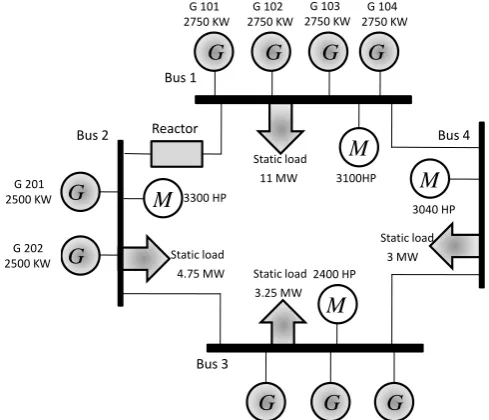
The system under study is a working oil production and refinery field located in Ras-shukair near Hurghada city, Egypt.
11 MW
3.25 MW 4.75 MW
3300 HP
2400 HP
Bus 4
Bus 3 Bus 2
G 201 2500 KW
G 101 2750 KW
3100HP
Static load
Static load
Bus 1
Static load
M
M
M
G
G
G 102 2750 KW
G 103 2750 KW
G 104 2750 KW
G
G
G
G
G 202 2500 KW
G
G
G
Reactor
3040 HP
3 MW Static load
M
Figure (1) Schematic diagram of the system
Bus 1 is considered as slack bus, the other five generators are identical and have the same rating 2500 KW with different prime movers as mentioned in Table (1), they are distributed as two on Busbar 2 and three on Busbar 3, Motors on each bus are represented by a large new equivalent motor.
Table (1) Generating unit arrangement
Generator Prime-
mover
Bus-bar
(KW) (V)
101-102 -103-104
[image:1.595.310.555.381.591.2]© 2016, IRJET | Impact Factor value: 4.45 | ISO 9001:2008 Certified Journal
| Page 1323
201-202 Diesel
Engine
2 2500 4160
301-302-303 Gas turbine 3 2500 4160
1- SYSTEM MODELING
A. SYNCHRONOUS GENERATOR
The following equations synchronous generator is represented by, i.e. with a field circuit and one equivalent damper winding on q-axis these equations are known as the electro-mechanical swing and the generator internal voltage equations [4, 5]:
1
1
md
d
t
M
T
D
(1)
1
b
d
d
t
(2)
'
1
'
'
'
qq d d d fd
do
d
d
E
E
i x
x
E
t
T
(3)The electrical torque can be represented in terms of d-axis and q-axis components of the armature current, and the terminal voltage, as follows:
e d d q q
T
v i
v i
(4) Voltages can be expressed as follows:2 2
t d q
V
v
v
(5)d d q
v
x i
(6)'
'
q q d d
v
E
x
i
(7)B. PRIME MOVER
B.1-Gas Turbine
The gas turbine under study in the site is a single shaft light industrial gas turbine. As shown in Figure (2), The model consists of Speed error sensing circuit, Power amplifier, Governor compensation, Fuel valve mechanism lag and Fuel valve limits [6].
Gh
e
P
m
P
Kdg
1
1 1
g S
T
2 2 1
g S
g S
K T
0
m
P
1
1 1
f S
T
2 1 2 2 1
t t S t
t S
K T K
T
Pm
Governer
Leadlag Fuel
V lave lag limit Fuel Vlave
Turbine Leadlag
3 3 3 4 1
g g S g
g S
T K K
T
Figure (2) Gas turbine model
B.2-Diesel Engine
In this model, the controller is modeled as a first order system; the diesel engine is modeled as a pure delay [7],as shown in Figure (3).
DieselEngine 11/T
K1
2 T
ref
m
T
Tm
PureDelay
Figure (3) Diesel Engine and governor model
C. TRANSMISSION SYSTEM AND LOAD
-The transmission system is treated as a short transmission ‘< 8
0KM’, and is taken into consideration as an additional resistive and inductive load as the longest transmission line is 20 KM long.
-Loads are also represented in both forms static and dynamic, Motors are represented as one relatively large motor about 2500 HP rating which is represented in a separate model associated with the power system, static loads are also represented as resistance and inductance.
C.1 Induction motor
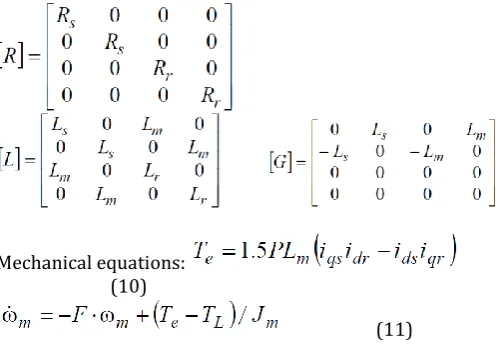
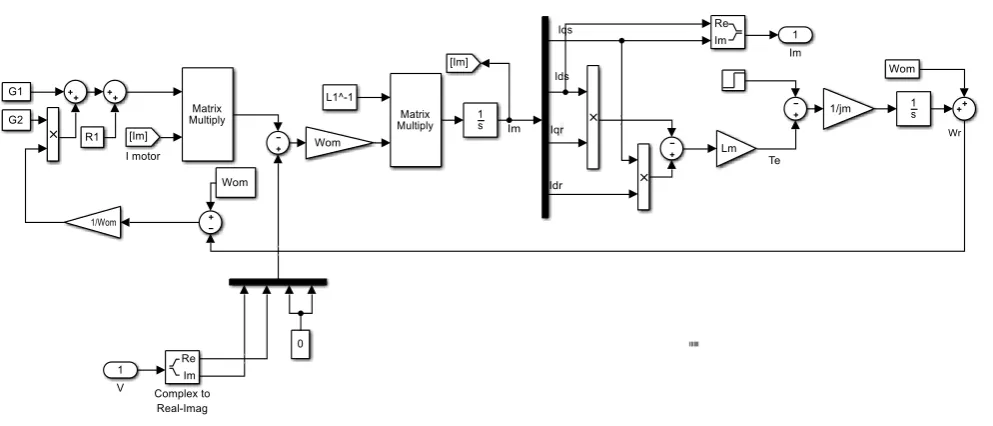
A squirrel cage induction motor (2500 KW) is modeled through a fast approach in which four differential equations of voltage and current in rotor reference frame along with the torque equation is used to model the motor in state space form [8], The equations are in synchronous reference frame.
[image:2.595.301.550.64.241.2] [image:2.595.304.565.341.417.2]© 2016, IRJET | Impact Factor value: 4.45 | ISO 9001:2008 Certified Journal
| Page 1324
Where,L
s
L
1s
L
m1 r r m
L
L
L
d
p
dt
Equation (8) is presented in state space form as follows:
1
1r
i
p
L
R
G
i
L
V
(9)Where;
A MATLAB-SIMULINK for the induction motor model is shown in Figure (4)
Mechanical equations: (10)
(11)
D. INITIAL CONDITION AND LOAD FLOW CALCULATIONS
The next step was to perform the initial condition and load flow calculations this can be done By using MATLAB M-File especially built to calculate the initial values of all system variables i.e., power flow (active and reactive power), bus voltages, currents and load angles etc. the load flow is done according to the system nodes self-admittance and mutual-admittance which include the lines resistances and reactances, The iterative used algorithm for the load flow is Newton–Raphson approach, This approach will be repeated until an acceptable tolerance is reached.
E. STAND-ALONE MULTI-MACHINE REPRESENTATION
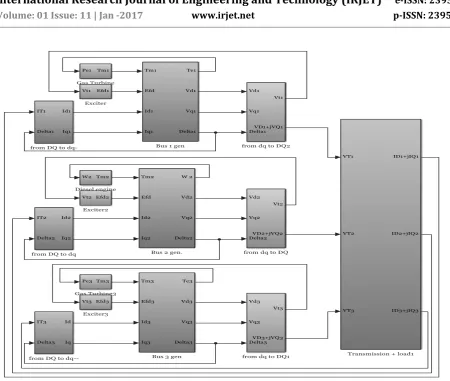
To implement more than one synchronous generator in a stand-alone system, the Busbar with the highest generating power should be taken as a slack bus. All the generators will be represented on a new D-Q axis. he MATLAB SIMULINK model is shown in Figure (5), which is built using the dynamic equations described in previous sections and the steady state equations are used to compute the initial conditions. In the
simulation, the nonlinear system equations are solved using Runge-Kutta Fourth order integration technique with an integration step of 2ms.
F. EXCITATION SYSTEM
-The IEEE Type-ST1 excitation system including both AVR and PSS considered [9]. It can be described as:
/
fd A ref pss fd A
E
K V
v u
E
T
(12)
2- DESIGN OF FUZZY LOGIC CONTROLLER
This paper is to present the application of fuzzy logic techniques to control the generator in multi-machine power systems. To demonstrate the generator control improvement, the simulation results are obtained in comparison with PID control system.
Any Fuzzy logic controller (FLC) will go through 3 stages, fuzzification, decision making and defuzzification (11,12) as shown in Figure (5). As shown in Figure (6), The input and output variables are thus represented as a collection of linguistic values L = {- ve, Z, + ve}. Each of the membership function is triangular type and the height of the membership functions is chosen to be one.
Fuzzy fire Knowledge
base
Decision Rules
Defuzzification
Crisp Input Crisp output
Fuzzification Decision making
Figure (6) Fuzzy logic control scheme
G.1 Fuzzification
A process in which a crisp input variable transfers into an equivalent fuzzy variable. Two inputs will be assigned to FLC , speed error (
) and its derivative (d
/
dt ).The input and output variables are thus represented as a collection of linguistic values L = {- ve, Z, + ve}. Each of the membership function is triangular type and the height of the membership functions is chosen to be one.
G.2 Decision making
[image:3.595.38.290.317.490.2]© 2016, IRJET | Impact Factor value: 4.45 | ISO 9001:2008 Certified Journal
| Page 1325
Table (2),(3) shows the Rule table for Busbar 2 and Busbar 3respectively
Table (2) Rule table for generators on Bus 2
d
/
dt
- ve Zero + ve- ve +ve +ve -ve
Zero -ve Zero Zero
+ ve -ve +ve Zero
Table (3) Rule table for generators on Bus 3
/
d
dt
- ve Zero + ve- ve +ve -ve +ve
Zero -ve Zero +ve
+ ve Zero +ve -ve
[image:4.595.50.558.46.536.2] [image:4.595.58.271.155.259.2] [image:4.595.52.549.307.520.2]© 2016, IRJET | Impact Factor value: 4.45 | ISO 9001:2008 Certified Journal
| Page 1326
Figure (5) SIMULINK model of Multi-machine power systemG.2 Defuzzification
Defuzzification is the process of transferring the fuzzy values into a crisp output once again
3- PERFORMANCE AND RESULTS
The dynamic performance of the system is tested among many disturbances, A comparison between both the PID and FLC will be performed and the results will be shown.
Case 1: Six cycles (100 ms) 3-phase short circuit on Bus 4. Results are taken on bus 2 (Diesel engine) and bus 3 (Gas turbine).
As we can see on bus 2 results: 1-slight improvement on the terminal voltage swings 2-Speed deviation swings amplitude is reduced 3- Rotor angle have the same settling time but the swings amplitudes are increased.
Bus 3 results: 1-slight improvement on the terminal voltage swings 2- Speed deviation settling time is improved 3- Rotor angle have the a longer settling time but the swings amplitude is decreased.
0 1 2 3 4 5
0.7 0.8 0.9 1 1.1
Time (sec)
G
e
n
e
ra
to
r
N
o
.
2
T
e
rm
in
a
l
V
o
lt
a
g
e
(p
u
)
PID+AVR Fuzzy+AVR
/ 0 1 2 3 4 5
0.5 0.6 0.7 0.8 0.9 1 1.1 1.2 1.3
Time (sec)
G
e
n
e
ra
to
r
N
o
.
3
T
e
rm
in
a
l
V
o
lt
a
g
e
(p
u
)
[image:5.595.76.527.56.437.2]© 2016, IRJET | Impact Factor value: 4.45 | ISO 9001:2008 Certified Journal
| Page 1327
0 1 2 3 4 5
-5 0 5 Time (sec) S p e e d d e vi a ti o n G e n N o .2 ( ra d /S e c) PID+AVR Fuzzy+AVR
0 1 2 3 4 5
-8 -6 -4 -2 0 2 4 6 Time (sec) S p e e d d e vi a ti o n G e n N o .3 ( ra d /S e c) PID+AVR Fuzzy+AVR
0 1 2 3 4 5
-25 -20 -15 -10 -5 0 Time (sec) R o to r a n g le G e n N o .2 ( d e g re e ) PID+AVR Fuzzy+AVR
0 1 2 3 4 5
-20 -10 0 10 20 30 Time (sec) R o to r a n g le G e n N o .3 ( d e g re e ) PID+AVR Fuzzy+AVR
Figure (7) System response for 5% increase in gen.2 reference voltage for 1s
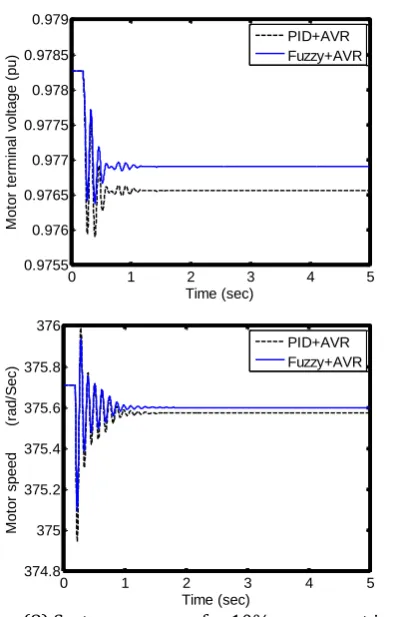
Case 2: 10% permanent increase in the motor load. As we can see on bus 2 and bus 3 results: 1-Speed deviation swings
amplitude is reduced 2- Rotor angle have the same settling time but with a better settling value. It is also noticeable that the motor terminal voltage drops by a lower value in case of applying FLC same for motor speed final value
0 1 2 3 4 5
-0.2 -0.15 -0.1 -0.05 0 0.05 0.1 0.15 Time (sec) S p e e d d e vi a ti o n G e n N o .2 ( ra d /S e c) PID+AVR Fuzzy+AVR
0 1 2 3 4 5
-0.05 -0.04 -0.03 -0.02 -0.01 0 0.01 Time (sec) S p e e d d e vi a ti o n G e n N o .3 ( ra d /S e c) PID+AVR Fuzzy+AVR
0 1 2 3 4 5
-18.3 -18.2 -18.1 -18 -17.9 -17.8 Time (sec) R o to r a n g le G e n N o .2 ( d e g re e ) PID+AVR Fuzzy+AVR
0 1 2 3 4 5
© 2016, IRJET | Impact Factor value: 4.45 | ISO 9001:2008 Certified Journal
| Page 1328
0 1 2 3 4 5
0.9755 0.976 0.9765 0.977 0.9775 0.978 0.9785 0.979 Time (sec) M o to r te rm in a l vo lt a g e ( p u ) PID+AVR Fuzzy+AVR
0 1 2 3 4 5
374.8 375 375.2 375.4 375.6 375.8 376 Time (sec) M o to r sp e e d (r a d /S e c) PID+AVR Fuzzy+AVR
Figure (8) System response for 10% permanent increase in the motor load.
After comparing the graphs of conventional PID and fuzzy logic controller as shown in Figure (7- 10) it is clear that system performance with fuzzy logic controllers has a better overall dynamic performance ,small overshoot and faster response compared to conventional PId controllers.
The simulation results are obtained when using this control strategy under different disturbances.
Simulation results show that the proposed FLC scheme is more effective for enhancing the stability of mentioned isolated system.
3- CONCLUSION
In this paper, A complete isolated system has been represented including nine generators with different prime movers (Diesel engine and gas turbine), static load and transmission system are also taken into consideration. The control is implemented in the excitation loop with the speed deviation as the main controlling signal. For both FLC and PID controller. PID controller and FLC parameters are chosen based on try and error. The simulation results show that, FLC scheme is more effective for enhancing the dynamic performance on different disturbances compared with that of a conventional PID controller.
4- APPENDIX
Diesel engine parameters:
1
1
0.02
1 0.04
/
K
2
0.05
AVR and PSS parameters:
Bus 2 Bus 3
1 2
100
0.05
0.12
0.012
0.2
a a pss pss pssK
T
T
T
K
1 2200
0.034
0.24
0.024
0.09
a a pss pss pssK
T
T
T
T
Gas turbine parameters:
2 3 1 2
.04
5
1
.06
.03
dg g g g gK
K
K
T
T
1 2 1 4 3 30.3
1.3
0.01
1
0.25
0.9
t t f g g tT
T
T
T
T
K
PID controller parameters:Bus 2 Bus 3
0.0010043
0.959780
0.0010994
pid pid pidP
I
D
0.065269
0.82612
0.0055816
pid pid pidP
I
D
Induction motor parameters:
2
2
120 *
/
63.87
0.5* * (
)
om
em
m
P
W
pi
W
W om P
J
H
J
W em
[image:7.595.59.258.101.410.2]© 2016, IRJET | Impact Factor value: 4.45 | ISO 9001:2008 Certified Journal
| Page 1329
Synchronous generator parameters:
1.464
0.757
'
0.187
'
0.757
0.657
d q
d
q
X
X
X
X
H
0
'
4.93
'
0.3287
0.706
0.018
2*
*60
doqo f a
T
T
R
R
W
pi
Static load “Assumed constant during the simulation”:
Consumed power at Bus 1: 6.119 watt
Consumed power at Bus 2: 3.980 watt
Consumed power at Bus 3: 2.390 watt
Consumed power at Bus 4: 2.619 watt
Transmission network:
Reactor impedance (Z12): R12 = 0.032; L12 = 0.0849
Z23 = 0.09 + 0.05 OHM
REFERENCES
[1] W. E.Reid, “Power quality issues – Standards and guidelines”, IEEE Transactions on Power Delivery, Vol. 32, No.3, May/ June 1996.
[2] A. Ghosh and G.Ledwich, Power Quality Enhancement Using Custom Power Devices, Kluwer Academic Publishers, London, 2002.
[3] E. Acha, V.G.Ageligis, O.Anaya-Lara and T.J.E Miller, “Power Electronic Control in Electrical Systems”. Newnes Power Engineering Series, Oxford, Britain, 2002
[4]-K. R. Padiyar, “Power System Dynamics Stability and Control”, BS Publications, 2nd Edition, Hyderabad, India, 2002.
[5]- Sidhartha Panda and Narayana Prasad Padhy “MATLAB/SIMULINK Based Model of Single- Machine Infinite-Bus with TCSC for Stability Studies and Tuning Employing GA”, World Academy of Science, Engineering and Technology International Journal of Electrical, Robotics, Electronics and Communications Engineering Vol:1 No:3, 2007
[6]-Sheldrake, A. L. “Handbook of Electrical Engineering For Practitioners in the Oil, Gas and Petrochemical Industry”. Bangalore, India: John Wiley & Sons, Ltd. (2003).
[7]-A.F Stonch and J.R smith , “Development of a simulation model of turbocharger diesel engine prime mover for power studies”, Electric power and energy system ,Vol.10,No2,PP123-128,1988
[8]-Mohamad H. M. and Pouria G. K. “A New Matlab Simulation of Induction Motor”, Australasian Universities Power Engineering Conference (AUPEC'08), Paper P-057 page 1,2008
[9]-M.A. Abido, Y.L. Abdel-Magid, “Coordinated design of a PSS and an SVC-based controller to enhance power system stability”, Electrical Power and Energy Systems 25 (2003) 695–704
[10]- Singh, A. “Design, Modeling and simulation of intelligent controller for small isolated diesel generator system”. International Conference on Industrial and Information Systems, pp. 638-643, August 2010.
[11]Bo Y. , Dongwei S. “Fuzzy PID Control Technology for Synchronous Generator Excitation”. International Journal of Control and Automation. Vol.8, No.10 , pp.91-98, 2015
[12] Z. Guo, H. Song, P. Wen, Z. Fan “Study on Synchronous Generator Excitation Control Based on FLC” World Journal of Engineering and Technology, 2015
BIOGRAPHY
Ragab A. Amer
received the B.Sc. in 2004, M.Sc. in 2007 and Ph.D.degrees in control of electrical power systems in 2012 from the University of Menoufia, Egypt. He has worked at Menoufia University, Egypt since 2005. He is interested in modeling and control design of electrical power systems and optimal power flow.
Gamal A. Morsy