© 2017, IRJET | Impact Factor value: 5.181 | ISO 9001:2008 Certified Journal | Page 2690
HEARING AID
Diksha Bolshette, Sonupriya Langote, Sonali Lokare, Prof. S. P.Tondare, Prof. S. P. Gaikwad.
Diksha Bolshette, B.Tech Biomedical, Department of Electronics, Bharati Vidhyapeeth College of Engineering,
Pune, India, (e-mail: [email protected]).
Sonupriya Langote, B.Tech Biomedical, Department of Electronics, Bharati Vidhyapeeth College of
Engineering, Pune, India, (e-mail: [email protected]).
Sonali Lokare, B.Tech Biomedical, Department of Electronics, Bharati Vidhyapeeth College of Engineering,
Pune, India, (e-mail: [email protected]).
Prof. S. p. Tondare, Assistant Professor, Department Of Electronics, Bharati Vidhyapeeth College of
Engineering, Pune, India, (e-mail: [email protected]).
Prof. S. p. Gaikwad, Assistant Professor, Department Of Electronics, Bharati Vidhyapeeth College of
Engineering, Pune, India, (e-mail: [email protected]).
---***---
Abstract-
To
improve one’s hearing & consequent communication ability in case of hearing loss. A small electronic gadget is worn in or behind the ear aid. This project is designed for people having hearing impairment. The elements of hearing aid are condenser microphone that converts sound into electrical signal, preamplifier to amplify the signal and audio amplifier for making sound louder. Headphones are receiver which serves to couple sound to the eardrum. Battery is power source. The performance of ear is defined by tightening of microphone and headphones.Key Words: Hearing loss, condenser microphone, frequency, eardrum, receiver, hearing aid.
1.
INTRODUCTION
Hearing is one of our most important senses while some people are born with hearing impairment and sometimes hearing loss can occur because of disease, aging, injury. Hearing loss could be partially impaired type or fully impaired type. Hearing problem could occur at any age and after a person learned to talk or it could occur before person learns to talk. Once live get affected by deafness and it creates worry and frustration to a particular
patient. With the help of science and technology to
overcome such ailment various efforts have been made and still being made to
measure patient’s hearing g sensitivity [1].
Hearing aid is light weight, small size, pocket held device e with various costs to solve problem of deafness. Hearing loss has many forms, which are related to the body aging process and to long-term cumulative exposure of ear to sound energy [1].
Hearing aids are built with basic components that are miniature and provide amplified sound for hearing aid user. Sound is simply kind of energy we can hear. Vibration of things creates sound. To gather sounds coming from different directions the pinna is so shaped and passes sound waves into ear canal. At the ear of the ear canal eardrum is present. Vibrations of eardrum occur because of application of sound waves [1].
© 2017, IRJET | Impact Factor value: 5.181 | ISO 9001:2008 Certified Journal | Page 2691 the cochlea wash back. Cilia detect these vibrations and it
sends electrical signal to brain, which we hear as sound of different frequencies. The human ear can distinguish 400000 different sounds [1].
2. METHODOLOGY
The auditory system perform primary role in hearing of humans. mechanical waves from surrounding which are known as vibrations are detected by ear. Vibrations are transuded into nerve impulses that are perceived by the temporal lobe of brain. Like touch, audition requires sensitivity for the movement of molecules in the world. Hearing and touch are types of mechanosensation.
2.1 Mechanism of ear
There are three main components of the human ear: the outer ear, the middle ear, and the inner ear.
Outer ear
The outer ear consists of pinna and ear canal. Pinna is the visible part of ear and the ear canal ends at eardrum, which is known as tympanic membrane. Because of asymmetric character of outer ear, sound filtered differently depending on the location where it is coming from. The pinna passes sound waves through ear canal to eardrum when sound waves arrive at the eardrum. There is air tight membrane which vibrates the sound coming from pinna.
Middle ear
A small air filled chamber is the part of the middle ear which is located medial to the eardrum. This chamber consist of malleus, incus and stapes which are the smallest bones in the body are known as the ossicles. These bones transmit vibrations from the eardrum to inner ear. The structure of middle ear may seem unnecessarily complex, because it is constructed to overcome from the
mismatching impudence between air and water, providing impendence matching. Through the stiffening reflex, stapedius and tensor tympanic muscles which are located in middle ear protect hearing mechanism. There is oval window through which the stapes transmits sound waves to the inner ear. The oval window is the flexible membrane which separates air filled middle ear from fluid filled inner ear. There is an another flexible membrane called round window which allows the smooth displacement of the inner ear fluid caused by the entering sound waves.
Inner ear
The inner ear consists of a spiral-shaped, fluid-filled tube known as the cochlea. It is lengthwise divided by the organ of Corti. The organ of Corti the main organ of mechanical to neural transduction consisting a basilar membrane. It is structure that vibrates when sound wave from the middle ear propagate through cochlear fluid endolymph. Due to tonotopic nature of basilar membrane, the each frequency has a place of resonance along it. Characteristic frequency are high at the basal entrance to cochlea and low at apex. Depolarization of hair cells causes due to basilar membrane motion, which are auditory receptor located within the organ of corti as the hair cells do not produce action potential themselves. Neurotransmitter released by hair cells at the synapses with the fibers of auditory nerve, produces action potential.
Neuronal
© 2017, IRJET | Impact Factor value: 5.181 | ISO 9001:2008 Certified Journal | Page 2692 information is relayed to the primary auditory cortex. In
primary auditory cortex sound is believed to first become consciously experienced. For understanding the spoken words and to interprete sound the primary auditory cortex lays wernickes area involving a cortical area. Hearing problem caused by disturbances at any of these levels especially if the disturbances are bilateral. The auditory hallucinations or more complex difficulties in perceiving sound can be lead in some instances.
2.2 Causes of hearing disabilities
There are different types of hearing impairment due to different causes. The commonly occurring problem is due to the ageing
Hearing loss occurs when there is difficulty for sound signals while reaching the brain. There are two main types of hearing loss, depending on the where problem lies.
1. Sensorineural hearing loss: is caused by damage to the sensitive hair cells inside the inner ear or damage to the auditory nerve. This occurs with age or as result of injury.
2. Conductive hearing loss: happens when sound are unable to pass from outer ear to inner ear, often because of blockage such as earwax or glue air.
To overcome from these losses, hearing aid works on the mechanism of hearing.
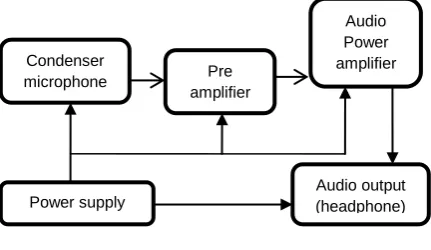
2.3 Block diagram
The block diagram of hearing aid is given below:
.
Fig. (a). block diagram of hearing aid
Condenser microphone:
Hearing aid microphones must be tiny, have high signal-to-noise ratio, be relatively insensitive to vibration from the nearby speaker, and operate at low hearing aid battery voltages.
The basic technology in microphone condenser is size reduction which maintains high signal-to-noise ratios. As hearing loss becomes ever more common, people will look for Smaller, more efficient, higher quality hearing aids. At the start of hearing aid signal chain, microphones sense voice and other ambient sound, so improved audio capture can lead to higher performance and lower consumption throughout the signal chain.
The acoustical signals converted into electrical signals by microphone and processed by the hearing aid’s audio signal chain. Many different types of technologies are used for this acoustic-to- electrical transduction, but condenser microphones have emerged as the smallest and most accurate.
The diaphragm in condenser microphone moves in response to an acoustic signal. This motion causes a change in capacitance which is then used to produce an electrical signal.
Pre amplifier Condenser
microphone
Audio output (headphone) Power supply
[image:3.595.295.511.115.240.2]© 2017, IRJET | Impact Factor value: 5.181 | ISO 9001:2008 Certified Journal | Page 2693
Pre-amplifier:
Here pre-amplifier is used to amplify the weak signals so that it can be heard properly. Many people lose there their hearing power because of old age or due to hearing loud music or because of any other reason. So to amplify the weak signals we can use circuit which is as similar to common audio amplifier. Advantage of this circuit is high sensitivity; it consumes low current and uses commonly available components and light weight.
Audio-amplifier:
An audio power amplifier is an electronic amplifier that strengthens low power, inaudible electronic audio signals. Power amplifier makes the signal audible to listeners. Key design parameters for audio power amplifier are frequency response, gain, noise and distortions. The increase in gain often leads to undesirable increase in noise and distortion.
Here LM 386L IC is used as low voltage audio power amplifier. It is designed for use in low voltage consumer application. The gain is internally set to 20 o keep external part count low but the addition of an external resistor and capacitor will increase he gain to any value up from 20 to 200 db.
Headphone:
The headphones are used here as hearing impaired earphones which are a personal sound amplifying device worn by individuals for enhancing their hearing through increasing the volume of sounds and spoken words. Conventional voices are boosted by hearing impaired earphones.
Power supply:
Hearing aids require a steady power supply in order to work properly, because even subtle changes in power
output can affect performance, clarity, and volume control. Different hearing aids require different types of batteries.
In hearing aid we mostly use batteries because we can replace batteries easily instead of a power supply. When the battery dies, it should be removed immediately. A completely discharged battery may become difficult to remove from the small device because of swelling.
2.4 Circuit diagram
Hearing aid uses microphone that is condenser microphone. Microphone needs a voltage supply, it get current with battery pass through resister R1=10k. Sound signal from microphone will be conducted through capacitor C1=0.1µf to amplify the signal. Capacitors C11 and C12 are called coupling capacitors. They are used to block DC components in the input and outputs of the pre-amplifier.
The pre-amplifier consist of resister R5 and capacitor c13 that decouples the power supply of the preamplifier stage. Capacitor C12 and resistors, R2, R3 and R4 with transistor T1forms a negative feedback amplifier which stabilizes the overall gain (A). Resistor, R4 is known as an emitter swamping resistor which also adds stability to the amplifier.
Fig. (b). Circuit diagram of hearing aid
[image:4.595.317.555.549.685.2]© 2017, IRJET | Impact Factor value: 5.181 | ISO 9001:2008 Certified Journal | Page 2694 IC and those external components needed to make the IC
function properly. This other external components are capacitors C14, C15, C16, C17, C18 and resistors R6 and R7. Resistor R5 and capacitor C13 form an RC decoupling circuit which are connected across the power supply to smooth out noise. Finally an earphone is used in the output Unit. [3]
RESULT:
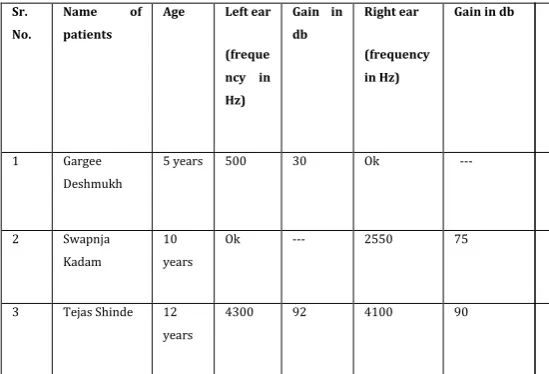
People uses hearing aid when they suffer from hearing impairments for testing hearing capacity on patient we had visited School of Audiology, Bharati Vidhyappeth Deemed University, Pune. They permitted us to test our instrument on their patients, who were suffering from partial or total hearing impairment.
Sr. No.
Name of
patients
Age Left ear
(freque ncy in Hz)
Gain in db
Right ear
(frequency in Hz)
Gain in db
1 Gargee
Deshmukh
5 years 500 30 Ok ---
2 Swapnja
Kadam
10 years
Ok --- 2550 75
3 Tejas Shinde 12
years
4300 92 4100 90
Table no. (A). Testing of patient’s right and left ear.
Procedure for patient:
-connect battery to the hearing aid circuit.
- Switch on hearing aid
- Place headphones in patient’s ear
-Vary the potentiometer to adjust the frequency for hearing
-Take the reading of frequencies.
CONCLUSION:
Hearing aid is a small electronic device used as an artificial ear. This device works on as like hearing mechanism of human. In future hearing aid will be completely wireless and will be lighter than the current version. This device is available in variety of styles for wearing. If we put sound in hearing aid the increased decibel sound come out of the aids. As this is because hearing aid amplifies sound, particularly speech for people with hearing impairment. The normal human hearing frequency is 20 Hz to 20 KHz but people having hearing loss cannot hear at this frequency so we have to increase the frequency until they can listen. This what hearing aid does for the diagnose the hearing loss. So people having hearing impairment can communicate consequently.
ACKNOWLEDGMENT:
We express our profound gratitude to electronics department for allowing us to proceed with the project and also for giving us full freedom to access the lab facilities.
Our heartfelt thanks to our guide Prof. S. p. Tondare, Assistant Professor, Department Of Electronics, Bharati Vidhyapeeth College of Engineering, Pune, India, for taking time and helping us through our project. She has been a constant source of encouragement without which the project might not have been completed on time. We are very grateful for her guidance.
[image:5.595.30.305.376.563.2]© 2017, IRJET | Impact Factor value: 5.181 | ISO 9001:2008 Certified Journal | Page 2695
REFERENCES:
1] R. S. Khandpur, ”Handbook of Biomedical Instrumentation “(SecondEdition), Tata McGraw-Hill Education, 2003
2]Mrs. Neelam Joshi 1, Prof. Dr.M.T.Kolte2 Computer Dept., MITCOE,
Pune,India1 E&TC Dept., MITCOE, Pune, India2,”DIGITAL HEARING AID –
A REVIEW” Vol. 1, Issue 8, November 2013
3] Yusuf M.A1, Zainab U.S1, M.I Ilyasu2, I.B. Shehu3, I H Jibrin5, S. Abdullahi4,
1Department Of Electrical Engineering Sokoto State Polytechnic,
2Department Of Physics Sokoto State Polytechnic,3Nuhu Bamalli
Polytechnic, Zaria, 4Department Of Physics Usmanu Danfodiyo University,
Sokoto, 5Federal Psychiatric Hospital, Kware, Sokoto “Design and Construction of Hearing Aid Device” (Jul. - Aug. 2013)
4] Domtau, D.L.1,Chagok, N.M.D.2,Akparanta, P.H.3, Fom, T.P.4, Mado, S.D.5 1, 2, 3, 4&5 Department of Physics, University of Jos, Nigeria *E-mail of the
corresponding author: [email protected],” DESIGN AND
CONSTRUCTION OF A LOW-COST HEARING AID” , International Journal of Scientific & Engineering Research, Volume 4, Issue 9, September-2013 1999 ISSN 2229-5518.
5] Kinsler, L.E. Frey, A.R., Coppers, A.B.and Sanders, J.V. (1982).Fundamentals of Acoustics 3rdedn. NewYork: John Wiley and Sons, 480.
6] Ravinder Grewal (4thyear MBChB) & John Irwin (Consultant in Audiological Medicine) Correspondence to: Ravinder Grewal: [email protected] “Innovative ways hearing aids can be improved for clinical use A Literature Review”, © 2012 Scottish Universities Medical Journal, Dundee Electronically Published SUMJ ‐007Published online: July2012Grewal R & Irwin J (2012). Innovative ways hearing aids can be improved for clinical use: Literature Review.
BIOGRAPHIES
Prof. S. P. Gaikwad, Department of Electronics, Bharati Vidyapeeth College of Engineering, Pune, India. Sonali Lokare, B.Tech Biomedical, Department of Electronics, Bharati Vidhyapeeth College of Engineering, Pune, India.
Diksha Bolshette, B.Tech Biomedical, Department of Electronics, Bharati Vidhyapeeth College of Engineering, Pune, India.
Sonupriya Langote, B.Tech Biomedical, Department of Electronics, Bharati Vidhyapeeth College of Engineering, Pune, India.