2018 International Conference on Computer, Electronic Information and Communications (CEIC 2018) ISBN: 978-1-60595-557-5
Digital Road Construction Connected Site
Andrey OSTROUKH
*and Nataliya SURKOVA
Moscow Automobile and Road State Technical University (MADI), Russian Federation
*Corresponding author
Keywords: Cloud service, Internet of Things (IoT), Road Construction Information Modeling (RCIM), SMART construction, Fleet Management Systems (FMS), Project monitoring system.
Abstract. Paper proposes the concept of Digital Road Construction Connected Site, that integrates the processes of interaction control systems road construction machinery. On the system tasked motion control construction machinery and spatial position and its working bodies, dispatching transport operations in real time. Search technologies appropriate to the level of economic justification of the main criterion of promotion of automation in the roads construction. Pairing interactive modeling with intelligent data frees engineers and architects to quickly analyze changes and design options in the physical environment. The potential impact is huge for saving time on rework, accelerating the building phase, and producing higher-quality projects.
Introduction
Digital transformation journey has to be adopted in order to stay competitive. The road construction productivity in general is largely left behind, compared to other industries, due to the slow digital transformation movement. Poor planning, lack of automation, insufficient communication, inadequate risk management, and unsophisticated supply chain practices are the major factors hampering productivity and causing significant cost and time overruns.
The need to boost productivity, coupled with the need to minimize project overruns and the reliance on unskilled labor, is the top driver for digital transformation in the road construction. In addition, the combination of new mega trends like urbanization, connectivity & convergence, smart is the new green, artificial intelligence, and other social trends are driving transformational changes in the industry. Ultimately, the move toward digital transformation will be inevitable for the road construction.
Digital Road Construction Connected Site helping you manage and share information in real-time using the Internet [1,2].
Road Construction Information Model
Road construction projects are ever more complex and larger in scale. The growing demand for environmentally sensitive construction means traditional practices must change. And the shortage of skilled labor and supervisory staff will only get worse. These are deep issues that require new ways of thinking and working.
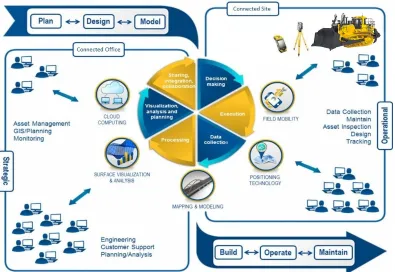
These challenges highlight the need for a technology-enabled solution that can potentially streamline a Road Construction Information Model (Figure 1). The key lies in facilitating more collaborative decision-making across the organization and beyond. By implementing mission-oriented solutions that connect the work of stakeholders in the field and office, organizations can reap the rewards of collaborative action and higher operational efficiency.
Figure 1. Road Construction Information Model.
Another benefit is the ability to offer construction plans that are optimized on the basis of a predetermined construction scope. Furthermore, by collecting various types of data during work, information regarding the results of all work can be saved, which is not only useful for managing the progress of current construction work, it can also be applied to simulations for subsequent construction plans. This chain of services organically unifies people, construction sites, and construction equipment, providing a three-pronged unit which transforming to Digital Road Construction Connected Site based Internet of Things Cloud Service.
Internet of Things Cloud Service
The Internet of Things (IoT) is a reality in many other sectors; sensors and wireless technologies enable equipment and assets to become “intelligent” by connecting them with one another [3 – 6]. On a construction site, the Internet of Things would allow construction machinery, equipment, materials, structures, and even formwork to “talk” to a central data platform to capture critical performance parameters. Sensors, near-field-communication (NFC) devices, and other technologies can help monitor productivity and reliability of both staff and assets [7, 8].
A major service provided by collecting and storing the aforementioned data is the IoT Cloud Service (Figure 2), based Microsoft Azure. The various data originating at construction sites is collected using DataStax Enterprise (Apache Cassandra), Azure BLOB Storage, Azure SQL Database, and Azure HDInsight (Apache Spark), and can then be used from various applications.
IoT Cloud Service ascertains work conditions, collecting information regarding the bucket edge position of an excavator can generate approximately five sets of data every second per machine [9, 10]. If 10 excavators were operating at a construction site, an amount of data exceeding 1 million records would be collected in a six-hour period.
Figure 2. Internet of Things Cloud Service.
Because UL Systems already supported Azure, we were able to deploy Apache Cassandra without any problems. DataStax Enterprise (DSE) was selected because it was often mentioned as a product with enhanced support functions for operational management, including backup and restoring, visual monitoring, and support for periodic maintenance work.
Fleet Management Systems
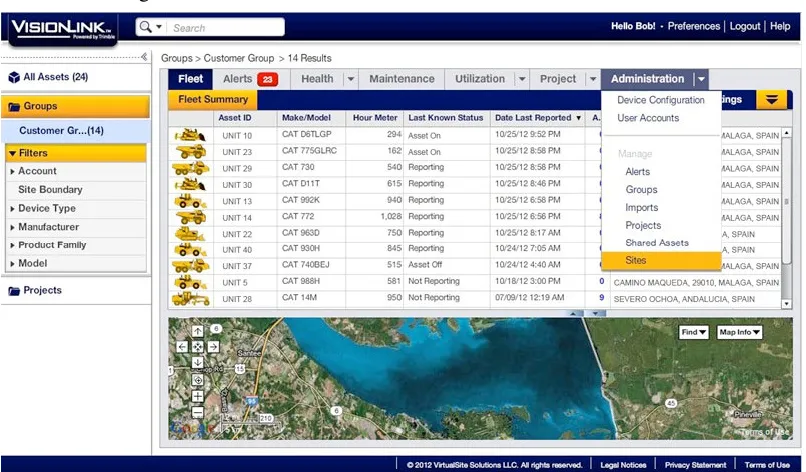
Fleet Management Systems (FMS, Figure 3) offers a unified view of health, location and productivity for the entire fleet, regardless of manufacturer.
Figure 3. Fleet Management Systems.
FMS applications are mobile-ready, with faster and better performance. Easily navigate through the intuitive interface and leverage telematics device information to improve your return on investment.
[image:3.612.105.508.421.657.2]No matter what brand of machines you own, FMS is designed to help better manage a mixed fleet from a desktop computer, laptop, tablet or mobile device.
Developed with the fleet or equipment manager and owner/operator in mind, FMS user-friendly screens display information such as: hours, miles, fuel, odometer, locations, idle time, asset status, asset utilization and operation, and customer-defined asset states. FMS ready for quick load times, simplified screens, easy-to-read content and simple navigation.
Road Construction Project Monitoring System
[image:4.612.106.508.235.500.2]Road Construction Project Monitoring System (RCPMS, Figure 4) helping you manage and share information in real-time using the Internet. Whether you're in the office working on a design or in the field working on a machine, you'll be in the know.
Figure 4. Road Construction Project Monitoring System. Feature and benefits:
• integrates with Digital Road Construction Connected Site applications and Connected Office (see Figure 1);
• capture cycle counts, load counts and material volumes;
• monitor completed work, map pass counts and create progress reports to keep projects on time and budget;
• make proactive decisions regarding production efficiency and minimizing costs.
With secure hosting, unlimited data retention, upgradeable storage plans and data back-up, RCPMS make your workflow easier and more productive. RCPMS sending email notifications and alerts to the site and office, file sharing and automatic file synchronization.
Summary
One reason for the industry’s poor productivity record is that it still relies mainly on paper to manage its processes and deliverables such as blueprints, design drawings, procurement and supply-chain orders, equipment logs, daily progress reports, and punch lists. Due to the lack of digitization, information sharing is delayed and may not be universal. Owners and contractors therefore often work from different versions of reality. The use of paper makes it difficult to capture and analyze data; that matters because in procurement and contracting, historical performance analytics can lead to better outcomes and risk management.
Owners and contractors are beginning to deploy digital-collaboration and field-mobility solutions. Several large project developers have already successfully digitized their project-management work flows.
References
[1] Ostroukh, A.V. (2013). Systems of Artificial Intelligence in the Industry, the Robotics and the Transport Complex. Krasnoyarsk, RU: Publishing House Science and Innovation Center, Ltd.
[2] Ostroukh, A.V. & Surkova N.E. (2015). Intelligence Information Systems and Technologies. Krasnoyarsk, RU: Publishing House Science and Innovation Center, Ltd.
[3] Nikolaev A.B., Vasuhova S.A., Ostroukh A.V. Automated Systems and Industrial Robots Remote Control//SGEM2014 Conference Proceedings, ISBN 978-619-7105-10-0/ISSN 1314-2704, June 19-25, 2014, Vol. 1, 51-56 pp. DOI: 10.5593/SGEM2014/B21/S7.007.
[4] Ostroukh A.V., Mezencev K.N., Krasnyanskiy M.N., Punam J., Surkova N.E. Simulated Operation of the Computer Network//SGEM2015 Conference Proceedings, ISBN 978-619-7105-34-6/ISSN 1314-2704, June 18-24, 2015, Book2 Vol. 1, 299-306 pp. DOI: 10.5593/SGEM2015/B21/S7.037.
[5] Ostroukh A.V., Krasnyanskiy M.N., Obukhov A.D., Karpov S.V., Dedov D.L. Development of Automated Information Systems for Monitoring of Intellectual Activity Results//SGEM2015 Conference Proceedings, ISBN 978-619-7105-34-6 / ISSN 1314-2704, June 18-24, 2015, Book2 Vol. 1, 101-108 pp. DOI: 10.5593/SGEM2015/B21/S7.014.
[6] Ostroukh A.V., Nikolaev A.B., Surkova N.E., Krasnyanskiy M.N. Development of Laboratory Work for Remote Access Laboratory//SGEM2014 Conference Proceedings, ISBN 978-619-7105-10-0/ISSN 1314-2704, June 19-25, 2014, Vol. 1, 119-126 pp. DOI: 10.5593/SGEM2014/B21/S7.016.
[7] Ostroukh, A. V., Nedoseko, I. V., Surkova, N. E., & Bulatov, B. G. (2016). Automated Control System for the Milling Unit of Mineral Powders Plant. International Journal of Applied Engineering Research, 11(4), 2625-2628.
[8] Ostroukh, A., Maksimychev, O., Nikolaev, A., Kolbasin, A., & Nedoseko, I. (2016). Development of automation of the drying and milling unit for the mineral powders plant. ARPN Journal of Engineering and Applied Sciences, 11(9), 5717-5721.
[9] Maksimychev O.I., Ostroukh A.V., Zbavitel P.Yu., Ivakhnenko A.M., Ephimenko D.B., Karelina M.Y. Technology of Monitoring and Control Algorithm Design for Earth-Moving Machine// International Journal of Applied Engineering Research. 2016. Vol. 11. No 9. pp. 6430-6434.