14th International Conference on Wireless Communications, Networking and Mobile Computing (WiCOM 2018) ISBN: 978-1-60595-578-0
Adjusted Probabilistic Broadcasting for Hovering Information
Xiaoying Shuai1
ABSTRACT
Hovering information is generated by specific area in a mobile ad hoc network (MANET) to be attached to the anchor area for some time. To improve the reachability, flooding is a fundamental mechanism with hovering information. Probabilistic flooding schemes are proposed to deduce the number of broadcasts. This paper proposed an adjusted probabilistic broadcasting (APB) for hovering information. Hovering node broadcasts hovering information with p1 when an uninformed node enters the range of hovering node. Nodes within hovering area relay the received hovering information with probability p2. The probability p1 and
p2 are decided by informed and uninformed neighbors, respectively. The analysis shows that the APB outperforms other candidate hovering information algorithms in terms of the number of broadcasts.
INTRODUCTION
Messages such as emergency messages, commercial advertisements must continue to be attached to the anchor area for some time to transmit the messages to new mobile ad hoc network nodes that enter the area. To float message within the anchor area, hovering information is proposed [1].
Mobile ad hoc
MANET [2]is a temporary dynamic network include many wireless mobile nodes, and it does not use any fixed network infrastructure. Node is free to move randomly and can exchange message directly with another mobile node within the range of radio transmission. When a destination that is located outside source node's radio radius, packets are stored and forwarded through a sequence of intermediate nodes. The all nodes in a MANET are required to participate in the relay of packets on behalf of other nodes.
VANET is vehicular MANET that has appeared over the past few years. VANET can provide safety and convenient services through wireless communications between vehicles that brings people with new functions and applications such as emergency services. However, VANET is confronted with many
1
great challenges due to fast changing network topology. It is an important problem to study an efficient and reliable solution for packets dissemination in a VANET [3].
Broadcast is a fundamental method in wireless networks such as route request, data dissemination and other. All nodes within the radio range can receive data transmitted by source. However, broadcast maybe result in redundant rebroadcast packets. Blindly flooding causes broadcast storm problem, collision problem, and increase delay [4]. To optimize broadcast in MANET, several schemes are proposed such as probabilistic broadcast [5,6], broadcast based on neighbor [7,8].
Hovering information
Hovering information is an information dissemination scheme in MANET. It was first proposed by A. Villalba and D. Konstantas, and a more elaborate and definition are provided by [9]. Alfredo A. Villalba Castro defined formally hovering information later in [10].
Some application, such as emergency messages in a MANET, as well as traffic accident and traffic congestion in the VANET, can generate a piece of floating information. The area around the source node is called hovering area. It is very important for each node residing in the hovering to be informed of the emergency to take effective and valid ways. Every node in hovering area stores and rebroadcasts the hovering information to suspend the information in the anchor area.
RELATED WORKS
A few researches have been done on disseminating information in MANET. This section reviews the epidemic routing and adaptive probability flooding protocol of hovering information in MANET (VANET).
Epidemic routing
In a MANET or VANET, due to a source and a destination are not always direct connect there must be a routing (such as DSR and DSDV, et al.) to deliver this messages through intermediate nodes. But these routings are limited to fully connected networks. In fact, there are disconnected portions of VANET due to the mobility of the nodes and limitations in radio range. The presence of such scenarios where the connection path from the source to the destination is not always available.
node through node mobility, two nodes exchange message. The message spread into additional island of nodes, so achieve high delivery ratios.
Adaptive probability flooding (APF)
Andreas Xeros [13] proposed an algorithm using adaptive probabilistic flooding to float information in VANET. APF used epidemic route inside the anchor area and probabilistic flooding outside the anchor area. Vehicles outside the anchor area received the information then rebroadcast it with probability p given by Eq. 1.
2 2
2
d
e
p (1)
The σ is a design parameter representing the standard deviation, d represents the distance from vehicles to the hovering area. The parameter σ is computed online and complexly based on the connectivity.
Because of possible partitioning of the network in some areas with sparse nodes, some nodes maybe not receive the hovering information. The epidemic routing approach can alleviate the problem. Those informed vehicles can store and forward the message serving as information bridges. With the mobility of informed vehicles, the hovering information may be relayed to the partitioned uninformed areas. However, epidemic routing within the anchor area will generate a lot of broadcast packets lead to broadcast storm problem and high latency in high traffic density network. Adaptive probability flooding reduces large number of redundant messages.
ADJUSTED PROBABILISTIC BROADCASTING
Adaptive probability flooding protocol reduces large number of redundant messages of hovering information based on epidemic routing and increases the achieved reachability of message. To reduce the complexity of p and the number of broadcasting, a new probability flooding based on neighbor discovery is proposed.
As shown in figure1, the nodes in the communication range can exchange neighbor information with each other through the neighbor discovery procedure, shown as follow. Each node has a neighbor list to store its current neighbors.
Procedure Discover neighbor
Send hello message to find neighbor;
Exchange(Node ID, Hovering information ID, ...); Update owe neighbor node list;
If Hovering information ID≠NULL then Set Node.hoveringflag=1;
R R
neighbor information (Node ID, Hovering information ID,...)
Uninformed node
Informed node
[image:4.612.135.488.425.521.2]R Transmission radius
Figure 1. Neighbor discovery.
Algorithm of adjusted probabilistic broadcasting
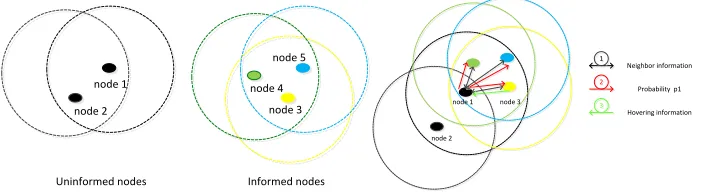
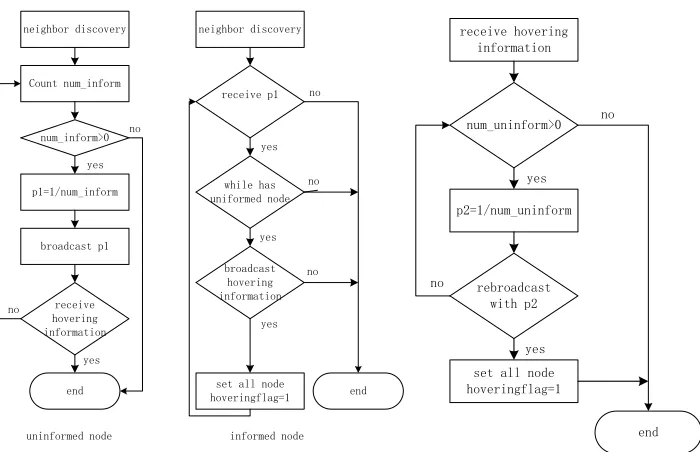
As shown in figure 2, when an uninformed node1 enters the range of hovered node3, node1 maybe trigger the hovering information broadcast. The process is shown in figure 3. First, node1 traverses its neighbor list to count the number of informed and uninformed neighbors respectively. Then, node1 computes and broadcasts the probability p1 if the num_inform (number of informed neighbors) is not zero. The probability p1 is determined by num_inform dynamically. Let
p1=1/num_inform. Any hovering neighbor that receives the probability will broadcast hovering information with p1 if it has uninformed neighbor.
Informed nodes Uninformed nodes
node 1
node 2 node 3
node 4 node 5
node 1
node 2
node 3
Neighbor information
Probability p1 Hovering information
1
1
2 2
3
3
Figure 2. Network topology change.
neighbor discovery
Count num_inform
p1=1/num_inform
broadcast p1
receive hovering information
end yes no
neighbor discovery
while has uniformed node
broadcast hovering information
set all node hoveringflag=1
receive p1
end no
no
no yes
yes
yes
uninformed node informed node
num_inform>0
yes no
receive hovering information
num_uninform>0
p2=1/num_uninform
set all node hoveringflag=1
rebroadcast with p2
end yes
yes
no
[image:5.612.105.455.81.307.2]no
Figure 3. Hovering information broadcast. Figure 4. Hovering information relay.
First, node1 checks its neighbor list to count the number of uninformed 1-hop neighbor nodes. If num_uninform>0, let p2=1/num_uninform. Second, node1 broadcasts the message with p2. Finally, node1 sets hoveringflag of all node in list to 1 if hovering information is broadcasted. The process is shown in figure 4.
Performance analysis
We analysis the number of broadcast message of the adjusted probabilistic broadcast (APB) in the scenario descripted in paper [13]. N= {5,10,15,20}, average number of neighbors is obtained by Eq.2 [13]. Through analysis, the number of message broadcast by APB is less than that of APF.
𝐸[𝑋] = 𝑁4𝜋𝑅+𝜋𝑟8𝑅22−𝑟2(2)
CONCLUSIONS
other. The result of analysis shows the APB outperforms APF in terms of the number of message.
In the future, we will use more realistic simulations of scenario and network. Use RGG to establish more accurate model for analysis and optimization.
ACKNOWLEDGEMENT
This research was supported by the Taizhou University Foundation for the Talents (QD2016035).
REFERENCES
1. Alfredo Villalba and D. Konstantas. 2006. “Towards hovering information”, the first European Conference on Smart Sensing and Context.
2. Subir Kumar Sarkar. 2012. “Ad Hoc Mobile Wireless Networks Principles, Protocols and Applications”, CRC Press.
3. D Tian, Jianshan Zhou and Yunpeng Wang, et al. 2016. “An Adaptive Vehicular Epidemic Routing Method Based on Attractor Selection Model”, Ad Hoc Networks, 36(2):465-481. 4. Yuchee Tseng, Sze Yao Ni and Yuhshyan Chen, et al. 2002. “The broadcast storm problem in a
mobile ad hoc network”, Wireless Networks, 8(2):153-167.
5. Yoav Sasson, David Cavin and Andre Schiper. 2003. “Probabilistic broadcast for flooding in wireless mobile ad hoc networks”, Conference on Wireless Communications and Networking. 6. Jie Wu and Fei Dai. 2003. “Broadcasting in ad hoc networks based on self-pruning”, IEEE
INFOCOM.
7. H. Lim and C. Kim. 2001. “Flooding in wireless ad hoc networks”, Computer Communications, 24(3-4):353–363.
8. W. Peng and X. Lu. 2001. “An efficient broadcast protocol for mobile ad hoc networks”, Journal of Science and Technology, 16(2):114-124.
9. Giovanna Di, Alfredo Villalba and D. Konstantas. 2007. “Dependable Requirements for Hovering Information”, the 37th Annual IEEE/IFIP International Conference on Dependable Systems and Networks.
10. Alfredo Villalba, Giovanna Di and D. Konstantas. 2008. “Hovering information- Self-Organising information that Finds its Own Storage”, International IEEE Conference on Sensor Networks, Ubiquitous and Trustworthy Computing.
11. A. Demers, D. Greene and C. Hauser, et al. 1997. “Epidemic Algorithms for Replicated Database Maintenance”, http://static.aminer.org/pdf/PDF/001/066/186/ maintenance.pdf.
12. Amin Vahdat and David Becker. 2000. “Epidemic routing for partially connected ad hoc networks”, http://www.doc88.com/p-9743109134523.html.