Open Access
Research article
Divided by a lack of common language? - a qualitative study
exploring the use of language by health professionals treating back
pain
Karen L Barker*
1,2, Margaret Reid
3and Catherine J Minns Lowe
1,2Address: 1Physiotherapy Research Unit, BRU, University of Oxford & Nuffield Orthopaedic Centre NHS Trust, Oxford, OX3 7LD, UK, 2School of Health Sciences, University of Birmingham, Birmingham, B15 2TT, UK and 3Qualitative Researcher at Margaret Reid Research and Planning, Scotland, UK
Email: Karen L Barker* - [email protected]; Margaret Reid - [email protected]; Catherine J Minns Lowe - [email protected]
* Corresponding author
Abstract
Background: The importance of using a common language when communicating to others about back pain is acknowledged in the literature. There are broadly three areas where difficulties in communication about back pain arise. Firstly, patients seeking information from health care professionals can experience difficulties understanding them and the medical literature; secondly, misunderstandings among health professionals concerning terminology can arise. Thirdly, the lack of standardised definitions for back pain terms can make comparison of research studies problematic. This study aims to explore the meanings and issues surrounding the use of existing medical terms for back pain from the perspective of health care professionals, lay people who have consulted health care practitioners for back pain and lay people who have not seen a health care professional regarding back pain.
Methods: A series of focus groups were used to explore participants' understanding. A purposive sampling approach was used to achieve a sample which included general practitioners, chiropractors, osteopaths, physiotherapists, and lay people. Focus groups were facilitated by an independent professional qualitative researcher. They were audio taped and full transcripts of each focus group underwent line by line analysis, identifying concepts and coded. Constant comparison was used to allow each item to be checked or compared against the rest of the data
Results: Lay participants understood the majority of the terms explored in the group differently to the health professionals. The terms, as understood by the lay participants, can be split into three broad categories. Firstly, terms which were not understood or were misconstrued and which had inadvertent negative connotations or implications. Secondly, terms which were not understood or were misconstrued, but without this leading to negative emotional responses. Thirdly, terms which were understood by lay participants as the health professionals stated they intended them to be understood.
Conclusion: Few of the existing medical terms were understood and accepted by lay participants in the way discussed and expected by health professionals. Misunderstandings, unintended meanings and negative emotional responses to terms were common within the study focus groups.
Published: 5 October 2009
BMC Musculoskeletal Disorders 2009, 10:123 doi:10.1186/1471-2474-10-123
Received: 31 December 2008 Accepted: 5 October 2009
This article is available from: http://www.biomedcentral.com/1471-2474/10/123 © 2009 Barker et al; licensee BioMed Central Ltd.
Background
Back pain is common. Two UK surveys report the lifetime prevalence of back pain as 59% [1,2] and 7% of the adult population consult with back pain in any one year [3]. Although common, the management of back pain is not straightforward and many patients continue to have long term back pain [4]. The importance of using a common language when communicating to others about back pain is acknowledged [5].
There are broadly three areas where difficulties in commu-nication about back pain arise.
Firstly, patients seeking information from health care pro-fessionals can experience difficulties understanding them and the medical literature [5,6]. The use of jargon and of medical models rather than patient-centred lay models, together with poor communications skills from profes-sionals are all considered contributing factors [6]. It is therefore important to shift from medical and scientific classification and terminology to a language understand-able to lay people to develop a shared health care pro-vider-patient language [5]. Furthermore, patients and professionals appear to define terms differently leading to misunderstandings when both think they are talking on common ground by using particular jargon [7,8]. Sec-ondly, misunderstandings among health professionals concerning terminology can arise. Multiple back pain classification systems and terms exist and many health professionals use medical terms in various ways reflecting habit, experience, personal views and professional back-ground [5]. This can hinder effective communication between professionals [9]. Thirdly, the lack of standard-ised definitions for back pain terms can make comparison of research studies problematic [10].
During a previous qualitative study exploring the views of lay people regarding the development and use of mass media interventions for health-care messages about back pain, it became apparent that further research was required to explore the issues surrounding the use of back pain language and terminology identified in the research [8]. Misunderstandings and unintended meanings for common back pain terms were observed. This study aims to explore the meanings and issues surrounding the use of existing terms regarding back pain, commonly used by health care professionals, lay people who have consulted health care practitioners for back pain and lay people who have not had back pain.
Methods
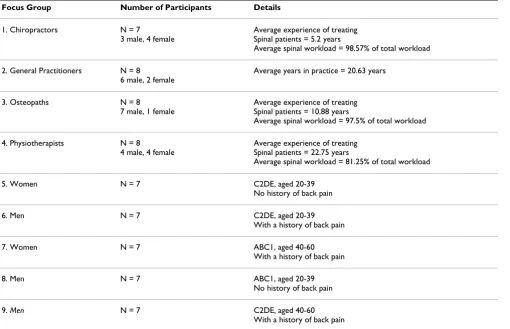
SampleA purposive sampling approach was used to achieve a sampling frame which included general practitioners, chi-ropractors, osteopaths, physiotherapists and lay
partici-pants. (Table 1). The sampling frame for lay participants included men and women, a broad spread of socio eco-nomic groupings and ages and those with and without experience of back pain. All those with experience of back pain had sought professional help. Fifty percent of C2DE Socio Economic Group Members had manual occupa-tions. Non English speakers were excluded. All health pro-fessionals worked in Birmingham or the West Midlands region and all lay participants lived in the West Midlands.
Focus Groups
Participants were approached and recruited by an inde-pendent professional qualitative research agency. Lay par-ticipants were approached on the street and were invited to a local focus group, which were held at convenient hotel venues. Health care professionals were approached by telephone and profession specific groups for Chiro-practors, General Practitioners, Osteopaths and Physio-therapists were held, again at convenient hotel venues. Informed consent was sought at the groups. Participants were offered refreshments, and given either a £30 shop-ping voucher (lay participants) or £60 (health care profes-sionals). Groups lasted for approximately one hour. All focus groups were lead by MR, an independent profes-sional qualitative researcher. A list of medical terms was presented individually; verbally and also written on cards. The list was not intended to be exhaustive. Terms were identified from multiple sources including journals, text-books and local copies of medical correspondence pro-vided to patients. The list of terms was used in reverse order in four groups to minimise order effects. The Sched-ule can be seen in Table 2 and the terms in Table 3. Ethics approval for the study was sought and attained -REC ref-erence number: 05/Q1605/62.
Data Analysis
coding in order to remain close to the data, and to chal-lenge any a priori assumptions. However, it is important to recognise that this process is an interpretative act and does not aim at scientific truth. The aim is to provide deeper understanding of human motivation and behav-iour.
Triangulation proposes that by using multiple ways of looking at the same thing we can converge on the truth [12] The philosophical underpinning of this piece of qual-itative research suggests that our aim is not to converge on reality, and that there will always be multiple perspectives (realities). In this study an independent researcher
re-ana-Table 1: Summary of groups
Focus Group Number of Participants Details
1. Chiropractors N = 7
3 male, 4 female
Average experience of treating Spinal patients = 5.2 years
Average spinal workload = 98.57% of total workload
2. General Practitioners N = 8
6 male, 2 female
Average years in practice = 20.63 years
3. Osteopaths N = 8
7 male, 1 female
Average experience of treating Spinal patients = 10.88 years
Average spinal workload = 97.5% of total workload
4. Physiotherapists N = 8
4 male, 4 female
Average experience of treating Spinal patients = 22.75 years
Average spinal workload = 81.25% of total workload
5. Women N = 7 C2DE, aged 20-39
No history of back pain
6. Men N = 7 C2DE, aged 20-39
With a history of back pain
7. Women N = 7 ABC1, aged 40-60
With a history of back pain
8. Men N = 7 ABC1, aged 20-39
No history of back pain
9. Men N = 7 C2DE, aged 40-60
[image:3.612.57.567.101.430.2]With a history of back pain
Table 2: Focus Group Schedule
Groups Questions used to facilitate focus groups
For all groups Do you think the language/type of words you use when you see your Patient/GP etc matters? Why? How?
For each term: What do you think this word/phrase means? What do you think other people think it means (e.g. such as patients, GPs etc) What do you think having an (eg.Xray, MRI) will show?
Follow up prompts used to explore the meaning and understanding of each term
For Health Professional Groups only
Are there any other words you used to describe back pain/ache to a patient?
Follow up prompts used to explore the meaning and understanding of each term
For Members of the Public Groups Only
Are there any other words that you have heard used to describe back pain? What do you think (list of health care professions in turn) do when you have back pain?
lysed the data on a line by line basis (CML) and another independent reviewer (KB) reviewed the analysis. Any dif-ferences of opinion were discussed and resolved. The aim of this was not to converge on a single truth, but to pro-vide additional perspectives [13] In this study, member checking was not practical.
Results
The results presented below focus on the findings we believe to be of most relevance to health professional readers.
Common terms do have unintended meanings or negative connotations
Lay participants understood many of the terms explored in the group differently to the health professionals. The terms, as understood by the lay participants, can be split into three broad categories. Firstly, terms which were not understood or were misconstrued and which had inad-vertent negative connotations or implications. Secondly, terms which were not understood or were misconstrued but without this leading to negative emotional responses. Thirdly, terms which were understood by lay participants as the health professionals stated they intended them to be understood. Although the lay participants who had been treated for back pain demonstrated some greater insight into some very specific terms, generally the areas and levels of understanding or misconception were simi-lar to non back pain sufferers. The research demonstrated that familiarity with a term is no guarantee of understand-ing. At least one person in each group discussion with the lay participants attempted to define unfamiliar terms; usually by guessing. There is insufficient space here to
present data for each term. We have chosen to focus on terms that were misunderstood by participants and had negative connotations or implications. Some of these are of particular interest as they are endorsed in low back pain clinical practice guidelines (acute, chronic, recurrent, dis-ability).
Non-specific back pain
No lay participants were familiar with the phrase non-spe-cific back pain. For some it implied that the health profes-sional did not understand the cause of their pain, or how to treat it. The phrase could suggest that the health profes-sional thought that it was "non-existent". The phrase also has implications for treatment, suggesting that the patient would be automatically referred for further investigations or opinion; "that spells referral to me." Others felt that non-specific meant that pain is not located in a non-specific place; "you would feel it all over really", or that it could not be con-nected to a specific injury or habit.
Health professionals agreed that the intended meaning of non-specific was that a cause has not yet been found, or that there was no diagnosis. However, at the same time they recognised that patients needed to know that the health professional understood the cause of pain; the term suggested that the professional "doesn't know what she's doing". They therefore said that they would not use the phrase to explain pain to patients.
[image:4.612.54.559.97.329.2]It's a posh way of saying I haven't got a clue ... it hurts our pride to put it down ... patients come to you because they want a diagnosis ... and you're not giving them one.
Table 3: summarising the responses of members of the public to terms discussed in the focus groups.
Speaking a different language - terms that could
lead to problematic misunderstandings
Speaking a different language - terms with unintended meanings but few negative repercussions
Speaking a common language - terms which the public
appeared to understand as intended
Acute (low) back pain/ache Muscle spasm
Chronic Mechanical back pain/ache Sensation
Recurrent Muscle sprain Manipulation
Muscle Weakness Muscle strain Mobilisation
Instability Sciatica Soft tissue technique
Non-specific back pain Radiated Rehabilitation Neurological involvement Muscle imbalance
Trapped nerve Nerve root pain
Paraesthesia Disc - prolapsed, slipped, Managing your back pain Herniated, ruptured
Coping Facet Joint
Psychological pain Alignment
Wear and Tear Posture
Arthritis Spondylitis
Exercise Stenosis
Acute
The lay participants were less familiar with the term acute than chronic in the context of low back pain. For some it suggested that pain was milder than chronic. For a minor-ity of the low back pain sufferers, acute means recent or current. Acute was usually understood as severe, in a spe-cific spot or sharp.
... acute could be more localized ... its acute, just one spot. Like acute appendicitis. It's just that area.
Health professionals believed that the intended usage of acute was pain of recent onset, but that lay people inter-preted acute as a term which quantifies severity of pain.
... It's a temporal thing rather than a qualitative.
Health professionals therefore did not use the term to describe pain to patients, although they did use it in patient notes.
I think patients if they go "Oh I've got acute back pain" they think it's like a quantifying factor ...that's why I don't tend to use it because ... it's incorrect language.
Chronic
The lay participants were very familiar with the term chronic in the context of low back pain. Most felt that chronic meant that the condition was very severe. To some is suggested that the pain was incurable.
Chronic means absolute, the pits.
Couple of steps from a wheelchair.
For others chronic meant long-term or constant
(Chronic) lasts as well, doesn't it? Acute can be a short period of time.
I think chronic is long-term.
Health professionals were aware that lay people inter-preted chronic as severe and or "incurable", and preferred to use phrases such as "long-term", "long-standing" and "ongoing".
It implies again something that's ... going to be there for-ever.
I don't use it that much because again it's like degenerative; it's unfair with "Is this it?" Am I going to be stuck with this?" It's scary.
Some chiropractors and osteopaths thought that chronic might reassure someone that they would receive long-term treatment.
the only time I might use things like chronic is if somebody has had a condition for a very long time and they're want-ing ... a diagnosis, then you can say this is a chronic condi-tion and they can go "OK, now I can manage it"
Physiotherapists tended to write chronic in patient notes, but not say it to patients. They recognised that patients might interpret it in different ways.
I think there are two definitions actually. One is comparing it with acute - in fact acute is like a thunderstorm if you like and chronic is like it's raining for a long time. But the patients, the elderly patients particularly often use the word chronic as something which is absolutely bloody awful.
Recurrent
In contrast to chronic, the term recurrent was interpreted by the lay participants as less severe and pain that comes and goes, whereas chronic pain never entirely going away.
You've always got chronic. It comes in waves. But recurrent it can, chronic can't ever go down to zero; you've always got something wrong.
GPs agreed that recurrent was often more accurate, useful and positive, than chronic in describing a patient's back pain.
... I don't think that [chronic] is a word I really use for patients. They know that it's chronic ...I think recurrent is more of a description of it. Chronic implies that it goes on and on and will never go away.
Physiotherapists did use the word recurrent, in particular in the context of the important educational role they have with patients.
What I often tell patients ... our role ... is really to prevent recurrence by teaching the patient how to manage his back.
Muscle weakness
The lay participants were unfamiliar with the phrase mus-cle weakness in the context of low back pain. Several described it as a condition caused by inability to exercise or move the body; that "muscles aren't exercised and giving adequate support.
Some thought that muscle weakness was permanent and that it would progress.
Health professionals were concerned that patients felt muscle weakness was permanent, or that it implied per-sonal weakness.
I use weakness if you're talking about physio, muscle strengthening exercises and that sort of thing; not very often though ... but the weakness might imply permanent ... no I wouldn't go there.
Instability
Very few lay participants were familiar with the term insta-bility. It was most often interpreted as the back could 'go' at any time.
If they get you back to working order the back is unstable because the least little thing can actually throw it off again.
Something's a bit loose ... It's liable to pop out.
Back instability was considered worrying. It tended to sug-gest a permanent condition and one from which a sufferer could never relax; "you're on a knife edge sort of thing.
It is not in a stable state so it can't be localised and control-led. It can flare up at any time, there's not a lot you can do about it.
Health professionals were aware of the negative connota-tions of the term and only used it in medical notes. Oste-opaths used the words "loose" as an alternative, as they felt that this would not worry the patient as much. One osteopath said that the advantage of using a word that might worry a patient was that it would encourage the per-son to adhere to professional advice and maintain exercise regimes.
They get a bit worried. I do use the word loose... It's a good way to almost, not scare the patients into it, but encourage patients to actually go and strengthen an area.
Chiropractors tended to avoid instability seeing it as hav-ing the potential to cause alarm, and suggesthav-ing some-thing more serious than it is.
I think sometimes the word unstable, if you put that idea instability it might panic patients a bit but again it depends on the context and the patient ... I think they just assume it's perhaps worse than it is.
Neurological involvement
Both low back pain sufferers and non-sufferers rarely came across this term. A few understood it to have
some-ents immediately mentioned heads and brains; "Something's going wrong in your head."
Some thought that neurological referred to the brain and often pointed to the base of the skull while explaining it.
Because it all stems from the brain doesn't it ... I think nerves because I think the brain ... your whole spinal cord runs up there doesn't it so your main nervous system runs up your back.
Neurological involvement was one of the most alarming of the terms used. To some, it even suggested the possibil-ity of imminent death.
When your heads involved you start worrying don't you.
Death within six months.
Could be a tumour.
Osteopaths, chiropractors and GPs said that they did not use the term neurological to explain pain to patients. This was not because they felt it might alarm the patient, but because it was not seen as useful without a diagnosis.
It's not necessary. It doesn't add anything to the descriptors that we're already using. It's too vague really.
Physiotherapists did use the phrase but stress that they always explained it, for example, in terms of loss of sensa-tion. Neurological deficit was mentioned in the Physio-therapist group as preferable to involvement because it is more accurate.
Trapped nerve
Trapped nerve was a very common phrase used by the lay participants, yet was poorly understood. Explanations were diverse. The lay participants described it as nerves stuck between bones or vertebral discs. For some this meant it was more serious, and for others, less serious. For some it involved 'inflammation'; for others, it meant no more than leading to pins and needles.
I don't know because none of these things have ever been sat and explained. It's just things that you perceive yourself.
Commonly, trapped nerve was interpreted as either the same as, or related to sciatica.
For health professionals, the term trapped nerve was introduced by patients rather than by themselves.
don't use it again ... It's another misnomer really, a bit like a slipped disc.
Health professionals were concerned that the term made the person's condition sound very serious and potentially untreatable or permanent.
I don't (use it). I tend to say nerve root irritation. Again I think trapped nerve sounds a bit drastic and negative ... irritation's something that can be alleviated or eliminated.
Some felt that trapped nerve can also be a 'catch all' cause of back pain, and sometimes they would have to correct a patient's understanding of it.
You might correct it sometimes when people talk about ... having their trapped nerve which implies that it can't move and nothing can be done and you might just explain that it's probably a nerve that has some pressure on it and then discuss the different causes of pressure and some may be alleviated easily and some may not.
Osteopaths discussed how the term trapped can mislead patients by suggesting that an expert must separate the bones to un-trap the nerve. GPs were concerned that trapped sounded unduly threatening and at the same time demanded detailed, lengthy and unnecessary explanation and so was avoided by some GPs although patients wanted to use it.
I've often avoided the phrase trapped nerve because they want to know exactly what's trapping it and if it's serious.
Wear and tear
This was a commonly used and heard phrase for the lay participants in relation to low back pain. It was inter-preted as the back "wearing out" or "being worn out" by age, work or sport. It was also described as "general disintegra-tion" of discs or bones; part of the natural process of get-ting old. In the extreme it could be seen as meaning "rotting away".
Wear and tear makes me think that something's actually diminishing. So, like a bone is getting thinner or a muscle is wearing thinner. It's shrinkage and it's unnatural. So that's what I think of wear and tear - something's rotting away.
To the lay participants, this suggested there was no treat-ment and that you just have to live with it. "Degenerative change" was recognised as an alternative to wear and tear and was defined as progressively getting worse.
No I wouldn't necessarily say age ... I think it might just be you've got one of those things. Like with arthritis it never gets better, it just gets worse.
There was also a perception that nothing could be done to treat degenerative change. There were two very different emotional responses to a diagnosis of wear and tear Some were relieved that their pain was due to wear and tear and was not something "more serious."
I'd feel relieved actually ... relieved it's nothing. I haven't got to have an operation, there's totally nothing wrong with me.
However, the majority of lay participants said that a diag-nosis of wear and tear would result in negative thoughts: I have to put up with this for the rest of my life as there is no treatment; it can only get worse; I am being fobbed off for wasting the doctor's time; I am disappointed to have no diagnosis; I am getting old before my time.
It's like they're taking the piss ... doctor sits there "Oh, it's just wear and tear."...It's quite condescending really isn't it when they say that? Especially when you're suffering
Osteopaths said that they used wear and tear rather than degeneration, thinking that it was kinder than arthritis or degeneration. Similarly Chiropractors and Physiothera-pists use wear and tear though some insist it be accompa-nied by an explanation of how wear and tear or arthritis is not necessarily serious and that something can be done.
...if you are describing wear and tear you must also say that's ok you've got this condition but we can do something to improve it.
GPs did use the phrase but replace it with more medical or technical terms, such as degenerative spine disease, for 'sick notes' or medical notes.
Arthritis
Many of the lay participants had never heard of arthritis in the context of back pain. Although the term was familiar in relation to other joints and in the elderly, knowledge of specific pathology is limited. Participants who had experi-enced back pain described it as: inflammation of the joints; bones rubbing together; crystallisation of the fluid in joints. Arthritis in backs was as particularly serious and worrying; "it means you're in big trouble". It was consid-ered incurable, untreatable and progressive, and would be particularly concerning for young people.
It'll get worse...you're diagnosed with that as you get older it's going to get worse and more painful ... There's not a lot of treatment for it that works.
We don't often use arthritis ... without specifically describ-ing ... we have to go into a lot of detail to try and help people stop being anxious, because they come in terribly anxious, don't they?
Some physiotherapists use the term because their patients are likely to hear it from other professional, and took the opportunity to explain arthritis and any likely treatment for it. Most preferred to use the phrase wear and tear.
Arthritis sounds like it's ill health and it's serious and a bit of wear and tear sounds just like living on this planet and normal and everybody in the room's got a bit. If somebody comes in and says they've got arthritis they're usually a bit more worried.
Chiropractors similarly avoid arthritis in favour of wear and tear or degeneration as perceived to be less alarming.
Oftentimes people don't want to hear they've got arthritis.
...Sometimes, people say the doctor's told me I've got arthri-tis and you say it's wear and tear it's normal ageing process they're quite relieved by that.
Osteopaths criticised those who used the word arthritis without an investigative diagnosis, and did not to use the term.
But they'll come away and I'll say "How do they know you've got arthritis?" "Oh, the doctor told me". "How does he know; did they do the blood test, did they do anything?" No, he just told me I had." ... they just tend to use it some-times and we have to somesome-times look at them and say well I don't see any arthritis I don't know where they've got that from.
Exercise and activity
For the lay participants, exercise and activity have distinct meanings and may infer these meanings upon the words used by professionals. Exercise is seen as a planned organ-ised programme either for specific back strengthening or training or general working out at a gym for example. Whereas activity means day to day movement, moving about normally, such as walking.
Exercise is always planned as opposed to activity (which is) just normal movement.
I think exercise is when you specifically go out to do like swim, go to the gym, workout. Whereas activity is your gen-eral activity during the day and how active you are...
Some professionals, but not all, believe exercise to be sim-ilar to activity and use the terms interchangeably.
You could use general exercise or general activity it means more or less the same thing.
There's prescribed exercise for your back and then there's exercises like walking and swimming but not jogging ... activity is anything...other than sitting in a chair or lying down ... activity implies normal lifestyle.
(GPs)
See Table 3 for a summary for all the terms discussed and the categories into which the terms were placed.
Discussion
Lay participants understood the majority of the terms explored in the group differently to the health profession-als. The words discussed were often not understood or were misconstrued and many had inadvertent negative connotations or implications. Although aware of some of the ways in which patients may misunderstand words, the health professionals were unaware of some important effects words had on lay people. In this study, two differ-ent pictures of back pain language and consultation dis-cussions emerged. The health professional groups showed awareness of the difficulties in communicating with back pain patients using language and reported their efforts and the strategies used to address them. The lay partici-pants generally did not feel that health professionals ade-quately explained terms and back pain in an understandable way. The findings indicate difficulties exist in the communication between professional and lay perceptions and understanding regarding back pain lan-guage and identify the need for further work designed to address this gap.
Strengths and limitations of the study
it is acknowledged that other professions have back pain patients and may use different terms and language.
Language is a component of the larger structure of com-munication but, whilst there are many studies emphasiz-ing the importance of verbal behaviours for effective health professional-patient communication [15,16], there is little research directly assessing the importance of the language used. This may be because language is consid-ered so personal, cultural, variable and non generalisable whilst key elements of communication, such as non ver-bal communication have wider applicability. The impor-tance of specific language terms and the resulting connotations of words used for specific patient popula-tions are however acknowledged [17]; Abramsky and Fletcher [17] concluded that the choice of words used to inform members of the public about prenatal diagnostic counselling may significantly affect how a genetic condi-tion or risk is perceived. Cedraschi et al [7] demonstrated the presence of a discrepancy between the theory and practice of the word 'chronic' and the possible misunder-standings that the word could produce. They conclude, and this study agrees, that the widespread use of a word can erroneously encourage the belief that everyone is talk-ing on common ground and attributtalk-ing the same mean-ing. As Klaber Moffett et al. [18] opine, why do health professionals, who know the power of words to harm, help and promote change, pay so little attention to the actual words we use? The impact of simple changes, using long term rather than chronic for example, seemed evi-dent in the lay member groups. Whether by increasing the awareness of health professionals regarding the under-standing of existing terms the language gap can suffi-ciently be addressed, or whether health professionals and lay people need to co-develop new terms is an area of fur-ther research.
The importance and process of diagnosis was raised repeatedly within groups though never raised by the mod-erator. Health professionals acknowledged that, whilst patients are keen to receive diagnoses, most importantly they want treatment. Professionals appreciate that clear diagnoses and diagnostic labels are not possible for many back pain patients [5]. However, as indicated in this study, patients may believe a diagnosis is a prerequisite for effec-tive treatment. Clear diagnoses are important; a recent review has concluded that greater attention should be paid to discussing diagnoses and causes of back pain with patients [19]. The lack of clear diagnoses and causal expla-nations can adversely affect patients; promote prolonged patient dependency [20], cause frustration [21] and impact upon patient compliance [5]. In this study, patients/former patients wanted clear diagnoses while professionals noticed patients returning to ask further
"why, what"? questions and seeking information. Back pain is known to produce complex consultations; the lack of a definitive diagnostic test, fear of being labelled with psychological pain or as a malingerer, plus the need to provide proof of suffering can all contribute to difficulties from the patient perspective [20]. Whilst health profes-sionals may wish to avoid conflict during consultations and find the application of recent research findings prob-lematic [22]. It is also likely that health professionals and patients perceive and recall diagnosis and information sharing differently; our study supports McIntosh and Shaw's [21] qualitative study finding that patients report little evidence of receiving information from most health professionals although the latter all speak of providing such information. Barriers to information sharing clearly exist and finding the right words to use in health profes-sional- patient consultations is a challenge [5].
In this study professionals continued to use words with patients which they appreciated were problematic. Either because the patient introduced them and they wished to respect the patient's language, because they lacked alterna-tive terms or because they believed that using the terms with additional explanation surmounted the difficulties created by using a problem term. Ex-patients in this study did not offer any examples where such explanations over-came the effects of a poorly perceived term but this infor-mation was not specifically sought. While the health professionals in this study believed providing patients with information is integral to practice [21], a language gap seems evident. Health professionals should not assume that simple terms are necessarily better and should be aware that the use of a widespread term does not ensure patients and clinicians understanding it simi-larly. Commonly used terms may be misunderstood and have a negative impact upon patients. Furthermore there is a need for further dialogue between health profession-als and patients regarding how present language gaps may be addressed.
Conclusion
Publish with BioMed Central and every scientist can read your work free of charge
"BioMed Central will be the most significant development for disseminating the results of biomedical researc h in our lifetime."
Sir Paul Nurse, Cancer Research UK
Your research papers will be:
available free of charge to the entire biomedical community
peer reviewed and published immediately upon acceptance
cited in PubMed and archived on PubMed Central
yours — you keep the copyright
Submit your manuscript here: BioMedcentral
verbal, needs careful consideration and attention. Inter-esting issues have been identified that need further cor-roboration in future studies.
Competing interests
The authors declare that they have no competing interests.
Authors' contributions
KB led and designed the study and secured funding. She oversaw all data coding and analysis processes and inde-pendently reviewed data coding and analysis. She drafted the manuscript. CML checked all transcriptions, inde-pendently analysed and coded the data, and co-authored the manuscript. MR recruited the participants, conducted and transcribed the focus groups and performed the ini-tial analysis for the study. All authors read and approved the final manuscript.
Acknowledgements
This work was supported by the Modernisation Agency Spinal Collabora-tive Programme and funded by the Department of Health Occupational Health Department, Department of Health Directorate of Access and Choice, Department for Work and Pensions and the Health and Safety Executive.
All authors state that this research has been carried out independently and has not been influenced in any way by the research funders.
References
1. Walsh K, Cruddas M, Coggon D: Low back pain in eight areas of Britain. J Epidemiol Community Health 1992, 46:227-30.
2. Papagerorgiou A, Croft P, Ferry S, Jayson MI, Silman AJ: Estimating the prevalence of low back pain in the general population. South Manchester Low Back Pain Survey. Spine 1995, 20:1889-94.
3. McCormick A, Fleming D, Charlton J: Morbidity statistics from general practice. Fourth national study 1991-1992 Office of Population Cen-suses and Surveys. London: HMSO; 1995.
4. Croft PR, Macfarlane GJ, Papageorgiou AC, Thomas E, Silman A: Out-come of low back pain in general practice: a prospective study. BMJ 1998, 316:1356-9.
5. Cedraschi C, Nordin M, Nachemson AL, Vischer TL: Health care providers should use a common language in relation to low back pain patients. Ballieres Clin Rheumatol 1998, 12:1-15. 6. Glenton C: Developing patient-centred information for back
pain sufferers. Health Expectations 2002, 5:319-29.
7. Cedraschi C, Robert J, Georg D, Perrin E, Fischer W, Vischler TL: Is chronic non-specific low back pain chronic? Definitions of a problem and problems of a definition. Br J Gen Pract 1999, 49:358-362.
8. Barker KL, Minns Lowe CJ, Reid M: The development and use of mass media interventions for health-care messages about back pain: What do members of the public think? Manual Therapy 2007, 12:335-341.
9. Schroeder RE, Morrison EE, Cavanagh C, West MP, Montgomery J: Improving communication among health professionals through education: a pilot study. J Health Adm Educ 1999, 17:175-98.
10. de Vet HCW, Heymans MW, Dunn K, Pope DP, van der Beek AJ, McFarlane GJ, Bouter LM, Croft PR: Episodes of low back pain: A proposal for uniform definitions to be used in research. Spine
2002, 27:2409-2416.
11. Charmaz K: Constructing Grounded Theory. United Kingdom, Sage Publications; 2006.
12. Morgan DL: Practical strategies for combining qualitative and quantitative methods: applications to health research. Qual
13. Sale JEM, Lohfeld LH, Brazil K: Revisiting the qualitative-quanti-tative debate: implications for mixed method research. Qual-ity and QuantQual-ity 2002, 36:43-53.
14. Cresswell JW: Qualitative inquiry and research design - choos-ing among five approaches. 2nd edition. Thousand Oaks: Sage Publications; 2007.
15. Beck RS, Daughteridge R, Sloane PD: Physician - patient commu-nication in the primary care office: a systematic review. J Am Board Fam Pract 2002, 15:25-38.
16. Roberts L, Bucksey SJ: Communicating with patients: what hap-pens in practice? Phys Ther 2007, 87:586-594.
17. Abramsky L, Fletcher O: Interpreting information: what is said, what is heard - a questionnaire study of health professionals and members of the public. Prenat Diagn 2002, 22:1188-94. 18. Klaber Moffett JA, Newbronner E, Waddell G, Croucher K, Spear S:
Public perceptions about low back pain and its management: a gap between expectations and reality? Health Expectations
2000, 3:161-168.
19. Vebeek J, Sengers M-J, Riemens L, Haafkens J: Patient expectations for the treatment for back pain. Spine 2004, 29:2309-18. 20. Glenton C: Chronic back pain sufferers- striving for the sick
role. Social Science and Medicine 2003, 57:2243-52.
21. McIntosh A, Shaw CFM: Barriers to patient information provi-sion in primary care: patients' and general practitioners' experiences and expectations of information for low back pain. Health Expectations 2003, 6:19-29.
22. Breen A, Austin H, Campion-Smith C, Carr E, Mann E: "You feel so hopeless": a qualitative study of GP management of acute low back pain. Eur J Pain 2007, 11:21-29.
Pre-publication history
The pre-publication history for this paper can be accessed here: