July–September 2005
Vol. 22 No. 3
pages 93-136
UPDATE
Science, Policy & Emerging Issues
School of Natural
Resources and
Environment
THE UNIVERSITY
OF MICHIGAN
Contributors
Mary Brook spent two years conducting research in an illegal mahogany hotspot for a dissertation on transnational environmental networks in Central America. She received her PhD from the Department of Geog-raphy and the Environment at the University of Texas at Austin. Mary is currently a Visiting Scholar at Dartmouth College in the Geography Department.
Curtis D. Bjurlin is a research biologist with the Endangered Species Recovery Program. He has studied the fauna of arid lands for eight years, with special interest in landscape and human dimensions. Brian L. Cypher, PhD is director of kit fox research at the Endangered Species Recovery Program. He has worked with canid populations since 1979 and is a recognized expert on the ecology of San Joaquin kit foxes.
Jeff Diez is completing his PhD at the Institute of Ecology in Athens, GA, where he has studied the population and community ecology of a variety of organisms. He is particularly interested in using hierarchical models to investigate multi-level effects on population processes and evaluate niche theory.
Bila-Isia Inogwabini’s previous work has included surveys of eastern lowland gorillas, chimpanzees, and elephants in the eastern Democratic Republic of Congo and bonobos in the Salonga National Park. Before joining the World Wide Fund for Nature/DRC Program, where he is currently the project manager for the CBFP-funded project in the Lac Tumba Landscape, he oversaw the Elephant Monitoring Program in the Odzala National Park in Congo-Brazzaville.
Omari Ilambu’s work includes inventories of great apes and other large mammals in the eastern Democratic Republic of Congo. He recently co-ordinated the Monitoring of Illegal Killing of Elephants survey in the Salonga National Park, under the Wildlife Conservation Society DRC Program. He joined the World Wide Fund for Nature/DRC Program, where he is currently the park advisor for the Salonga National Park. Wm. Robert Irvin is Senior Vice President for Conservation Programs, Defenders of Wildlife, Washington, D.C. The author is co-editor, with Donald C. Baur, of Endangered Species Act: Law, Policy, and Perspectives (American Bar Association 2002). He is a member of the summer faculty at Vermont Law School where he teaches Biodiversity Protection. David King’s interests are in avian ecology and conservation, with an emphasis on Neotropical-Nearctic migrant passerines. Dr. King’s cur-rent research includes the effects of habitat restoration on bird com -munities, habitat selection by Whip-poor-wills, patterns and potential causes of long-term population trends in subalpine bird populations in New Hampshire, and the interaction between birds and invasive plants.
Robert Ovetz, PhD is the Save the Leatherback Campaign Coordinator with the California-based Sea Turtle Restoration Project.
John Rappole is senior research scientist in ornithology and conserva-tion biology at the Smithsonian Naconserva-tional Zoological Park’s Conserva-tion and Research Center. His principal research interests are ecology and evolution of migratory birds, south Asian ornithological diversity, and environmental change threat assessment for natural communities.
Endangered
Species
UPDATE
Science, Policy & Emerging Issues
A forum for information exchange on endangered species issues
July-September 2005 Vol. 22 No. 3
Jennifer Muladore ...Editor Michele Tobias ...Editor Katia Aviles-Vazquez ... Translator Josh Baur ...Editorial Assistant Jason Good ...Editorial Assistant Elena Doucet-Beer ... Editorial Assistant Sarah Seiter ...Editorial Assistant Lauren Sullivan ...Editorial Assistant Vanessa Tobias ... Editorial Assistant Bobbi Low ...Faculty Advisor Emily Silverman ...Faculty Advisor Johannes Foufopoulos ...Faculty Advisor
Advisory Board
Richard Block
Santa Barbara Zoological Gardens
Susan Haig, PhD
Forest and Rangeland Ecosystem Science Center, USGS Oregon State University
Patrick O’Brien, PhD
ChevronTexaco Energy Research Company
Jack Ward Thomas, PhD
Univeristy of Montana
Subscription Information: The Endangered Species UPDATE is published four times per year by the School of Natural Resources and Environment at The University of Michigan. Annual rates are: $78 institution, $33 individual, $25 student/senior, and $20 electronic. Add $5 for postage outside the US, and send check or money order (payable to The University of Michigan) to:
Endangered Species UPDATE School of Natural Resources and Environment
The University of Michigan 440 Church Street Ann Arbor, MI 48109-1041 (734) 763-3243; fax (734) 936-2195
E-mail: [email protected] http://www.umich.edu/~esupdate
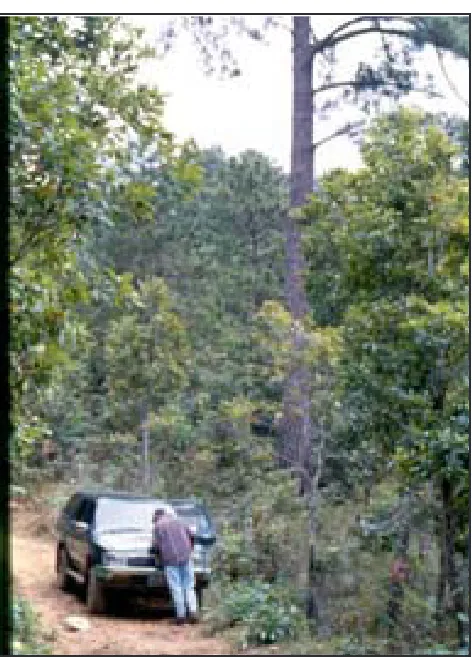
Cover: Photo of endangered mahogany trade in Nicaragua courtesy of Mary Brook.
The views expressed in the Endangered Species UPDATE
may not necessarily reflect those of the U.S. Fish and Wildlife
Service or The University of Michigan.
The Endangered Species UPDATE was made possible in
part by Chevron Corporation and the U.S. Fish and Wildlife
Abstract
Populations of Golden-cheeked Warblers (
Dendroica chrysoparia
) are
small, apparently declining, and limited to breeding in oak-juniper in
central Texas, a habitat threatened by urbanization and clearing for
cattle pastures. In addition, Texas studies indicate that oak-juniper
patches less than 50 ha in size have few breeding birds. Theoretical
work predicts that members of migratory species should be absent
from seemingly suitable breeding habitat if their populations are held
below breeding habitat carrying capacity by winter habitat
availabil-ity. A recent study using satellite imagery to calculate total amounts
of breeding and wintering habitat, along with field studies assessing
potential and actual warbler densities during the breeding and
win-tering phases of the life cycle, suggest that diminishing winter
pine-oak habitat in the highlands of southern Mexico and Central America
could limit warbler populations and cause breeding habitat to appear
underused. Conservation efforts should take into account the possibil
-ity of winter population control for this species.
Resumen
Las poblaciones de chipe (reinita, Dendroica chrysoparia) son
peque-ñas, están en aparente disminución, y limitadas a reproducción en el
hábitat de encino-junípero (roble-enebro) del centro de Texas, un
hábi-tat amenazado por la urbanización y pastoreo de ganado. Además,
estudios de Texas indican que los fragmentos de encino-junípero
(roble-enebro) de un tamaño menor de 50 ha. tienen pocos pares
re-productivos. El trabajo teórico predice que los miembros de especies
migratorias estarían ausentes de su hábitat de reproducción
aparente-mente ideal, si sus poblaciones se mantienen por debajo de la
capaci-dad de carga por la disponibilicapaci-dad del hábitat invernal. Usando
imá-genes de satélite para calcular la cantidad de hábitat reproductivo e
invernal, un estudio reciente, junto con estudios para determinar las
densidades posibles y actuales de chipe (reinita) durante las etapas
de reproducción e invierno de su ciclo de vida, sugiere que el hábitat
invernal de pino-encino (pino-roble) en disminución de las montañas
del sur de México y Centro América podrían limitar las poblaciones de
chipe (reinita) y causar que el hábitat reproductivo parezca
subutiliza-do. Los esfuerzos de conservación deberían tomar en consideración la
Factors Affecting Population Size in
Texas’ Golden-cheeked Warbler
John H. Rappole
1David King
2Jeff Diez
3Jorge Vega Rivera
41Smithsonian Conservation
and Research Center, 1500 Remount Road, Front Royal, VA 22630
2U. S. Forest Service
North-east Experiment Station, 203 Holdsworth Natural Re-sources Center, University of Massachusetts, Amherst, MA 01003
3Institute of Ecology,
Univer-sity of Georgia, Athens, GA 30602
4Estación de Biología
Introduction
The Golden-cheeked Warbler (Dendro-ica chrysoparia) breeds in mature oak-juniper habitat in the hill country of central Texas and winters over 1,200 km to the south in highland pine-oak from southern Mexico to Honduras (Figure 1). Concern regarding declines in this species began over a century ago, as biologists noted the rate of conversion of their woodland breeding habitat to
pasture for cattle. These concerns have
only increased over time as the species’ numbers have dwindled. The bird was formally placed on the U.S. Endangered Species List in 1990 (USFWS 1990).
Until recently, almost all attention
by conservationists had been focused on the preservation of breeding ground habitat because that appeared to be the factor limiting Golden-cheeked Warbler populations (Beardmore et al.
1996). However, there was very little
information on the nonbreeding por-tion of the life cycle, with fewer than 50 winter records (sight or specimen) published when we began our investi-gations (Rappole et al. 2000). In a proj-ect funded by the U.S. Fish and Wildlife Service, we spent three seasons (De-cember through February) investigat-ing the occurrence, density, and ecology for Golden-cheeked Warblers on their wintering grounds in Chiapas, Mexico, Guatemala, and Honduras from 1995 to 1998. Sherry Thorn, Wylie Barrow, Peter Leimgruber, and several others
provid-ed assistance with the work. We collect-ed detailcollect-ed information on habitat and elevation at all sites where the bird was found and used these data along with satellite imagery to map and quantify the amount of Golden-cheeked War-bler winter habitat. The U.S. Fish and Wildlife Service had sponsored a simi-lar mapping exercise in the 1990s cov-ering the Texas breeding ground, pro-viding us with the unique opportunity for comparing breeding versus winter habitat carrying capacity to determine which portion of the life cycle might
serve as the bottleneck for the
Golden-cheeked Warbler. Using both our data and those collected by D. Diamond and C. True, we estimated carrying capac-ity for known breeding habitat in Texas and wintering habitat within the range of the bird in the highland tropics. Our analyses indicate that winter habitat availability could limit Golden-cheeked Warbler populations (Rappole et al. 2003). In this paper, we review report-ed threats to Golden-cheekreport-ed Warbler populations, interpret them relative to new information on population densi-ties and breeding and wintering habi-tat extent, and consider the possible theoretical implications concerning the point in the annual cycle where Golden-cheeked Warbler population limitation might occur.
Factors Thought Responsible for
Golden-cheeked Warbler
Popula-tion Decline
The following is an exhaustive review of factors that have been suggested in the literature as potentially limiting Golden-cheeked Warbler populations. These can be divided into two general categories: habitat extent and habitat quality.
1. Habitat Extent—For a migratory species like the Golden-cheeked War-bler, habitat extent can be divided into at least two parts depending on time of the year, namely breeding and
of 35% of oak-juniper habitat suitable for breeding Golden-cheeked Warblers since 1962, with a trend toward increas-ing rates of loss, particularly to urban-ization along the Austin-San Antonio corridor. In addition to apparent de-clines in amounts of breeding habitat, Rappole et al. (1999, 2000) found that
significant declines had occurred in
Central American highland pine-oak as well, the preferred wintering habitat for Golden-cheeked Warblers.
2. Habitat Quality—Various
fac-tors have been suggested as affecting
habitat “quality,” i.e., the ability of a
warbler pair to produce offspring in a
particular piece of habitat. One such factor is the size of remaining
breed-ing habitat blocks. Significant amounts
of the Golden-cheeked Warbler breed-ing habitat that remains is in fragments less than 50 ha in size, which are more or less isolated. Wahl et al. (1990) found few or no birds breeding on visits to some patches less than 50 ha in size de-spite the fact that these sites appeared to be otherwise suitable for the species. Cowbird nest parasitism has also been
cited as affecting habitat quality. Pulich
(1976) reported cowbird parasitism in 19 of 33 (58%) Golden-cheeked Warbler
nests found. The actual effect of social
parasitism on breeding populations is unknown, but assumed to be impor-tant (Keddy-Hector 1992). In addition to these factors, the Golden-cheeked Warbler Recovery Plan (Keddy-Hector 1992) listed various forms of human
disturbance (e.g., traffic noise, trails,
roads, fences, and rights-of-way) as po-tentially damaging to warbler breeding
populations through their effects on
habitat quality. Benson (1990) reported
an apparent negative effect of urban -ization on warbler breeding densities. Nest predation is another factor
poten-tially affecting warbler numbers; En -gels and Sexton (1994) found a negative correlation between an important nest predator in urban environments, the
Blue Jay (Cyanocitta cristata), and Gold-en-cheeked Warbler breeding density. Finally, habitat deterioration caused by oak wilt (Ceratocystis fagacearum), over-browsing by white-tailed deer (Odocoi-leus virginianus) and exotic ungulates, or various human range treatments af-fect oak-juniper habitat in central Texas with possible negative consequences for Golden-cheeked Warblers (Wahl et al. 1990, Keddy-Hector 1992).
Each of these factors may have the
potential to affect local numbers of
Golden-cheeked Warblers. However, the association between the disappear-ance of the species from a particular site and range-wide population change is not clear. In order to determine which factor is most likely to limit the total population of Golden-cheeked War-blers, all of the potential limiting factors need to be considered together. This ef-fort requires estimates of warbler num-bers and breeding and winter habitat availability, as well as consideration of
the potential effects of different forms
of habitat change on warbler popula-tions.
Golden-cheeked Warbler Habitat
Availability and Population Size
There have been several attempts to
estimate the total extent of breeding
[image:5.612.258.593.54.302.2]habitat for Golden-cheeked Warblers. Pulich (1976) estimated 3,003,933 acres (1,215,675 ha) for the total amount of the warbler’s “virgin cedar brake” breeding habitat in 1974 using Soil Con-servation Service (SCS) data. Based on subsequent discussions with SCS per-sonnel and his own experience with the bird, he reduced the estimate of warbler habitat to 739,645 acres (299,330 ha) of “virgin Ashe juniper.” In contrast, Wahl et al. (1990) used satellite imagery, cor-rected based on random visits to sites
identified in the initial LANDSAT im -age analysis as Golden-cheeked Warbler habitat (ground-truthing) to obtain a
supervised habitat classification, which
subsequent ground-truthing
demon-strated to be 91% accurate. The figure
for total amount of suitable warbler habitat (237,163 ha) was then reduced using the following habitat patch size considerations. First, the investigators assumed that patches less than 50 ha in size would not support warbler breed-ing populations, based on surveys in several patches of that size or smaller where they found few or no birds. Then they calculated the percent of habitat in blocks less than 50 ha in size for two ur-ban counties and two rural counties and used the range of percentages obtained to calculate “best” and “worst” case per-centages of habitat in patches less than 50 ha for the remaining counties in the assessment based on whether they were rural or urban. These procedures re-duce the estimated total amount of suit-able Golden-cheeked Warbler breeding habitat to either 106,776 ha (“best”) or 32,149 ha (“worst”).
D. Diamond and C. True, in a study conducted for the U. S. Fish and Wild-life Service, also used data gathered by LANDSAT thematic mapper satel-lite imagery to obtain estimates of total breeding habitat for Golden-cheeked Warblers, although they did not use
buffering criteria as restrictive as those
used by Wahl et al. (1990) (i.e.,
eliminat-ing habitat fragments < 50 ha in size). They prepared an estimate of oak-juni-per in blocks greater than 5 ha in size for 29 of the 31 Texas counties in which the warbler is known to breed, an amount equaling 643,454 ha.
We estimated the extent of winter habitat for Golden-cheeked Warblers, also using LANDSAT thematic map-per satellite imagery. We prepared an
“unsupervised” classification (i.e., a habitat classification not corrected by
random site visits) of pine-oak habitat greater than 1,219 m in elevation (96.8% of all winter records are from elevations greater than 1,219 m) throughout the known winter range of the species in southern Mexico, Guatemala, and Hon-duras. We then conducted random site visits at localities in all three countries, collecting vegetation information to cor-rect the satellite habitat assessment, and running transects to estimate Golden-cheeked Warbler density in appropriate habitat. With these data, along with ad-ditional satellite information from the USGS EROS Data Center, we calculated the total amount of pine-oak habitat greater than 1,219 m in elevation for the bird’s winter range, an amount equal to 675,005 ha.
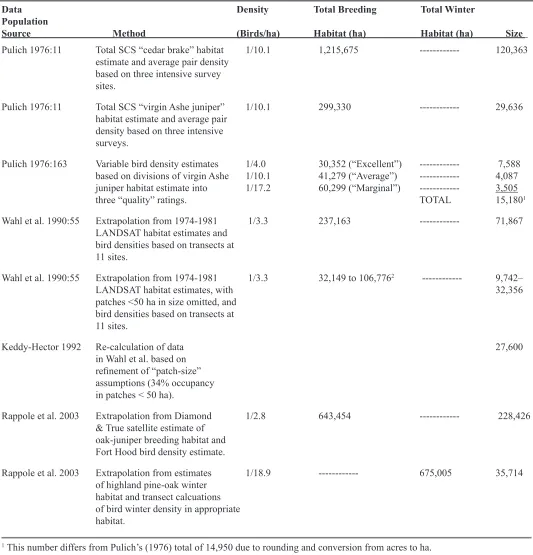
These estimates of habitat extent were combined with known warbler densities to derive population estimates (Table 1). Pulich (1976) used his habitat estimate in combination with an esti-mated average density of one pair/50 acres (one adult bird/10.1 ha) to calcu-late a potential population size of 29,500
birds. He then modified this estimate by
further re-classifying the “virgin Ashe juniper” habitat into “excellent” (one pair/8.0 ha), “average” (one pair/20.2 ha), and “marginal” (one pair/ 34.2 ha).
This classification was based on visits to
breed-ing population.
Similarly, Wahl et al. (1990) con-ducted censuses for Golden-cheeked Warblers at 11 sites located in nine
mates in appropriate habitat. They then combined this estimate with their habi-tat assessment to obtain an estimate for total breeding population size (Table
Data Density Total Breeding Total Winter
Population
Source Method (Birds/ha) Habitat (ha) Habitat (ha) Size
Pulich 1976:11 Total SCS “cedar brake” habitat 1/10.1 1,215,675 --- 120,363
estimate and average pair density based on three intensive survey sites.
Pulich 1976:11 Total SCS “virgin Ashe juniper” 1/10.1 299,330 --- 29,636
habitat estimate and average pair density based on three intensive surveys.
Pulich 1976:163 Variable bird density estimates 1/4.0 30,352 (“Excellent”) --- 7,588
based on divisions of virgin Ashe 1/10.1 41,279 (“Average”) --- 4,087
juniper habitat estimate into 1/17.2 60,299 (“Marginal”) --- 3,505
three “quality” ratings. TOTAL 15,1801
Wahl et al. 1990:55 Extrapolation from 1974-1981 1/3.3 237,163 --- 71,867
LANDSAT habitat estimates and bird densities based on transects at 11 sites.
Wahl et al. 1990:55 Extrapolation from 1974-1981 1/3.3 32,149 to 106,7762 --- 9,742–
LANDSAT habitat estimates, with 32,356
patches <50 ha in size omitted, and bird densities based on transects at 11 sites.
Keddy-Hector 1992 Re-calculation of data 27,600
in Wahl et al. based on refinement of “patch-size”
assumptions (34% occupancy in patches < 50 ha).
Rappole et al. 2003 Extrapolation from Diamond 1/2.8 643,454 --- 228,426
& True satellite estimate of oak-juniper breeding habitat and Fort Hood bird density estimate.
Rappole et al. 2003 Extrapolation from estimates 1/18.9 --- 675,005 35,714
of highland pine-oak winter habitat and transect calcuations of bird winter density in appropriate habitat.
__________________________________________________________________________________________________________
1 This number differs from Pulich’s (1976) total of 14,950 due to rounding and conversion from acres to ha.
[image:7.612.58.591.106.661.2]from Wahl et al., in combination with
recent findings documenting warbler
use of 34% of sites < 50 ha in size (Ben-son 1990), to recalculate the population size data, which yielded a similar esti-mate (Table 1).
Rappole et al. (2003) calculated a potential population based solely on satellite estimation of total oak-juniper breeding habitat and an established breeding density using the analyses of Diamond and True. Making no as-sumptions concerning variations in the suitability of this habitat, we calculated the potential breeding population size for the species by dividing total habitat by the average pair density of 1 pair/5.6 ha (one adult bird/2.8 ha) found in the largest and best-studied breeding
pop-ulation (Fort Hood, Jettj et al. 1998).
This is an intermediate estimate that we consider to be representative of range-wide densities based on recent exten-sive reports in the literature (Ladd and Gass 1998).
Finally, we used our wintering
habi-tat estimate with our density data de-rived from winter transects (1 bird/18.9 ha) to obtain an estimated population
size of 35,527 birds, with a 95% confi -dence interval of - 14,467 to 83,317 birds (Rappole et al. 2003). Note that the low density estimates derived from our transect counts occur because Golden-cheeked Warblers appear to be obligate
mixed-species flock participants dur -ing the winter period, normally with a single member of this species in 87% of
flocks containing Golden-cheeked War -blers. Only three of 157 birds observed
were found outside flocks.
The variation among estimates for breeding populations of
Golden-cheeked Warblers reflect differences
among studies in the technology avail-able to assess habitat extent, and also the assumptions used to classify habitat as
suitable. We are confident that, of these
estimates, that of Rappole et al. (2003) is the most reasonable, for the follow-ing reasons. Pulich (1976) used the best
data available to him; however, he did
not have access to sophisticated remote sensing technology. Wahl et al. (1990) used remote sensing although they used what turned out to be an unrea-sonable assumption, i.e., that warblers would not use fragments < 50 ha, when in fact published information indicates that they will use fragments < 1 ha in size (Benson 1990).
The results of these attempts to es -timate the Golden-cheeked Warbler population size, as summarized in Ta-ble 1, demonstrate the extraordinary
difficulty of obtaining reliable numbers
for a migratory bird population spread thinly across hundreds of thousands of hectares, much of which is inaccessible. Slight variations in assumptions or pro-cedures can produce large variation in
findings. Nevertheless, a critically im -portant conclusion can be drawn from these estimates: either the Golden-cheeked Warbler population size is far larger than has been assumed, or vast
[image:8.612.119.355.419.749.2]areas of apparently suitable breeding habitat are underoccupied or unoccu-pied (Wahl et al. 1990, Beardmore et al. 1996).
Carrying Capacity and Population
Control in Migratory Species
Reduction of breeding ground car-rying capacity, whether from actual habitat loss or some form of degrada-tion, has been cited or implied as the underlying reason for Golden-cheeked Warbler declines by most investigators (Pulich 1976, Wahl et al. 1990, Keddy-Hector 1992, Beardmore et al. 1996, Ladd and Gass 1999). Clearly habitat loss has the potential to reduce population size. However, available evidence indicates that, despite the fact that breeding habi-tat is declining, large amounts remain,
apparently sufficient to support a popu -lation several times the estimated size of the population (Table 1).
Negative effects of habitat degra -dation on populations are much more
difficult to substantiate than changes in
habitat extent. In most cases, the
docu-mentation presented to prove effects
of various forms of degradation, from patch size to human disturbance, is scarcity or absence of birds (Pulich 1976, Keddy-Hector 1992). But lack of birds from breeding habitat is not evidence of a breeding population that has reached carrying capacity. In fact, an opposite
effect would be expected. Theoretically,
all suitable breeding habitat should be
filled for a population in which breed -ing habitat is limit-ing, in marginal as well as excellent habitats (Fretwell 1972, Rappole and McDonald 1994, 1998).
The implication concerning degrad-ed habitats containdegrad-ed in the carrying capacity argument is that they are
un-usable; i.e., that birds using them would be unable to raise offspring. Therefore,
they do not use the degraded sites and thus habitat degradation is equivalent to habitat destruction. The investiga-tions by Wahl et al. (1990) document
< 50 ha, but do not document absence of suitability, i.e., whether or not birds
could successfully raise offspring if
they were to use a patch < 50 ha in size. Investigation of this question by other researchers has documented that Gold-en-cheeked Warblers can and do occu-py smaller patches. For instance, Ben-son (1990) examined impact of patch size, per se, on warbler breeding
den-sity, and found no statistical difference
in occupancy rate on his study sites between large and small patches, with some pairs occupying patches as small as 0.6 ha. Benson’s patch size study did, however, show lower densities of
birds in highly urbanized settings, re -gardless of patch size. Nevertheless, though numbers were lower in urban areas, there were still pairs using them, indicating that urban patches were not “unusable,” and hence not evidence of limitation from a carrying capacity per-spective. Kroll (1980) found that breed-ing pairs did not avoid sites borderbreed-ing roads, trails, or clearings and, in fact, were as successful or more so in raising
offspring than birds on sites less sub -ject to human disturbance. Ladd (1985) reported similar results, although the
findings of both studies have been chal -lenged by Keddy-Hector (2000).
Sherry and Holmes (1995), among many others, have argued that mul-tiple factors control population size in migratory birds so that summer, win-ter, and migration mortality factors all contribute toward the determination of total numbers. This argument is correct only under the special circumstance in which the population never reaches carrying capacity during any portion of the annual cycle. However, if carrying capacity is reached during one portion of the year, then mortality factors occur-ring at other times become essentially irrelevant in terms of limiting the popu-lation.
birds in which breeding habitat carry-ing capacity was limitcarry-ing would show
breeding habitats filled to capacity, re -gardless of quality. However, if winter-ing ground carrywinter-ing capacity was less than breeding ground carrying capac-ity, the species would show lower than expected densities in breeding habitat. They based these predictions on the logic of Fretwell (1972), and further pre-dicted that species limited by winter habitat availability would likely show
an “area effect” during the breeding pe -riod, in which breeding pairs would be rare or absent from small or otherwise marginal habitat because the competi-tion for excellent habitat had been
re-duced or eliminated. This pattern was
documented 30 years ago in the Gold-en-cheeked Warbler by Pulich (1976), and it is our contention that much of the data on breeding populations gathered since, showing low occupancy rates or absence of birds from suitable habitat (e.g., Wahl et al. 1990), implies possible wintering ground population limitation for this species.
Our recent study of winter social organization and total amounts of re-maining habitat for breeding and win-tering birds provides further indication that these birds could be threatened by winter habitat loss (Rappole et al. 2003). As mentioned above, we found Golden-cheeked Warblers restricted to
association with mixed-species flocks
in highland pine-oak habitats, with
one individual per flock. Though we
have few observations from the fall ar-rival period, we have seen that, initially, several Golden-cheeked Warblers will
settle in a flock. However, competition,
including chases and vocalizations,
ap-pears to be intense, and within a matter
of a few days, only one Golden-cheeked
Warbler remains as a flock member; the
others, presumably, have moved on to
locate a flock of their own.
Measures Required to Avoid
Ex-tinction in the Golden-cheeked
Warbler
Based on our wintering ground studies of the species (Rappole et al. 1999, 2000, 2003, King and Rappole 2000), along with results of breeding ground studies documenting scarcity of birds in seem-ingly appropriate habitat, we conclude that the destruction of winter habitat is a possible cause of Golden-cheeked Warbler decline. Naturally, we agree with the many excellent conservation biologists working hard in Texas to pre-serve the species (e.g., Keddy-Hector 2000) that destruction or degradation
of breeding habitat will affect pres -ence or abs-ence of local populations, and, of course, if allowed to continue, could surpass winter habitat as the fac-tor controlling warbler population size. At present, however, it appears that the loss of highland pine-oak habitats in southern Mexico, Guatemala, and Hon-duras is the probable reason for Gold-en-cheeked Warbler disappearance. If we want Golden-cheeked Warblers to continue to be part of the Texas avi-fauna, something will have to be done to preserve their threatened highland pine-oak wintering habitat in Central America, as well as their Texas cedar brakes breeding habitat.
Literature Cited
Beardmore, C., J. Hatfield, and J. Lewis (eds). 1996. Golden-cheeked Warbler population and habitat viability assessment. U.S. Fish and Wildlife Service, Austin, Texas.
Benson, R. H. 1990. Habitat area requirements of the Golden-cheeked Warbler on the Edwards Plateau. Texas Parks and Wildlife Department, Austin, Texas.
Benson, R. H. 1996. The effect of roadway traf -fic noise on territory selection by Golden-cheeked Warblers. Texas Dept. Trans. Report, April 1996.
Engels, T. M., and C. W. Sexton. 1994. Negative correlation of Blue Jays and Golden-cheeked Warblers near an urbanizing area. Conserva-tion Biology 8: 286-290.
Princ-Jettj, L. A., T. J. Hayden, and J. Cornelius. 1998. Demographics of the Golden-cheeked Warbler (Dendroica chrysoparia) on Fort Hood, Texas. U. S. Army Corps of Engineers, Champaign, Il-linois, USA.
Keddy-Hector, D. P. 1992. Golden-cheeked War-bler Recovery Plan. U. S. Fish and Wildlife Ser-vice, Austin, Texas.
Keddy-Hector, D. 2000. Myths of convenience and the role of the golden_cheeked warbler in central Texas forest restoration. Wild Earth, Fall 2000: 78.-82.
King, D. I., and J. H. Rappole. 2000. Mixed-spe-cies foraging flocks in montane pine forests of Middle America. Condor 102: 664-672
Kroll, J. C. 1980. Habitat requirements of the Golden-cheeked Warbler: management impli-cations. J. Range Manage. 33:60-65.
Ladd, C. G. 1985. Nesting habitat requirements of the Golden-cheeked Warbler. Unpubl. MS Thesis, Southwest Texas State University, San Marcos, Texas.
Ladd, C., and L. Gass. 1999. Golden-cheeked Warbler. Birds of North America 420:1-22.Mass-Burleigh, D. 1998. Factors influencing demographics of Golden-cheeked Warblers (Dendroica chrysoparia). Unpubl. MS thesis,
Uni-versity of Oklahoma, Norman, Oklahoma. Pulich, Sr., W. 1976. The Golden_cheeked
War-bler. A bioecological study. Texas Parks and Wildlife Department, Austin, Texas.
Rappole, J. H., and M. V. McDonald. 1998. A re-sponse to Latta and Baltz. Auk 115: 246-251. Rappole, J.H., and M.V. McDonald. 1994. Cause
and effect in migratory bird population chang -es. Auk 111:652-660.
Rappole, J. H., D. I. King, and W. Barrow. 1999. Winter ecology of the endangered Golden-cheeked Warbler (Dendroica chrysoparia). Con-dor 101. 762-770.
Rappole, J. H., D. I. King, and P. Leimgruber. 2000. Winter habitat and distribution of the en-dangered Golden-cheeked Warbler (Dendroica chrysoparia). Animal Conservation 2:45-59. Rappole, J.H., D.I. King, and J. Diez. 2003.
Win-ter versus breeding habitat limitation for an endangered avian migrant. Ecological Appli-cations 13:735-742.
Sherry, T. W., and R. T. Holmes. 1995. Summer versus winter limitation of populations: what are the issues and what is the evidence? Pp. 85-120 In Ecology and management of Neo-tropical migratory birds (T. E. Martin, and D. M. Finch, Eds.), Oxford University Press, Ox-ford.
U. S. Fish and Wildlife Service. 1990. Endangered and threatened wildlife and plants; final rule to list the Golden-cheeked Warbler as endan-gered. Federal Register 55(87): 53153-53160. Wahl, R., D. D. Diamond, and D. Shaw. 1990. The
Golden-cheeked Warbler: a status review.
Abstract
High demand for big-leaf mahogany creates pressure for
unsustain-able extraction. While mahogany logging provides foreign exchange
for developing economies, inadequate regulations and resource
con-flicts exacerbate social injustice and ecological degradation. Additional
measures are necessary to help member parties uphold their CITES
commitments and improve broader political, economic, and
envi-ronmental policies. Institutional and financial support to mahogany
source countries can help increase participation in natural resource
governance and shift incentive structures to encourage long term forest
management. International buyers and consumers can also purchase
more selectively, including products from independently certified sus
-tainable sources and lesser-known tree species, to allow for mahogany
regeneration.
Resumen
La alta demanda por la caoba de hoja ancha aumenta la presión para
extracción no sustentable. Mientras la tala de caoba provee
intercam-bio de divisas para las economías en desarrollo, regulación inadecuada
y conflictos de recursos aumentan la injusticia social y la degradación
ecológica. Se necesitan medidas adicionales para ayudar a todas las
partes a mantener sus compromisos con CITES y mejorar su política
general de pólizas económicas y ambientales. Apoyo institucional y
financiero a los países de donde viene la caoba pueden ayudar a au
-mentar la participación en el gobierno de recursos naturales y cambiar
las estructuras de incentivos para promover el manejo forestal a largo
plazo. Compradores internacionales y consumidores también pueden
comprar con mas discreción, incluyendo productos de fuentes
inde-pendientemente certificadas y de especies de árboles menos conoci
-das, para permitir que la caoba se regenere.
Mary Brook
Department of Geography Dartmouth College 6017 Fairchild Hall Hanover, NH 03755 Mary.M.Brook@Dartmouth. edu
Opinion
Big-leaf mahogany (Swietenia macrophyl-la) is one of the Convention on Interna-tional Trade in Endangered Species of Wild Fauna and Flora’s (CITES) greatest challenges to date. Pressures to extract and trade are intense because mahog-any is the most precious tree in mmahog-any Latin American countries. Between 1995 and 2002, under a CITES Appen-dix III listing, illegally obtained big-leaf mahogany frequently entered interna-tional markets. S. macrophylla was trans-ferred to Appendix II in 2002, where it joined two other mahogany species.
The Appendix II listing may have several important results. Most impor-tantly, a yearly quota must be set by each exporting country to assure that sustainable levels are not surpassed, thus requiring states to complete forest inventories and determine regeneration
patterns. However, these activities are
time consuming and expensive: many countries are uncertain how to proceed. CITES depends on each member party to uphold its commitments, since
over-sight procedures have little regulatory
“bite.”
While providing an essential frame-work to monitor trade, CITES policies neither target the root causes of over-extraction nor address issues of social justice surrounding mahogany harvest-ing and sales. CITES’ mandate will be
weakened if current efforts are unsuc -cessful in protecting this threatened species, but the convention requires ad-ditional support to institute sustainable management. The following activities, which target reform within and beyond the CITES framework, should be priori-tized.
Decentralization and Improved Partici-pation: CITES offices in mahogany-sup -plying countries are overly centralized
and non-state partnerships often remain
poorly developed, with a few high-
profile exceptions. Decentralized state institutions usually do not influence
the formulation of mahogany
manage-ment legislation even though they are
expected to implement it. Local officials
are less likely to invest scarce resources to uphold mandates that they consider
misguided or ineffective. Wider partici -pation from impacted populations and civic or nongovernmental organiza-tions is also necessary to make policy more sensitive to local conditions and improve voluntary compliance.
Economic Incentives and Alternatives:
First, there are insufficient economic
incentives to regulate harvest in export countries. Buyers and consumers gen-erally do not prioritize mahogany origi-nating from sources deemed sustain-able. Blundell and Gullison (2003) note that buyers in U.S. markets, where 60% of mahogany exports end up, not only accept illegally harvested mahogany
but also help finance foreign logging
operations in order to secure supply (Blundell and Gullison 2003). Due to
indifference about the sustainability of
sources, most mahogany purchased in international markets does not originate from concessions independently
certi-fied as sustainable. Rather than financ -ing long-term operations, mahogany hunters search for new areas with exist-ing stands. As sources become depleted,
extractors shift to other locations. Liqui -dation logging provides more
ate and higher financial returns when
compared to sustainable forestry. Sec-ond, while extraction creates important rural income, some populations sell
ma-hogany trunks or timber for as little as
US $25 per cubic meter, even though a cubic meter of mahogany lumber on the international market is routinely sold for over US$1,000. In addition to fairer prices, source areas need economic al-ternatives, such as markets for lesser known timber species or non-timber forest products.
Land Tenure Resolution: Much ma-hogany is harvested from indigenous territories lacking formal land titles. There is increasing violence stemming
from resource conflict as mahogany
scouts target remote areas looking for remaining stands. Participatory land demarcation is necessary to resolve
ac-cess and tenure conflicts and to create a
foundation for community based forest management.
Domestic Controls: Internal trade does not fall under CITES’ responsi-bilities, but only a portion of tropical roundwood enters international mar-kets. Mahogany is also popular in Latin American domestic markets. Although the asking price is considerably lower, mahogany generally remains the most valuable species circulated internally.
When export controls tighten so that mahogany can only cross borders or ship from ports when accompanied with CITES permits, undocumented wood may be dumped domestically. The availability of inexpensive mahog-any in national markets reinforces in-ternal demand and local preference for mahogany.
Poor domestic controls and the in-crease in international mahogany trade monitoring coincide to encourage ex-traction and illegality. First, loggers
remain confident that they will find a
national buyer even if they do not
ac-cess more profitable export markets. Second, ineffective national regulations create new opportunities for profit from
illegal harvest and trade. For example, while some countries have improved domestic controls through the use of transportation checkpoints, this has sometimes contributed to the
concen-tration of logging profits within elite
groups that either have the political connections to avoid punitive measures
or the financial ability to pay bribes or fines.
Although limited by insufficient funding, CITES is expected to fulfill a difficult and overly broad mandate. With the potential for profit from illegal
mahogany and a labyrinth of domestic and international transit routes, harvest
and trade documents are often unreli
-able or falsified. While it is essential for
convention party members to improve the implementation of trade policies, CITES cannot be expected to resolve all mahogany management constraints. Additional actions beyond the author-ity and focus of CITES are necessary to lower extraction to sustainable levels while protecting local livelihoods and rights.
Literature Cited
Blundell, A.G. and R. E. Gullison (2003). “Poor regulatory capacity limits the ability of science to influence the management of mahogany.” Forest Policy and Economics 5: 395-405. These mahogany trunks
Encounter Frequency with the
Urbanized San Joaquin Kit Fox
Correlates with Public Beliefs and
Attitudes Toward the Species
Curtis D. Bjurlin
1,3Brian L. Cypher
21California State University -
Stanislaus, Endangered Spe-cies Recovery Program, P.O. Box 9622, Bakersfield, CA 93389, USA
2California State University -
Stanislaus, Endangered Spe-cies Recovery Program, P.O. Box 9622, Bakersfield, CA 93389, USA
Abstract
A systematic public survey can prove vital to resource managers as a means of quan-tifying willingness to protect endangered species, helping to focus education, and
evaluating the factors that influence public beliefs and attitudes. During the fall of 2003, we conducted a postal survey of 879 randomly selected citizens of Bakersfield, California to assess the factors related to beliefs and attitudes regarding a robust
population of endangered San Joaquin kit foxes (Vulpes macrotis mutica) living within city limits. Of 248 respondents, 89% indicated familiarity with the kit fox. Of these
self-identified knowledgeable respondents, 86% had seen an urbanized fox at least
once. Those who reported the most encounters, however, were more likely to incor-rectly perceive kit foxes as common or abundant rangewide, suggesting a failure or absence of education regarding species status and obstacles to recovery. Despite this misconception, many respondents appreciated (40%) or were neutral (45%) toward urbanized foxes and supported their protection (49%). Furthermore, respondent ex-posure to and appreciation of foxes were directly related, suggesting that this urban-ized population may act as an ambassador for the species. As natural and low-den-sity human landscapes are converted to urban and suburban uses, wildlife-human
encounters will continue to increase. This study identifies some of the ways these encounters may influence public opinion.
Resumen
Una encuesta de opinión publica puede ser vital para los que manejan recursos como
una manera de cuantificar la disposición de proteger especies amenazadas, ayudar a enfocar en la educación, y evaluar los factores que influyen las creencias y actitudes
del público. Durante el otoño de 2003, hicimos una encuesta por correo de 879
ciu-dadanos de Bakersfield, California escogidos al azar para determinar los factores
relacionados a las creencias y actitudes con relación a la robusta población dentro de los limites de la ciudad de la amenazada zorra desértica de San Joaquín (Vulpes mac-rotis mutic). De los 248 que respondieron a la encuesta, 89% indicaron estar
famil-iarizados con la zorra desértica. De los que respondieron que se auto-identificaron
como conocedores, 86% había visto una zorra urbanizada al menos una vez. Sin em-bargo, los que reportaron la mayor cantidad de encuentros eran los más propensos a
incorrectamente identificar la zorra desértica como abundante en todo su territorio,
lo que sugiere un fracaso o una falta de educación con respecto al status de la especie y sus obstáculos para la recuperación. A pesar de esta mala interpretación, muchos de los que contestaron la encuesta apreciaban (40%) o estaban neutrales (45%) hacia la zorra urbanizada y apoyaban su protección (49%). Aun mas, la exposición de los que contestaron la encuesta, y su apreciación por la zorra estaban directamente relacionadas, sugiriendo que esta población urbanizada puede actuar como emba-jador para la especie. Mientras los paisajes naturales y de poca densidad humana se convierten a usos urbanos o suburbanos, los encuentros de vida silvestre y seres
Conservation efforts are more often
successful when social and political fac-tors are evaluated prior to implementa-tion (Kellert 1985, Reading and Kellert 1993, Riley and Decker 2000, Rodriguez et al. 2003). This is perhaps most true in human-dominated landscapes, such as urban areas, where human interests are prioritized above those of wildlife, and where economic (e.g., property values) and social (e.g., property rights) consid-erations can inhibit conservation. Yet, as urban areas continue to grow, natu-ral resource managers are frequently asked to mediate between the needs of people and urbanized wildlife (e.g., Kellert 1995). Solutions range from hab-itat mitigation to lethal control or trans-location of nuisance animals. In the rare instances that conservation programs
affect private lands or otherwise reduce
availability of land for human uses,
polarized citizen conflict often results
(e.g., Peterson et al. 2002, 2004). It is in this environment that wildlife manag-ers must carefully balance conservation priorities against the social implications of meeting these goals. Therefore, an accurate assessment of the factors that
influence public opinion regarding rare
species in urban environments is vital. Red wolf (Canis rufus; e.g., Moore and Smith 1991), gray wolf (Canis lupus, e.g., Bath and Buchanan 1989), Key deer (Odocoileus virginianus clavium, e.g., Pe-terson et al. 2002, 2004), and numerous other endangered species recovery
ef-forts have benefited from evaluating citizen beliefs, attitudes, and behaviors.
One factor that routinely goes unstud-ied, however, is the impact that interac-tion with a species has in forming pub-lic opinion. Human-wildlife interaction, especially where large mammals are in-volved, also can increase indirect expo-sure to the species (e.g., media coverage or word of mouth) as people relate their experiences. When endangered wildlife coexists with humans in urban environ-ments, the chances of interaction and
potential consequences for conserva-tion (both positive and negative) can be expected to increase.
The San Joaquin kit fox (Vulpes mac-rotis mutica) is an ideal model species for investigating the relationships between human-wildlife interaction and public opinion in an urban environment. A 2 to 3 kg canid that is adapted to arid lands, the kit fox was listed as endangered federally in 1967 and threatened in Cal-ifornia in 1973 (U. S. Fish and Wildlife Service 1998). Approximately 95% of the shrub and grassland communities historically occupied by kit foxes have been converted to human uses, pro-foundly reducing recovery potential, bringing remaining populations into close contact with humans, and increas-ing likelihood of encounters. In fact, ro-bust fox populations occur on highly al-tered private land in some urban centers of the southern San Joaquin Valley (Cy-pher et al. 2003). Because the extent of urban fox populations has only recently been appreciated by regulatory
agen-cies, they are currently not identified as
critical to the recovery of the species (U. S. Fish and Wildlife Service 1998). The largest of these populations, in the city
of Bakersfield, is likely to become a fu -ture conservation priority. It occupies an important location for maintaining connectivity among natural lands and
has been identified as a potential source
population for reintroduction.
Bakers-field, however, is rapidly developing.
Meaningful protection of its foxes will certainly result in economic, social, and political consequences.
Clearly, an informed and sympa-thetic public will be necessary to suc-cessfully implement changes to urban
land development that benefit the kit
fox. Our informal interactions with
Ba-kersfield residents over the past seven
within city limits and expressed appre-ciation and concern for their welfare. Furthermore, it appeared that people with the greatest frequency of interac-tion with the species were most con-cerned about its protection. Among this group were citizens who had a recur-rent pastime of kit fox observation and feeding and who expressed knowledge
and affinity for individual animals (Fig -ure 1). Misconceptions regarding the species also were prevalent. Most im-portantly, citizens frequently were un-aware or doubted that the species was endangered.
Our interactions with Bakersfield
citizens, while useful in framing the issues regarding human-fox interac-tions in urban environments, were an-ecdotal and may have been mislead-ing if applied directly to conservation and education programs. Therefore we conducted a systematic mail survey to evaluate relationships among public demographics, exposure to, knowledge
of, and attitudes toward the kit fox. Our
goals were three-fold: (1) assess public
support for urban fox conservation; (2)
identify beliefs and misconceptions to
be addressed with targeted education;
and (3) test the hypotheses that expo-sure to urbanized kit foxes positively relates to citizen knowledge of fox bi-ology, appreciation of the species, and support for protection. While the re-sults of this study are directly pertinent to kit fox conservation, they also yield information on relationships between human interaction with urban wildlife and public opinion that will prove
use-ful to rare species conservation efforts
in other urbanizing environments.
Study area
Bakersfield is located at the southern
end of the San Joaquin Valley in cen-tral California. As of January 2003, the metropolitan area was approximately 580 km2 (224 mi2) with 394,234 residents
(Greater Bakersfield Chamber of Com
-kersfield grew by 23.6% from 1990-2000
(U.S. Census Bureau 2000) and future expansion is expected. San Joaquin kit foxes occupy golf courses, commercial and industrial developments, schools, parks, canals, drainage basins, unde-veloped lots, and construction sites throughout the city (Cypher et al. 2003). During opportunistic trapping in the
southwest sector of Bakersfield from
1997 to present, we captured 365 indi-viduals a total of 812 times (Cypher un-published data). Urban foxes consume a mixed diet of natural and anthropo-genic foods, including rodents, birds, insects, refuse, pet food, and handouts from residents. Preliminary results in-dicate that reproduction and survival of
the Bakersfield fox population is simi -lar to that reported for natural habitat.
A number of factors negatively affect
urbanized kit foxes, including land con-version to higher density development
and increasing traffic volume – both currently prevalent within Bakersfield.
Methods
To obtain information on citizen
[image:17.612.257.585.52.357.2]foxes, we designed a mail-back survey consisting of 15 questions. In 2003, this survey was delivered using the United
States Postal Service to 879 Bakersfield
residents. Recipients were randomly selected from telephone directories and screened for single-family and apart-ment dwellings using zoning maps in a geographical information system. To increase response rate we avoided technical jargon, and enclosed a self-ad-dressed stamped envelope, a free pass to a local zoo, and a statement of pur-pose on California State University let-terhead.
We began by asking whether the respondent knew what a kit fox was and prompted those responding nega-tively to forgo the remaining questions and return the survey. Two questions then gauged respondent exposure to kit foxes, 3 assessed respondent knowl-edge of kit fox biology, and 5 evaluated
attitudes regarding foxes and their con -servation. These questions employed multiple-choice responses with ordinal scaling where appropriate. An opened-ended question prompted respondents to express their concerns about kit foxes in the urban environment. We ended the survey with questions pertaining to respondent gender, age, and length of residency. The questionnaire was reviewed by 6 natural resource profes-sionals and pre-tested on 24 randomly
selected Bakersfield citizens. Questions were modified based on the responses
of these test groups. To evaluate poten-tial bias on the part of nonrespondents, we conducted a telephone survey of 160 households that had not replied to the postal survey. We successfully admin-istered the survey to 27 of these resi-dents.
We used contingency table analysis to test for relationships between citizen demographics, exposure to kit foxes,
knowledge of fox biology, attitudes
about foxes and their conservation. We recoded perceived abundance of kit
fox-es in the San Joaquin Valley by combin-ing those who answered “almost none” and “few” into the category “rare” and those answering “common” or “abun-dant” into “common.” Similarly, we
recoded attitudes toward kit foxes by
expanding the categories “like” and “dislike” to include both those with strong and mild feelings. Finally, re-spondents who reported encountering kit foxes weekly or monthly were recod-ed as having “frequent” exposure. We used chi-square tests for homogeneity to examine potential nonresponse bias by comparing answers to each question between the postal and telephone sur-veys. P-values <= 0.05 were considered
statistically significant.
Results
We received 248 completed question-naires for a response rate of 28%. Re-spondents varied in age (23% within 20 to 39 year age bracket, 41% within 40 to 59 age bracket, and 35% were 60 or over), typically had greater than
five years of local residence (90%), and
lacked gender bias (χ2
1 = 0.42, P = 0.52).
Most individuals (89.1%) reported pre-vious knowledge of kit foxes. The sur-vey population and associated statistics
are hereafter limited to self-identified
knowledgeable respondents.
Eighty-six percent of those familiar with the San Joaquin kit fox reported seeing foxes within city limits, and 74.4% reported multiple encounters. Most respondents (81.7%) correctly
identified night as the period of peak fox
activity. Beliefs regarding overall abun-dance of kit foxes in the San Joaquin Valley were mixed, with many answer-ing that kit foxes are abundant (7.8%), common (35.6%), few (30.1%), or of unknown numbers (26.0%). In general, respondents expressed positive (40.3%)
(76.1%). A near majority of respondents supported protection of kit foxes with-in city limits (Yes = 48.6%, No = 17.9%, Neutral = 24.3%, Don’t Know = 9.2%).
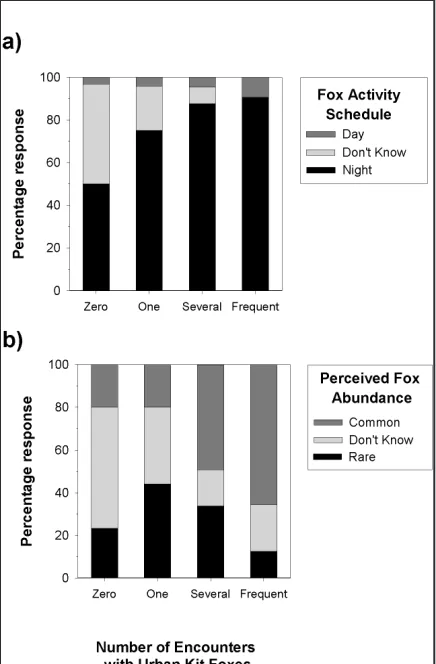
Our hypothesis that frequency of interaction with foxes would relate to citizen knowledge was upheld, but the relationship was not simple. With great-er exposure to urban foxes, respondents were more likely than expected to cor-rectly answer that the species is noctur-nal (χ2
6 = 34.36, P < 0.01; Figure 2a), but
also more often had the misconception
that kit foxes are common rangewide (χ2
6 = 33.76, P < 0.01; Figure 2b).
Respon-dents having only a single encounter with urban kit foxes were most likely to consider them rare throughout the San
Joaquin Valley; those with no exposure
were more frequently unsure of both activity and abundance.
There also was evidence
support-ing our hypothesis that citizen attitudes
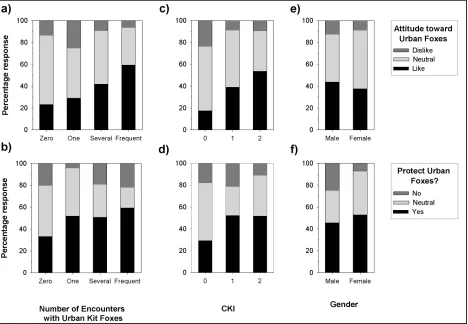
and frequency of encounter with kit foxes are correlated. Respondents who reported frequent encounters more of-ten expressed appreciation of urban foxes, while those who had no inter-action with the species generally were neutral (χ2
6 = 14.00, P = 0.03; Figure 3a).
Likewise, there was a significant rela -tionship between exposure and beliefs regarding whether kit foxes harm peo-ple (χ2
6 = 14.25, P = 0.03), with
percep-tion of threat appearing to decrease as interaction with urban foxes increased. Exposure was not related to beliefs re-garding whether people harm foxes (χ2
6
= 8.98, P = 0.18) or support for urban fox protection (χ2
6 = 10.36, P < 0.11).
Never-theless, there appeared to be a general trend wherein those with greater expo-sure were more supportive of protec-tion (Figure 3b).
To test whether knowledge related
to attitudes, we compiled respondent
answers to fox activity schedule and abundance into a composite knowledge index (CKI). The index consisted of 3 groups, those answering correctly to
both questions (code = 2), those with 1 correct answer (code = 1), and those with no correct answers (code = 0). There was
a significant relationship between CKI and attitude toward urban foxes (χ2
4
= 15.01, P < 0.01), and it appeared that more knowledgeable respondents held more favorable opinions (Figure 3c). Likewise, CKI and willingness to pro-tect were related (χ2
4 = 11.35, P = 0.02).
Approximately 50% of respondents who correctly answered one or more knowledge questions were in favor of protection (Figure 3d). In contrast, a majority (53%) of those who responded incorrectly to both questions were neu-tral toward protection.
Of the demographic variables we examined, only gender was related to
beliefs and attitudes. There was sup -port that men had more encounters with urban foxes (χ2
3 = 7.60, P = 0.06).
Furthermore, men were more likely to view foxes as common or abundant (χ2
2
[image:19.612.258.476.404.736.2]= 8.74, P = 0.01), while women appeared more likely to be unsure of fox popu-lation status. While there was no
rela-tionship between gender and attitude
toward foxes (χ2
2= 1.58, P = 0.45; Figure 3e), men appeared more likely than ex-pected to oppose protection (χ2
2= 8.55, P = 0.01; Figure 3f). Length of residency and age were unrelated to beliefs and
attitudes.
There were relationships between
all attitudinal questions, indicating con -sistency of response. Respondents who
liked kit foxes in Bakersfield were more
likely to support protection (χ2
6 = 50.60,
P < 0.01) and feel that people harmed foxes (χ2
4 = 18.28, P < 0.01), but were less
likely than expected to feel that foxes harmed people (χ2
4 = 45.13, P < 0.01).
Likewise, those in favor of protection were less likely to feel that foxes harmed people (χ2
6 = 24.69, P < 0.01), and more
likely to feel that people harmed foxes (χ2
6 = 31.65, P < 0.01).
In general, those who had
previous-ly stated appreciation for urban foxes used our open-ended inquiry (“What is your greatest concern about foxes living
in Bakersfield?”) to express concerns
for fox welfare, while those who held
a negative attitude toward urban foxes
expressed concerns for human welfare. Primary concerns for fox welfare includ-ed harm by people or domestic animals, road kill, urban sprawl, loss of habitat,
and insufficient protection (listed in
decreasing order of response). Others were apprehensive that foxes would halt development, spread disease, at-tack humans or domestic animals, and that protection would infringe upon citizen rights, or that “environmental-ists” would cause harm on behalf of kit foxes.
There were no significant differ -ences between answers provided by respondents and the nonrespondents contacted by telephone. Nevertheless, nonrespondents encountered kit foxes less frequently (70% versus 86% for
[image:20.612.91.559.417.741.2]respondents), less often correctly an -swered that foxes are nocturnal (74%
versus 82%), and were more often neu -tral toward urban foxes (57% versus 45%). Therefore, the respondent pool may have had greater knowledge of, appreciation for, and frequency of en-counter with urban foxes than the gen-eral populace. There is no reason to suspect, however, that there was a
non-response bias to the significant relation -ships among demographics, exposure,
beliefs, and attitudes.
Discussion
There appears to be widespread
interac-tion between citizens of Bakersfield and
urbanized kit foxes. Furthermore, we found strong support for our hypothe-ses that interaction with urbanized foxes
correlates to public beliefs and attitudes.
In particular, the observed relationship between exposure and beliefs may have important implications for the recovery of the species. While the knowledge that kit foxes are nocturnal increased among respondents who had greater encounter frequency, we also found a relationship between encounter rate and the mis-conception that the endangered kit fox is common rangewide. These results suggest that citizen perception of the species was based on direct experience (the greater the encounters, the greater the perceived abundance) rather than formal education. Given that the kit fox has been listed as endangered for nearly forty years, there would appear to have been ample time to educate the citizen-ry regarding its conservation status. Ei-ther the relationship between encounter frequency and perception of abundance is strong and persistent, or communi-cating information to the public has not been a conservation priority. In support
of the latter, current access by Bakers
-field citizens to information regarding
the kit fox is limited to a local zoological park display and periodic news stories,
which often result from human-fox con
-state) and conservation organizations do not have local or regional education programs for this species. We suggest that targeted information on kit fox
le-gal status, justification for protection,
and threats to recovery may be an im-portant part of future initiatives. While access to factual information has been
shown to influence public behavioral
beliefs (e.g., Luaber and Knuth 2004),
information appears to affect people in different ways. Therefore, a means
of selecting the type of information for
dispersal and testing the effectiveness
of the education program is warranted. Despite the misconception of kit fox abundance, citizens generally re-ported positive feelings toward foxes
and, more often than not, were in favor
of protective measures for the urban population. The kit fox was only infre-quently viewed as a direct source of harm, unlike public perception of many larger carnivores that are implicated in human or livestock depredation (Clark et al. 1996, Kellert et al. 1996). Some au-thors suggest that increased knowledge of wildlife is simply used to support a pre-existing perspective (Reading and Kellert 1993, Kellert et al. 1996). When respondent knowledge of kit foxes was examined as an index (CKI), however,
there was a relationship to both atti -tude and willingness to protect. Most notably, those who answered both knowledge questions incorrectly rarely (17.6%) expressed appreciation of ur-banized animals, but a majority (53.7%) of the most knowledgeable respondents mildly or strongly liked fox presence in
Bakersfield. It remains unclear whether
knowledge was a correlate to some
oth-er variable that affected attitudes, or in
fact contributed to the formation of at-titudes toward the urbanized fox popu-lation.
For example, men appeared to have
more frequent encounters, more often
thought of foxes as common, and were less supportive of protection. Perhaps
gender affects the way an individual
uses information to make decisions about wildlife issues, as some authors suggest (e.g., Lauber et al. 2001, Dough-erty et al. 2003). Teal and Loomis (2000),
however, did not find differences be -tween the sexes in willingness to pay for environmental programs for wildlife in the San Joaquin Valley. An alternative
hypothesis is that gender-specific be
-haviors affected exposure to foxes (e.g.,
men may have worked or engaged in
leisure activities more often outside or
at night), and the level of exposure (not
gender) influenced beliefs and attitudes
toward the species.
Specific concerns expressed by
residents provided further evidence of misinformation. Although citizens who worried about fox welfare
identi-fied sources of mortality with remark -able accuracy (e.g., vehicle strike, pre-dation by domestic animals, urban development and associated habitat loss), some anxieties over urban foxes (inhibited urban development, disease
transmission, attacks on people or do -mestic animals) were factually unsup-ported. A habitat conservation plan for
Bakersfield was implemented in 1994
to minimize the impact of endangered species rulings on urban development
(Metropolitan Bakersfield Habitat Con -servation Plan 1994). Under the terms of this plan, the core conservation strat-egy for kit foxes entails acquisition of
natural habitat outside of Bakersfield.
Required mitigation for urbanized kit foxes is limited to pre-construction sur-veys where dens are known to occur (strongly biased toward areas of past research) and excavation of occupied dens prior to land conversion. There-fore, only in rare cases (e.g., presence of natal dens) do resident foxes impact development, and these impacts are in
the form of delays as opposed to project preclusion. The San Joaquin kit fox has never been implicated in the transmis-sion of infectious diseases (e.g., canine parvovirus, canine distemper virus) to domestic animals or zoonotic diseases (e.g., rabies) to humans. Thus, although they can never be discounted as a vec-tor of disease, this risk appears to be minimal. Finally, there are no reports of
kit fox attacks on humans or domestic
animals, although domestic dogs may be a source of mortality for urbanized foxes (Cypher unpublished data).
The results of this survey in conjunc-tion with our informal discussions with
residents of Bakersfield suggest three
important conclusions. First, citizens appear to favorably regard the urban fox population. Many express enjoy-ment at observing foxes and some feed the animals that frequent their homes or businesses. Second, residents are mis-informed about kit foxes in the urban environment and in general. The public largely does not comprehend the threat of extinction this species faces. Third,
beliefs and attitudes appear to be based
at least in part on personal experiences, including frequency of exposure to ur-banized foxes, which of course varies widely among people. Encounters be-tween wildlife and humans are likely to increase as natural habitats come into closer and more fragmented con-tact with human landscapes. How citi-zens interpret the resulting encounters
with wildlife may strongly influence attitudes towards conservation. In this
case, the positive relationship between citizen exposure to and appreciation of foxes indicates that the urbanized kit
Literature Cited
Bath, A. J., and T. Buchanan. 1989. Attitudes of interest groups in Wyoming toward wolf res-toration in Yellowstone National Park. Wild-life Society Bulletin 17:519-524.
Clark, T. W., A. P. Curlee, and R. P. Reading. 1996. Crafting effective solutions to the large carnivore conservation problem. Conserva-tion Biology 10:940-948.
Cypher, B. L. 1997-2005. Endangered Species Re-covery Program, 1900 North Gateway Blvd., Fresno, California, 93727. Unpublished data. Cypher, B. L., P. A. Kelly, and D. F. Williams.
2003. Factors influencing populations of en -dangered San Joaquin kit foxes: implications for conservation and recovery. Pages 125-137 in M. A. Sovada and L. Carbyn, editors. The swift fox: ecology and conservation in a chang -ing world. Canadian Plains Research Center, Regina, Saskatchewan, Canada.
Doughtery, E. M., D. C. Fulton, and D. H. Ander-son. 2003. The influence of gender and the re -lationship between wildlife value orientations, beliefs, and the acceptability of lethal deer con-trol in Cuyahoga Valley National Park. Society and Natural Resources. 16:603-623.
Greater Bakersfield Chamber of Commerce. 2004. Bakersfield Community Profile. http;// www.bakersfieldchamber.org/pdf/commu-nit