2018 2nd International Conference on Modeling, Simulation and Optimization Technologies and Applications (MSOTA 2018) ISBN: 978-1-60595-594-0
Traffic Center Allocation Method Based on Load Balancing Mechanism
for Off-site Double-active Call Platforms
Xu-sheng LIU, Zi-qian LI, Wei HAN and Lei WANG
*State Grid Customer Service Center, Tianjin 300000, China
*Corresponding author
Keywords: Load balancing, Off-site double-activity, Call platform, State Grid 95598, Traffic center allocation.
Abstract. The off-site double center is the development trend of the traditional big data center. Aiming at the requirements of large-scale traffic access, massive data processing, emergency response and rapid disaster recovery of State Grid 95598 traffic platform, a multi-active system traffic center allocation algorithm based on global load balancing mechanism is proposed. The algorithm considers the load of each center in traffic system and the traffic quality of all assigned users, and uses the linear programming tool to optimize the solution selection in the solution process. The simulation results show that under the condition of random user traffic, the algorithm can adjust the access points of users accessing the data center in real time, give a reasonable user access planning, and balance the traffic pressure of each call center. Provide technical support for the construction of the era's traffic platform and the construction of disaster recovery systems.
Introduction
With the continuous development of the "three episodes and five majors" system, lots of power companies are accelerating the construction of a customer service system that meets the requirements of the national grid standardization in order to improve the quality and level of power supply services comprehensively. 95598 is a public service telephone for the Chinese power system. It is mainly responsible for the interpretation of local power policy and power structure changes. It is an important part of the power supply service system. The good operation of the 95598 customer service hotline is of great significance to the power industry. With the advent of the era of big data, power information is developing towards diversification and sea quantification. In order to adapt to this development, the State Grid 95598 call platform must be upgraded to improve its security and reliability to meet the growing power customers’ demand [1].
The traditional 95598 call platform uses single center mode. It can meet the customer's needs while ensuring the security of the platform itself by the multi- protection for center. However, this single-center design is less flexible. It is difficult to ensure the stability of the system when natural disasters occur [2]. In addition, the platform traffic continues to rise and the variety of services is constantly enriched, the traditional single-center mode is a little difficult to adapt the change, so a new solution is urgently needed [3].
In order to break the limitations of the traditional single-center mode, the multi-active mode is gradually being widely used in various fields. Among them, multi-activity refers to serving all customers by multiple centers at the same time. This mode can avoid all services caused by individual center failures [4]. But the load level of each center must be considered in order to maintain the quality of service for each user in the multi-active mode. Excellent balance can ensure the rational use of the resources of the center, which is of great benefit to the operation and maintenance management of the entire system.
and load balance, we use linear programming to propose the best central choice for all customers. The simulation results show that the GLBAA algorithm can effectively balance the traffic pressure of each call center while ensuring the service quality, and optimize the traffic access capability of the multi-active system to the greatest extent.
System Model
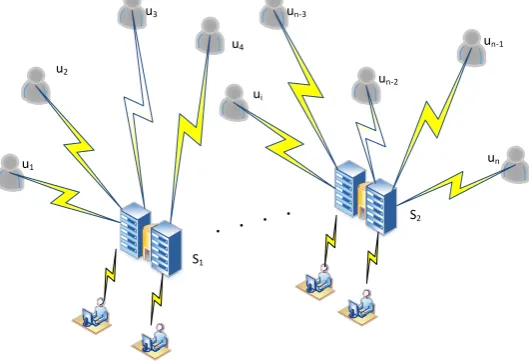
This paper defines a topological network with a directed graph G(U, S, E), where ui∈U represents
a user with traffic requirements, si∈S represents a traffic center, lij∈E is the directional
communication link between user ui and its traffic center sj. N and M respectively represent the
number of users and traffic centers in the network. Figure 1 shows the dual-center traffic platform access network.
u1
u3
u2
u4
ui un-3
un-2
un-1
un
S1
[image:2.595.168.433.242.423.2]S2
Figure 1. A dual-center traffic platform access network diagram.
Traffic Model
Traffic is the abbreviation of telecommunication traffic, also known as telecom load. It represents both the load on the telecommunication equipment and the degree to which the user needs communication. Since the occurrence of a user call and the time required to complete a communication are random and variable, the traffic is a random variable that changes with time. It is assumed that the user ui causes traffic to the system as follows:
( )
i
T P (1) where Ti represents the traffic caused by the user ui to the system, and the randomness of the traffic
is described by the Poisson distribution P(λ) with a mean of λ.
Traffic Quality Model
Traffic quality is an important indicator to determine the service quality of the traffic platform. High traffic quality can effectively guarantee the user experience. The indicator is related to the distance between the user and the call center. The calculation method is as follows:
1
,
( )
ij ij
D i U j S
d
(2) where Dij is used to quantify the traffic quality when the user ui communicates with the traffic center sj. dij is the distance between the user ui and the traffic center sj, and μ and η are related
Traffic Center Access Selection Algorithm
In order to reflect the relative level of each user's traffic quality, the traffic quality of each user is standardized as shown in equation (3).
1 , ij ij N ij i D
P i U j S
D
(3)where Pij represents the relative level of the traffic quality that traffic center sj assigned to the user
ui among all users.
For the traffic system, it is especially important to ensure the fairness to all user services. So the parameter of traffic quality entropy is proposed to evaluate the difference in the traffic quality of all users. The calculation method is as shown in equation (4).
1 1 ( ) 1 log N ij e i ij H P P P
(4)where H(P) represents the traffic quality entropy of all users in the network, P is the traffic quality set of all users, and lower H(P) means that the system guarantees better fairness for all users.
In addition, after upgrading from a single-center system to a multi-active system, the impact of load balancing on the performance of each center can’t be underestimated. The central balance degree CV(L) is used to effectively analyze the load balance of the system center.
,ij
j i
i S l
L T
(5)( ) ( ) / ( )
CV L SD L MN L (6) where Lj represents the traffic load of the central sj, the calculation method is as shown in equation
(5). L is the load set of all traffic centers. MN(L) is the average of all central traffic loads, and SD(L) is the standard deviation of all centers’ load, the ratio of this value to MN(L) is the center equilibrium, which reflects the dispersion of the central loads. The lower CV(L) means that all centers of the system have a good balance.
In summary, to ensure the fairness of traffic quality and the balance of the center load, the linear programming tool is used to provide the optimal solution for the center selection of all users, as shown in equation (7).
1 1
min ( ) ( )
. . j 0, ij 0( , )
N M
i j
i j
CV L H D
s t L D i U j S
T L
(7)Simulation Analysis
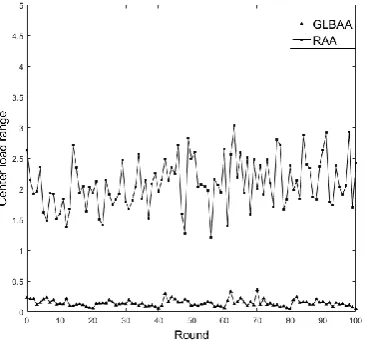
[image:4.595.160.432.204.706.2]In this paper, the algorithm is simulated by Matlab. The simulation parameters are shown in Table 1. The users are randomly distributed in the simulation area. The two fixed traffic centers are responsible for receiving all the traffic. All users in each round make a request for traffic to the system. The traffic is random. The central load range and the traffic quality variance is used as the performance index to evaluate the effect of the algorithm on service fairness and central load balance. Taking multiple rounds of average can avoid contingency. The simulation results are as follows.
Table 1. Simulation parameter table.
Simulation parameters Value
Simulation area 100m×100m
1
Sink (25,50)
2
Sink (75,50)
user number 100
packet size 2000bits/packet
0.5
[image:4.595.207.390.549.720.2] 0.5
Figure 2. Comparison of traffic quality variance.
Figure 3. Contrast diagram of center load range.
load range of the GLBAA algorithm are much lower than the RAA algorithm, and the variation range is also significantly lower, because the GLBAA algorithm considers the traffic in the linear programming process. The quality entropy and the central load balance degree ensure the service fairness while taking into account the central load balance. Therefore, the GLBAA algorithm can effectively balance the pressure of each center traffic while maximizing the performance of the system.
Conclusion
As the most advanced construction mode, the remote-area dual-active system has relatively few related researches at home and abroad, especially for the application of load balancing mechanism in remote data centers. Therefore, based on the research of global load balancing mechanism and the actual construction and application background of State Grid 95598 call platform, this paper proposes a traffic center allocation algorithm based on global load balancing mechanism. Considering the service fairness of the client and the load balance of each center of the system, the optimal central access plan is obtained through the linear programming tool.
References
[1] Y Yong, S Hao, Z Shuang, Z Ruiqian, L Xin, S Wansheng,Research and Analysis on Operations and Support Application of 95598, J. Energy and Energy Conservation. 2015(04):53-56.
[2] F Hao, An implementation of the “active-active” data center, J, Telecommunication Science. 2016, 32(01):182-187.
[3] D Jianli, W Binqiang, Z Chao, Optimising Division of Service Regions of Distant Double Live Data Centre. J .Computer Applications and Software, 2016, 33(02):30-32+54.