R E S E A R C H
Open Access
Convergence analysis of a variable metric
forward–backward splitting algorithm with
applications
Fuying Cui
1, Yuchao Tang
1,2*and Chuanxi Zhu
1,2*Correspondence:
1Department of Mathematics,
Nanchang University, Nanchang, P.R. China
2School of Management, Nanchang
University, Nanchang, P.R. China
Abstract
The forward–backward splitting algorithm is a popular operator-splitting method for solving monotone inclusion of the sum of a maximal monotone operator and an inverse strongly monotone operator. In this paper, we present a new convergence analysis of a variable metric forward–backward splitting algorithm with extended relaxation parameters in real Hilbert spaces. We prove that this algorithm is weakly convergent when certain weak conditions are imposed upon the relaxation
parameters. Consequently, we recover the forward–backward splitting algorithm with variable step sizes. As an application, we obtain a variable metric forward–backward splitting algorithm for solving the minimization problem of the sum of two convex functions, where one of them is differentiable with a Lipschitz continuous gradient. Furthermore, we discuss the applications of this algorithm to the fundamental of the variational inequalities problem, constrained convex minimization problem, and split feasibility problem. Numerical experimental results on LASSO problem in statistical learning demonstrate the effectiveness of the proposed iterative algorithm.
MSC: 90C25; 47H05; 65K05
Keywords: Forward–backward splitting algorithm; Monotone inclusion; Variable metric; Split feasibility problem
1 Introduction
LetHbe a real Hilbert space with inner product·,·and induced norm·. The forward– backward splitting algorithm is a classical operator-splitting algorithm, which solves the monotone inclusion problem
findx∈Hsuch that 0∈Ax+Bx, (1.1)
whereA:H→2His a maximal monotone operator andB:H→His aβ-inverse strongly
monotone operator (see Sect.2for the precise definition) for someβ> 0. The forward– backward splitting algorithm, which dates back to the original work of Lions and Mercier [1], has been studied and reported extensively in the literature; see, for example, [2–6]. The emergence of compressive sensing theory and large-scale optimization problems as-sociated with signal and image processing has resulted in the forward–backward splitting
algorithm receiving much attention in recent years. A forward–backward splitting algo-rithm with relaxation and errors in Hilbert spaces was proposed by Combettes [4]. More precisely, letx0∈H, set
xk+1=xk+λk
JγkA
xk–γk(Bxk+bk)
+ak–xk
, k≥0, (1.2)
where{γk} ⊂(0, 2β),{λk} ⊂(0, 1],{ak}and{bk}are absolutely summable sequences inH. In addition,JγkA:= (I+γkA)
–1denotes the resolvent of operatorAwith indexγ
k> 0.
Com-bettes [4] proved the convergence of the iterative scheme (1.2) when certain conditions are imposed upon the parameters. Jiao and Wang [7] proved the convergence of (1.2) by requiring the parameters{λk}such that{λk} ⊂(0,2β4+βγ
k) whenbk= 0. It is easy to see that
4β
2β+γk is strictly larger than one when{γk} ⊂(0, 2β). Further, Combettes and Yamada [8] improved the range of the relaxation parameters{λk}in (1.2) to (0,4β–γk
2β ). After a
sim-ple calculation, we know that 4β–γk
2β > 4β
2β+γk. Therefore, the range of{λk}in the work of Combettes and Yamada [8] is larger than that of Jiao and Wang [7].
In the case when γk=γ andak=bk= 0, the iterative scheme (1.2) is reduced to the
forward–backward splitting algorithm with a constant step size [9]:
xk+1=xk+λk
JγA(xk–γBxk) –xk
, k≥0, (1.3)
whereγ ∈(0, 2β) and{λk} ⊂(0,4β2–βγ). Bauschke and Combettes [9] obtained the conver-gence of the iterative algorithm (1.3) by adopting the Krasnosekii–Mann (KM) iteration for computing the fixed points of nonexpansive operators. Some recent progress on the KM iteration for solving fixed point problem and split inclusion problem can be found in [10–12]. The forward–backward splitting algorithm with constant step size (1.3) is usu-ally considered to be stationary, whereas the forward–backward splitting algorithm with variable step sizes (1.2) is referred to as non-stationary.
It is worth mentioning that by lettingλk= 1, then (1.3) reduces to the classical forward–
backward splitting algorithm. More precisely, the iterative sequence{xk}is defined by
xk+1=JγA(xk–γBxk), k≥0. (1.4)
In the context of convex optimization, the forward–backward splitting algorithm is equiv-alent to the so-called proximal gradient algorithm (PGA) applied to solve the following convex minimization problem:
min
x∈Hf(x) +g(x), (1.5)
where f :H→R is convex, differentiable with anL-Lipschitz continuous gradient for someL> 0 andg:H→(–∞, +∞] is a proper, lower semicontinuous, convex function. The convex optimization problem (1.5) has found widespread application in signal and image processing, for example, [13–17]. As a consequence of [4], Combettes and Wajs [18] employed the forward–backward splitting algorithm (1.2) to solve the minimization problem (1.5). The obtained iterative algorithm is defined as
xk+1=xk+λk
proxγ
kg
xk–γk
∇f(xk) +bk
+ak–xk
where{γk} ⊂(0, 2/L),{λk} ⊂(0, 1], and{ak},{bk}are absolutely summable sequences inH.
proxγg denotes the proximity operator ofgwith indexγ > 0. In addition, Combettes and Wajs [18] presented applications of this algorithm to many concrete convex optimization problems. This iterative algorithm (1.6) was subsequently improved by Combettes and Yamada [8] who extended the range of the relaxation parameters{λk}.
Inspired by solving large-scale convex optimization problems arising in image process-ing, machine learnprocess-ing, and economic management, many efficient primal–dual splitting algorithms have been proposed for structured monotone inclusions involving maximal monotone operators and single-valued Lipschitz or inverse strongly monotone opera-tors; see, for example, [19, 20]. Although these monotone inclusions are more compli-cated than the monotone inclusion problem (1.1), they can be transformed into the form of this problem in a suitable product space. Therefore, it is natural to consider using the forward–backward splitting algorithm (e.g., (1.2) or (1.3)) to solve the equivalent mono-tone inclusion problem. Because the backward steps cannot be decomposed, direct use of the forward–backward splitting algorithm often fails to obtain a completely splitting algorithm. Many researchers attempted to overcome this difficulty by investigating vari-able metric operator splitting algorithms. The use of a suitvari-able varivari-able metric envari-ables the implicit step of backward splitting to be easily decomposed. For example, the primal– dual hybrid gradient algorithm [21] (also known as the primal–dual of the Chambolle– Pock algorithm [22]) is equivalent to the variable metric proximal point algorithm [23, 24]. We refer the readers to a subsequent paper [25] for more details. V˜u [26] proposed a variable metric extension of the forward–backward–forward splitting algorithm [3] for solving monotone inclusion of the sum of a maximal monotone operator and a monotone Lipschitzian operator in Hilbert spaces. Liang [27] proposed a variable metric multi-step inertial operator-splitting algorithm for solving the monotone inclusion problem (1.1). Bonettini et al. [28] developed a scaled inertial forward–backward splitting algorithm for solving (1.1) in the context of convex minimization. Neither of the respective algorithms in the work by Liang [27] and Bonettini et al. [28] was compatible with the relaxation strat-egy. The variable metric forward–backward splitting algorithm was originally studied in finite-dimensional Hilbert spaces [2,29]; however, the methods in these studies either had to be strongly monotone to study the convergence rate or they did not make use of the in-verse strongly monotone property ofBin (1.1). For infinite-dimensional Hilbert spaces, Combettes and V˜u [30] proposed a variable metric forward–backward splitting algorithm to solve (1.1) and analyzed its weak and strong convergence. This algorithm is defined as follows. Letx0∈H, and set
⎧ ⎨ ⎩
yk=xk–γkUk(Bxk+bk),
xk+1=xk+λk(JγkUkA(yk) +ak–xk),
(1.7)
where{Uk} ⊂Pα(H),{λk} ⊂(0, 1],{γk} ⊂(0, 2β),{ak}and{bk}are absolutely summable
sequences inH. This algorithm (1.7) includes a variable metric, variable step sizes, relax-ation parameter, and errors. It includes nearly all of the forward–backward type of split-ting algorithms mentioned above. For example, by letsplit-tingUk=Iin (1.7), it is reduced to
forward–backward splitting algorithm by replacing the relaxation parameters{λk}in (1.7) with self-adjoint, strong positive linear operators. However, this approach still requires the maximum eigenvalue of the operators to be smaller than one.
The purpose of this paper is to introduce a new convergence analysis for the variable metric forward–backward splitting algorithm (1.7) with an extended range of relaxation parameters. We prove the weak convergence of the variable metric forward–backward splitting algorithm by setting the relaxation parameter{λk}larger than one in real Hilbert spaces. To achieve this goal, we make full use of the averaged and firmly nonexpansive property of operatorsJγkUkA(I–γkUkB) andJγkUkA, whereλk> 0 andUk∈Pα(H). In con-trast, existing solutions mainly rely onJγkUkAbeing firmly nonexpansive. Consequently, we obtain the convergence of the forward–backward splitting algorithm with variable step sizes. Moreover, we impose a slightly weak condition on the relaxation parameters to ensure the convergence of this algorithm. The results we obtained complement and extend those of Combettes and Yamada [8]. As an application, we obtain the variable met-ric forward–backward splitting algorithm for solving the minimization problem (1.5). We also present the application of this algorithm to the variational inequalities problem, con-strained convex minimization problem, and split feasibility problem. To the best of our knowledge, the iterative algorithms we obtained are the most general ones for solving these problems. Finally, we conduct numerical experiments on LASSO problem to vali-date the effectiveness of the proposed iterative algorithm.
The remainder of this paper is organized as follows. Section2reviews selected nota-tions and lemmas on monotone operator theory and presents some technical lemmas. In Sect.3, we prove the main convergence results of the variable metric forward–backward splitting algorithm with relaxation in real Hilbert spaces. Consequently, we obtain sev-eral corollaries of some special cases. Section4presents our use of the proposed iterative algorithm to solve three typical optimization problems including the variational inequal-ities problem, constrained convex minimization problem, and split feasibility problem. In Sect.5, we present preliminary numerical results on LASSO problem to illustrate the performance of the proposed iterative algorithm. Finally, we provide our conclusions.
2 Preliminaries
In this section, we recall selected concepts and lemmas that are commonly used in the context of convex analysis and monotone operator theory. Throughout this paper, letH be a real Hilbert space. The inner product and the associated norm of Hilbert spaceHare denoted by·,·and · , respectively.Idenotes the identity operator and the symbols
and→denote weak and strong convergence.
LetA:H→2Hbe a set-valued operator. We denote its domain, range, graph, and zeros
bydomA={x∈H|Ax=∅},ranA={u∈H|(∃x∈H)u∈Ax},graA={(x,u)∈H×H|u∈ Ax}, andzerA={x∈H|0∈Ax}, respectively.
Definition 2.1([9]) LetA:H→2Hbe a set-valued operator.Ais said to be monotone if
x–y,u–v ≥0, ∀(x,u), (y,v)∈graA.
A well-known example of a maximal monotone operator is the subgradient mapping of a proper, lower semicontinuous convex functionf :H→(–∞, +∞] defined by
∂f :H→2H:x→u∈H|f(y)≥f(x) +u,y–x,∀y∈H.
Definition 2.2([9]) LetA:H→2Hbe a maximal monotone operator. The resolvent
op-erator ofAwith indexλ> 0 is defined as
JλA= (I+λA)–1.
According to the Minty theorem, the resolvent operatorJλAis defined everywhere on
Hilbert spaceH, andJλAis firmly nonexpansive.
Let us recall the definition of the proximity operator, which was first introduced by Moreau [32]. Letf ∈Γ0(H), whereΓ0(H) denotes the set of all proper lower
semicontin-uous convex functionsf:H→(–∞, +∞]. The proximity operator off with indexλ> 0 is defined by
proxλf:H→H:x→arg min y∈H
1 2y–x
2+λf(y)
.
In fact, the resolvent operator of the subdifferential operator of anyf ∈Γ0(H) with index
λ> 0 is the proximal operator off with indexλ> 0, that is,
proxλf= (I+λ∂f)–1.
In fact, letx∈H. Setp=proxλf(x). By the famous Fermat lemma, we have 0∈λ∂f(p) +p– x⇔x∈λ∂f(p) +p. Thenp= (I+λ∂f)–1(x). In other words, (I+λ∂f)–1=proxλf. Therefore, the proximity operators have the same property as the resolvent operators.
Definition 2.3([9]) LetB:H→Hbe a single-valued operator. Letβ> 0, thenBis said to beβ-inverse strongly monotone if
x–y,Bx–By ≥βBx–By2, ∀x,y∈H.
Theβ-inverse strongly monotone operator is also known as aβ-cocoercive operator. It is easy to see from the above definition that aβ-inverse strongly monotone operator is
1
β-Lipschitz continuous, i.e.,Bx–By ≤ 1 βx–y.
Next, we recall the definitions of nonexpansive and related mappings. These mappings often appear in the convergence analysis of optimization algorithms.
Definition 2.4([9]) LetCbe a nonempty subset ofH. LetT:C→H, then
(i) Tis considered to be nonexpansive if
Tx–Ty ≤ x–y, ∀x,y∈C.
(ii) Tis considered to be firmly nonexpansive if
(iii) Tis referred to asα-averaged, whereα∈(0, 1), if there exists a nonexpansive mappingSsuch thatT= (1 –α)I+αS.
It follows immediately that a firmly nonexpansive mapping is a nonexpansive mapping and anα-averaged mapping is also nonexpansive.
We denote byFix(T) the set of fixed points of a mappingT, that is,Fix(T) ={x∈H|x= Tx}.
Lemma 2.1(Demiclosedness principle [9]) Let C be a nonempty subset of H.Let T:C→
H be a nonexpansive mapping withFix(T)=∅.If{xk}is a sequence in C that converges weakly to x and if{(I–T)xk}converges strongly to y,then(I–T)x=y;in particular,if y= 0, then x∈Fix(T).
The following proposition provides some equivalent definitions of the firmly nonexpan-sive mappings. This proposition can be found in Proposition 4.4 of [9].
Proposition 2.1([9]) Let C be a nonempty subset of H.Let T:C→H,then the following
are equivalent:
(i) Tis firmly nonexpansive; (ii) I–Tis firmly nonexpansive; (iii) 2T–Iis nonexpansive;
(iv) x–y,Tx–Ty ≥ Tx–Ty2,∀x,y∈C.
From Proposition2.1(iii) and (iv), we know that ifT is firmly nonexpansive, thenT is
1
2-averaged, and a 1-inverse strongly monotone operator is firmly nonexpansive.
The following proposition is taken from Proposition 4.35 of [9].
Proposition 2.2 Let C be a nonempty subset of H.Let T:C→H,then T isα-averaged if
and only if
Tx–Ty2≤ x–y2–1 –α
α (I–T)x– (I–T)y, ∀x,y∈C.
The following lemma provides a relation between an operatorT with its complement
I–T.
Lemma 2.2([9]) Let C be a nonempty subset of H.Let T:C→H,then
(i) Tis nonexpansive if and only if the complementI–Tis12-inverse strongly monotone; (ii) T isα-averaged if and only if the complementI–Tis 21α-inverse strongly monotone.
We refer interested readers to [9] for further properties of nonexpansive, firmly nonex-pansive, andα-averaged nonlinear mappings.
Lemma 2.3 Let C be a nonempty subset of H.Let T1:C→H beα1-averaged and T2:
C→H beα2-averaged.Then
T:=T1T2is
α1+α2– 2α1α2
1 –α1α2
-averaged.
Remark2.1
(i) It is worth mentioning that two other results of the combination of averaged operators were reported. From Proposition 4.32 of [34],T:=T1T2is
α= 2 1+max(α1
1,α2)
-averaged. From Byrne [35],T:=T1T2isα=α1+α2–α1α2-averaged. It is not difficult to verify that α1+α2–2α1α2
1–α1α2 is smaller than the other two constantsα
andα.
(ii) The constantαis used in [7] to show the upper bound of the relaxation parameter
λksuch thatλk<α1.
We employ the following previously used notation [30]. LetB(H,G) be the spaces of
bounded linear operators from Hilbert space H to Hilbert spaceG. The norm ofL∈
B(H,G) is defined asL=supx∈HLxx. We setB(H) =B(H,H) andS(H) ={L∈B(H)|L= L∗}, whereL∗denotes the adjoint ofL. The Loewner partial ordering onS(H) is defined by, for anyU,V∈S(H),
UV ⇔ Ux,x ≥ Vx,x, ∀x∈H.
Letα∈[0, +∞), set
Pα(H) =
U∈S(H)|UαI.
We denote by√U the square root ofU∈Pα(H). Moreover, for everyU∈Pα(H), we
define a semi-scalar product and a semi-norm (a scalar product and a norm ifα> 0) by
(∀x∈H) (∀y∈H) x,yU=Ux,y and xU=Ux,x.
We borrow the following results on monotone operators in a variable metric setting from Combettes [30].
Lemma 2.4([30]) Let A:H→2Hbe maximal monotone,letα∈(0, +∞),let U∈P α(H),
and let HU–1be the real Hilbert space with the scalar productx,yU–1=U–1x,y,∀x,y∈ H.Then the following hold:
(i) UA:H→2His maximal monotone;
(ii) JUA:H→2His1-inverse strongly monotone,i.e.,firmly nonexpansive.More
precisely,
JUAx–JUAy2U–1≤ x–yU2–1–(I–JUA)x– (I–JUA)y 2
U–1, ∀x,y∈H. (2.1)
LetU∈Pα(H) for someα> 0. The proximity operator off ∈Γ0(H) relative to the metric
induced byUis defined by
proxUf :H→H:x→arg min y∈H
1 2x–y
2 U+f(y)
.
We haveproxUf =JU–f∂f and we can writeproxIf=proxf.
We make full use of the following lemmas to obtain the weak convergence of the con-sidered iterative sequence. Both of the two lemmas were previously reported [36]. In the following, we denote by 1
+(N) the set of summable sequences in [0, +∞), whereNis a set
of nonnegative integer numbers.
Lemma 2.5([36]) Letα∈(0, +∞),and let{Wk}be inPα(H),let C be a nonempty subset
of H,and let{xk}be a sequence in H such that
xk+1–zWk+1≤(1 +ηk)xk–zWk+k, ∀z∈C, (2.2)
where{ηn} ⊂ 1+(N)and{k} ⊂ 1+(N).Then{xk}is bounded and,for every z∈C, (xk–
zWk)converges.
Lemma 2.6([36]) Letα∈(0, +∞),and let{Wk}and W be inPα(H)such that Wk→W
pointwise as k→+∞,as is the case when
sup
k∈NWk< +∞ and
∃{ηk} ⊂ 1+(N) (1 +ηk)WkWk+1.
Let C be a nonempty subset of H,and let{xk}be a sequence in H such that(2.2)is satisfied. Then{xk}converges weakly to a point in C if and only if every weak sequential cluster point of{xk}is in C.
The following lemma can be found in Corollary 2.15 of Bauschke and Combettes [9].
Lemma 2.7([9]) Let x∈H,y∈H,andα∈R.Then
αx+ (1 –α)y2=αx2+ (1 –α)x2–α(1 –α)x–y2. (2.3)
3 Variable metric forward–backward splitting algorithm
In this section, we study the convergence of the variable metric forward–backward split-ting algorithm. First, we prove the following useful lemmas.
Lemma 3.1 Let B:H→H be aβ-inverse strongly monotone operator.Letα> 0,and let U∈Pα(H).Let HU–1be a real Hilbert space with the scalar productx,yU–1=U–1x,y,
∀x,y∈H.Then I–γUB is aγ2Uβ -averaged operator on HU–1for anyγ∈(0,U2β).
Proof Letx,y∈H. BecauseBisβ-inverse strongly monotone, we have
UBx–UBy,x–yU–1=Bx–By,x–y
On the other hand, we obtain
UBx–UBy2U–1≤ U · Bx–By2. (3.2)
From (3.1) and (3.2), we obtain
UBx–UBy,x–yU–1≥ β
U· UBx–UBy
2
U–1, (3.3)
which means thatUBis Uβ -inverse strongly monotone onHU–1. ThenγUBxis β
γU
-inverse strongly monotone. By Lemma2.2(ii),I–γUBis a γU2β -averaged operator on
HU–1.
Lemma 3.2 Let A:H→2H be maximal monotone.Letα∈(0, +∞),and let U∈P α(H).
Let HU–1be a real Hilbert space with the scalar productx,yU–1=U–1x,y,∀x,y∈H.Let B:H→H be aβ-inverse strongly monotone operator.Then,for anyγ ∈(0,U2β),JγUA(I–
γUB)is4β–2γβU-averaged on HU–1.
Proof BecauseAis maximal monotone, then for anyγ > 0,γUAis maximal monotone. According to Lemma2.4(ii),JγUAis 1-inverse strongly monotone onHU–1. ThenJγUAis
1
2-averaged. Lemma3.1determines thatI–γUBis γU
2β -averaged. Therefore, we apply
Lemma2.3, from which we know thatJγUA(I–γUB) is
α1+α2– 2α1α2
1 –α1α2
=
1 2+
γU 2β –
γU 2β
1 –12·γU2β = 2β
4β–γU, (3.4)
which is the averaged operator.
Lemma 3.3 Let H be a real Hilbert space.Let A:H→2Hbe a maximal monotone
opera-tor.Let B:H→H be aβ-inverse strongly monotone operator for someβ> 0.Suppose that Ω:=zer(A+B)=∅.Letγk> 0,α> 0,and{Uk} ⊂Pα(H).Then the following are equivalent:
(i) x∗∈zer(A+B).
(ii) x∗=JγkUkA(I–γkUkB)(x∗)for anyγk> 0.
(iii) x∗= (U–1k +γkA
α )
–1◦(Uk–1–γkB α )x∗.
Proof (i)⇔(ii) Letx∗∈zer(A+B), then we have
0∈γkAx∗+γkBx∗
⇔ 0∈γkUkAx∗+γkUkBx∗ ⇔ x∗–γkUkBx∗∈x∗+γkUkAx∗ ⇔ x∗= (I+γkUkA)–1
x∗–γkUkBx∗
⇔ x∗=JγkUkA(I–γkUkB)
(ii)⇔(iii) Letx∗=JγkUkA(I–γkUkB)x
∗, then
x∗–γkUkBx∗∈x∗+γkUkAx∗
⇔ Uk–1x∗–γkBx∗∈Uk–1x∗+γkAx∗
⇔
U–1 k –γkB
α
x∗∈
U–1 k +γkA
α
x∗
⇔ x∗=
Uk–1+γkA
α
–1 ◦
Uk–1–γkB
α
x∗.
Lemma 3.4 Let H be a real Hilbert space.Let A:H→2Hbe a maximal monotone
oper-ator.Let B:H→H be aβ-inverse strongly monotone operator for someβ> 0.Let r> 0 and s> 0,and let U,V ∈Pα(H). Define a variable metric forward–backward operator
TrU:=JrUA(I–rUB).Then,for any x∈H,we have
TrUx–TsVx ≤
1 λmin(U–1)
U–1–r sV
–1
(x–TsVx)
,
whereλmin(U–1)represents the minimum eigenvalue of U–1.
Proof Letx∈H, in which case we have
U–1x–U–1T rUx
r –Bx∈ATrUx,
V–1x–V–1T sVx
s –Bx∈ATsVx.
It follows from the monotonicity of operatorAthat
TrUx–TsVx,
U–1x–U–1T rUx
r –
V–1x–V–1T sVx
s
≥0.
Then
TrUx–TsVx2U–1≤r
TrUx–TsVx,
U–1 r – V–1 s
(x–TsVx)
.
Because of the Cauchy–Schwarz inequality and the fact thatλmin(U–1)x2≤ x2U–1, for anyx∈H, we obtain
TrUx–TsVx ≤
1 λmin(U–1)
U–1–r sV
–1
(x–TsVx)
.
We are ready to state our main theorems and present their convergence analysis.
Theorem 3.1 Let H be a real Hilbert space.Let A:H→2H be maximal monotone.Let B:H→H beβ-inverse strongly monotone for someβ> 0.Suppose thatΩ:=zer(A+B)=∅. Letα> 0,{ηk} ∈ 1
+(N),and{Uk} ⊂Pα(H)such that
μ=sup
Let{γk} ⊂(0,U2β
k)and{λk} ⊂(0,
1
αk),whereαk= 2β
4β–γkUk.Let{ak}and{bk}be two
se-quences in H such that+k=0∞λkak< +∞andk+∞=0λkbk< +∞.Let x0∈H,and set
⎧ ⎨ ⎩
yk=xk–γkUk(Bxk+bk),
xk+1=xk+λk(JγkUkA(yk) +ak–xk).
(3.6)
Then we have:
(i) For anyx∗∈Ω,limk→+∞xk–x∗Uk–1exists.
Suppose that0 <λ≤λk≤α1
k –τ,whereτ∈(0,
1
αk –λ),then
(ii) limk→+∞xk–JγkUkA(xk–γkUkBxk)= 0.
Suppose that0 <γ ≤γk,then
(iii) {xk}converges weakly to a point inΩ.
Further,suppose thatγk≤2βμ–,where∈(0, 2β–μγ),then (iv) Bxk→Bx∗ask→+∞,wherex∗∈Ω.
Proof According to condition (3.5), we have
Uk–1≤ 1 α, U
–1
k ∈Pμ1(H), and (1 +ηk)Uk–1Uk–1+1. (3.7)
Hence,
(1 +ηk)x2U–1
k ≥
x2
U–1k+1, ∀x∈H. (3.8)
For the sake of convenience, let
xk+1=xk+λk
JγkUkA(xk–γkUkBxk) –x
k. (3.9)
Then iterative scheme (3.6) can be rewritten as
xk+1=xk+1+λkek, (3.10)
where ek=JγkUkA(yk) –JγkUkA(xk–γkUkBxk) +ak such that
+∞
k=0λkek< +∞. In fact,
becauseJγkUkAis nonexpansive onHU–1k , we have
λkek ≤√μλkekU–1
k
≤√μλkyk– (xk–γkUkBxk)U–1
k +
√
μλkakU–1
k
≤μγkλkbk+
1 αλkak
≤μ2β
α λkbk+
1
αλkak. (3.11)
From Lemma 3.2, we know that JγkUkA(I –γkUkB) is
2β
4β–γkUk-averaged. Let αk =
2β
4β–γkUk, then there exist nonexpansive mappingsRksuch thatJγkUkA(I–γkUkB) = (1 – αk)I+αkRk. Consequently, the iterative sequence{xk+1}in (3.9) is equivalent to
xk+1= (1 –λk)xk+λk
(1 –αk)xk+αkRkxk
= (1 –λkαk)xk+λkαkRkxk. (3.12)
(i) Letx∗∈zer(A+B), according to Lemma3.3,x∗=JγkUkA(I–γkUkB)(x∗). Thenx∗=
Rkx∗. From (3.8), (3.10), and (3.12), we obtain
xk+1–x∗U–1
k+1≤
(1 +ηk)xk+1–x∗U–1
k
≤(1 +ηk)xk+1–x∗U–1
k +
λkekU–1
k
≤(1 +ηk)(1 –λkαk)
xk–x∗
+λkαk
Rkxk–x∗U–1
k
+(1 +ηk)
1 αλkek
≤(1 +ηk)xk–x∗U–1
k +
k, (3.13)
where k=
(1 +ηk)
1
αλkek. Because
+∞
k=0λkek< +∞and
+∞
k=0ηk< +∞, then
∞
k=0k< +∞. On the basis of Lemma2.5, we conclude thatlimk→+∞xk–x∗U–1k exists.
Moreover,{xk–x∗}is bounded. LetM> 0 such thatsup
k≥0xk–x∗ ≤M.
(ii) With the help of the inequalityx+y2≤ x2+ 2y,x+y,∀x,y∈H. We obtain
xk+1–x∗2U–1
k+1≤(1 +ηk)
xk+1–x∗2U–1
k
= (1 +ηk)xk+1–x∗+λkek2U–1
k
= (1 +ηk)xk+1–x∗ 2 U–1
k + 2λk
ek,xk+1–x∗
U–1
k
≤(1 +ηk)xk+1–x∗2U–1
k + 2(1 +ηk)M
Uk–1λkek. (3.14)
From Lemma2.7and (3.9) we derive that
xk+1–x∗2U–1
k =
(1 –λk)
xk–x∗
+λk
JγkUkA(xk–γkUkBxk) –x
∗2 Uk–1
= (1 –λk)xk–x∗ 2
U–1k +λkJγkUkA(xk–γkUkBxk) –x
∗2 U–1k
–λk(1 –λk)xk–JγkUkA(xk–γkUkBxk)
2
Uk–1. (3.15)
BecauseJγkUkA(I–γkUkB) isαk-averaged, it follows from Proposition2.2that
JγkUkA(xk–γkUkBxk) –x
∗2 Uk–1
≤xk–x∗2U–1
k – 1 –αk
αk
xk–JγkUkA(xk–γkUkBxk)
2
Substituting (3.16) into (3.15) yields
x¯k+1–x∗ 2
Uk–1≤xk–x ∗2
U–1k –λk
1 αk
–λk
xk–JγkUkA(xk–γkUkBxk)
2
Uk–1. (3.17)
Combining (3.17) with (3.14), we obtain
xk+1–x∗2U–1
k+1≤(1 +ηk)
xk–x∗2U–1
k + 2(1 +ηk)M
U–1 k λkek
– (1 +ηk)λk
1 αk
–λk
xk–JγkUkA(xk–γkUkBxk)
2
Uk–1, (3.18)
which implies that
λk
1 αk
–λk
xk–JγkUkA(xk–γkUkBxk)
2 U–1
k
≤(1 +ηk)xk–x∗2U–1
k –
xk+1–x∗2U–1
k+1+ 2(1 +
ηk)MUk–1λkek. (3.19)
Observe thatlimk→+∞xk–x∗Uk–1exists and
+∞
k=0λkek< +∞. Then by lettingk→+∞
in the above inequality and considering the condition on{λk}, we obtain
lim
k→+∞xk–JγkUkA(xk–γkUkBxk)Uk–1= 0. (3.20)
Because the two norms · U–1
k and · defined on the Hilbert spacesHare equivalent, it follows from (3.20) that
lim k→+∞
xk–JγkUkA(xk–γkUkBxk)= 0. (3.21)
(iii) In this part, we prove that the sequence {xk} converges weakly to a point inΩ. In fact, letx¯be a weak sequential cluster point of{xk}, then there exists a subsequence
{xkn} ⊂ {xk}such thatxknx¯. Because{γk} ⊂(γ,
2β Uk)⊂(γ,
2β
α) is bounded, there
ex-ists a subsequence of{γk}converging toγ ∈(γ,2αβ). Without loss of generality, we may assume thatγkn→γ. According to condition (3.5), it follows from Lemma2.6that there existsU–1∈P
1
μ(H) such thatU –1
k →U–1pointwise.
With the help of Lemma3.4, we make the following estimation:
xkn–JγUA(xkn–γUBxkn)
≤xkn–JγknUknA(xkn–γknUknBxkn)
+JγknUknA(xkn–γknUknBxkn) –JγUA(xkn–γUBxkn)
≤xkn–JγknUknA(xkn–γknUknBxkn)
+ 1
λmin(Uk–1)
Uk–1n –γkn γ U
–1x
kn–JγUA(xkn–γUBxkn)
+μ γU
–1 knγ –U
–1 knγkn
xkn–JγUA(xkn–γUBxkn)
+μ
γU
–1 knγkn–U
–1γ kn
xkn–JγUA(xkn–γUBxkn)
≤xkn–JγknUknA(xkn–γknUknBxkn)
+ μ
γ α|γ –γkn|xkn–JγUA(xkn–γUBxkn)
+μ
γ 2β
α U
–1 kn –U
–1x
kn–JγUA(xkn–γUBxkn). (3.22)
Because{xkn–JγUA(xkn–γUBxkn)}is bounded, it follows from the conditions above, and we can conclude from (3.22) that
xkn–JγUA(xkn–γUBxkn)→0 askn→+∞. (3.23)
AsJγUA(I–γUB) is nonexpansive, based on the demiclosedness property of nonexpansive
mapping, we deduce thatx¯=JγUA(x¯–γUBx¯), which means thatx¯∈zer(A+B). Because ¯
xis arbitrary, together with conclusion (i), we can conclude from Lemma2.6that{xk} converges weakly to a point inzer(A+B).
(iv) On the other hand, asJγkUkAis firmly nonexpansive, it follows that we have
JγkUkA(xk–γkUkBxk) –x
∗2 Uk–1
≤xk–γkUkBxk–
x∗–γkUkBx∗ 2 U–1
k
–(I–JγkUkA)(xk–γkUkBxk) – (I–JγkUkA)
x∗–γkUkBx∗ 2 Uk–1
=xk–x∗–
γkUkBxk–γkUkBx∗ 2 Uk–1
–xk–JγkUkA(xk–γkUkBxk) –
γkUkBxk–γkUkBx∗ 2 U–1k
=xk–x∗ 2 U–1k – 2
xk–x∗,γkUkBxk–γkUkBx∗
Uk–1
+γkUkBxk–γkUkBx∗ 2 Uk–1
–xk–JγkUkA(xk–γkUkBxk) –
γkUkBxk–γkUkBx∗2U–1
k . (3.24)
BecauseBisβ-inverse strongly monotone, we have that
xk–x∗,γkUkBxk–γkUkBx∗
Uk–1≥γkβBxk–Bx ∗2
. (3.25)
In addition, we have
γkUkBxk–γkUkBx∗ 2 U–1k ≤γ
2
kUkBxk–Bx∗ 2
≤μγk2Bxk–Bx∗ 2
Substituting (3.25) and (3.26) into (3.24), we obtain
JγkUkA(xk–γkUkBxk) –x
∗2 Uk–1
≤xk–x∗ 2
Uk–1–γk(2β–γkμ)Bxk–Bx ∗2
–xk–JγkUkA(xk–γkUkBxk)
–γkUkBxk–γkUkBx∗2U–1
k . (3.27)
The combination of (3.27) with (3.15) yields
xk+1–x∗ 2 Uk–1
≤xk–x∗ 2
Uk–1–λkγk(2β–γkμ)Bxk–Bx ∗2
–λkxk–JγkUkA(xk–γkUkBxk) –
γkUkBxk–γkUkBx∗2U–1
k
–λk(1 –λk)xk–JγkUkA(xk–γkUkBxk)
2 U–1
k . (3.28)
Further, on the basis of (3.28) and (3.14), we obtain
xk+1–x∗2 Uk–1+1
≤(1 +ηk)xk–x∗2U–1
k – (1 +
ηk)λkγk(2β–γkμ)Bxk–Bx∗2
– (1 +ηk)λkxk–JγkUkA(xk–γkUkBxk) –
γkUkBxk–γkUkBx∗ 2 U–1
k
– (1 +ηk)λk(1 –λk)xk–JγkUkA(xk–γkUkBxk)
2 Uk–1
+ 2λk(1 +ηk)MUk–1ek, (3.29)
which implies that
λkγk(2β–γkμ)Bxk–Bx∗ 2
≤(1 +ηk)xk–x∗ 2
Uk–1–xk+1–x ∗2
U–1k+1
– (1 +ηk)λk(1 –λk)xk–JγkUkA(xk–γkUkBxk)
2 Uk–1
+ 2λk(1 +ηk)MUk–1ek. (3.30)
By the conditions on{γk}and{λk}, and together with conclusions (i), (ii) and the fact that+k=0∞λkek< +∞, lettingk→+∞in the above inequality, we obtain
Bxk→Bx∗ ask→+∞. (3.31)
This completes the proof.
Remark3.2 If we assume thatλk∈(λ, 1], then we reaffirm the conclusion that
+∞ k=0Bxk–
Bx∗2< +∞as in Theorem 4.1 of the paper by Combettes and V˜u [30]. In fact, from
in-equality (3.30), we have
λγ Bxk–Bx∗ 2
≤λkγk(2β–γkμ)Bxk–Bx∗ 2
≤(1 +ηk)xk–x∗ 2
U–1k –xk+1–x ∗2
Uk–1+1
+ 2λk(1 +ηk)MUk–1ek.
By summing the above inequality from zero to infinity, we have
λγ
+∞
k=0
Bxk–Bx∗ 2
≤x0–x∗ 2 U0–1+
+∞
k=0
ηksup k≥0
xk–x∗ 2 Uk–1
+
+∞
k=0
2λk(1 +ηk)MUk–1ek,
which implies that+k=0∞Bxk–Bx∗2< +∞.
Remark3.3 In view of Theorem3.1(iii), the iterative sequence generated by (3.6) con-verges weakly to a point inΩ. The strong convergence of{xk}requiresxk→x∗,x∗∈Ω.
Similar to Theorem 4.1 of Combettes and V˜u [30], we need to assume that one of the following conditions holds:
(i) lim infk→+∞dΩ(xk) = 0;
(ii) AorBis demiregular at every point inΩ; (iii) intΩ=∅and there exists{vk} ∈ 1
+(N)such that(1 +vk)UkUk+1.
Because the proof is the same as that of Combettes and V˜u [30], we omit it here.
Next, we impose a slightly weaker condition on the iterative parameter{λk}than in The-orem3.1to ensure the weak convergence of the iterative sequence{xk}.
Theorem 3.2 Let H be a real Hilbert space.Let A:H→2H be maximal monotone.Let
B:H→H beβ-inverse strongly monotone for someβ> 0.Suppose thatΩ:=zer(A+B)=∅. Letα> 0,{ηk} ∈ 1
+(N),and{Uk} ∈Pα(H)such that
μ=sup
k∈NUk< +∞ and (1 +
ηk)Uk+1Uk, ∀k∈N. (3.32)
Let the iterative sequence{xk}be defined by(3.6).Then we have:
(i) For anyx∗∈Ω,limk→+∞xk–x∗Uk–1exists.
Suppose that
(a) +k=0∞λk(α1
k –λk) = +∞,whereαk=
2β 4β–γkUk;
(b) 0 <γ≤γk≤2βμ–,where∈(0, 2β–μγ); (c) +k=0∞|γk+1–γk|< +∞,
+∞
k=0|γk+1Uk+1–γkUk|< +∞,and
+∞
Then
(ii) limk→+∞xk–JγkUkA(xk–γkUkBxk)= 0;
(iii) {xk}converges weakly to a point inΩ.
Further,suppose thatλk≥λ> 0.Then (iv) Bxk→Bx∗ask→+∞,wherex∗∈Ω.
Proof (i) Letx∗∈Ω, it follows from the same proof of Theorem3.1(i) and we know that
limk→+∞xk–x∗U–1k exists. Then,{xk–x∗}is bounded. LetM:=supk≥0xk–x∗.
(ii) From (3.19), we obtain
+∞
k=0
λk
1 αk
–λk
xk–JγkUkA(xk–γkUkBxk)
2 Uk–1
≤x0–x∗ 2 U0–1+
1 αM
2 +∞
k=0
ηk+ 2
1 α
+∞
k=0
(1 +ηk)Mλkek. (3.33)
Because+k=0∞ηk< +∞and
+∞
k=0λkek< +∞, then
+∞
k=0
λk
1 αk
–λk
xk–JγkUkA(xk–γkUkBxk)
2
Uk–1< +∞. (3.34)
LetTk=JγkUkA(I–γkUkB). By condition (a), (3.34) implies that
lim inf
k→+∞xk–TkxkUk–1= 0.
Consequently, lim infk→+∞xk –Tkxk = 0. Because Tk is αk-averaged, where αk = 2β
4β–γkUk, there exist nonexpansive mappingsRkonHUk–1such thatTk= (1 –αk)I+αkRk. Then,lim infk→+∞xk–RkxkU–1
k = 0. Next, we prove thatlimk→+∞xk–Rkxk= 0. Using formulation (3.10) and the fact thatRk+1is nonexpansive onHU–1k+1, we have
xk+1–Rk+1xk+1U–1k+1
(3.10)
= xk+1–Rk+1xk+1+λkekUk–1+1
≤ xk+1–Rk+1xk+1U–1
k+1+λkekU–1k+1
=(1 –λkαk)xk+λkαkRkxk–Rk+1xk+1U–1
k+1+
λkekU–1
k+1
=(1 –λkαk)(xk–Rkxk) +Rkxk–Rk+1xk+1U–1
k+1+λkekU –1
k+1
≤(1 –λkαk)xk–RkxkUk–1+1+Rkxk–Rk+1xkUk–1+1
+Rk+1xk–Rk+1xk+1Uk–1+1+λkekUk–1+1
≤(1 –λkαk)xk–RkxkU–1
k+1+Rkxk–Rk+1xkUk–1+1+xk–xk+1Uk–1+1
+λkekU–1
k+1
≤ xk–RkxkU–1
k+1+Rkxk–Rk+1xkUk–1+1+ 2
1
On the other hand, using the relationRk= (1 –α1k)I+ 1
αkTkand Lemma3.4, we have
Rkxk–Rk+1xkUk–1+1
=
1 – 1
αk
xk+
1 αk
Tkxk–
1 – 1
αk+1
xk–
1 αk+1
Tk+1xk
Uk–1+1
≤ 1
αk+1
– 1
αk
xkU–1
k+1+
α1kTkxk–
1 αk+1
Tk+1xk
Uk–1+1
≤ 1
αk+1
– 1
αk
xkU–1
k+1+
α1kTkxk–
1 αk+1
Tkxk
Uk–1+1
+ 1
αk+1
Tkxk–
1 αk+1
Tk+1xk
Uk–1+1
≤ 1
2βγkUk–γk+1Uk+1xkU–1k+1+TkxkUk–1+1
+ 1
αk+1
Tkxk–Tk+1xkUk–1+1
≤ 1
2βγkUk–γk+1Uk+1xkU–1k+1+TkxkUk–1+1
+ 2
1
αTkxk–Tk+1xk
≤ 1
2βγkUk–γk+1Uk+1xkU–1k+1+TkxkUk–1+1
+ 2 1 α μ γk+1
γk+1Uk–1–γkUk–1+1
(xk–Tk+1xk) ≤ 1
2βγkUk–γk+1Uk+1xkU–1k+1+TkxkUk–1+1
+ 2 1 α μ
γ|γk+1–γk|U
–1
k (xk–Tk+1xk)
+ 2 1 α μ γ 2β α U
–1 k –Uk–1+1
(xk–Tk+1xk). (3.36)
The combination of (3.36) with (3.35) yields
xk+1–Rk+1xk+1U–1k+1
≤ xk–RkxkU–1
k+1+ 1
2βγkUk–γk+1Uk+1xkUk–1+1+TkxkUk–1+1
+ 2 1 α μ
γ|γk+1–γk|U
–1
k (xk–Tk+1xk)
+ 2 1 α μ γ 2β α U
–1 k –Uk–1+1
(xk–Tk+1xk)+ 2
1 αλkek
≤(1 +ηk)xk–RkxkU–1k +
1
2βγkUk–γk+1Uk+1xkUk–1+1+TkxkUk–1+1
+ 2 1 α μ
γ|γk+1–γk|U
–1
k (xk–Tk+1xk)
+ 2 1 α μ γ 2β α U
–1 k –U
–1 k+1
(xk–Tk+1xk)+ 2
1
With the help of Lemma2.5, we can conclude from (3.37) thatlimk→+∞xk–RkxkUk–1= 0.
Hence,limk→+∞xk–Rkxk= 0. As a consequence,limk→+∞xk–Tkxk= 0.
(iii) and (iv) can be proven using the same proof as Theorem3.1.
Remark3.4 In Theorem3.2, we prove the weak convergence of the iterative sequence
generated by (3.6) with a weaker condition on{λk}than that in Theorem3.1.
In Theorems3.1and3.2, letUk=I, in which case we obtain the following corollary,
which shows the convergence of the forward–backward splitting algorithm with variable step sizes.
Corollary 3.3 Let H be a real Hilbert space.Let A:H→2Hbe maximal monotone.Let B:H→H beβ-inverse strongly monotone for someβ> 0.Suppose thatΩ=zer(A+B)=∅. Let{γk} ⊂(0, 2β)and{λk} ⊂(0, 1
αk),whereαk=
2β
4β–γk.Let{ak}and{bk}be two sequences
in H such that+k=0∞λkak< +∞and+k=0∞λkbk< +∞.Let x0∈H,and set
⎧ ⎨ ⎩
yk=xk–γk(Bxk+bk),
xk+1=xk+λk(JγkA(yk) +ak–xk).
(3.38)
Then we have:
(i) for anyx∗∈Ω,limk→+∞xk–x∗exists.
Suppose that
(a1) 0 <λ≤λk;
(a2) λk≤α1k –τ,whereτ∈(0, 1 αk –λ); (a3) 0 <γ≤γk;
(a4) γk≤2β–,where∈(0, 2β–γ); (a5) +k=0∞λk(α1
k –λk) = +∞and
+∞
k=0|γk+1–γk|< +∞.
If the conditions of(a1)–(a2)or(a3)–(a5)hold,then we have
(ii) limk→+∞xk–JγkA(xk–γkBxk)= 0.
If the conditions of(a1)–(a3)or(a3)–(a5)hold,then we have
(iii) {xk}converges weakly to a point inΩ.
If the conditions of(a1)–(a3)or(a1), (a3)–(a5)hold,then we have
(iv) Bxk→Bx∗ask→+∞,wherex∗∈Ω.
Remark3.5 Under conditions (a1)–(a3), Corollary3.3reaffirms Proposition 4.4 of Com-bettes and Yamada [8]. In addition, we obtain the convergence of the iterative scheme (3.38) under conditions (a3)–(a5), which provide a weaker assumption on the relaxation parametersλkthan conditions (a1) and (a2). Consequently, the obtained results improve
and generalize Proposition 4.4 of Combettes and Yamada [8].
As an application of Theorems3.1and3.2, we have the following convergence results for solving the convex minimization problem (1.5).
Ω=∅.Let x0∈H,and set
⎧ ⎨ ⎩
yk=xk–γkUk(∇f(xk) +bk),
xk+1=xk+λk(prox U–1
k
γkg(yk) +ak–xk),
(3.39)
where{Uk},{γk},{λk},{ak},and{bk}satisfy the same conditions as in Theorem3.1or The-orem3.2.
Then the following hold:
(i) For anyx∗∈Ω,limk→+∞xk–x∗U–1
k exists;
(ii) limk→+∞xk–prox Uk–1
γkg(xk–γkUk∇f(xk))= 0;
(iii) {xk}converges weakly to a point inΩ; (iv) ∇f(xk)→ ∇f(x∗)ask→+∞,wherex∗∈Ω.
Proof Becausefis convex differentiable, according to the Baillon–Haddad theorem,∇f is β-inverse strongly monotone. From the definition of the proximity operator on the Hilbert spaceHU–1, we know that
proxU
–1
k
γkg (u) =JγkUk∂g(u). (3.40)
SetA=∂gandB=∇f in Theorem3.1and Theorem3.2and this enables us to confirm the
conclusions of Corollary3.4.
In the following, we employ the variable metric forward–backward splitting algorithm investigated above for solving several classes of nonlinear optimization problems. First, we consider the variational inequality problem (VIP):
findx∗∈C, such thatBx∗,y–x∗≥0, ∀y∈C, (3.41)
whereCis a nonempty closed convex subset ofH, andB:H→His a nonlinear operator. Recall the indicator functionδC, which is defined as
δC(x) =
⎧ ⎨ ⎩
0, x∈C,
+∞, otherwise. (3.42)
The proximal operator of δC is well known to be the metric projection onC, which is
defined by
PC(x) =proxδC(x) =arg miny∈Cx–y.
The normal cone operator ofCisNC, which is defined by
NC(x) =
⎧ ⎨ ⎩
{w|w,y–x ≤0,∀y∈C}, x∈C,
Then VIP (3.41) is equivalent to the following monotone inclusion problem:
0∈Bx+NC(x). (3.44)
Assuming thatBisβ-inverse strongly monotone, (3.44) is a special case of the monotone inclusion problem (1.1). LetA=NC, then we know thatJγUA=PU
–1
C for anyγ > 0 andU∈
Pα(H). The operatorPU
–1
C denotes the projector onto a nonempty closed convex subsetC
ofHrelative to the norm · U–1. More precisely,
PUC–1(x) =arg min
y∈Cx–yU–1.
On the basis of Theorems3.1and3.2, we obtain the following convergence theorem to solve VIP (3.41).
Theorem 3.5 Let H be a real Hilbert space.Let B:H→H be aβ-inverse strongly mono-tone operator.We denote byΩthe solution set of VIP(3.41)and assume thatΩ=∅.Let x0∈H,set
⎧ ⎨ ⎩
yk=xk–γkUk(Bxk+bk),
xk+1=xk+λk(P Uk–1
C (yk) +ak–xk),
(3.45)
where{Uk},{γk},{λk},{ak},and{bk}satisfy the same conditions as in Theorem3.1or The-orem3.2.
Then the following hold:
(i) For anyx∗∈Ω,limk→+∞xk–x∗U–1
k exists;
(ii) limk→+∞xk–P Uk–1
C (xk–γkUkAxk)= 0; (iii) {xk}converges weakly to a point inΩ; (iv) Bxk→Bx∗ask→+∞,wherex∗∈Ω.
Second, we consider the following constrained convex minimization problem:
minf(x)
s.t.x∈C,
(3.46)
whereCis a nonempty closed convex subset ofH, andf :H→Ris a proper closed convex differentiable function with a Lipschitz continuous gradient.
It follows from the definition of the indicator function that constrained convex mini-mization problem (3.46) is equivalent to the following unconstrained minimini-mization prob-lem:
min
x∈Hf(x) +δC(x). (3.47)
It is obvious that problem (3.47) is a special case of (1.5). Therefore, by takingg(x) =δC(x),
Theorem 3.6 Let H be a real Hilbert space.Let f :H→R be a proper, closed convex function such that f is differentiable with an L-Lipschitz continuous gradient.We denote byΩ the solution set of the constrained convex minimization problem(3.41)and assume thatΩ=∅.Let x0∈H,and set
⎧ ⎨ ⎩
yk=xk–γkUk(∇f(xk) +bk),
xk+1=xk+λk(P Uk–1
C (yk) +ak–xk),
(3.48)
where{Uk},{γk},{λk},{ak},and{bk}satisfy the same conditions as in Theorem3.1or The-orem3.2.
Then the following hold:
(i) For anyx∗∈Ω,limk→+∞xk–x∗Uk–1exists;
(ii) limk→+∞xk–P Uk–1
C (xk–γkUk∇f(xk))= 0; (iii) {xk}converges weakly to a point inΩ; (iv) ∇f(xk)→ ∇f(x∗)ask→+∞,wherex∗∈Ω.
Finally, we consider the split feasibility problem (SFP) as follows:
findx∈Csuch thatLx∈Q, (3.49)
whereCandQare nonempty, closed convex subsets of Hilbert spacesHandG, respec-tively.L:H→Gis a bounded linear operator. SFP (3.49) was first introduced by Censor and Elfving [37] in a finite dimensional Hilbert space and has been extensively studied by many authors; see, for example, [38,39] and the references therein.
SFP (3.49) is closely related to the constrained convex minimization problem (3.46). More precisely, the corresponding constrained convex minimization problem of SFP (3.49) is
min x
1
2x–PQ(Lx)
2
s.t.x∈C.
(3.50)
Letx∗ be a solution of SFP (3.49), thenx∗ is a solution of (3.50). Conversely, letx∗be a solution of (3.50) andf(x) :=12x–PQ(Lx)2= 0, thenx∗is a solution of SFP (3.49). Under
the assumption that the solution set of SFP (3.49) is nonempty, SFP (3.49) and constrained convex minimization problem (3.50) are equivalent.
The functionf(x) = 12x–PQ(Lx)2is convex differentiable and the gradient operator ∇f(x) =L∗(Lx–PQ(Lx)) is L12-inverse strongly monotone. Therefore, we obtain the fol-lowing theorem for solving SFP (3.49).
Theorem 3.7 Let H and G be real Hilbert spaces.Let L:H→G be a bounded linear operator.Let C and Q be nonempty closed and convex subsets of H and G,respectively.We denote byΩthe solution set of SFP(3.49)and assume thatΩ=∅.Let x0∈H,and set
⎧ ⎨ ⎩
yk=xk–γkUk(L∗(Lxk–PQ(Lxk)) +bk),
xk+1=xk+λk(P Uk–1
C (yk) +ak–xk),
where{Uk},{γk},{λk},{ak},and{bk}satisfy the same conditions as in Theorem3.1or The-orem3.2.
Then the following hold:
(i) For anyx∗∈Ω,limk→+∞xk–x∗Uk–1exists;
(ii) limk→+∞xk–P Uk–1
C (xk–γkUkL∗(Lxk–PQ(Lxk)))= 0; (iii) {xk}converges weakly to a point inΩ;
(iv) L∗(Lxk–PQ(Lxk))→L∗(Lx∗–PQ(Lx∗))ask→+∞,wherex∗∈Ω.
Remark3.6 To the best of our knowledge, the proposed iterative algorithms (3.45), (3.48), and (3.51) are the most general ones for solving variational inequality problem (3.41), con-strained convex minimization problem (3.46), and split feasibility problem (3.49), respec-tively. Most of the existing algorithms [7,35,39–41] are special cases of ours.
4 Numerical experiments
In this section, we apply the proposed iterative algorithm (3.39) to solve the famous LASSO problem [42]. All the experiments are performed on a standard Lenovo Laptop with Intel (R) Core (TM) i7-4712MQ 2.3 GHZ CPU and 4 GB RAM. We run the program with MATLAB 2014a.
Let us recall the LASSO problem:
min x∈Rn 1
2Ax–b
2 2
s.t.x1≤t,
(4.1)
whereA∈Rm×n,b∈Rm, andt> 0. DefineC:={x|x1≤t}, by using the indicator
func-tion, we see that (4.1) is equivalent to the following unconstrained optimization problem:
min x
1
2Ax–b
2
2+δC(x), (4.2)
which is a special case of the general optimization problem (1.5). Letf(x) = 12Ax–b22 andg(x) =δC(x), then we can apply iterative algorithm (3.39) to solve (4.2). Notice that
the gradient off(x) is∇f(x) =AT(Ax–b) and the Lipschitz constant of∇f isL:=A2.
Besides, the proximity operator of indicator functionδC(x) is the orthogonal projection
onto the closed convex setC. Although it has no closed-form solution, it can be calculated in a polynomial time.
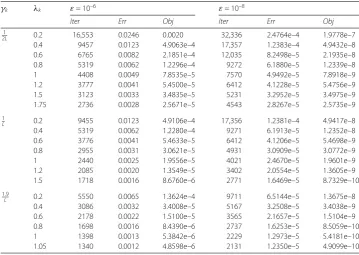
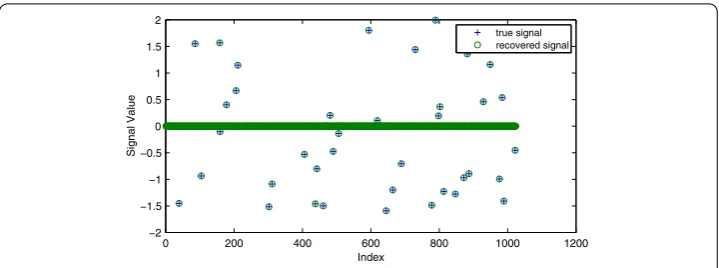
In the tests, the true signalx∈Rnhasknon-zero elements, which is generated from uni-form distribution in the interval [–2, 2]. The system matrixA∈Rm×nis generated from standard Gaussian distribution. The observed signalbis given byb=Ax. In the experi-ment, we setm= 240,n= 1024, andk= 40. The stopping criterion is defined as
xk+1–xk2 xk2 ≤
ε, (4.3)
whereε> 0 is a small constant. We test the performance of the proposed iterative algo-rithm with different choices of the step sizeγkand the relaxation parameterλk. For