2019 International Conference on Artificial Intelligence and Computing Science (ICAICS 2019) ISBN: 978-1-60595-615-2
An Emergence Analysis Method for System of Systems Capability
Items Based on Soft Set
Hong-jun ZHANG
1, Zheng-xian WEI
1,2and Min SONG
3,* 1Systems Engineering Research Institute, Beijing, China2Pilot National Laboratory for Marine Science and Technology, Qingdao, China
3Information Technology Centre, Beijing Foreign Studies University, Beijing, China
*Corresponding author
Keywords: System of systems, Capability items, Emergence, Soft set.
Abstract. Oriented emergence new capability items for system of systems (SoS), a measurement model for SoS capability items emergence was proposed in this paper. The soft set which has obvious advantages in dealing with the uncertainty problem based on the nature of its data, as well as measuring attribute significance and knowledge dependence. The decision division between component objects set of SoS and capability items set has been defined by the adopt soft set. The importance of the emerging capability items in the overall SoS is analyzed through changes in decision division in order to obtain the measurement of SoS capability items emergence, then the measurement method for SoS capability items emergence is formed. A case study is then conducted to verify the effectiveness of method.
Introduction
The concept of “System of Systems” (SoS) has been around for a long time [1]. Scholars and organizations in many different fields have proposed definitions of SoS based on their respective backgrounds and perspectives, but none of these definitions have been universally accepted. SoS is a collection of connected systems that communicate and cooperate with each other, for example “C4I” (Command, Control, Computers, Communications and Information) and ISR (Intelligence, Surveillance and Reconnaissance) systems [2]. SoS is an integration of systems which aims to use the evolution, coordination and optimization of those systems to ultimately achieve the purpose of improving overall efficiency [3]. SoS is the integration of collaborative systems. Its components have two additional characteristics: operational autonomy and management autonomy [4,5]. As pointed out by the United States Department of Defense, “The combined links of interdependent systems provide far greater capabilities than the sum of the capabilities of individual systems” [6]. According to this definition, the systems are linked by a network of member systems distributed in different locations, thereby forming a complex organic whole.
dependence. The decision division between component object set of SoS and capability items set has been defined by the adopt soft set. The importance of the emerging capability items in the overall SoS is analyzed through changes in decision division in order to obtain the measurement of SoS capability items emergence, then the measurement method for SoS capability items emergence is formed. A case study is then conducted to verify the effectiveness of method.
Soft Set Theory [7]
In practical terms, there is a lot of uncertainty information contained in things, which cannot be directly measured by specific values. Molodtsov proposed a method to deal with such uncertainty information: the soft set. Widely used in solving problems of uncertainty, this method is characterized by its simple operation and easily understandable nature. It is more intuitive in its representation and can provide a satisfying description of the relationships between the parts and the whole in a system.
Definition 1. Assume U is a finite non-empty set called a “scheme set” and E is a finite non-empty
set called a “parameter set”. A⊆E, ordered pair
(
F A,)
is called a “soft set” when (and only when) Fis the mapping from A to the power set on set U, namely F A: →P U
( )
.
According to the definition, soft set
(
F A,)
on a domain of U can be considered a parameter family of a subset of domain U, and a soft set gives an approximation of domain U (soft description).For any parameter,
ε
∈A, F( )
ε ⊆U can be regarded asε
- approximate set in a soft set(
F A,)
. The following example is a more in-depth explanation of the definition of a soft set.Example 1. Assume that a SoS contains a capability items set U =
{
h h h h1, 2, 3, 4}
, and for thesecapability items, the component sets contained in this SoS are E=
{
e e e e e e1, 2, ,3 4, ,5 6}
, assuming( ) {
1 1, 2}
F e = h h , F e
( ) {
2 = h h h1, 2, 4}
, F e( ) {
3 = h h1, 3}
, F e( ) {
4 = h h h1, 2, 3}
, F e( ) { }
5 = h1 and( ) {
6 2, 3, 4}
F e = h h h , in which F represents the mapping of component set Eto all subsets on domain
U, and soft set
(
F A,)
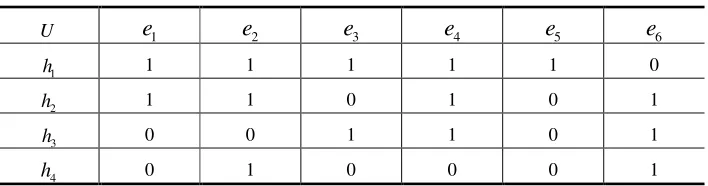
describes the advantages of these 4 capability items relative to SoS. [image:2.612.130.484.505.598.2]In order to better represent a soft set, scholars have proposed a variety of different representation methods to adapt to different scenarios. Graphic representation is proposed by Maji et al [8].Take Example 1 the purpose of formatting and storing data is shown in Table 1.
Table 1. Soft sets data.
U e1 e2 e3 e4 e5 e6
1
h 1 1 1 1 1 0
2
h 1 1 0 1 0 1
3
h 0 0 1 1 0 1
4
h 0 1 0 0 0 1
It is difficult to predict, restore or trace SoS emergence. During the evaluation and measurement of SoS emergence, decision-makers will encounter considerable uncertainty information. Data-oriented soft set theory can analyze and measure SoS emergence more reasonably and effectively.
Measurement Model for SoS Capability items Emergence
Definition of SoS Capability Items Emergence
In order to discuss the new capability items emerging of SoS, the following definitions are given:
Definition 2. For one soft set
(
F A,)
and object set U ={
h h1, 2,…,hn}
,h h1, 2,...,hn is capabilityitems. The value of fE
( )
i shall be calculated according to the indiscernibility relation, and data objects in universal set U are divided and ranked according to this value to obtain{
}
{
}
{
}
{
1 2 1 1 2}
= , , , , , , , , , ,
s
E i f i j f k n f
C h h ⋯ h h+ ⋯ h ⋯ h ⋯ h . It is defined as a “decision division”.
For a soft set
(
F A,)
, components set E=
{
e e1, ,2 …,em}
and capability sets U ={
h h1, 2…hn}
and{
}
{
}
{
}
{
1 2 1 1 2}
= , , , , , , , , , ,
s
E i f i j f k n f
C h h ⋯ h h+ ⋯ h ⋯ h ⋯ h belong to one decision division. If ei is deleted
from the parameter set, the decision division may be changed and expressed as:
{
}
{
}
{
}
{
1 2 1 1 2}
= , , , , , , , , , ,
i s
E e i f i j f k n f
C h h h h h h h
′ ′ ′
′ ′ ′ ′ ′ ′ ′
− ⋯ + ⋯ ⋯ ⋯
For convenience, we use
{
}
1, 2, , s
E f f f
C = E E ⋯ E and CE e−i =
{
E−eif1′,E−eif2′,⋯,E−eifs′}
toindicate the above results.
Definition 3. For a soft set, the related components set E is
{
e e1, 2…em}
, and object set{
1, 2 n}
U = h h …h represents various capability items. The decision division of such a soft set and the
decision division after deleting a component are respectively
{
}
1, 2, , s
E f f f
C = E E ⋯ E and
{
1, 2, ,}
i
E e if if ifs
C E e E e E e
′ ′ ′
− = − − ⋯ − , and the importance of ei to the decision division is defined as:
{
1, 2, ,}
1
i i i i
e e e s e
r
U α α α
= + +⋯+
,
,if the presence of z lead to = 1 ,1
, other
k z
i
k
f if k z
k e f
E E e f f z s k s
E
α
′ ′ − − ′ ≤ ′≤ ′ ≤ ≤
=
,
Among them, i represents the cardinality of the set.
Assume that the SoS should have a specific set of capability items U =
{
h1,⋯,hn}
, then component importance reflects that the SoS shall have impacts of knowledge (i.e. component) E on the overall capabilities of the SoS based on capability items set U . The component importance has a maximum value of 1. If the component importance approximates 1, this indicates that the component is of greater importance to the SoS.Definition 4. The SoS capability items emergence measurement is: = i
i i e e
e
r
r
η
.Measurement Process of SoS Capability Items Emergence
The new nature and new function lead to a new capability items after SoS establishment. The emergency is analyzed by changes in the decision division of the capability items set in soft set theory.
We have defined the component set contained in the SoS as E=
{
e e1, 2,⋯,en}
an object set{
1, 2 n}
U = h h …h as a set of various capability items. The measurement of SoS capability items
emergence is analyzed through the following steps:
Step 1: A component-capability items data sheet is established according to the evaluation results
capability item is not available, the value of capability item will be 0. If that capability is available, the range of capability value will be
[
1, 5 . Among them, 1 indicates that the device has little capability]
while 5 indicates that it has great capability. Step 2: First, the component-capability items data sheet on the decision division of capability items set E is obtained; that is, the decision division after additional capability items due to emergence. Then, the decision division after removing one emerging capability items from set E will be obtained in order; that is, the overall SoS did not have such a capability in its internal nature before the emergence. The importance of ei to the decisiondivision is obtained according to Definition 3.
Step 3: The measurement of SoS capability items emergence shall be obtained according to
Definition4.
Through the above process, the measurement of SoS capability items emergence can be analyzed reasonably and effectively through changes in the data related to various SoS capability items set.
Case Analysis
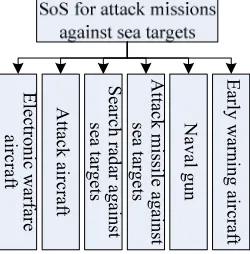
In order to illustrate the effectiveness of the proposed method, the SoS for aircraft carrier formation in attack missions against sea targets is taken as an example for analysis. The SoS consists of different weapon sets, as shown in Figure 2 below.
E
le
ct
roni
c
w
arfa
re
ai
rc
ra
ft
A
tta
ck
ai
rc
ra
ft
E
arl
y
w
arni
ng
ai
rc
ra
ft
A
tta
ck
m
is
si
le
a
ga
ins
t
se
a
ta
rge
ts
N
ava
l gun
S
ea
rc
h
ra
d
ar
aga
ins
t
se
a
ta
rge
[image:4.612.253.378.313.440.2]ts
Figure 1. Composition diagram of SoS for attack mission against sea targets.
Table 2. Weapon capabilities data sheet with e6.
Capability Weapons
e1 e2 e3 e4 e5 e6 f( )•
A 2 0 4 0 0 4 10
B 1 0 4 0 0 3 8
C 2 3 0 5 4 0 14
D 0 0 0 4 3 0 7
E 1 1 3 0 0 3 8
F 1 3 5 0 1 4 14
G 2 3 2 0 2 3 14
H 0 3 0 4 0 3 10
[image:4.612.202.411.484.663.2]In table 2, A represents detection and tracking guidance capability, B represents command coordination control capability, C represents firepower striking capability, D represents protection and survival capability, E represents communication transmission capability, F represents sustained combat capability, G represents rapid response capability and H represents ultra-long-range attack capability.
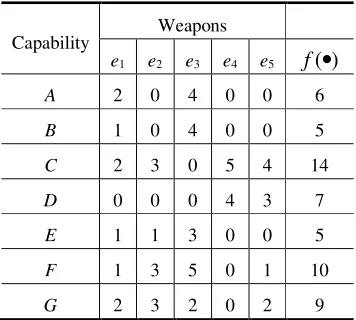
In table 2, if early warning aircraft (e6) is removed from the SoS, it loses its ultra-long-range attack
[image:5.612.217.395.208.368.2]capability. Table 3 is the weapon capability items data sheet established according to the evaluation results of the evaluation objects for each capability after the early warning aircraft is removed from the SoS.
Table 3. Weapon capabilities data sheet without e6.
Capability Weapons
e1 e2 e3 e4 e5 f( )•
A 2 0 4 0 0 6
B 1 0 4 0 0 5
C 2 3 0 5 4 14
D 0 0 0 4 3 7
E 1 1 3 0 0 5
F 1 3 5 0 1 10
G 2 3 2 0 2 9
It can be concluded from the above table that when the early warning aircraft is present in the SoS, not only do the early warning aircraft in the SoS have the corresponding capabilities but the attack aircraft and missiles also gain ultra-long-range attack capability. Therefore, H can be considered a capability item which emerged after the SoS was established. The decision division of table 2 is as follows:
(
) (
) (
) ( )
{
}
( ) (
) ( ) ( ) (
)
{
}
(
) ( ) ( ) (
)
{
}
( ) ( ) ( ) ( ) ( ) ( ) ( ) ( )
{
}
(
) ( ) ( ) (
) ( ) ( )
{
}
( ) ( ) (
) (
) ( )
{
}
( ) ( ) ( ) ( ) ( ) (
) ( )
{
}
1 2 3 4 5 614 10 8 7
13 12 10 8 7
11 10 8 7
14 12 10 9 7 6 5 4
14 10 9 8 6 3
13 12 10 8 4
14 10 9 7 6 5 0
, , , , , , , , , , , , , , , , , , , , , , , , , , , , , , , , , , , , , , , , , , , , , , , , E E e E e E e E e E e E e
C C F G A H B E D
C F C G H A B D E
C C F G A B D E H
C C G H F D A E B
C F G A C B E H D
C F G A C H B E D
C C F G D A B E H
− − − − − − = = = = = = = ,
According to the above classification results, the importance e6 can be obtained as:
(
)
6
1 6
2 2 2 0
8 8
e
r = × + + + = .Therefore, the measurement results of emergence after the early warning
aircraft is added to the SoS are as:
6 6
6 / 8 6
= =
29 / 8 29 i e e e r r η =
.Summary
There is emergence characteristic of SoS, and such emergence can only be observed in the SoS as a whole. The emergence of SoS is difficult to predict, restore and trace SoS emergence, but it can be measured after the SoS is constructed. In this paper, a measurement model for SoS capability items emergence was proposed. The soft set which has obvious advantages in dealing with the uncertainty problem based on the nature of its data, as well as measuring attribute significance and knowledge dependence. The decision division between component object set of SoS and capability items set has been defined by the adopt soft set. The importance of the emerging capability items in the overall SoS is analyzed through changes in decision division in order to obtain the measurement of SoS capability items emergence, then the measurement method for SoS capability items emergence is formed. The measurement method of SoS emergence can reversely analyze and trace the mechanisms of SoS emergence, providing directions for SoS design, integration and verification.
Acknowledgement
This work is sponsored by the National Natural Science Foundation of China under Grant No. 61502037, 61772152, Innovation Special zone of National Defense Science and Technology Project.
References
[1] Lane, Jo Ann, and R. Valerdi. “Synthesizing SoS concepts for use in cost modeling.” Systems Engineering 10.4(2007): 297-308.
[2] Manthorpe Jr., W.H. “The Emerging Joint System-of-Systems: A Systems Engineering Challenge and Opportunity for APL,” John Hopkins APL Technical Digest, Vol. 17, No. 3 (1996), pp. 305-310.
[3] Pei, R.S. “Systems-of-Systems Integration (SoSI)—A Smart Way of Acquiring Army C4I2WS Systems,” Proceedings of the Summer Computer Simulation Conference, (2000), pp. 574-579.
[4] Sage, A.P. and C.D. Cuppan. “On the Systems Engineering and Management of Systems-of-Systems and Federations of Systems,” Information, Knowledge, Systems Management, Vol. 2, No. 4, 2001, pp. 325-345.
[5] Authors, Sebok. “Architecting Principles for Systems-of-Systems.” Incose International Symposium 6.1(2013): 565-573.
[6] GAO. Defense Acquisitions DoD Management Approach and Processes Not-Well Suited to Supports Development of Global Information Grid,” January 2006.
[7] Molodtsov, D. . “Soft set theory―First results.” Computers & Mathematics with Applications 37.4-5(1999): 19-31.