2019 International Conference on Computation and Information Science (ICCIS 2019) ISBN: 978-1-60595-644-2
The Development and Application of a New
Water Control Technology with Fine
Segmentation Features
LiZhi Song, Shaowei Wu, Hui Yuan, Xiaojin Wan
and Hongyu Zhou
ABSTRACT
To counter the high water-cut issues in the later production stage of horizontal wells in the western South China Sea, a water control technology that combines inflow control devices and light proppant has been developed. The development of the new technology combined both flow theory analysis and physical modeling methods, to reach a conclusion that the axial flow resistance of a gravel packed screen annulus is much higher than its radial flow resistance, utilizing this conclusion, the inflow control screens can be gravel-packed to balance the production profile along the horizontal wellbore, with a better sand control effect. Comparing to the conventional water control methods, the new technology’s advantages include: no need to pin-point the water production location before water control jobs, little risk of damaging the reservoir during operations. The new technology has been applied in oilfields in western South China Sea, after implementation, the experimental well produced 30m3/D more oil at 20% less water cut, which provides a new option of water conformance technologies in offshore horizontal wells.
1. BACKGROUND INFO
Production issues brought by high water cut in oil fields become more and more serious along the progression of development, especially in water-drive reservoirs. The stats till now shows that 38% of the oil wells in western South China Sea oilfield
have reached 80% water cut. Due to factors such as irregular structures, heterogeneities in reservoirs and uneven pressure depletion, the production along the horizontal section is nonuniform, that the high-perm sections are producing almost 100% of water while the low-perm sections with oil are suppressed and cannot be effectively produced. In the absence of proper water conformance methods, the water drive profile cannot be improved, which affects the ultimate recovery of the oil wells.
The water conformance technologies mainly include mechanical methods that focus on the inner part of wellbores, and chemical methods that can affect the near-wellbore areas. The major issues of mechanical water control technologies are difficulties locating the water source, selecting proper candidate wells, and building effective zonal segregation in wells with sand control screens, etc., therefore applications of such technologies were limited, on the other side, the chemical methods encounter challenges such as risks in placement by pumping, large quantities of fluids being used, and risks of damaging the reservoirs. In this article, a new water conformance method has been brought up based on the researches on both mechanical and chemical water control technologies.
2. THEORIES BEHIND THE TECHNOLOGY
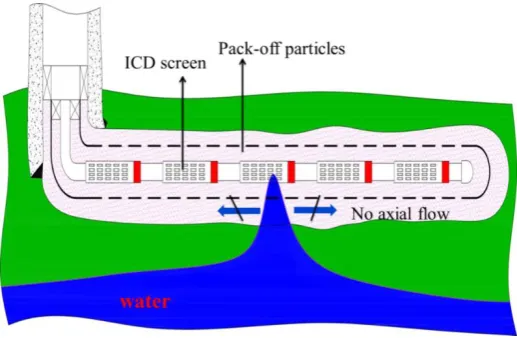
[image:2.595.177.436.541.710.2]The technology uses a tightly-packed proppant layer to reduce the axial flow in the annulus outside of the screens, while the inflow control screens increases the restriction forces in high-perm sections to reduce the draw-down in such area, thus adjust the pressure profile to ensure an even production along the wellbore. Inflow control valves with higher restriction forces are installed in the high water-cut sections to reduce the production from the zones, while the rest low-perm oil-rich sections can produce at a relatively higher draw-down, in such way the total oil production can be increased while the water production is reduced(Fig.1).
2.1 Calculations of Axial Flow Resistance of Packing Proppants
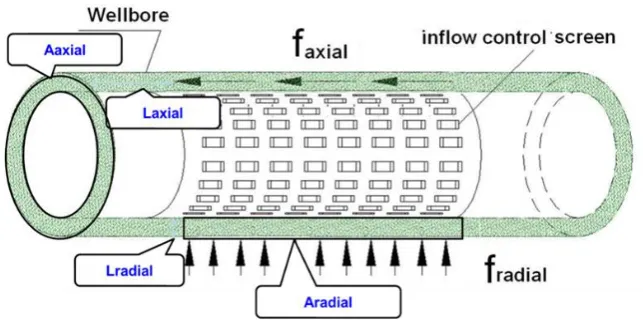
Assuming the technical parameters of the packing proppants for calculations as below: 7in casing(157mm ID), with 3.5in inflow control screen(120mm OD) installed; the length of the screen is 10m with an 8m filtration jacket and 2m blanking section(Fig.2). The length Laxial=1.9cm, radial section area Aradial=30144cm2,
Lradial=200cm, Aaxial=80cm2, according to the equations shown as below:
Q P
f (1)
A L K Q
P
(2)
A deduction could be made:
A L K
f (3)
[image:3.595.146.468.504.666.2]Since the flowing fluids and the permeability of both directions are the same, the radial and axial values of the parameters μ and K should be the same, then another deduction could be made as below:Then a conclusion can be reached that the axial flow restriction of a 10m-long, packed screen is approximately 40,000 times of that of the radial direction.
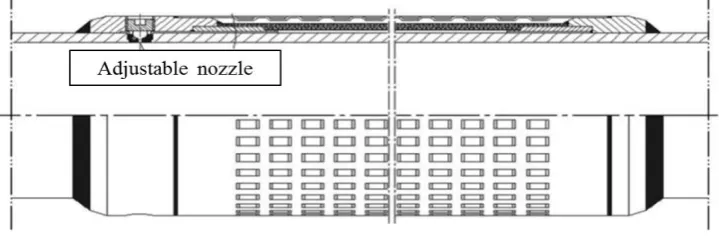
Figure 3. The structure of nozzle type ICD screen.
2.2 Working Principles Of Inflow Control Screen Technologies
The inflow control screes can provide additional adjustment of flows over conventional screens, the typical structure of an ICD screen is shown in Fig.3, the formation fluids flows through the filtration layer, then into adjustable nozzles, by setting nozzles with different sizes on each screen joints, the overall production profile of a horizontal well can become uniform. The design principle is to restrict production from high water-cut sections by setting smaller nozzles with higher restrictions. In combination with the packing proppants, segmentation can be achieved without the use of conventional open-hole packers.
3. EXPERIMENTAL RESEARCH
The test device is 2m long, the outer-most layer is a 5.5” casing(ID 122mm), a 2-7/8” regular screen(73mm OD) is put in the device, the annulus between the screen and casing is packed with 40-60 mesh packing proppants.
The testing agent of the radial flow restriction is 20cP oil(Fig.4), and that of the axial flow restriction is 1cP water(Fig.5), the testing parameters are listed in table.1. The average radial flow restriction value(with 20cP oil) fradial=0.03(MPa/(m3/D)); the
average axial flow restriction(with 1cP water) faxial=7.86(MPa/(m3/D)), deducted from
the test results above, regardless of the fluid viscosity, the ratio of
faxial/fradial=7.86/0.03=262, thus two main conclusions could be made: (1) the radial
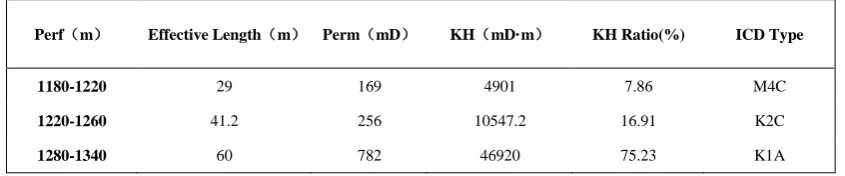
TABLE I. A22 WELL ICD SCREEN DESIGN.
Perf(m) Effective Length(m) Perm(mD) KH(mD·m) KH Ratio(%) ICD Type
1180-1220 29 169 4901 7.86 M4C
1220-1260 41.2 256 10547.2 16.91 K2C
1280-1340 60 782 46920 75.23 K1A
4. INFO OF THE TARGET WELL
WZ11-4-A22 well is a horizontal well completed with 7in perforated casing, the horizontal section is 160m long with 140m perforations. Due to the heterogeneities of the reservoir layer, the toe of the well has higher water cut than the heel, which has lower perm but potentially, more unproduced oil. The numerical modeling results show that the whole section is almost water flooded except for the heel section, the goal is to release the production from the heel area by readjustment of the production profile along the horizontal section.
5. WATER CONTROL DESIGN
5.1 Selection Of Packing Proppants
The size of the proppant selected is 40-60mesh based on Saucier’s method and the sand sieve analysis results of the produced sand from the well. Due to the additional flow restrictions generated by ICD screens, the friction during gravel packing pumping could be higher, thus pumping rate could be lower than that is needed to carry proppants with regular density, thus a light proppant with a density close to sea water is used in the gravel packing job, while the axial flow restriction remains the same as regular proppants.
5.2 ICD Screen Design
Since the toe end is the presumed high water production zone, smaller ICD nozzles with higher restrictions were placed in that depth to control the water flow, the heel end, in the contrary, was less restricted due to its water cut is lower. Based on multiple factors such as reservoir data, production history, a completion design was done, shown as Table I.
6. FIELD APPLICATION
in total according to the design, after the gravel packing string is in place, 1.6m3 of 40-60 mesh proppants was placed around the screen at a packing efficiency of 115%, excessive proppants was reversed out at the end of pumping. No sand production was detected after the operation. The fluid production during the test production stage was 380m3/d, the oil production was 90m3/d, and the water cut reached 76%, comparing to the production data before the operation, the oil production was enhanced by 30m3/d, the water cut was reduced by 20%.
7. CONCLUSIONS
(1)The new technology that combines tightly-packed proppant and ICD screens has proved its advantages in preventing axial flow against conventional expandable packers, the proppants acted as segmentation media that can be as short as 10m in section length, which has provided a new solution for water conformance jobs in offshore horizontal wells in the future.
(2)A preventive water control job utilizing this technology is recommended at the completion stage of a new well, to avoid complexities in well interventions in the later production stage.
(3)It is recommended to combine new technologies such as AICD(Auto-Inflow Control Device), water-phobic coated proppants in such technology, in further development in the next stage.
ACKNOWLEDGMENTS
The authors thank the Comprehensive scientific research project of CNOOC(YXKY-2019-ZJ-03) for their financial support.
REFERENCE
1. S.Sinhai, R.Kumar, 2001. “Flow Equilibration Towards Horizontal Wells Using Downhole
Valves”, SPE 68635, 2001.
2. Jansen J D, Wagenvoort A M, 2002. “Smart Well Solutions for Thin Oil Rims: Inflow Switching