2019 International Conference on Applied Mathematics, Modeling, Simulation and Optimization (AMMSO 2019) ISBN: 978-1-60595-631-2
The Application of Improved SNIP Algorithm Based on Simpson in the
Background Subtraction of AGS
Fei LI
1,2, Liang-quan GE
1,2,*, Jin YANG
2, Xin-yu TANG
2, Yi GU
2,
Kun SUN
2and Zhi-peng DENG
21
Applied Nuclear Technology in Geosciences Key Laboratory of Sichuan Province, China
2
College of Nuclear Technology and Automation Engineering, Chengdu University of Technology, China
*Corresponding author
Keywords: Airborne gamma-ray spectrometry, SNIP algorithm, Simpson, Background subtraction.
Abstract. Spectrum unfolding technology is a vital process of airborne gamma-ray spectrometry survey system. Due to the Compton scattering effect, the small angle scattering of gamma ray, environmental radionuclide, electronic noise, cosmic rays, etc., background subtraction is considered as one of the most complicated research field in the spectrum unfolding technology. The sensitive nonlinear iterative peak (SNIP) algorithm is widely implemented because of its simple mathematic structure and reliable background subtraction effect. However, the convergence speed of the iterative process in the second step slow down the running time. In view of this, the SNIP iteration in the original algorithm is replaced by the Simpson formula with higher algebraic accuracy. Compared with the original SNIP algorithm, the improved algorithm has fewer iterations and higher accuracy.
Introduction
Airborne gamma-ray spectrometry (AGS) survey refers to the airborne gamma spectrometer system installed on airplanes, airships or other aircraft to measure the energy spectrum content of radioactive uranium, thorium, potassium and other nuclides. It can also be applied to the survey of other minerals related to radionuclides such as precious metals, rare earth minerals and polymetallic ore deposits [1]. In recent years, it has been increasingly applied in many aspects, such as lithologic geological mapping, groundwater resource search, radioactive environmental pollution monitoring, etc. [2][3].
The type and concentration of radionuclides reflected by the current spectral can be calculated through the energy-count information of the spectrum. Therefore, the AGS spectral analysis has been the focus and difficulty in this field. During the process of spectrum unfolding, the background subtraction of the whole spectrum is one of the most important steps [4]. The subsequent processes such as peak finding, peak area calculation and nuclide content inversion will be affected directly by the accuracy of background subtraction.
there are plenty of other independent nuclides, and if these nuclides are also radioactive, there will be counter interference [10]. In the process of the analysis of gamma spectra, the scattering background increases the complexity of gamma spectra, making some weak omnipotent peaks difficult to be identified, thus reducing the accuracy of energy spectra analysis data [11]. In the process of gamma ray measurement, background subtraction is an inevitable problem to improve the measurement accuracy of energy spectrometer. In order to improve the accuracy of radionuclide content and activity analysis, it is necessary to effectively identify and deduct the count independent of the total peak area [12].
Material and Method
SNIP and the Improved Algorithms
A large amount of methods which include the sensitive nonlinear iterative peak (SNIP) and its related derivative methods [13-16], the Fourier transform [17] [18], peak clipping [19], iterative method [20] have been proposed for background subtraction. The simplest method is the linear method. The basic theory is to connect two wave trough of the energy characteristic peak by a straight line, which is regarded as the baseline, and the part below the baseline is the background. However, this method will take the effective count as the background, which has a large relative error and is only applicable to rough estimation.
At present, SNIP algorithm is considered as one of the best background subtraction algorithms. In 1988, C.G. Ryan first put forward the principle of SNIP algorithm to subtract the background of energy spectrum. However, the SNIP algorithm is greatly affected by the width parameter of peak area in terms of detail description [13]. Later in 1997, Morhac et al. improved the SNIP algorithm under the weak peak by applying the LLS operator (twice log operators plus square-root operator), and transformed the energy spectrum count of each address before applying the SNIP algorithm [14]. In 2009, Morhac replaced the functions in the original SNIP algorithm with high-order filtering function to alleviate the background subtraction error caused by fixing the same window width when the original SNIP algorithm was applied in different energy areas, to obtain a more accurate background subtraction effect [15]. In 2012, YiMing Wang adjusted the SNIP filter window width adaptively by virtue of FWHM scale to further solve the influence of fixed window width. [16] In 2019, Li et al. gave an accurate evaluation of the evolution of SNIP algorithm and proposed a new improving direction. They pointed out that the improved algorithm based on SNIP could avoid large errors in the high-energy window and low-energy window of the peak in the process of subtracting the background due to changing the width. While in the SNIP step, perhaps the idea of an iterative optimization can be taken.
The SNIP algorithm has three steps. Firstly, the address count of each energy spectrum needs to be transformed by the LLS operator (Formula 1). By natural logarithm operation, the counting range is compressed, the high counting spectral line is calculated, and the weak peak information can be extracted by square root operation.
( ) ln[ln( ( ) 1 1) 1]
V i y i (1) Where, i represents the trace address, y(i) represents the count of I trace address, and V(i) represents the transformation value of LLS operator.
Secondly, by means of iteration, V1(i), V2(i), …, Vm(i). Assuming that the iteration reaches p times, the smaller value of the current Vp-1(i), Vp-1(i+p) and Vp-1(i-p) is taken as the value of the next iteration by comparing the average value of the current Vp-1(i), Vp-1(i+p) and Vp-1(i-p).
1 1 1
1
( ) min{ ( ), [ ( ) ( )]}
2
p p p p
Where, p represents the p-th iteration, and Vp(i) represents the transformation value of the p-th iteration.
Finally, through the inverse LLS transformation (see formula 3), the spectral data can be deducted and subtracted from the original spectral data to obtain the net peak count spectrum of the whole gamma spectrum.
( ) 1 2
( ) [ ev i 1] 1
y i e (3) The idea of rectangle formula is used in the second iteration of the SNIP algorithm. Although the calculation is simple and the method is reliable, the convergence speed is too slow. In this paper, the SNIP iteration in the second step is replaced by the Simpson formula. Due to the higher algebraic accuracy of the Simpson formula, the calculation results are more accurate than the SNIP iteration. In the iterative process, the step size is set as the unit distance, and the value converted by LLS is the corresponding function value. The formula is obtained as follows:
1 1 1 1
1
( ) min{ ( ), [ ( ) 4 ( ) ( )]}
6
p p p p p
V i V i V ip V i V ip (4)
Where, p represents the p-th iteration, and Vp(i) represents the transformation value of the p-th iteration.
Experiment Data
In this paper, the measured data is from the XPG-3000A aribonre gamma-ray spectrum exploration system. The system uses two boxes and each box consists of two 40*10*5 (cm) array-type NaI crystal detectors. The energy resolution of the single crystal was less than 8.0% at 0.661MeV of 137Cs, and the energy spectrum peak drift (2.62MeV of 208Tl) is less than 0.5 channel. Maximum energy range is 1-10MeV, upper limit count is 200K/ SEC, max count is 264 per channel.
The XPG-3000A system was applied to test the response of 137Cs exemption artificial nuclide source. The activity of 137Cs source is 9795 Bq. To obtain a better reflection of the characteristic gamma information, the detector is used to measure it at close range (the radar altitude is 0m). Due to the array structure of scintillation detector, the electron deposition situation of gamma ray and material reaction in the detector is not the same, so different detection point position analysis is adopted. The time of each experimental measurement is 180s, and the total number of measurements is 20 times.
Result and Discussion
In 1997, two coefficients: single-peak net peak count retention rate r and background subtraction rate
t were proposed by Morhac to evaluate the background subtraction effect of the algorithm.
0
100% PNC
r
PNC
(5)
100%
PNC t
PTC
(6)
Where, PNC is the net peak count after background subtraction, PNC0 is the net peak count without background subtraction, and PTC is the total peak count after background subtraction.
The characteristic airborne gamma spectrum data of 137Cs radionuclides are used in this paper, and the corresponding energy of the characteristic peak is 0.661MeV, which is converted into the 395th channel. The m value is generally determined by following formula:
Where, W represents the width of the filter window, namely the width of transformation, and m is the number of SNIP iterations. The m value calculated by the formula will not cause the variation of the spectrum peak, and the best spectrum peak background subtraction effect can be obtained.
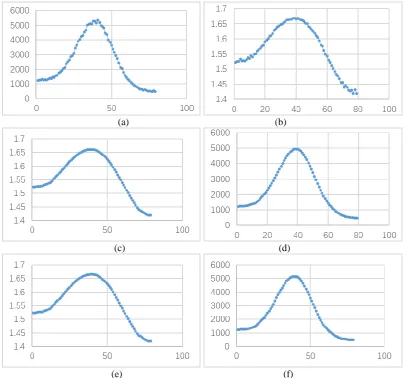
In order to verify the background subtraction effect of the improved algorithm and the original SNIP algorithm, we randomly selected 5 different measured spectrums, and selected spectrum peak range is 355-433. The background subtraction methods are implemented respectively. The subtraction process is shown in figure 1 and the results of the subtraction effect are shown in table 1.
(a) (b)
(c) (d)
(e) (f)
Figure 1. The comparison of the two background subtraction algorithms (a) original spectral data, (b) the spectral data after applying the LLS operator, (c) the calculation of SNIP algorithm, (d) the inverse transformation of the LLS operator,
[image:4.595.95.503.177.555.2](e) the calculation of improved SNIP algorithm, (f) the inverse transformation of the LLS operator after the calculation of improved SNIP algorithm.
Table 1. The evaluation coefficient of background subtraction of the improved SNIP algorithm and the original SNIP algorithm.
Serial number Improved SNIP algorithm Original SNIP algorithm
r/% t/% r/% t/%
1 99.73 95.75 98.89 96.08
2 99.88 99.75 99.08 95.77
3 99.79 98.34 99.80 99.09
4 99.91 99.66 99.74 97.36
5 99.80 99.98 99.98 99.90
SNIP algorithm ranges from 98.89% to 99.98%, and that of the original SNIP algorithm ranges from 95.77% to 99.90%, with an average value of 99.50% and 97.64%, respectively. Through comparison, it is proved that the improved SNIP algorithm has slightly improved the net counting retention and background subtraction of single peak compared with the original SNIP algorithm, but the evaluation coefficients r and t of the two methods are both over 95%, with high enough precision.
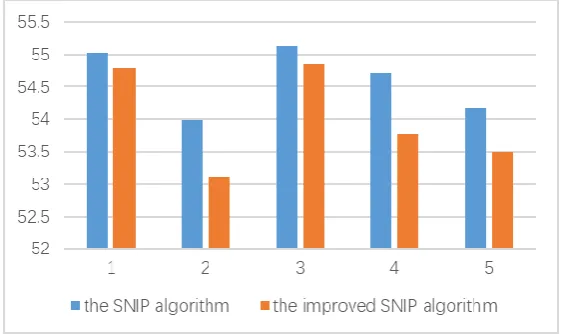
[image:5.595.157.439.290.457.2]The most significant advantage of the SNIP algorithm is its simplicity and rapidity, so it is necessary to evaluate the working efficiency of the improved SNIP algorithm. We recorded the number of iterations of these two algorithms. The optimal iteration number of the original SNIP algorithm are 12 times, while the optimal iteration number of the improved SNIP algorithm based on Newton iteration are only 9 times, which is 3 times less than the original SNIP algorithm and a certain improvement. The running time of the two algorithms was further evaluated by the tic-toc timing method. As shown in Figure 2, the running time of the improved SNIP algorithm is 53.08ms, while that of the original SNIP algorithm is 54.83ms. It can be seen from the comparison that the operating efficiency of the improved SNIP algorithm is 3.19% higher than that of the original SNIP algorithm, but both of them still have high computing speeds.
Figure 2. The comparison of the running time of the two algorithms.
Conclusion
In this paper, the SNIP algorithm is modified by replacing the SNIP iterative formula with the Simpson formula, and applied to the spectral background subtraction of airborne gamma detection instruments. The results show that in practical application, the improved SNIP algorithm can not only save the advantages of the original algorithm in simplicity and efficiency, but also reduce the number of iterations and computing time, and it can subtract the background with a higher degree of accuracy, thus completing the preprocessing of gamma spectrum and providing a good foundation for the quantitative analysis of subsequent nuclides.
Acknowledgement
This work was funded by the opening Fund of Provincial Key Lab of Applied Nuclear Techniques in Geosciences, the National Key R&D Project (No. 2017YFC0602100) and National Natural Science Foundation of China (No.4177040587). Also thanks to Professor Zhang Qingxian for his guidance and opinions.
Fei Li and Liangquan Ge contributed equally.
References
[2] Zhang Ye, Hua Rongzhou, Shi Baishen. Survey of radioactive method. Beijing: atomic energy press, 1990.
[3] Cheng Yexun, Wang Nanping, Hou Shengli. Nuclear radiation field and radioactive exploration. Beijing: geological press, 2005.
[4] Fei Li, Zhixing Gu, Liangquan Ge, Di Sun, Xutao Deng, Shun Wang, Bo Hu, Jingru Xu. Application of artificial neural networks to X-ray fluorescence spectrum analysis. X-Ray Spectrometry. 2018, 48(2): 138-150.
[5] Fei Li, Zhixing Gu, Liangquan Ge, Hui Li, Xinyu Tang, Xinle Lang, Bo Hu. Review of recent gamma spectrum unfolding algorithms and their application. Results in Physics. 2019, 13: 102211.
[6] Zhang Yupeng, Xiao Xiaoling, Zhang Xiang, Tang Xiaofeng Research on elimination background by extending clipping window of SNIP algorithm. China Energy and Environmental Protection. 2017, 39(3):143-152.
[7] Fei Li, Liangquan Ge, Zhuoyao Tang, Yi Chen, Jing Wang. Recent developments on XRF spectra evaluation. Applied Spectroscopy Reviews. 2019, 4: 1-25.
[8] Meng-Hua Zhu. On estimating the background of remote sensing gamma-ray spectroscopic data. Nuclear Instruments and Methods in Physics Research A. 2016, 832: 259–263.
[9] Mattia Fornasa, Miguel A. Sánchez-Conde. The nature of the Diffuse Gamma-Ray Background. Physics Reports. 2015, 598: 1-58.
[10] Miltiadis Alamaniotis, Alexander Heifetz, Apostolos C. Raptis, and Lefteri H. Tsoukalas. Background Spectrum Estimation for Low Count Spectra Using Kernel-Modeled Gaussian Processes. Transactions of the American nuclear society. 2012, 106: 273-274.
[11] Fei Li, Liangquan Ge, Wenxuan Dan, Yi Gu, Qingju He, Kun Sun. Application of Improved Variable Learning Rate Back Propagation Neural Network in Energy Dispersion X-Ray Fluorescence Quantitative Analysis. ICCCBDA. 2019.
[12] Miroslav Morháč. Sophisticated algorithms of analysis of spectroscopic data. Proceedings of Science 2008, 208.
[13] CG Ryan, E Clayton, WL Griffin, SH Sie, DR Cousens. SNIP, a statistics-sensitive background treatment for the quantitative analysis of PIXE spectra in geoscience applications. Nuclear Instruments & Methods in Physics Research B. 1998, 34: 396-402.
[14] Miroslav Morháč, Ján Kliman, Vladislav Matousek. Background elimination methods for multidimensional coincidence γ-ray spectra. Nuclear Instruments and methods in physics research A. 1997, 401(1): 113-132.
[15] Miroslav Morháč, Vladislav Matousek. Peak Clipping Algorithms for Background Estimation in Spectroscopic Data. Applied Spectroscopy. 2008, 62(1): 91-106.
[16] W.M Yin, H.Z Liu, B. Tang. Discussion and Application of Eliminating the Background in γ-ray Spectrum by SNIP Algorithm. Journal of East China Institute of Technology. 2009, 32(3): 245-248.
[17] C.V. Hampton, B. Lian, Wm. C. McHarris. Fast-Fourier-transform spectral enhancement techniques for γ-ray spectroscopy. Nuclear Instruments and Methods in Physics Research A. 1994, 353 (1-3) 280-284.
[19] P.J. Statham. A comparative study of techniques for quantitative analysis of the X-ray spectra obtained with a Si(Li) detector. X-ray Spectrum. 1976, 5: 16-28.