2019 International Conference on Applied Mathematics, Modeling, Simulation and Optimization (AMMSO 2019) ISBN: 978-1-60595-631-2
Effects of Triangle Internals on Temperature Distribution of Granular
Material in Rotating Horizontal Drum
Yun-fu CHEN
College of engineering Nanjing agricultural university, Nanjing 210031, China
Keyword: Particles, Discrete element method, Triangle internal, Temperature.
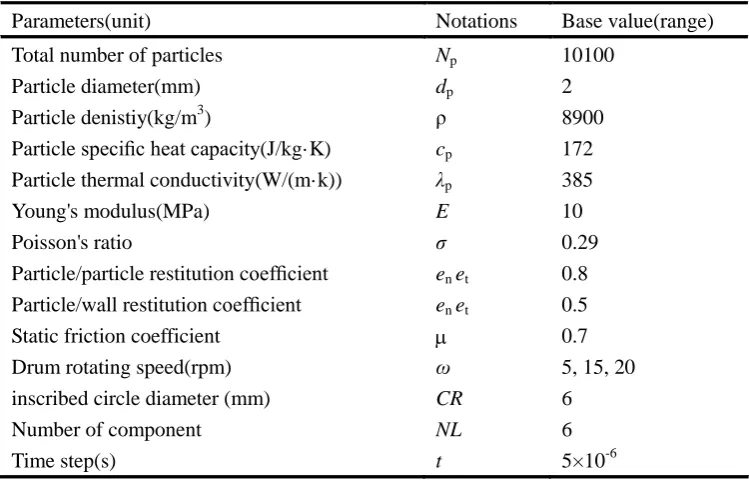
Abstract. The DEM-based heat transfer model is carried out to investigate effects of triangle internals on temperature distribution of granular material in rotating horizontal drum. The model is verified by comparing with literature published previously. The effect of triangle internals on temperature distribution of granular material accounting for triangle number and rotation speed is discussed. The results show that triangle internals breaking the vortex core zone involving low-velocity and mixing dead zone in the granular bed can effectively enhance heat transfer and temperature uniformity inside the drum. Heat transfer and temperature uniformity increased with increasing triangle number and rotating speed, but slightly increased as the value is higher.
Introduction
The process of heating granular materials such as catalyst particles, plastic pellets, and food products is encountered in many industrial applications [1]. Rotating horizontal drums are the most commonly equipment for handling and processing granular materials[2], and its structure design play a critical role in temperature distribution of granular material in rotating horizontal drum.
Over the past decades, there has been continued interest in investigating effect of different structure design on temperature distribution of granular materials in rotating drum. Njeng[3]and Chaudhuri et al[4] experimentally investigated effects of rotational speed, and lifter configuration (straight, arc and L-shape lifters) on heat transfer, which determines temperature distribution of granular materials. However, particle-surface interaction or the detailed microstructure of the granular bed cannot be captured. Scherer et al. [5] used a DEM model to study the effect of straight baffles and L-shaped baffles on heat transfer, and discovered that L-shaped baffles lead to higher heat transfer than straight baffles due to a more even distribution of the particles across the cross-section of the drum. These studies found a vortex core zone involving low-velocity core, mixing dead zone of granular system in the rolling regime, which is not very helpful to improve the heat transfer efficiency and uniformity of temperature distribution.
Therefore, attempts to directly break vortex core zone involving low-velocity core, mixing dead zone of granular system in the rolling regime have been made by using triangle internals wee set in the horizontal drum. Effects of triangle internals and rotation speed on temperature distribution of granular material in rotating horizontal drum are studied, based on coupling the DEM with a conductive heat transfer model.
Heat Transfer in Rotating Horizontal Drum Fitted with Triangle Internals
Temperature distribution of granular material in rotating horizontal drum are significantly affected by triangle internals wee set in the drum and operation condition. So the configuration of the drum, which is fitted with triangle internals, is constructed to investigate the effects of triangle internals and operation variables (rotating speed) on temperature distribution. The rotating horizontal drum being equipped with triangle internals consists of a cylindrical 120 mm diameter container with length of 20 mm, which rotates along the z-axis. Triangle internals consists of a certain number of Triangle component (Cn=6) with externally circle diameter (CR=6mm). Triangle component is
Numerical Models and Boundary Conditions
To simulate temperature distribution of granular material in rotating horizontal drum equipped with triangle internals, the three-dimensional DEM-heat transfer model is developed. DEM is applied to capture the particle motion in rotating horizontal drum in which the particle-particle and particle-wall interactions are described by a soft sphere approach [6]. A heat transfer model, only considering conductive heat transfer through particle-wall and particle-particle contacts, is applied to estimate the heat transfer behaviors in a drum [7].
At the initial time, the drum was at its static state and a certain amount of particles with initial temperature (298K) are fed in forming a packed bed with being allowed to reach mechanical equilibrium. Then, the temperature of the drum was suddenly raised to Tw=598K. In the meantime,
[image:2.595.110.485.293.534.2]the drum started to rotate along the z-axis at ω rpm. The drum is considered as a rigid, motion-controlled large particle with a finite radius, infinite mass walls. No-slip boundary condition is assumed on the inner wall of drum. The present numerical simulation, the corresponding parameters are listed in Table 1.
Table 1. The parameters used in the numerical simulation.
Parameters(unit) Notations Base value(range)
Total number of particles Np 10100
Particle diameter(mm) dp 2
Particle denistiy(kg/m3) ρ 8900
Particle specific heat capacity(J/kg·K) cp 172
Particle thermal conductivity(W/(m·k)) λp 385
Young's modulus(MPa) E 10
Poisson's ratio σ 0.29
Particle/particle restitution coefficient en et 0.8
Particle/wall restitution coefficient en et 0.5
Static friction coefficient 0.7
Drum rotating speed(rpm) ω 5, 15, 20
inscribed circle diameter (mm) CR 6
Number of component NL 6
Time step(s) t 5×10⁻⁶
Experimental Validation
x y
θ CR
RC
0 2 4 6 8 10 12 14 16
300 350 400 450 500 550 600 650 700
literature simulaton Tavg
/K
[image:3.595.146.265.78.201.2] [image:3.595.312.464.88.209.2]t /s
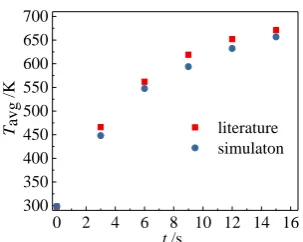
Figure 1. Schematic diagrams of the drums. Figure 2. Comparison of simulation results and literature.
Results and Discussion
Dynamics and Temperature of Particle Flow
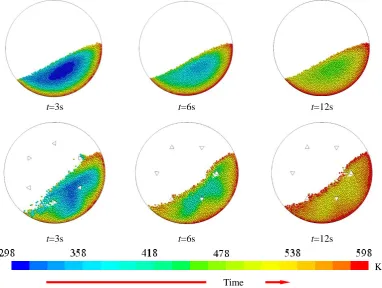
Fig.3 presented particle velocity field and axial snapshots of the granular bed in the transverse plane of the drum at 15 rpm. There are two distinct zones in the particle bed within the rotating drum, which is accord with characteristic of rolling region. As known, the two distinct zones are the passive layer in the bottom and the active layer on the top. In the passive layer, the particles rotate with the drum wall as a rigid body, indicating that the mixing rate among the particles is insignificant. The temperature distribution showed obvious temperature gradients. It is not conducive to quickly reach the uniformity of particle temperature. Moreover, there have vortex core zone involving low-velocity core, mixing dead zone near a fictitious boundary layer separating the two regions, in which form cold granular core indicating low particle temperature, as shown in Fig.3. Although the mixture of the particles is intense and thus favoring energy transfer in the active layer, breaking the vortex core zone involving low-velocity core, mixing dead zone in the granular bed and redistributing the particles causing rapid mixing within bed is still helpful to improve heat transfer and uniformity temperature distribution.
t=0.01s t=0.5s t=0.7s t=1.3s t=6s
K
Figure 3. Snapshots of the granular bed in the transverse plane of the drum at 15 rpm.
Effect of Triangle Internals Configuration
[image:3.595.89.502.473.591.2]with no column internals at the same time point. These indicate the presence of triangle internals can speed up heat transfer. Furthermore, although it is observed that the mean bed temperature increase quickly at the early stage and then gradually getting slower over time at both cases, the rate of change in the particle average temperature inside the drum with the triangle internals change faster than that inside the drum with no triangle internals. Consequently, the uniformity of the granular bed temperature can also be improved, which is estimated by the standard deviation of the particle temperature, as shown in Fig.5 (b).
t=3s t=6s t=12s
t=3s t=6s t=12s
K
[image:4.595.107.490.171.459.2]Time
Figure 4. Axial snapshots of flow and temperature in the drum with no triangle internals (top) and in the drum with triangle internals (bottom) at different times (ω=15rpm).
0 3 6 9 12 15
300 350 400 450 500 550 600
Average tem
perature /
K
Time/ s
no internals triangle
0 3 6 9 12 15
0.0 0.2 0.4 0.6 0.8 1.0
SD of temperat
ure / K
Time/ s
no internals triangle
Figure 5. (a) The evolution of particle average temperature in the drum with no triangle internals and in the drum with triangle internals at different times (ω=15rpm). (b) The standard deviation (SD) of the particle temperature in the drum with no triangle internals and in the drum with triangle internals at different times (ω=15rpm).
Effect of Rotation Speed
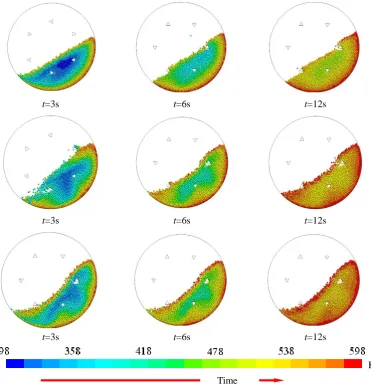
[image:4.595.97.493.501.654.2]unit of time, redistribute the particles, and then interrupt the quasi-static zone in the center of the granular bed. As a result, the cold core shrinks with time for all the cases, but it shrinks faster for drum rotated at higher speed, especially the obvious change at the speed from 5 rpm to 20 rpm. The effect of speed on temperature distribution is quantified calculating the average bed temperature as a function of time, as shown in Fig.7 (a). It is clear that the higher rotating speed enhances the heat transfer process within the simulated range. The uniformity of the granular bed temperature is presented in Fig.7 (b), which is estimated by standard deviation of the particle temperature. As expected, the bed rotated at higher speed reaches thermal uniformity faster.
t=3s t=6s t=12s
t=3s t=6s t=12s
t=3s t=6s t=12s
K
[image:5.595.113.485.187.572.2]Time
Figure 6. Axial snapshots of flow and temperature in the drum with triangle internals at different times and rotational speed.
0 3 6 9 12 15
300 350 400 450 500 550 600
Average tem
perature
Time/ s
=5
=15
=20
0 3 6 9 12 15
0.0 0.2 0.4 0.6 0.8 1.0
SD of temperat
ure /K
Time/ s
=5
=15
=20
[image:5.595.99.493.611.766.2]Conclusions
DEM simulations coupled with a contact heat transfer model have been conducted to study heat transfer in rotating drums equipped with triangle internals. Effects of triangle internals and rotation speed on temperature distribution of granular material in rotating horizontal drum are analyzed based on axial snapshot, particle average temperature and standard deviation of particle temperature. The results showed that triangle internals breaking the quasi-static zone in the center of the granular bed can effectively enhance heat transfer and temperature distribution uniformity inside the drum. Heat transfer and temperature distribution uniformity increased with rotating speed, but slightly increased as the value is higher. The position of triangle internals locating in the drum enhance performance of heat transfer and temperature distribution uniformity, which is dependent on number of scooping and redistribution of particles resulting in augment particle mixing and shrinking cold granular core per unit of time. Therefore, the role of triangle internals in heat transfer and temperature distribution uniformity has been identified.
Acknowledgement
This research was financially supported by “the Fundamental Research Funds for the Central Universities” (KYZ201762, Y0201900028).
References
[1] A. Lekhal, B.J. Glasser, J.G. Khinast, Impact of drying on the catalyst profile in supported impregnation catalysts, Chem. Eng. Sci. 56 (2001) 4473.
[2] Yohannes B, Emady H, Anderson K, et al. Scaling of heat transfer and temperature distribution in granular flows in rotating drums[J]. Phys.rev.e, 94(2016) 042902.
[3] Njeng A S B, Vitu S, Clausse M, et al. Wall-to-solid heat transfer coefficient in flighted rotary kilns: experimental determination and modeling[J]. Exp. Therm Fluid Sci. 91(2018)197-213.
[4] Chaudhuri B, Muzzio F J, Tomassone M S. Experimental Validated Computations of Heat Transfer in Granular Materials in Rotary Calciners[J]. Powder Technol. 198(2010):6-15.
[5] Scherer V, Mönnigmann M, Berner M O, et al. Coupled DEM–CFD simulation of drying wood chips in a rotary drum—Baffle design and model reduction[J]. Fuel, 184(2016) 896-904.
[6] P.Y. Liu, R.Y. Yang, A.B. Yu, Chem. Eng. Sci. 86 (2013) 99-107.
[7] Figueroa I, Vargas W L, Mccarthy J J. Mixing and heat conduction in rotating tumblers [J]. Chem. Eng. Sci. 65(2010) 1045-1054.