2019 International Conference on Artificial Intelligence and Computing Science (ICAICS 2019) ISBN: 978-1-60595-615-2
Big Data Platform Access Control Rule Generation Method
Based on Data Mining
Chun MENG
1, Zi-xiao KONG
1*, Long YOU
2and Zuo LUO
1 1School of Computer Science and Technology, Beijing Institute of Technology,Beijing 100081, China
2Academy of Intelligent Collaborative Cloud System, China Aerospace Science and Industry
Corporation Limited, Beijing 100048, China
*Corresponding author
Keywords: Access control, Data mining, Big data.
Abstract. The access control problem of big data platform is related to personal privacy, corporate interests and national security. In the context of big data platform, the fine-grained permission relationship between users and resources is difficult to be explored through the experience of administrators, and the permission granularity is difficult to be refined. In this paper, we propose an access control rule generation method based on data mining. By selecting appropriate data preprocessing, clustering analysis, association analysis algorithms and improving them, we dig out the normal access behavior rules of users from the user logs and attributes, and generate fine-grained control rules based on these rules, and improve the accuracy through negative feedback regulation. The experiment results verify the effectiveness and practicability of the method which can provide accurate access control for the big data platform.
Introduction
With the rapid development of big data technology, it is becoming more and more simple and effective to analyze trends and regularities through big data, and data is becoming more and more important. Through continuous infiltration into various industries, big data has exerted profound influence on national defense, people's livelihood, economy and politics. The security of big data is also closely related to national security, corporate interests and personal privacy[1-2].
As an important means of security protection, the main task of access control is to ensure that resources are not used illegally. In the traditional application, the access control model has been developed relatively perfect and has been widely used in the practical application. But in the environment of big data platform, access control is facing new difficulties.
In the access control system, the control rules are originally controlled by the administrator. However, in the face of huge big data resources, making control rules manually for each resource will make the administrator's work very tedious. At the same time, it is difficult for the administrator to consider comprehensively due to the complexity of system application. Especially in the face of big data platform, which has a large number of services, a wide variety, and a complex and diverse user role and access behavior, the control rules are more difficult to explore[3-4].
Based on this, we research the generation method of access control rules aims at Hadoop—the core of big data platform and account system. The efficiency and quality of access control rule generation are improved through data mining combined with artificial audit method.
Control Rule Generation Method Based on Data Mining
Design Idea
[image:2.612.112.497.223.512.2]Through investigation and analysis of access control of big data platform, this paper conducts data mining on user access logs. Combined with part of manual audit, the model is negatively feedback adjusted. Thus, a highly automated access control rule generation method is realized, as shown in figure 1.
A set of characteristics of the user's overall behavior
Pre-authorized user cluster
The initial control rule set
Audit results User attribute feature set
Figure 1. An access control rule generation method based on data mining.
(1) Data preprocessing: Collect user access logs from relevant components of the big data platform. Through data cleaning and feature extraction, the feature set of user's access behavior to a resource is constructed.
(2) Cluster analysis: The improved DBSCAN method was used to cluster the user behavior feature set and obtain the high-density cluster representing the legitimate access users.
(3) Correlation analysis: Based on the frequent itemset generation method of Apriori algorithm, we mined the unique attributes of legal users. In this case, an initial control rule set is formed. (4) Negative feedback adjustment: Evaluate the quality of the initial access control rules by means
of manual audit. Besides, the data mining model is adjusted by negative feedback.
(5) Role reduction: In order to improve the efficiency of access control, roles are merged and simplified according to the reduction of different roles of different resources.
Data Preprocessing
In this paper, the control rule mining aims at a specific resource. First, users' access behaviors are classified according to the accessed resources to form different data sources. In each data source, it is further divided according to the user to obtain the access behavior set of different users of the resource.
Feature Set Construction Based on the User's Overall Behavior. After obtaining the user access behavior record for a certain resource, it is necessary to summarize the multiple access behaviors of each user. Further on, extract the characteristics that can represent the overall behavior of users to access the resource, so that each user corresponds to a record in the feature set required by clustering analysis.
To represent the overall access behavior of the user, summary statistics are required, including frequency, mode, mean and median of the location measures, and standard deviation of the spread measures. Initial features selected from the access record include: total visits a week average, standard deviation of total visits every week, every day in the median number of total visits, the standard deviation of the total daily visits, average for each visit on the same day, standard deviation of each visit on the same day, the time period of the most frequent visit every day, sub-frequent time periods and the corresponding proportion of various operation.
After the initial feature set is obtained, Principal Component Analysis (PCA) is used to conduct dimensional reduction of features [6], mapping data from high-dimensional space to low-dimensional space. Moreover, PCA finds out new attributes (principal components), making these attributes a linear combination of the original attributes and orthogonal to each other. And the maximum variation of the data is captured.
Feature Set Construction Based on User Attributes. Through clustering analysis of user behavior characteristics, users with different permissions can be distinguished. Then the relationship between user's own attributes and permissions, namely roles, can be mined. In this way, it is necessary to combine the results of clustering analysis with the relevant attribute information of user accounts to build the feature set required by association analysis.
The feature set based on user attributes can be represented in a form similar to the shopping basket data set. Each user corresponds to a transaction, and each transaction mainly includes the following attributes: whether it is a pre-authorized user; various user attributes obtained from the user account system, such as department, post, rank, seniority, etc.
There are many classification attributes and continuous attributes in the above feature set. For example, the department is the classification attribute, which may take “operation department”, “research and development department” and other classification values. While seniority is a continuous property of values that may be greater than or equal to zero. In order to facilitate the processing of the subsequent association analysis method, it needs to be converted into a binary attribute, which is similar to the form of “whether to be a pre-authorized user”.
For classification properties, you can first convert them to “items”, which means that creating a new item for each different attribute-value pair. For example, the attribute of department can be replaced by n binary items: Is it an operations department, is it a research and development department... . n is the number of possible values of the department.
For continuous attributes, discrete method is adopted to group adjacent values of continuous attributes. Form a finite number of intervals, become classification attributes, and then converted to binary attributes.
Cluster Analysis of Users' Overall Access Behavior
Through density-based clustering of users' access behaviors, this paper uses high-density clusters and non-clustering noises to distinguish legitimate and unauthorized users. It provides the foundation of authority grant for subsequent control rule mining.
when the density of the cluster changes greatly (cluster with variable density), the clustering quality is poor.
There are four natural clusters of A, B, C and D in A certain data set. However, the density of clusters A and B is large, while that of clusters C and D is small. The density of noise around the two denser clusters A and B is the same as that of clusters C and D. If the Eps threshold is low enough for DBSCAN to detect clusters C and D, then A, B, and the points surrounding them become a single cluster. If the Eps threshold is high enough, DBSCAN can find clusters A and B and mark the points surrounding them as noise, then C, D, and the points surrounding them will also be marked as noise. It can be seen from the above analysis that the global variable Eps value affects the clustering quality, especially when the data distribution is uneven. At the same time, in the clustering of resource access behavior in this paper, the density difference between clusters corresponding to different roles and their regions is large, that is, there is a large proportion of variable density clusters. Therefore, it is necessary to learn from the idea of “divide and conquer” to divide data. Make the data distribution in each partition relatively uniform, and select the respective Eps value according to the density of data distribution in each partition. In this way, the impact of the global variable Eps value is reduced on the one hand. On the other hand, due to multiple partitions, parallel processing can be considered to improve clustering efficiency and reduce the high memory requirements of DBSCAN algorithm.
Data Partitioning Method. Data partitioning mainly refers to the improved DBSCAN clustering algorithm [8]. This method firstly reduces the dimension of data. To be more specific, the transformation from multidimensional to two-dimensional is within the acceptable range of information loss rate. Besides, this transformation is only used for data partitioning, and the subsequent clustering still uses multi-dimensional features.
Not all cases need to be divided into data, when it is found that the data distribution density is not too different, not to be divided.
When the following three situations occur: (1) the data distribution density is a straight line; (2) data distribution density increases;
(3) data distribution density decreases.
In this case, the data partition on two dimensions should be considered together, and the data partition should be carried out according to the number of processors. Assuming the number of processors is N, Ki(i = X or i = Y) regions are divided in one dimension, and N/Ki regions are divided equally in the other dimension.
DBSCAN Parallel Processing. After the data partition is completed, each grid is allocated to a processor (or thread). Then the DBSCAN algorithm can be used for each processor in parallel, and each data region can select the native Eps value. Each processor also built an R * tree, which is easy to area query. The specific process is as follows:(1) construct the R* tree of the data of the processor;(2) select Eps value suitable for the machine;(3) clustering according to the local Eps value. In order to improve the merging efficiency of local clustering, it is necessary to record the noise points, boundary points of the class and boundary information of division in the process of local clustering. They may be the boundary points of a global cluster or the points of a small cluster that is divided. Since partitioning may divide data points belonging to the same class into two adjacent regions, it is necessary to merge the two classes finally. In order to improve the clustering efficiency, possible useful information, such as noise points and boundary points, has been saved in the local clustering process. Class merging involves three cases:
(1) the two classes A and B are combined if and only if:
a. A and B are respectively located in two adjacent grids PA and PB;
b. Let Eps(A) and Eps(b) be respectively the values of PA and PB in the grid, and the distance between boundary points in the two classes is less than or equal to Eps(PA,PB).
(2) the noise point N, which is located at the boundary of the grid, may be the boundary point of a certain class C in the global. At this time, it is necessary to classify the noise point N into this class C. The merge is made when the noise point N satisfies the following conditions:
a. Class C and noise point N are located in two adjacent grids respectively;
b. Let EC be the boundary point in class C, if the distance between boundary point and noise point N is less than or equal to Eps(PC).
(3) multiple noise points generate new classes
During data partitioning, some smaller classes are divided into different grids. These points are considered noise points because of the small amount of data in the same grid. Firstly, a noise point Ei is selected randomly. If the distance between noise point Ei and other noise points Ej is less than or equal to Eps value, Ei is regarded as the core object point of a new class. And then the remaining noise points are merged according to the second method.
Association Analysis for Role Mining
By cluster analysis of user access behavior, legitimate users and unauthorized users can be distinguished. Then we need to use association analysis to dig out the unique attributes of legal users as the basis of authorization.
Role Mining Based on Apriori Algorithm. The purpose of association analysis is to mine the unique attributes of legal users, namely roles. Based on the Apriori algorithm [9], this paper proposes a role mining method. Compared with the traditional Apriori algorithm, this method has the following two characteristics:
(1) only the part of frequent item set generation in Apriori algorithm is needed. Generally speaking, association rule mining is divided into the following two major parts:
a. Frequent item set generation: the goal is to find all item sets that meet the minimum support threshold, which are called frequent item sets.
b. Rule generation: the goal is to extract all high-confidence rules from the frequent item set discovered in the previous step, known as strong rules. However, the result required in this paper is a user-specific attribute, not a form of implication or association rule. It is just a set of terms, and the terms in the set don't have to be derived from each other. Therefore, instead of using confidence - based rule generation, role mining can be carried out only through frequent item set generation.
(2) frequent item sets generated by Apriori algorithm need to be screened and compared. In order to obtain the set of unique attributes of legitimate users, it is necessary to compare with unauthorized users and unaccessed users, so as to preserve the unique attributes of legitimate users. At the same time, there is a relationship between superset and subset in the frequent item set. However, because the authorization rules need to be based on the item set (superset) that contains the most unique attributes of legitimate users, it is necessary to filter the resulting frequent item sets.
Frequent Item Set Generation with Contrast Filtering. Frequent item sets of the original Apriori algorithm are generated by layer-by-layer iteration from 1-item sets to k-item sets. In the process, the pruning based on the prior principle is used to obtain all frequent item sets.
In this paper, the results are obtained by comparing and screening supersets on the basis of frequent item sets. If frequent item sets are obtained through the original Apriori algorithm and then compared and screened, then a single traversal is needed for the results, and the calculation amount will be relatively large. Therefore, comparison and screening are integrated into the iterative process of Apriori algorithm, so as to effectively reduce the computation.
The principle of contrast is: The same set of frequent items in a pre-authorized user as in a Pre-privileged user cannot be treated as attributes specific to legitimate users. It should be removed from that final result.
The principles for filtering supersets is: If the superset of an item set is also a frequent item set, the item set needs to be removed from the final result.
(1)Two data sets are initially scanned through a single pass: pre-authorized user set A and pre-privileged user set B determine the support degree of each item. Then we get two initial sets of frequent 1- item sets FA1 and FB1.
(2)Using the two frequent (k-1)-item sets discovered in the last iteration, two new candidate k-item sets are generated. During this process, the same candidate item set in FA(k-1) and FB(k-1) is marked as non-specific frequent item set by performing a comparison operation at the same time. Candidate generation is implemented using the apriori-gen function [10].
(3)In order to count the support of candidate items, the algorithm needs to scan the data set again. A subset function is used to determine all candidate k-item sets contained in Ck in each transaction t. (4)After calculating the support count of candidate items, the algorithm will delete all the candidate item sets whose support count of candidate FAk is less than minsupA and that of candidate FBk is less than minsupB. After FAk and FBk are obtained, a subset of FAk in all FA(k-1) is marked as a non-specific frequent item set.
(5)When no new frequent item set is generated, that is, Fk= empty set. The algorithm ends by selecting the part of the obtained frequent item set that is not marked as non-specific frequent item set as the final result.
Feedback Adjustment in Conjunction with Manual Audit
Data mining can not only generate control rules automatically, but also discover potential control rules. However, due to the sensitivity of permissions, the control rules still need to be checked manually. The audit results can just adjust the feedback of the data mining model, so as to make it more accurate and effective.
After association analysis, the initial set of control rules can be obtained, where the control rules are similar to the form of white list: That is, which roles can have access to resources, and the roles are collections of user attributes. The form can be expressed by an implication: {operation department, manager, level 12}{access rights for a node}.
The corresponding relationship between the initial control rules generated by records and the data mining results (clusters or frequent item sets) is submitted to the audit module for auditing. Then the parameters in the clustering and correlation analysis model are adjusted accordingly according to the audit results.
If the initial access control rule is not passed, it will be marked as the corresponding tag by the administrator:
(1)attribute error: refers to the addition of user attributes that cannot be authorized to this control rule.
It indicates that the limitation of the set of legal user attributes in association analysis may need to be strengthened. Accordingly, the minsup generated by frequent item sets of pre-authorized users can be simultaneously increased and the minsup of pre-privileged users can be reduced to meet the following requirements: this property set appears more frequently in pre-authorized users and less frequently in pre-privileged users.
At the same time, the problem may also occur in cluster analysis— there are many unauthorized users mixed in the legal user cluster. Therefore, the Eps threshold of DBSCAN clustering can be reduced accordingly.
(2) attribute shortage: indicates that the attribute in this control rule is insufficient to grant the corresponding permission.
This indicates that the restrictions on the set of legal users in association analysis may need to be relaxed. So minsup generated by frequent item sets of pre-authorized users can be reduced correspondingly, and minsup of pre-privileged users can be increased to make it easier for potential legal attributes in pre-authorized users to enter frequent item sets. However, the potential legal attributes in the pre-privileged users will not be removed from the frequent item set.
The data mining model can automatically adjust the corresponding parameters according to the reason and proportion of rejected control rules
Experimental Analysis
For the access control rule generation method of big data platform based on data mining proposed in this paper, each link is connected in series through experiments. And the generated control rule set is manually reviewed to evaluate the application effect of this method in access control.
Experimental Data
The purpose of this experiment is to verify the effectiveness of the method. The purpose of this experiment is to verify the effectiveness of the method. The Loghub data set [11] in the LogPAI of the open source project was mainly adopted. Besides, some simulation data generated by anonymization and desensitization are combined. The main content of Loghub data set is the collection of various system logs. Some of these logs are production data from previous studies, others were collected from real systems in laboratory environments. Moreover, this data set ensures that the logs are not sanitized, anonymous, or modified in any way. In addition, our experiment mainly used the HDFS log, containing 11,175,629 records.
All data sets include the access records of different users to different resource nodes, as well as the account information of users. Through data preprocessing, classification is conducted according to the accessed resource nodes (HadoopURL). Further on, the resource nodes with fewer access records and low effectiveness are removed. Then, 50 related access records of resource nodes were randomly selected as the final initial data set.
Experimental Steps
The experimental steps mainly include data preprocessing, cluster analysis, correlation analysis and feedback adjustment.
In the data preprocessing stage, the user's overall behavior is extracted from the initial data set to form the feature set of the user's overall access behavior for each resource. Then the dimensionality reduction processing is carried out through principal component analysis to obtain the 50 feature sets required by clustering analysis. Among them, 40 feature sets are used as training sets to determine the appropriate initial values of relevant parameters in the data mining algorithm, and the remaining 10 feature sets are used as test sets.
In the cluster analysis stage, it is divided into the traditional DBSCAN method and the improved DBSCAN method based on data partition, which are carried out independently. At the beginning, both of them only used the same 10 feature sets, and the best one was selected for the comparison effect before completing the experiment of all feature sets. Then the feature set was input into the cluster analysis model, and different data blocks were formed by data partition method. After this, DBSCAN algorithm based on data partition was used for parallel processing. Finally output all the high-density clusters.
In the correlation analysis stage, the legal user set is obtained from the high-density cluster obtained by cluster analysis. And the required feature set based on user attributes is constructed by combining user account information. After that, we adopt the method of role discovery based on the Apriori algorithm, and we utilize the contrast filter to produce the most frequent item sets of the legitimate user's unique properties—the roles.
Experimental Results and Analysis
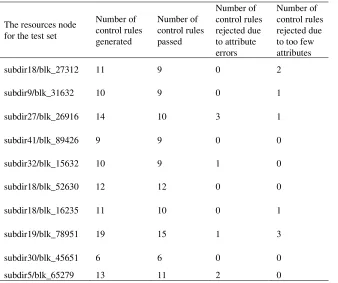
[image:8.612.142.480.146.429.2]The manual audit of the generated control rule set can represent the accuracy of the results. The higher the proportion of the control rule set passed, the higher the accuracy of the control rule mining on this resource. The manual audit of the control rule set generated by the 10 test sets is shown in table 1.
Table 1. The experiment results.
The resources node for the test set
Number of control rules generated
Number of control rules passed
Number of control rules rejected due to attribute errors
Number of control rules rejected due to too few attributes
subdir18/blk_27312 11 9 0 2
subdir9/blk_31632 10 9 0 1
subdir27/blk_26916 14 10 3 1
subdir41/blk_89426 9 9 0 0
subdir32/blk_15632 10 9 1 0
subdir18/blk_52630 12 12 0 0
subdir18/blk_16235 11 10 0 1
subdir19/blk_78951 19 15 1 3
subdir30/blk_45651 6 6 0 0
subdir5/blk_65279 13 11 2 0
As can be seen from the above table, the control rule set generated by each resource. The number of control rules is about 11, the approval rate is between 70% and 100%, and the average approval rate is about 85%.In general, the expected effect of the experiment was achieved.
In addition, the following phenomena or laws can be observed from the experimental process of training set and test set:
(1) When the total number of control rules is small, the approval rate is high and it is easier to pass all the rules. The reason for this phenomenon is that when there are fewer authorized roles for a certain resource, the differences between these roles will be relatively large. And this difference will be reflected in the characteristics of user behavior. In clustering analysis, the greater the difference between different roles, the higher the accuracy of clustering (it can be found from the clustering results that the clustering between classes is relatively far and the boundary is obvious).It makes the division between pre-authorized users and pre-privileged users more accurate, so the generated control rules have higher accuracy.
According to this rule, the following automatic audit condition can be set under the condition of tolerating the occurrence of very few control rule errors: When the total number of control rules is small, it can be audited automatically to reduce the workload of manual audit.
Compared with the marked cluster observed by the administrator, less than 2/3 clusters are often found.
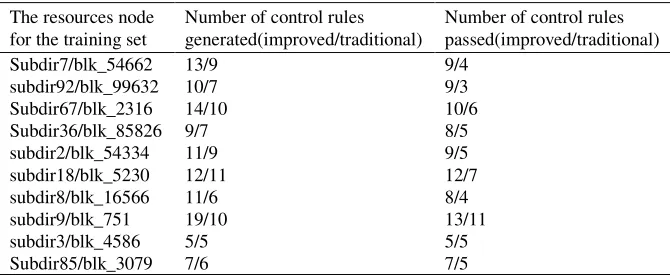
[image:9.612.138.473.181.320.2]Meanwhile, in the comparative experiment of cluster analysis, part of the training set was used to adopt the traditional and improved DBSCAN method, and the results are shown in table 2. The average acceptance rate of the improved method was about 78.6%, much higher than the 63.2% of the traditional method. Besides, the improved method can excavate more control rules. Therefore, the improved method with better effect was selected for cluster analysis in the subsequent experiments.
Table 2. The experimental results of improved/traditional method.
The resources node for the training set
Number of control rules generated(improved/traditional)
Number of control rules passed(improved/traditional) Subdir7/blk_54662 13/9 9/4
subdir92/blk_99632 10/7 9/3 Subdir67/blk_2316 14/10 10/6 Subdir36/blk_85826 9/7 8/5 subdir2/blk_54334 11/9 9/5 subdir18/blk_5230 12/11 12/7 subdir8/blk_16566 11/6 8/4 subdir9/blk_751 19/10 13/11 subdir3/blk_4586 5/5 5/5 Subdir85/blk_3079 7/6 7/5
It can be concluded from the above analysis that the DBSCAN improvement method based on data partition selected in this paper is effective and feasible. Although compared with traditional DBSCAN, the improved method based on data partition is more complex. Moreover, the extra data partitioning process and parallel management also take some time. Therefore, the improved method takes a little longer than the traditional method, but it is still acceptable.
(3) Attribute errors and attributes too few cases rarely occur at the same time, even if the number of the difference between the two is not small. At the same time, it was found in the experiment that different directions of parameter changes of the data model could lead to different error situations. It shows that the feedback adjustment is effective, which is helpful to define the direction of parameter change of data mining model.
(4) Test set by the distribution of the model parameters after feedback regulation of our training set experiment to get the initial value as the center. And the range of change is not large (but still shows some possible regular distribution, preliminary inference may be related to the type of resources, but the information of the type of resources cannot be obtained in the data set, and further analysis of the data source needs to be expanded subsequently), which confirms the role of the initial value.
(5) Due to limited data (mainly limited to manual review of data), there may still be undiscovered laws or problems in the experiment, which need to be further improved in the future. There is still a large room for improvement of this method model.
Summary
pre-authorized users are extracted by generating frequent item sets to form the initial control rule set. After passing the audit, the initial control rules are applied to the access control module or the data mining model is adjusted according to the failed results. In this paper, various links in the access control rule generation method are connected in series through experiments to evaluate and analyze the method. The approval rate of control rules mined has reached more than 85%. For big data platforms with “excessive authorization”, the permission can be effectively refined.
Acknowledgement
This work was supported by the National Key Research & Development Program of China (2016QY06X1205).
References
[1] Viktor Mayer-Schonberger, Kenneth Cukier. Big data: a revolution that will transform how we live, work and think. Boston: Houghton Mifflin Harcourt, 2013.
[2] Feng Dengguo, Zhang Min, Li Hao. Big data security and privacy protection [J]. Chinese Journal of Computers, 37(1): 246-258, 2014 (in Chinese).
[3] Wang Q, Jin H. Quantified risk-asaptive access control for patient privacy protection in health information systems [C]//Proceedings of the 6th ACM Symposium on Information, Computer and Communications Security (ASIACCS), Hong Kong, China, 2011: 406-410.
[4] Zeng W, Yang Y, Luo B. Access control for big data using data content [C]//Proceedings of the 2013 IEEE International Conference on Big Data. Santa Clara, USA, 2013: 45-47.
[5] Li Hao, Zhang Min, Feng Dengguo, Hui Zhen. Research on access control of big data [J]. Chinese Journal of Computers, 40(1): 72-91, 2017 (in Chinese).
[6] Zafar Annam, Kamran Muhammad, Shad Shafqat Ali, Nisar Wasif. A robust missing data-recovering technique for mobility data mining [J]. Applied Artificial Intelligence. 31(5): 425-438, 2017.
[7] Savvas I.K., Tselios D. Parallelizing DBSCAN algorithm using MPI [C]//IEEE International Conference on Enabling Technologies: Infrastructure for Collaborative Enterprises, 2016: 77-82.
[8] Shaorong Feng, Wenjun Xiao. An Improved DBSCAN Clustering Algorithm [J]. Journal of China University of Mining & Technology, 37(1): 105-111, 2008.
[9] Li N., Zeng L., He Q., et al. Parallel implementation of apriori algorithm based on mapreduce [C]//Proceedings of the 13th ACIS International Conference on Software Engineering, Artificial Intelligence, Networking and Parallel & Distributed Computing. Washington D. C., USA: IEEE Press, 2012: 236-241.
[10]Liu Li, Yu Shuo, Wei Xiang, Ning Zhaolong. An improved Apriori-based algorithm for friends recommendation in microblog [J]. International Journal of Communication Systems, 31(2): 2018.