II. FRAME OF THEORIES
This chapter discusses certain points; the literature review deals with the nature of speaking, concept of teaching speaking, concept of cooperative learning, concept of Student Team Achievement Divisions (STAD) technique, concept of procedure text, procedure of STAD technique implemented in speaking class and the advantages and disadvantages of STAD technique categorized like the following:
2.1 The Nature of Speaking
Speaking is one of important skills that should be taught to students. In this section, the writer presents the nature of speaking including the concept of speaking, components of speaking and types of speaking.
2.1.1 Concept of Speaking
Speaking is an active productive skill. According to Welty and Welty (1976:47), speaking is one of four basic skills of language and it has widely important role in daily life because it is the main skill in communication. It means that people can communicate to each other by speaking. In Webster’s Ninth New Colligate Dictionary (1990), speaking is defined as follows:
2. To express the feeling by others than verbal means (action sounds louder than words).
3. To express thought, opinion or feeling orally.
Communication itself consists of two ways, written and oral. As Byrne (1984:81) states speaking or oral communication is a two way process between speaker and listener and involves productive and receptive skill of understanding. In line with that statement, Scott in Johnson and Morrow (1981:70) clarifies speaking as an activity involving two (or more) people, in which the participants are both hearers and speakers having to react to what they hear and make the contributions at high speed. Therefore, one of requisites in speaking process is having at least two people who make interaction: one as a speaker who brings the information while another as a listener who receives the information. They also have a feedback to each other.
Murcia (1978:91) says speaking is the primary element of language and it can be developed from the beginning when someone was born, from the first contact with the language. From that statement, we know that language is a gift from God when someone is born. After that speaking can be learnt automatically according to the environment because it just occurs for the first language. Then it develops based on its phase. Jeremy (1983:41) confirms that someone speaks because:
1. He wants to speak. The speaker makes the definite decision to someone. 2. He has some communicative purposes. The speaker says something
speaker may want address to charm his listener, to give information, to express pleasure.
3. He selects from his language store. In order to achieve his communicative purpose, he will select from the store of language he possesses, the language he thinks is appropriate to the purposes.
Meanwhile Chaney (1998:13) defines speaking as the process of building and sharing meaning through the use of verbal and non-verbal symbols, in a variety of contexts. Based on the definition above, speaking happens only when the speaker uses verbal symbols and non-verbal symbols. Verbal symbols can be word and sentence, while non-verbal is gesture. Both verbal and non-verbal has same important level to convey the intention in speaking process.
Speaking is the essential skill in learning communication. According to Canale and Swain (1980), there are four competences underlying speaking effectiveness:
a. Grammatical Competence
Grammatical competence is an umbrella concept that includes increasing expertise in grammar (morphology, syntax), vocabulary and mechanics (basic sound of letters and syllables), pronunciation of words, intonation and stress. Grammatical competence enables speakers to use and understand English language structure accurately and unhesitatingly, which contributes to their fluency.
b. Discourse Competence
This competence is concerned with intersential relationship. In discourse, the rules cohesion and coherence apply which aid in holding the communication together in a meaningful way.
c. Sociolinguistic Competence
Knowledge of language alone does not adequately for effective and appropriate the use of the language. Speaker must have competence which involves knowing what is expected socially and culturally.
d. Strategic Competence
conversation and how to clear up communication breakdown as well as comprehension problems.
Harris (1974:9) says that speaking is encoding process where people can communicate the ideas, thought and feeling orally. The same concerning is proposed by Rivers (1978:162) who states through speaking someone can express his ideas, emotions, attentions, reactions to other person and situation and influence other person. It means that speaking is the right tool for communication. Through speaking someone can deliver the idea naturally and get the attention directly from others. In this process, we can express, share, influence even interact with other people about what we think and feel freely.
2.1.2 Components in Speaking
Speaking is a complex skill since its existence involves some important aspects. If we want to be a good speaker, we need to know about it. According to Harris (1974:75), here are five main components in speaking:
1. Pronunciation
Pronunciation is the way we say a word sounds when it is spoken. Pronunciation refers to the ability to produce easily comprehensible articulation (Syakur, 1987). Meanwhile Harris (1974:81) defines pronunciation as the intonation patterns. Pronunciation refers to be the one’s way of pronouncing the words. Furthermore O’Connor (1989) explains pronunciation as the analyzed sound that is very different from the written language. It means that when we read some words in dictionary, the way we pronounce is totally different with the written form. The words in the bracket point us about how to pronounce it well. For example “like” we should say /laɪ k/ and “colour” should be said /ˊ kʌlɚ/.
2. Grammar
the sentence “I always happy” is incorrect while the correct one is “I am always
happy”.
3. Vocabulary
Vocabulary refers to the words used in language. Phases, clauses and sentence are built up by vocabulary. One cannot communicate effectively or express ideas in oral form well if they do not have sufficient vocabulary. Therefore, vocabulary means the appropriate diction which is used in communication as what is stated by Syakur (1987). In short, Wilkins (1983:111) states vocabulary is very important because without words we cannot speak at all. Vocabulary itself is divided into two parts; close and open class. Close class consists of preposition, pronoun and conjunction. While open class consists of noun, adjective, verb and adverb. For example fruit, big, round, green and sweet are some vocabularies about melon.
4. Fluency
Fluency is defined as the ability to speak with speed, accuracy and proper expression, in order to understand what they speak about. Fluency refers to the ease and speed of the flow of the speech (Harris, 1974:81). Fluency is the smoothness or flow with which sounds, syllables, words and phrases are joined to other when speaking. Oster (1985:210) says fluency refers to the one who express quickly and easily. For example, when a student says this “My name is Agnes
Monica. I am 27 years old. I live in Jakarta. I love singing and dancing very
and there is no long pause occurred. As matter of fact, signs of fluency include a reasonably fast speed of speaking and only small numbers of pauses.
5. Comprehensibility
Comprehensibility is the ability to understand, to be understood, intelligible. Heaton (1991:35) states comprehensibility denotes the ability of understanding the speaker’s intention and general meaning. If someone can express something fluently and correctly as well as catch the point of conversation from the other well, it indicates his comprehensibility in speaking. For example when a student says something, other students will be able to understand and comprehend what he says. It also can be proved by his ability to respond what another student says.
2.1.3 Types of Speaking
Brown (2001:251) said that much of our language teaching is devoted to instruction in mastering English conversation. He classifies the types of oral language as the diagram below:
Planned
Monologue
Unplanned
Types of Speaking
Interpersonal Dialogue
1. Monologue
In monologue, when a speaker uses spoken language for any length of time, like in speech, lecture, storytelling, newscast, etc, the listener must process long stretches of speech without any interruption. The stream of the speech will go on without heeding whether the listener comprehends or not. Monologue itself is divided into two kinds, planned and unplanned. Planned usually refer little redundancy and are relatively difficult to comprehend. Whereas unplanned manifest more redundancy which makes for ease in comprehension, but the presence of more performance variables and other hesitations, can help or hinder comprehension. For example:
Dewa: Hello guys. My name is Dewa. I am a Lampungnese but I live on Ngurah Rai street no.25, Denpasar. I am the second child in my family. My hobby is playing guitar. Well, if you want to know more about me, you can follow my twitter.
2. Dialogue
Contradictory with monologue, dialogue involves two or more speakers and can be subdivided into interpersonal and transactional. An interpersonal language is a dialogue with the purpose is to promote social relationship between speakers. On the other hand, transactional language is a dialogue which involves two or more speakers and the purpose is to convey propositional or factual information. For example:
Jack : Hello, what is your name?
Rose : Hi, my name is Rose, and you?
Jack : My name is Jack. Where do you study?
Rose : I study in Oxford University.
Jack : Oh, nice to see you Rose.
In line with the theories above, it can be concluded that there are two types of speaking, monologue and dialogue. Both of them have different purpose. Monologue is singular speaking which is only intended to convey our intention, while dialogue is plural speaking consists of at least two people, speaker and hearer, who make an interaction. One transmits the message orally and another receives and processes it in his mind in order to understand the meaning of the message for the purpose of replying to the speaker’s message orally too.
Brown (2001, 271-274) also provides types of classroom speaking performance, they are:
1. Imitative
A very limited portion of classroom speaking time may legitimately be spent generating “human tape recorder” speech, where for example drilling. Learner practices an intonation contour or tries to pinpoint a certain vowel sound. Imitation of this kind is carried out not for the purpose of meaningful interaction, but for focusing on some particular element of language form in a controlled activity.
2. Intensive
3. Responsive
A good deal of the students’ respond directly in the classroom is responsive: short replies to teacher and peer’s questions or comments. These replies are usually sufficient and do not extend into dialogues. Such speech can be meaningful and authentic.
4. Transactional (dialogue)
Transactional dialogue, which is carried out for the purposes of conveying or exchanging specific information, is an extended form of responsive language. Conversations, for example, may have more of a negotiate nature to them than does responsive speech such as information-gathering interview, role play or debate.
5. Interpersonal (dialogue)
6. Extensive (monologue)
Students at intermediate to advanced level are called on to give extended monologues in the forms of oral reports, oral summaries or perhaps short speeches. In this, the register is more formal and deliberative. This monologue can be planned or impromptu.
In this study, almost all types of classroom speaking performance would be used by teacher and students. Because it was qualitative descriptive analysis, so all types of speaking performance above had same chance appeared in teacher-student or teacher-student-teacher-student’s interaction during teaching learning process.
2.2 Concept of Teaching Speaking
Teaching speaking means teaching how to use language for communication, for delivering ideas, thought even feeling to other people in any situation. Based on that statement, in teaching speaking skill, it is necessary to have clear understanding involved in speech. Swain (1985:235) in Lawtie (2004:35) states we learn to speak by speaking. The more students practice their speaking the more they will develop their oral skill. Hence, the teacher must create speaking activities that can be easily practiced in speaking class.
that apply in each communicative situation (Burnkart, 1998:2). Penny Ur (1991:201) says that characteristics of successful speaking activity:
o Learners talk a lot. As much as possible of the period of time allotted the activity is in fact occupied by learner talk. This may seem obvious, but often most time is taken up with teacher talk or pauses.
o Participation is even. Classroom discussion is not dominated by a minority of talkative participants: all get a chance to speak and contributions are fairly evenly distributed.
o Motivation is high. Learners are eager to speak because they are interested in the topic and have something new want to say about it, or because they want to contribute to achieve a task objective.
o Language is of an acceptable level learner express that are relevant, easily comprehensible to each other and of an acceptable level of language accuracy.
According to Harmer (1990), the aim of teaching speaking is to train students for communication. Therefore, language activities in speaking class should focus to language use individually. The duty of teacher is not only to create a warm and humanistic classroom atmosphere, but also to provide each student to speak.
Then he adds that language is an activity that permits people to communicate with each other. The statement above asserts that language is necessary for people. As teacher, we do not only teach about what will be spoken but also the situation we deal it. It is by carrying out students into certain situation when the topic occurred. The topic here must be well-known for the students, so that the ideas and organization are clear. Besides that, the learners will easily describe the topic. Nunan, 2003 in Kayi, 2006 states that teaching speaking is to teach English learners to:
Produce the English speech sounds and sounds patterns
Use word and sentences stress, intonation patterns and the rhythm of the second language
Select appropriate words and sentences according to the proper social setting, audience, situation and subject matter
Organize their thoughts in a meaningful and logical sequence Use language as a means of expressing values and judgments
Use the language quickly and confidently with few unnatural pauses, which are called as fluency
In addition, Nunan (2003:54-56) says there are five principles for teaching speaking:
1) Be aware of difference between second language and foreign language in learning context.
3) Provide opportunities for students to talk by using group work or pair work.
4) Plan speaking task that involve negotiation for meaning.
5) Design classroom activities that involve guidance and practice in both transactional and interaction speaking.
Therefore, if the pioneers of education do not give much more opportunities to their students to speak during the class, the students will lose their motivation and interest in learning speaking. On the other hand, if the right activities are taught in the right way, surely speaking class will be full of fun and raise general learners’ motivation. It also makes speaking class become an active place.
The goal of teaching speaking itself is to improve students’ communicative skill. So language learners need to recognize that speaking involves three areas of knowledge:
(1) Mechanics (pronunciation, grammar and vocabulary): using the right words in the right order with the correct pronunciation.
(2) Functions (transaction and interaction): knowing when clarity of message is essential (transaction/information exchange) and when precise understanding is not required (interaction/relationship building).
After that, to help students practice their speaking skill, a teacher should help them with understanding about what makes speaking difficult that are revealed by Brown (2001:270-271) as follows:
1. Clustering
Fluent speech is phrasal, not word by word. Sometime, students are difficult to make coherent speech. They often pause the speech for remembering what they will say in appropriate word. Learners can organize their speaking both cognitively and physically (in breath groups) through such clustering.
2. Redundancy
Students have opportunity to make meaning clearer through the redundancy of language such as rephrasing, repetitions and little insertions. Learners can capitalize on this feature of spoken language.
3. Reduced forms
Contractions, elisions, reduced vowels, etc., all form special problems faced by students in teaching spoken English. They have to learn more English forms to solve this problem. Students who do not learn colloquial contractions can sometimes develop a stilted bookish quality of speaking that in turn stigmatizes them.
4. Performance variables
hesitations, pauses, backtrackings and corrections. Students are allowed to use “thinking time” such as uh, um, well, you know, I mean, like, etc.,
while thinking the idea to speak.
5. Colloquial language
Make sure your students are reasonably well acquainted with the words, idioms and phrases of colloquial language and they get practice in producing these forms.
6. Rate of delivery
Rate of delivery is one of characteristics in speaking fluently. Students often think that native speakers always speak fast. So, one of our tasks as a teacher in teaching spoken English is to help learners achieve an acceptable speed along with other attributes of fluency.
7. Stress, rhythm and intonation
This is the most important characteristic of English pronunciation. The stress-times, rhythm of spoken English and its intonation patterns can help the students to convey important messages clearly.
8. Interaction
Those characteristics above should be handled by students in improving their speaking proficiency. Even though there are some difficulties in teaching speaking, it is clear that speaking is the ability to express one’s thought and the proper forms of communication. There are several ways of teaching speaking that we can use during teaching learning process. In order to teach second language learners how to speak in the best way possible, teachers should help and facilitate students to practice English speaking a lot. They must use speaking activities that can be practiced and applied in the classroom. One of the examples is cooperative learning.
2.3 Concept of Cooperative Learning
Small group discussion, role-play and simulation, case study, discovery learning, self-directed learning, cooperative learning, collaborative learning, contextual instruction, project based learning, problem based learning and inquiry, and task based learning are the techniques of students center learning models.
teacher. In these groups, all member of the group can share their ideas in order to finish their tasks.
While Slavin (2008:4) states that cooperative learning refers to any kinds of teaching methods in which the students work together in small groups for helping each other in learning a certain lesson material. In cooperative class, the students are hoped can help each other, discuss and argue with one another in order to sharpen current knowledge and close discrepancy in understanding on their own. This kind of learning is very important because one who is categorized to a low student will be helped by others. So that, they will get more knowledge through this learning.
In addition, Kagan and Olsen in Kessler (1992:1) states that cooperative learning is a body of literature and research that has examined the effects of cooperation in education. It offers ways to organize group work to enhance learning and increase academic achievement. It can be said that cooperative learning has big effects in education and it also provides many ways to organize group work in order to create high quality learning and to increase students’ academic achievement. In this case, the researcher focuses on the students’ achievement in spoken procedure text.
to the facilitator. He also states that not all of group work can be regarded as cooperative learning. It is not cooperative learning if students sit together in groups and work on problems individually and let one person do all the work. Besides, a teacher should be a motivator for students in class. In other words, Teachers give motivation and know the way how to push maximum ability of their students.
According to Johnson, Johnson & Holubec (1993), cooperative learning should fulfill five principles. They are:
a) Positive Interdependence
Students perceive that they need each other in order to complete the group's task (sink or swim together). It means that one cannot succeed unless everyone succeeds.
b) Face to Face Interaction
Group members have to orally explain how to solve problems, teach one’s knowledge to others, check for understanding, discuss concepts being learnt, associate the present learning with the past one and share the result to classmates.
c) Individual Accountability
selecting one group member to give the answer. Moreover, the size of the group should be kept small. The smaller size of the group is, the greater individual accountability may be.
d) Interpersonal and Small Group Skills
Groups cannot function effectively if students do not have and use the needed social skills. In cooperative learning students have to learn how to make an interaction with the others in their group. They also learn how to convey their ideas in their group and it will be demanded special ability.
e) Group Processing
Groups need specific time to discuss how well they are achieving their goals and maintaining effective working relationships among members.
2.4 Concept of Student Team Achievement Divisions (STAD) Technique
In line with models of cooperative learning, Depdiknas (2007:128) introduces five types of cooperative learning; jigsaw, student team achievement divisions (STAD), roundtable, group investigation (GI) and inside-outside circle. Others cooperative learning techniques are number head together, team games tournament (TGT), team assisted individually (TAI), structural approach and think pair share (TPS). The models above are known as models of PAIKEM (fun, effective, creative, innovative and active learning).
STAD is one of cooperative learning techniques in which students work in a group. It is one of simplest and most extensively researched forms of all cooperative learning; and is a good technique to begin with for students who are new to the cooperative learning method (Slavin, 1995). The main idea behind Student Team Achievement Divisions (STAD) technique is to motivate students, encourage and help each other in understanding the material presented by the teacher. In addition, STAD can be used by students of all ages and any subject areas (Killen, 1998:96).
academic materials. These quizzes are scored and each individual is given an improvement score.
Furthermore, Slavin, 1986 in Wang (2009:116) also states clearly that STAD is a prevailing and simple technique in cooperative learning. It consists of five major components as proposed by Slavin (1995) i.e class presentation, teams, quizzes, individual improvement scores and team recognition. Those components will be elaborated in the following section:
(a) Class Presentation. In this component, the material is introduced in direct instruction or discussion way, but involves audio – visual presentations. It can be a lecture, a discussion and demonstration on the blackboard or whiteboard. Priest (1994) argues that the material taught should closely match to the objective tested by the quiz. Students must pay attention carefully during the class presentation and then students can do the quizzes well afterward to gain good scores for their teams.
(b) Teams. Teams consist of four or five students working in heterogeneous teams according to academic performance (Slavin, 1995). The team meets to study worksheets, discuss problems together, compare answers and correct misconceptions. The major function of the team is to promote its members to do best on their work.
the quizzes, they are not allowed to help each other. It makes sure that every student is responsible for knowing the material.
(d) Individual Improvement Scores. Students’ quiz scores are compared to their past average. The students earn points for their teams based on how much their scores could exceed their previous quizzes. When students make progress on their quizzes, the whole group’s performance will be improved.
(e) Team Recognition. If students’ average scores exceed a certain criterion,
teams can earn certificates or other rewards. Slavin (1995) states that the teacher can be creative in how the award are distributed and the important thing is no so much the use of large rewards, but rather the recognition of students’ accomplishment. In this study, the best team among others would get reward from teacher.
From the explanation above, it can be stated that Student Team Achievement Divisions (STAD) technique gives students the opportunity to collaborate with peers in the form of group discussions to solve a problem each group member.
2.5 Concept of Procedure Text
things work through several steps directions. While spoken procedure text means explaining the steps or instructions orally in making or doing something. The function is giving information for listeners especially students about the action steps and instructions how something is able to be accomplished, so they will easier understand about what they are going to do.
As a kind of genre, procedure text also has language features. Derewianka (1990:28), Watkins and Knapp (2005:156) argue that there are some language features of procedure text. First, it mainly uses many action verbs for command (take, chop, add) and usually uses simple present tense. Action verbs which are used in instructions represent the processes involved in completing a task, for example, “walk the jungle, defeat the enemy there, then cross the river”. Meanwhile, verbs are in the simple present tense to create a sense of timelessness. They are also stated as imperatives. Second, procedure text focuses on specific people or things, such as “first, you take…” and focuses on generalized human agents, such as “you heat the oil”. Besides, according to Gerot and Wignell (1994), procedure text usually uses temporal connectives to do with time or sequence of action and it can be used to link information (first, then, next, when, etc). Finally, Derewianka (1990) adds procedure text uses detail factual description of participants (shape, size, color, amount, etc.), such as “place two
eggs into a bowl” and simple language due to the purpose to give clear information and detail information on how (mix it slowly), where (cut 5cm from the top), when (until it turns golden).
instructions that give the information about the rule of the games, and 3) Scientific experiments that give the information about steps to do experiment.
Here is an example of procedure text and its schematic structure:
Goal: “How to Make Chicken Meatball”
Ingredients:
400 grams boneless chicken 2 pcs garlic (big size) 1 pcs small onion 1 tsp salt
3 tbs starch or corn flour 1/4 tsp pepper
1/2 litre water
1 pcs egg (remove the egg yolk) onion leaves to garnish
a pinch of food seasoning 1 tbs oil
Steps:
Chicken Balls:
Place the chicken, 1 pcs garlic, onion and salt in food processor. Process until smooth
Put the processed chicken in a bowl and mix with the egg and flour. Knead the dough and roll the dough into small balls
Boil the water
Drain the balls The Soup:
Heat the oil
Crush 1 pcs of garlic and fry the garlic
When the good smell comes out and the color turn golden, add the stocks (the water which was used to boil the chicken balls), let it boiled
Add the salt, pepper and food seasoning
Add the chicken balls and garnish with onion leaves The chicken meatball soup is now ready to be served
http://www.easyrecipeworld.com/chicken-meatball-soup/
2.6 Procedure of STAD Technique Implemented in Speaking Class
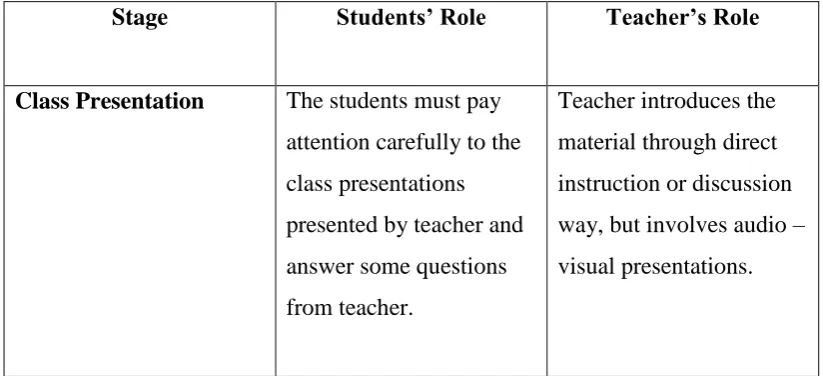
[image:28.595.106.518.506.694.2]The table presented below is steps of Student Team Achievement Divisions (STAD) technique proposed by Slavin, 1986 in Wang (2009:116) which modified for speaking class, they are:
Table 2.1 Stage of Student Team Achievement Divisions (STAD) technique
Stage Students’ Role Teacher’s Role
Class Presentation The students must pay attention carefully to the class presentations presented by teacher and answer some questions from teacher.
Teams A team consists of four or five students working in heterogeneous teams according to academic performance. The team meets to study
worksheets, discuss problems together, compare answers and correct misconceptions about the task that is given by teacher.
Teacher prepares a problem/case or task to be finished by students in group.
Teacher designs and monitors the teaching learning process and the result of students’ team work.
Quizzes Students take individual
oral quizzes. It is done to make sure that every student is responsible for knowing the material in his/her group.
Teacher oversees the process when the oral quizzes are go on and gives scores individually.
Individual
Improvement Scores
Students earn points for their teams based on how can they answer the questions from another group. If students are able to answer the questions well, the group score will be improved.
Team Recognition If the group’s scores exceed a certain criterion, teams can earn
certificates or other rewards.
Teacher gives praises or rewards for the best team among others.
2.7 Advantages and Disadvantages of STAD Technique
2.7.1 Advantages of STAD Technique
There are some advantages in implementing STAD technique in the teaching learning process. According to Lundgren (1994), the advantages of STAD are:
1. It can increase the students’ motivation 2. It can increase the students’ score
3. It can increase the students’ retention or save the data for long time
2.7.2 Disadvantages of STAD Technique
Besides the advantages, STAD technique also has the disadvantages in its implementation. According to Kagan (1992:109), the disadvantages of STAD are:
1. Teacher get hardly the class’ attention 2. The noise level become too high