INTERNET USAGE AND INFORMATION SEEKING BEHAVIOUR OF
STUDENTS CONDUCTING HISTORY PROJECTS: DETERMINING
THE NEED OF A DIGITAL LIBRARY FOR HISTORICAL RESOURCES
Abrizah Abdullah and A.N. Zainab MLIS Programme,
Faculty of Computer Science &Information Technology, Universiti Malaya, Kuala Lumpur
[email protected]; [email protected]
ABSTRACT
This paper reports the results of a user study done at the formative stage of
development of a collaborative resource development (CoreDev) digital library
for Malaysian historical resources by collaborating partners. CoreDev aims to
provide an electronic system to help students obtain information on local history;
collect, store and organize information in digital format; publish and share
electronic resources. While most digital library projects were driven, by
technology development and research, there has been little investigation into
how to develop a creative, working community around a digital library. This
paper presents preliminary findings on students' readiness and receptivity to
participate in the building of the digital library as content providers and
developers, and their motivation and willingness to collaborate and share digital resources, as well as their understanding of their role in the collaborative digital
library environment. Our findings indicate the feasibility of implementing the
digital library for Malaysian schools. Series of surveys and interviews have led
to rich findings of the students' and teachers' concerns and priorities regarding
the digital library. Insights from these descriptions will then be used to establish
a set of framework and design principles that could be used in designing our
digital library.
Keywords: Collaborative digital libraries; User studies; ICT skills; Online resources; Student-teacher collaboration
INTRODUCTION
Library professional literature has emphasized that students' personal information environment has evolved to be a hybrid of both digital and traditional library sources (Cmor & Lippold, 2001; Fidel, 1999; Seiden,
Therefore, it is important to understand how, why and when students use digital resources, especially if we seek to provide or improve ways for students to access and use these resources. It is essential to know how students would integrate digital libraries into their repertoire of resources, how it would be integrated into their individual information seeking behaviour and how the digital library would impact that behaviour.
User studies have been a continuing topic of interest in the digital library community. Most digital library projects however were driven by technology development and research, and there was little involvement of the actual user community in the design and analysis of the system. Itis generally recognized that incorporating user input into the design and development of digital libraries will result in the construction of better systems (Bishop, Van House, & Buttenfield, 2003; Nardi & O'Day, 1999; Twidale, Nichols, & Paice, 1997). Digital libraries will only realize their potential when they are usable, useful and used by a broad cross-section of users (Blanford, & Buchanan, 2002). However, user studies tend to focus on comparing user interfaces and search techniques rather than considering what people require from digital libraries, and how they might use them (Bryan-Kinns & Blandford, 2000). Several studies have looked at the digital library in context, that is, how it fits in a larger frame of use. Two fme examples of such studies are Bishop's consideration of the use of digital libraries by potential users from different social and economic backgrounds (Bishop, Tidline, Shoemaker & Salela, 1999) and Covi and Kling's study of the patterns of use of digital libraries by users of different academic backgrounds (Covi and Kling's 1997).
Digital libraries serve communities of people and are created and maintained by and for people. All efforts to design, implement and evaluate digital libraries must be rooted in the information needs, characteristics and context of the people who would use those libraries (Marchionini, Plaisant and Komlodi, 2002). While there are several public and private sector models for building and maintaining digital libraries, there is no model yet that involves participants of varying strength, needs, experience, and interests. These variables would make a significant difference in the design, development, and utility of digital libraries for education (Giersch, 2004). Development of a model that describes participants' involvement would enhance the effective involvement of multiple audiences in all facets of the digital libraries. Therefore, in order to benefit from their participation, a researcher must have some idea of the level of knowledge of the potential users, the problems they might encounter and the areas they would be interested in learning.
Recent years have seen a steep rise in the number of digital library initiatives for the K-12 community in the United States, planned towards developing novel digital library technologies and making them accessible to the learning community. Projects like the American Memory and California Heritage are the first step in a vast, collaborative effort to extend historical digital resources. CoreDev, a collaborative digital library project currently underway at the Faculty of Computer Science & Information Technology, Universiti Malaya (the Faculty), uses the same implementation technology, focusing on a different community - secondary school students conducting their school-based projects. The purpose of CoreDev is to provide the learning community with an experience in collaboratively building a digital library of history projects, which indirectly allow members of the community to be aware and be actively involved in e-publishing as well as enhances member's ICT literacy skill. The digital library would benefit both the students who would create and publish their digital history project works and teachers who would gain the experience of managing digital information. This initiative is a focal point for the creation, use and investigation of electronic information services, resources, and systems, developed from a user's perspective.
At the Faculty, researchers are building useful test beds to enable a continuous system of testing, feedback, analysis and improvement. In addition to having excellent collections, flexible, standards-based tools for management and access, we also need some knowledge of the changing needs and information-seeking behaviors of the user communities and their access to emerging technologies. Continuous improvement of our systems also requires that we undertake rigorous research on the information-seeking behaviors of our largest user-group, the secondary school students. As Don Waters, Director of the Digital Library Federation, stated, " ... an effort must be made to understand the ways in which users interact with systems, their needs in relation to new information types, and the functionality of these types in the emerging digital environment" (Waters,
1999).
The approach used by the Faculty in developing a digital library model inthe Malaysian context is forward-looking and its successful implementation could be based upon the following premises of the Networked Readiness Framework (Dutta &Jain, 2003):
a) There are three important stakeholders to consider in the development and implementation of the digital library enterprise: students, teachers and the education administrators;
b) There is a supportive environment for ICT in which the stakeholders play their respective roles;
c) The degree of usage of ICT by the three stakeholders is linked to their degree of readiness to use and benefit from ICT.
These three premises provide the foundation to gain further insights into the key drivers in which the digital library can successfully operate: the Stakeholders' Readiness and Usage. In the Faculty's collaborative digital library, the schools, teachers, students, the public, universities, and depositories are the expected stakeholders, and the Ministry of Education will host the system. Students and teachers will be partners in digital resource development as content developers and content managers respectively, and it is this partnership that will form the nucleus of the collaborative resource development in the digital library.
As a collaborative digital library is a user-centred system (DELOSINSF, 2003), the focus of the study is to investigate the existing stakeholder's characteristics and environment that would ensure the reception of the collaborative digital library. The Faculty has conducted a series of surveys and interviews to investigate the readiness and reception of potential users of the digital library project. Currently, researchers are conducting focus group interviews, controlled observations, and are collecting user comments and feedback from the system testing. The CoreDev project establishes collaboration between students and other community partners in building a collection of digital tools and resources that the former will find both usable and useful for their history projects. This paper describes findings of the preliminary survey aimed at understanding the students' characteristics and environment that would ensure the reception of a collaborative digital library for history projects in the schools. The objectives of this survey are to:
a) Ascertain students' readiness to participate as content providers and developers in the building of the digital library including their ICT skills, their knowledge and use of the Internet.
b) Carry out a needs analysis for digital resources among students undertaking their history projects including their perceived and actual needs for digital resources.
d) Find out students' motivation and willingness to collaborate and share digital resources including their understanding of their role in the collaborative digital library environment.
THE SURVEY
The digital library model has been conceived, and is being constructed to meet the needs in support of the development of local historical resources for secondary school students. The community chosen, students, is one that is relatively well understood and has been the focus of research for many years. It was felt that choosing a community where data on their information needs exists would help to provide an indication of the effectiveness of the methodology. At the least it would be able to derive similar insights to digital library initiatives that have been built over the years; at the best it would provide a more detailed understanding of this community in terms of their interaction with information and the implications for a digital library product that would meet their information needs.
We conducted a survey on 60 Secondary Two and Three students from two schools in the Klang Valley who were preparing their History Project. The schools were chosen because both provided Internet connections and the schools were situated close to numerous cyber cafes, thus putting the stakeholders in an leT-rich environment. The survey's sample comprised nearly equal number of girls' and boys, and was ethnically and culturally diverse. Participation in the survey was voluntary. The survey used the questionnaire method to obtain the information needed. All parts of the questionnaire were assessed for content and were validated by a faculty member from the library and information science programme, a faculty member in research methods and statistics, two secondary school teachers teaching information technology and another two teaching history. The questionnaire was then field-tested for reliability on 30 Secondary Three students who were not part of the sample. The 10-page questionnaire was administered a week after the students had submitted their history project to their respective teachers. The first part contained questions seeking for demographic information of the respondents. The second part comprised questions that aimed at ascertaining student's level of computer and Internet literacy, the method and resources used to gather information for history projects, their readiness to use digital library and their expectation of the digital library. The survey yielded a usable response rate of 100% (n=60). Data were analyzed with descriptive statistics.
The question on the factors related to stake holder's characteristics and reception of the collaborative digital library for history projects is of particular interest in this survey. This questionnaire aimed at eliciting response on specific procedures
and processes of the digital library, as well as to identify the resources (information, people and technology) used in the processes. The specific questions about student readiness and usage included:
(a) What did the students use the computers for? (b) Where did they use the computers?
(c) Did they use the Internet? What did they use the Internet for?
(d) Did they have any experience in creating digital resources and Web development over the Internet?
(e) How did the students choose their project topics?
(f) How did the students get all the information needed for the projects? (g) Did the students use the Internet to obtain information?
(h) Were the students skilled in searching the Internet? (i) Were they satisfied with the information obtained?
(j) How did they handle or utilize the information they obtained from the Internet?
(k) Which among all the resources they used gave them the most satisfaction and why?
(1) Were the students willing to share or exchange information they found? Did they think sharing was a good practice? How did they think sharing could be done?
(m) Did the students acknowledge information resources they obtained from the Internet?
(n) Did the students know about digital libraries? Did they fmd them useful? (0) What was the information and features that they would like to see in a
digital library?
(P) Were they willing to participate as partners in developing the content of a digital library?
FINDINGS
a) Computer and Internet Use
Respondents were asked to describe themselves as Internet users on a 4-point scale ranging from 1 (very infrequent user) to 4 (regular user).
At this early stage some interesting findings were already emerging. Responses from the students on computer and Internet usage were quite similar and provided insight into the great diversity of IT penetration, especially in the Malaysian homes. Preliminary findings indicated that students were ready to utilize digital libraries as computer ownership was high and all respondents in the sample indicated having used computers. All respondents have used the computer for word processing, creating slideshow and surfing the Internet. A total of 28 students have used it for creating spreadsheet, 6 for creating databases, 2 for creating multimedia, 15 for editing photographs, 14 for scanning images, 29 for drawing, 5 for basic programming and 1 for developing a system.
A high majority had access to the Internet. The majority (90%) had Internet access from their homes, and they also used the Internet at their friend's homes (63%), cyber cafes (50%), public libraries (20%), parents' office (17%), community centre and schools (7%). A total of 43% (26) had online usage experience of 3-4 years, while 40% (24) had more than 5 years. The students sampled were also frequent users of the Internet with 27% (16) logging on everyday, 20% (12) at least every alternate day and 40% (22) at least once a week. Most of the students rated themselves as moderate users (1-3 times per week).
The list of online activities in the questionnaire was adapted from several studies (Nie & Ebring, 2000; Pew Research Centre, 2000). Respondents were asked to mark which of the 19 online activities they engaged in and the frequency of doing so. Respondents checked "Yes" if they conducted an activity and left the item if they did not. Generally, the main uses of the Internet were to chat (97%), e-mail (93%), computer games (90%), browse for information, (70%), fmding information for project work (48%), using search engines (47%), finding information for school work (43%), downloading music (40%), and downloading image (35%). These data suggest that computer and Internet usage is pervasive with over half of the respondents reporting having used the Internet in a variety of settings, multiple times per week.
Most students have never had formal instruction in Web searching. We have anticipated students would most often state that they learned from their peers. However, half of the respondents indicated that they learned searching the Web on their own (50%), while only 13% (8) noted that they had learned from their friends, 27% (16) from parents and 10% (6) learned from their siblings. Interestingly, although more than half of the students had formal library
instruction, only 17% (10) indicated that this contributed to their knowledge of how to search online.
Although all respondents reported not having their own personal web page, a group web page, or have created web pages as a service to others, a total of27%
(16) indicated having experience in creating digital resource. and web development over the Internet. In terms of the Internet searching skills, most reported having intermediate skills (63%), while 20% (12) and 17% (10) rated themselves as a beginners and advance users respectively. It was interesting to note that the advance users were all boys, having more than 5 years of experience using the Internet.
One question asked the students to indicate which subjects they used the Internet for with the intention of finding out if they used the Internet to find resources for their History projects. Students sampled mainly used the Internet resources to get information for the following subjects: History (90%), Science (67%), and Geography (57%). A total of 90% (54) used the Internet to find resources for their History project. This clearly indicates that the students use Internet resources for project-based school subjects only. Only 22 students used the Internet to search for information for the subject Living Skills and 8 for English Language. The sample did not use the Internet at all for Mathematics, Malay Language and Religious Education.
b) The Information Seeking Process When Conducting Project Work
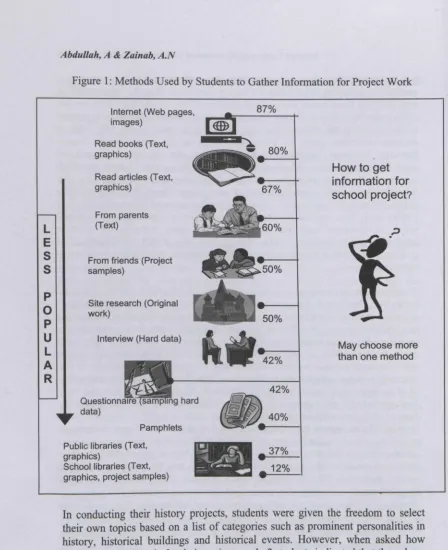
For preferred information seeking pattern, the students ranked the resources or methods of gathering information for their project work thus: the Internet (87%), read chapters from books (80%), read articles (67%), sought help from parents (60%), and from friends (50%). One reason which students consistently pointed to for choosing the Internet was the high success rate. About 50% (30) of students indicated going to actual sites such as the personalities' homes, historical buildings, museums, national archive and the relevant municipal council offices to obtain information. Other methods such as reading pamphlets and brochures, interviewing persons, and distributing questionnaires were also used. However, only a small number of respondents reported having used the public library (37%) and school library (12%) as sources of information for their project work. This was not the case in an earlier study, conducted two years ago when the libraries were the most frequently used resource for students conducting project work (Zainab, Abdullah & Ng, 2002). The methods of gathering information among students when conducting their project work are as shown in Figure 1.
Figure 1: Methods Used by Students to Gather Information for Project Work
Internet (Web pages, 87% images)
Read books (Text, ). 80% graphics)
~
Read articles (Text, How to get
graphics) 67% information for
school project?
From parents
L
(Text)E
S
From friends (ProjectS
samples)p
Site research (Original
0
work)p
U Interview(Hard data)
L
May choose moreA than one method
R
I/l),
42%Question g hard data)
40% Pamphlets
Public libraries (Text,
37% graphics)
School libraries (Text, 12% graphics, project samples)
In conducting their history projects, students were given the freedom to select their own topics based on a list of categories such as prominent personalities in history, historical buildings and historical events. However, when asked how they selected the topic for their projects, only 2 students indicated that they chose the topic themselves, 9 students chose a topic that they were familiar with, 4 chose the topic that many friends wrote about, 5 chose the topics that none of their friends have chosen, 13 chose topics that parents suggested, 11 chose the topics that have been written by their siblings before and 16 chose the topics that
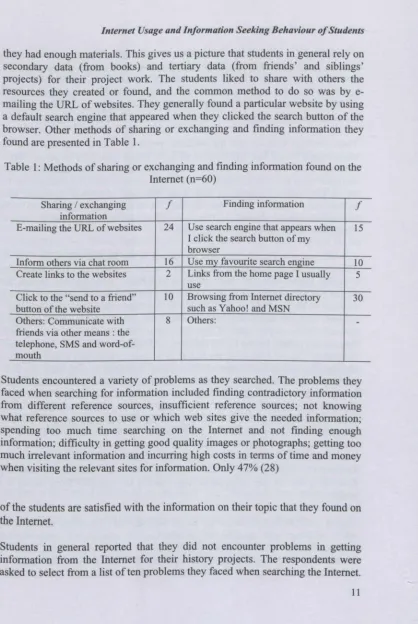
they had enough materials. This gives us a picture that students in general rely on secondary data (from books) and tertiary data (from friends' and siblings' projects) for their project work. The students liked to share with others the resources they created or found, and the common method to do so was by e-mailing the URL of websites. They generally found a particular website by using a default search engine that appeared when they clicked the search button of the browser. Other methods of sharing or exchanging and finding information they found are presented in Table 1.
Table 1: Methods of sharing or exchanging and fmding information found on the Internet (n=60)
Sharing / exchanging
/
Finding information/
informationE-mailing the URL of websites 24 Use search engine that appears when 15 I click the search button of my
browser
Inform others via chat room 16 Use my favourite search engine 10 Create links to the websites 2 Links from the home page I usually 5
use
Click to the "send to a friend" 10 Browsing from Internet directory 30 button of the website such as Yahoo! and MSN
Others: Communicate with 8 Others:
-friends via other means: the telephone, SMS and word-of-mouth
Students encountered a variety of problems as they searched. The problems they faced when searching for information included finding contradictory information from different reference sources, insufficient reference sources; not knowing what reference sources to use or which web sites give the needed information; spending too much time searching on the Internet and not finding enough information; difficulty in getting good quality images or photographs; getting too much irrelevant information and incurring high costs in terms of time and money when visiting the relevant sites for information. Only 47% (28)
of the students are satisfied with the information on their topic that they found on the Internet.
Students in general reported that they did not encounter problems in getting information from the Internet for their history projects. The respondents were asked to select from a list of ten problems they faced when searching the Internet.
The problems indicated by the students were: I do not know how to locate relevant resources; I had problems getting relevant information for the project; I
get a lot of irrelevant information on the Internet, It took me so long to search for
sources in the Internet and I had problems getting good pictures for the project.
However these five statements represented less than 33% of respondents.
These findings indicate that the students' perceptions as to why a search was unsuccessful rarely had anything to do with search strategies or search terms, although these were frequently the cause. When asked for the reasons that their searches were not successful, five said there was too little information on the topics they were researching, and three indicated that their searches were unsuccessful because there was nothing on their topics on the Web. This indicates that these students had certain expectations with respect to the type of materials to be retrieved that were unmet.
c) Willingness to Collaborate and Readiness to use Digital Libraries
This part of the questionnaire focused on whether or not respondents knew what a digital library was and their previous experience in using web portals and digital libraries. Selecting from a list of web portals, respondents were asked to indicate "Yes" or "No" if they have had experience using the portals. Only 3 students reported being familiar with and have used Portal Pendidikan Utusan (www.tutor.com.my) and CikguNet (www.cikgu.net.my), two popular educational portals hosted by the Ministry of Education Malaysia. Eight students have used Utusan Online (www.utusan.my). one of Malaysia's leading online newspapers. However, a total of 29 students indicated having used the MSN portal (www.msn.com). The number of students who have had experience using any government and library web sites was very low, i.e. only 2 and 6 respectively. However the number of those using entertainment websites, especially online games, was high, that is 68% (41). Efforts were made to ask a group of students, after the administration of the questionnaire, on the reasons they have not accessed the two Malaysian educational portals. The common reasons given were that they did not know that the portals existed. A student who has used the two portals said that the portals were very useful for examination purposes; however most of the information there could be obtained from books and newspapers.
Successful collaboration depends on social readiness (ITRISOC +1M, 2000). The introduction of collaborative projects and technologies has often failed because there was a lack of willingness to collaborate and lack of openness to change. Studies on use and usability of digital libraries also explore users' receptivity in order to determine usage for a long time to come. While it is clear that there is a growing receptivity to digital libraries in developed countries, there have been no studies in the Malaysian educational context to ascertain that.
In order to ascertain if respondents are ready to use digital libraries and are willing to collaborate, two variables have been included in this research, namely "willingness to collaborate" and "readiness to use digital libraries". In this study, respondents were asked if they were willing to collaborate in the digital library project. Willingness to collaborate was measured on a 5-point Likert-scale ranging from I (not willing at all) to 5 (very willing). In determining the readiness to use digital libraries, a "Yes/No" question was posed asking the respondents if they found digital libraries useful and if they wanted to use digital libraries for educational purposes.
The survey indicated that the students needed a digital library and that they were willing to participate in the development of the prototype. Over 90% of the students felt that there was a need for digital libraries of local history information and this would definitely benefit them, however only a small majority was willing to be content providers of historical projects portal. Students were unanimous in their response about the usefulness of a digital library and the need to create portals for historical project works. A total of 77% (46) responded "Yes" to these two questions. We have reason to believe that these 46 students were the most active, engaged, or interested respondents and therefore provided a realistic representation of those who would take part in a digital library of historical resources user community. There was less unanimity among the respondents on the willingness to participate in the project; only 37% (22) students agreed to participate and were willing to produce and submit their project work to the digital library. Even less number agreed or "willing to be a content provider to a portal of historical projects" and "willing to be trained on how to publish projects in the portals". The reasons for this unwillingness were that they were "shy to let people see my work" and "not ready to let others see my
work". These responses indicate the need to have students' work reviewed and
approved before the digital objects are incorporated into the collection.
items that could be made to students on the Internet. However, since no real guidance on this subject was available in the literature, the researchers visited as many K-12 websites and educational portals as possible to get ideas before developing the list for use in the questionnaire. Respondents were also requested to add any other items of information that they thought were useful but not indicated in the list. The researchers adapted a list of functions and features from several studies (Nie & Ebring, 2000; Pew Research Centre, 2000). Respondents were asked to mark which 10 functions and features they would like to see in the digital library.
Table 2: Information that could be made available on the Digital Library of Historical Resources (n=60)
Historical information plus picture and aranhs 26
Information that is current 33
Information that is concisely written 34
Information that is correct 23
Sample test and examination papers 15
Graded project reports from previous vears 42 Teaching materials used by History teachers in class 12 Required reading materials used inclass 19 List of web sites with useful and related materials for Historv subject 33
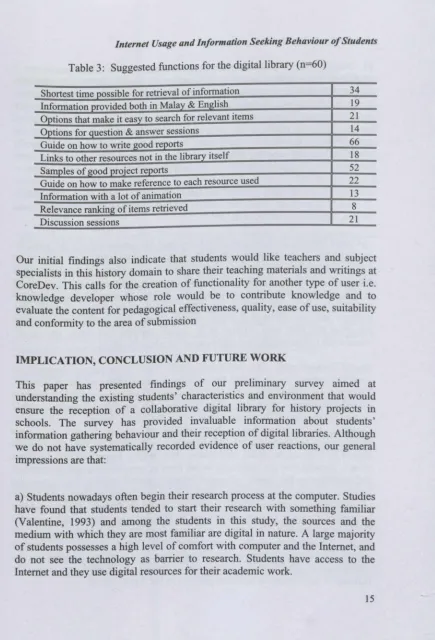
Across the board, almost everyone wanted a digital library where they could easily find samples of good project reports and guides on how to write good reports. They also wanted historical information accompanied by good quality images; current information updated continuously; accurate, precise, useful and detailed information; and information retrievable in the shortest time as well as options that could make it search for relevant items easier. Other preferred features were bilingual information; notes on history lessons taught in schools; opportunity to submit questions or inquiries; and links to other local history web resources. This feedback helped to ascertain the main features required for the historical portal. Response to the features and functions suggested is as presented in Table 2 and 3.
Table 3: Suggested functions for the digital library (n=60)
Shortest time possible for retrieval of information 34 Information provided both in Malay & English 19 Options that make it easy to search for relevant items 21 Options for Question & answer sessions 14
Guide on how to write good reports 66
Links to other resources not in the library itself 18
Samplesofgoodpr~ectreports 52
Guide on how to make reference to each resource used 22
Information with a lot of animation 13
Relevance ranking of items retrieved 8
Discussion sessions 21
Our initial findings also indicate that students would like teachers and subject specialists in this history domain to share their teaching materials and writings at CoreDev. This calls for the creation of functionality for another type of user i.e. knowledge developer whose role would be to contribute knowledge and to evaluate the content for pedagogical effectiveness, quality, ease of use, suitability and conformity to the area of submission
IMPLICATION, CONCLUSION AND FUTURE WORK
This paper has presented findings of our preliminary survey aimed at understanding the existing students' characteristics and environment that would ensure the reception of a collaborative digital library for history projects in schools. The survey has provided invaluable information about students' information gathering behaviour and their reception of digital libraries. Although we do not have systematically recorded evidence of user reactions, our general impressions are that:
a) Students nowadays often begin their research process at the computer. Studies have found that students tended to start their research with something familiar (Valentine, 1993) and among the students in this study, the sources and the medium with which they are most familiar are digital in nature. A large majority of students possesses a high level of comfort with computer and the Internet, and do not see the technology as barrier to research. Students have access to the Internet and they use digital resources for their academic work.
b) Overall, there is a strong preference for digital sources. This preference is reinforced by the ease of access to these resources, as indicated by a few students who wrote that Web resources are the best option for obtaining fast information. One student reported that the library presented more barriers to her research process than the Internet. She wrote of the difficulty in finding what she needed on the shelf, the problems to get a copy of the information needed and the arrangement of the shelves, which were not in the expected order of the Dewey classification. Her recovery strategy from navigational problem in the physical library was to utilize the Internet resources. This provides strong evidence that students choose research methods which would get them in and out of the library as quickly as possible, consistent with studies conducted by Valentine (1993) and Seiden, Szymborski and Norelli (1997).
c) Digital libraries have been accepted in a very favourable way by the students. In the survey, it was apparent that users' concerns and priorities were centered on getting the relevant information and participating in the digital library community as content providers. Primary findings of the users study revealed the need for search and publishing tools in the digital library, as well as the need for a community developed around the digital library. The survey revealed that students not only desired a digital library where they could find historical resources but also were willing to be design partners and being part of the community within which they could communicate with others.
Digital libraries need to be useful and usable. There is, as yet, no consensus on what key criteria to use to rate the usefulness and usability of digital libraries. However, we foresee that inthe implementation CoreDev, it should be exposed to students and used as an integral part of classroom activities i.e. students should engage in meaningful activities when using the digital library. In the case of CoreDev, we propose that students should be able to publish their own documents in the digital library and share them with others. In this case, students should be allowed to create and submit their project reports in the electronic format. Reports that are submitted in the form of scrapbooks could be digitized and published in the "space" allocated for participating schools. Teachers would be given the opportunity to utilize their ICT knowledge by validating the quality of submissions to maintain content quality of the digital library. They would also be needed to grade projects online and to add links to other useful resources found in the Internet. This would encourage teachers and students to be active players in building the digital library and indirectly would inculcate ICT literacy among the education community. The success of this project depends on the willingness of schools to participate and to change the mindset concerning the delivery or submission of historical projects in the digital library.
Since the number of participants in this study was small, and the study is still at a preliminary stage, the generalizability of results is uncertain. What the results do provide are promising paths for future research, and they suggest significant variables in information behaviour of students conducting their project work. Insights from this study will then be used to establish a set of framework and design principles that we could use in continuing our design work. Subsequent phases of this digital library research will further investigate the requirements of users by applying the survey instruments to wider sample groups; expanding contents to include resources on historical buildings and sites; incorporating digital library history lessons, teaching tools, and creating an examination questions bank on history for lower secondary schools.
Digital libraries offer a wealth of opportunities to improve access to information resources in support of both 'traditional' instruction and independent learning. We are still at the early stage of realizing the potential of digital libraries in educational contexts. CoreDev is building upon a rich source of historical information resources created by secondary school students in the form of project works, advanced technical infrastructure at the faculty, and the participation of students as content developers and teachers as content managers. What have been described in this paper are avenues for participation, anchored in real-life experiences. We need more forums for exploring the issues on the digital library enterprise, more demonstration projects, and more legislative efforts.
REFERENCES
Bishop A.P., N.A. Van House, and B. Buttenfield, editors .2003. Digital library
use: social practice in design and evaluation. Cambridge, MA: MIT Press.
Bishop A.P., et. al. 1999. Public libraries and networked information services in low-income communities. Libraries & Information Science Research, Vol. 21, no. 3: 361-390.
Blanford, Ann & George Buchanan 2002. Workshop report: Usability of digital libraries @JCDL 2002. SIGIR Forum, Vol. 36, no. 2: 83-89.
Bryan-Kinns, Nick & Ann Blandford. 2000. A survey of user studies for digital libraries. RIDL working paper.
Cmor, D. and Lippold, K. 2001. Surfing vs. searching: the Web as a research tool. Presented at the 21st Annual Conference of the Society for Teaching
and Learning in Higher Education. http://www.mun.ca/library/research_help /qeii/stlhe/
Covi, L &R.Kling. 1997. Organisational dimensions of effective digital library use: Closed rational and open natural systems model. In Kiesler, S (ed.)
Culture of the Internet. Lawrence Erlbaum Associates, New Jersey.
pp.343-360.
DELOS/NSF Working Group. 2003. Reference models for digital libraries:
Actors and roles.
http://delos-noe.iei. pi.cnr.it/ acti vities/internationalforumiJ oint- W Gs/ actors/ Actors-Roles.pdf
Dutta, Soumitra and Amit Jain. 2003. The Networked Readiness Index
20003-2004: Overview and analysis framework. New York: Oxford University
Press.
Fidel, Raya et.al. 1999. A visit to the information mall: Web searching behavior of high school students. Journal of American Society for Information
Science, Vol. 50, no. 1: 24-37.
Giersch, Sarah, et al. 2004. If you build it, will they come? Participant involvement in digital libraries. D-Lib Magazine, July/August. http://www.dlib.orgidlib/july04/giersch/07giersch.html
ITRiSoc
+
1M: Sustainable and generalizable technologies to support collaboration in science. 2000. http://www.crew.umich.edulresearch/ research_itr_proposal. pdfNardi B.A. and V.L. O'Day. 1999. Information ecologies: using technology with
heart. Cambridge, Mass: MIT Press.
Marchionini, G., Plaisant, C., Komlodi, A. 2002. The people in digital libraries: Multifaceted approaches to assessing needs and impact. In A. Bishop, B. Buttenfield, & N. VanHouse, eds. Digital library use: social practice in
design and evaluation. MIT Press.
Nie, N., and Ebring, L. 2000. Internet and society: A preliminary report (Stanford Institute for the Qualitative Study of Society). http://www.stanford.eduidept!news/pr/00/0002l6internet.html
Organisation for Economic Cooperation and Development. 2003. OECD
Government Studi~s. Paris, France: OECD.
Pew Research Center. 1999. The Internet news audience goes ordinary: online
newcomers more middle-brow, less work oriented.
http://www.people-press.org/reports
Seiden, Peggy, Kris Szymborski and Barbara Norelli. 1997. Undergraduate
students in the digital library: information seeking behaviour in a
heterogeneous environment.
http://www.ala.org/alalacrlbucketinashvilleI997pap/seidenszymborski.htm
Twidale M., D.M. Nichols, and C.D. Paice. 1997. Browsing is a collaborative process, Information Processing &Management, Vol. 33, no. 6: 761-783. Valentine, Barbara. 1993. Undergraduate research behavior: using focus groups
to generate theory. The Journal of Academic Librarianship, Vol. 18, no. 5: 300-304.
Waters, Donald 1. 1999. Enabling access in digital libraries: A report on a workshop on access management held in Washington, D.C. on April 6, 1998.
CLIR Issues, Vol. 7: 2.
Zainab, A.N. Abrizah Abdullah; W.K. Ng, (2002). Collaboratively building digital libraries: focus on local historical resources for educational use. Paper presented at the Conference of the International Association of School
Librarianship, Petaling Jaya, Kuala Lumpur, 4-9 August, 2002.