Citation:
Fabri, M (2015) Thinking with a New Purpose: Lessons Learned from Teaching Design Thinking
Skills to Creative Technology Students. Lecture Notes in Computer Science, 9186. 32 - 43. ISSN
1611-3349 DOI: https://doi.org/10.1007/978-3-319-20886-2_4
Link to Leeds Beckett Repository record:
http://eprints.leedsbeckett.ac.uk/1769/
Document Version:
Article
The aim of the Leeds Beckett Repository is to provide open access to our research, as required by
funder policies and permitted by publishers and copyright law.
The Leeds Beckett repository holds a wide range of publications, each of which has been
checked for copyright and the relevant embargo period has been applied by the Research Services
team.
We operate on a standard take-down policy.
If you are the author or publisher of an output
and you would like it removed from the repository, please
contact us
and we will investigate on a
case-by-case basis.
Thinking with a new purpose:
Lessons Learned from Teaching Design Thinking Skills
to Creative Technology Students
Marc Fabri
Faculty of Art, Environment and Technology Leeds Beckett University
United Kingdom
Abstract. This paper reports on the insights gained from introducing Design Thinking into the final year of a UK university course where students created positive behavior change interventions. The rationale for course design and teaching process is outlined, with a discussion of design as an engineering pro-cess versus an innovation propro-cess. The students followed Stanford University’s d.school 5-step approach of Empathize-Define-Ideate-Prototype-Test, and their journey is described in detail. We observed that initially students found the De-sign Thinking approach counter-intuitive and confusing, yet on further progress they recognized the strengths and opportunities it offers. On the whole, students reflected positively on their learning and the re-evaluation of their role as a de-signer of digital artefacts. Lessons learned from a teaching point of view are outlined, the most poignant being the realization that it was required to 'un-teach' certain design practices students had come to adopt, in particular the view of design as a self-inspired process where users are consulted for feedback but not as a source for innovation.
Keywords: Design Education, Situated Learning, Design Thinking, Service Design, Human-Centered Design, Behavior Change, Persuasive Design
1
Introduction
assumed end-user needs, predictions of usability, and within the contained environ-ment of higher education. The rationale behind introducing Design Thinking was to mature the students' abilities for conceptualizing and approaching creative challenges, and in the process engage with potential end users in order to create artefacts that closely meet those people's needs and desires – rather than those of the student. It was hoped that at the end of the course, students would have broadened their understand-ing of what design is, and their role in the design process of interactive experiences.
In this paper we evaluate the impact of the new curriculum introduction on the stu-dents' learning experience, their design practice, their achievements and reflections as well as the wider lessons that can be learned from a pedagogical perspective.
2
Design Thinking
Design Thinking is a human-centered methodology that uses co-design and intui-tive problem-solving techniques to match people's needs with what is technologically feasible and organizationally viable [1]. It is typically applied to deal with difficult, multi-dimensional problems that lack recognizable requirements and solutions – tradi-tionally referred to as "wicked problems" [19]. Based on the premise that by combin-ing empathy, creativity and analytical processes, true innovation can emerge in the process of solving such problems. This process utilizes our ability to be intuitive, to discover patterns, and to construct ideas that are both meaningful and functional [2]. Unlike scientific thinking where the focus is on analyzing patterns and facts to identi-fy solutions, Design Thinking promotes the invention of new patterns to realize new possibilities – aptly coined as "the reverse of scientific thinking" [5].
There has been an increased uptake of Design Thinking in design, business and more recently sustainability, health and social innovation [24]. Much of the rise can be attributed to a few key organizations such as design consultancy IDEO, Stanford’s d.school group, Toronto's Rotman School of Management, and the UK Design Coun-cil. A number of frameworks are available that help with the execution of a Design Thinking approach, the most popular ones being IDEO's educator's toolkit [9] with 5-steps Discovery-Interpretation-Ideation-Experimentation-Evolution; IDEO's HCD toolkit [10] with the 3-phase process of Hear-Create-Deliver; UK Design Council's double-diamond [4] stages Discover-Define-Develop-Deliver; Stanford University's d.school [3] 5-step approach of Empathize-Define-Ideate-Prototype-Test which is closely aligned with IDEO's educator's toolkit. It should be noted that the terminology used to describe the concepts and steps in Design Thinking is not universal, e.g. in Northern Europe the term "Service Design" is preferred – which to some encompasses more than Design Thinking [18]. However, the underlying ethos and many of the methods are markedly similar.
3
Behavior Change Context
be-havior change intervention, whether facilitated face-to-face or through digital tech-nology, is a service rather than a delivered good. The Design Thinking approach works particularly well with the design of service experiences where the outcome is not particularly tangible, e.g. "This app helped me adopt a healthier lifestyle", rather than the tangible benefit of "owning" a product or of having "completed a task". The success of such a service may instead derive from lived experiences, habits adopted, views changed, or encounters with digital interfaces and with humans.
Outcomes like these can be difficult to design for, particularly for students who lack the professional experience as well as the insight and knowledge about end users' circumstances. A Design Thinking approach can help here as design-thinkers are "encouraged to think broadly about problems, develop a deep understanding of users and recognize the value in the contributions of others" [5, p512]. Another strong cor-relator between the challenge of creating a behavior change intervention and the ethos of the design thinking approach is the inherently personal nature of human behavior. We are all individuals, and any attempt at influencing or helping with maintaining a newly adopted behavior is likely to work better if the intervention is based on a good understanding of people's mindset and the different facets of self [23].
Creating the course around a behavior change service challenge was therefore con-sidered appropriate, offering sufficient practical and intellectual complexity whilst at the same time providing students with a set of tools to tackle an unfamiliar challenge. We worked closely with the Behaviour Change Research group at Leeds Beckett University (www.leedsbehaviourlab.org), which is primarily concerned with the role of digital technology in behavior change interventions. The research group provided the theoretical background as well as the design challenges for students to work on.
[image:4.595.171.428.497.586.2]After careful consideration of the available Design Thinking frameworks, we chose Stanford's d.school 5-step model [3] as it contains and further granulizes other frame-works well. This is in line with Lugmayr et al's approach to teaching media students at a Finnish university [14]. Figure 1 illustrates the 5 key steps:
Fig. 1. The 5-step Design Thinking Process (adapted from [3])
4
Pedagogical Context
There are several learning and teaching theories underpinning the approach chosen for the Design Thinking course, outlined in [20][24] and briefly below. Firstly, Con-structivism emphasizes student-centered learning where students construct their own understanding through experiencing things and then reflecting on their experience in a ‘learning by doing’ approach [17]. Experiential Learning - building on constructivism - values learning through ‘reflection on doing’. Students learn through their own re-flection and that of their peers, which is important for students’ metacognitive devel-opment. The approach considers a cyclic model with four stages of learning: concrete experience, reflection, abstract conceptualization and active experimentation [12].
These experiences and reflections are closely correlated to the principles of Design Thinking with its focus on empathy, making sense of observed phenomena through reflection and conceptualization, collaboration between learners as well as with users, creativity and imagination, and solution refinement through iterative prototyping.
Situated Learning [13] is learning that takes place in the same context in which it is applied, typically in a community of practice where a group of people work towards a common goal. In this way, learning is seen as the process of becoming a member of this community through collaborating with individuals with greater experience [21]. Hung [8] argues that this provides authentic social experiences and when students are in these real-life situations, they are more compelled to take part and to learn.
The introduction of Design Thinking into the curriculum, both as a process and a philosophy, clearly offers an opportunity for situated learning to take place: students collaborate in order to find creative solutions to a given problem, under the guidance of an experienced tutor, through engagement with potential end-users and in an au-thentic environment outside of the classroom.
5
Course Structure
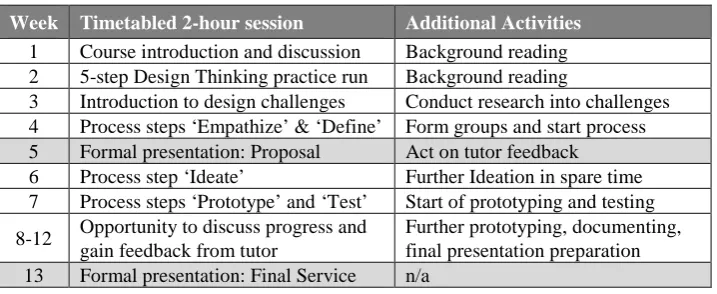
The 13-week ‘Design Thinking’ course was offered to final year Creative Media students during the 2013/14 academic year. This was the first time it ran. Students could choose from a number of different courses, of which Design Thinking was one. The high level learning outcomes for this course were: 1) Investigate and think crea-tively about design problems and opportunities; 2) Demonstrate a critical awareness of how design thinking can be applied in a variety of contexts; and finally 3) Work effectively in a creative team. Students had 2 hours of scheduled contact time per week with their tutor and were expected to spend another 6 hours per week on course related activities, as independent learners. Timetabled sessions took place in a com-puter lab with projector, two large white-boards, break out space for group work and ample wall space for post-it notes and posters.
Week Timetabled 2-hour session Additional Activities
1 Course introduction and discussion Background reading 2 5-step Design Thinking practice run Background reading
3 Introduction to design challenges Conduct research into challenges 4 Process steps ‘Empathize’ & ‘Define’ Form groups and start process 5 Formal presentation: Proposal Act on tutor feedback
6 Process step ‘Ideate’ Further Ideation in spare time 7 Process steps ‘Prototype’ and ‘Test’ Start of prototyping and testing 8-12 Opportunity to discuss progress and
gain feedback from tutor
[image:6.595.120.479.145.292.2]Further prototyping, documenting, final presentation preparation 13 Formal presentation: Final Service n/a
Table 1. Course Lesson Plan
The assignment was a design challenge that drew from real-life problems, provided by organizations with an actual need for a behavior change intervention. Representa-tives of these organizations presented their challenge to the students during a tutorial in week 3. There were two challenges to choose from:
1.Create a virtual writing coach that helps aspiring and active writers develop their practice and keep their projects on track.
2.Create a mobile companion app to a weight management program that is currently based on facilitator-run face-to-face group meetings.
Students worked in groups of 3-5 and were assessed twice: in week 5 when results from preliminary user research were presented (20% of grade), and in week 13 when the full service proposal was delivered (80%). It should be pointed out that students were not expected to create working versions of these products. Instead, the course required the design of a concept and test of a prototype. The final deliverable was a written proposal accompanied by a promotional video that illustrated both the ra-tionale for the design choices and the key features of the product. All students already had advanced skills in graphic design, video production and motion graphics.
15 students out of 45 in that year group, students chose the Design Thinking course. Students formed four groups, three of which chose the weight management challenge whilst one group chose the writing coach challenge. Attendance throughout the course duration was high (75% on average), which is significantly higher than on other courses that ran simultaneously (ranging between 48% and 57%).
5.1 Practice run
talk to strangers. However, all returned with some useful information on library user behavior, likes and dislikes. These were collated and potential design problems were articulated as ‘How Might We…?’ statements (the Define stage, cf. [3]).
During the Ideate stage, some surprising and innovative proposals emerged, e.g. having books with wings that fly to the waiting customer, or the idea that students who have been fined for not returning books in time could work off these fines by delivering books to other students’ houses. The ‘book with wings’ idea in particular sparked lively discussions, stemming from students’ unwillingness to walk along long book shelves to locate individual items. The idea eventually led to the design concept of an interactive order system that allows students to request books, which are then delivered automatically to their study desk by a flying drone, with attached camera that documents the delivery via live feed to the student’s mobile device. During the Prototype stage students developed concepts of the accompanying app, seeking feed-back on their prototypes from their peers.
What started out as an ‘absurd’ idea (book with wings) was rapidly transformed in-to an innovative, disruptive and arguably feasible solution in-to a problem – somewhat supporting the claim that Design Thinking can lead to dramatic new solutions [1].
6
Observations on the 5-step Process
A key purpose of this paper was to examine how students responded to using a hitherto unfamiliar design approach – Design Thinking – when creating a Behavior Change intervention app, and how their perception of the role of a designer may be affected. Since there was no control group, the prime instruments to assess this were tutor observations of the students, material produced by the students, and a short re-flective report each student wrote at the end of the course.
In the following sections we will look at the student journey in detail by consider-ing one of the student groups that consisted of 4 members and selected the first chal-lenge: Create a virtual writing coach that helps aspiring and active writers develop their practice and keep their projects on track. The group was chosen as a case study because it took particular care in documenting the design activities and learning pro-gress throughout the weeks. Outcomes by other groups were comparable. The Design Thinking process is illustrated alongside examples of work from this particular group. Student quotes were drawn from the written reflections of all course attendants.
Empathize.
users so that they had something to show them. Method cards for interviewing were highly valued by the students as they provided a framework for approaching, learning from and empathizing with the writers. Students also created 'A day in the life of…' maps which track daily activities and habits, in order to identify existing habits, tech-nology touchpoints and ultimately to spot opportunities for new coaching support. Gradually students understood the purpose of this step. In the words of one of the students: “I began to see how engaging with people can open your eyes to the way they think about the subject, rather than one’s own preconceptions”
Define.
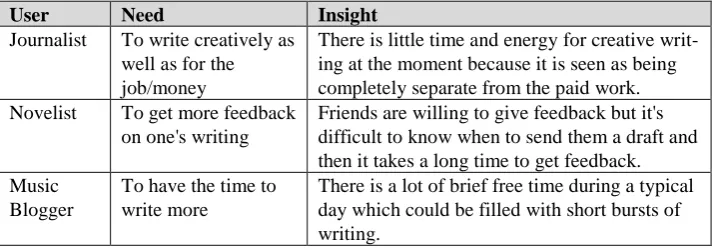
The Define phase prompted students to consider users and their needs, and then develop insights based on these needs. Some examples:
User Need Insight
Journalist To write creatively as well as for the job/money
There is little time and energy for creative writ-ing at the moment because it is seen as bewrit-ing completely separate from the paid work. Novelist To get more feedback
on one's writing
Friends are willing to give feedback but it's difficult to know when to send them a draft and then it takes a long time to get feedback. Music
Blogger
To have the time to write more
[image:8.595.120.478.309.434.2]There is a lot of brief free time during a typical day which could be filled with short bursts of writing.
Table 2. Users, needs and insights
These insights eventually led to the articulation of several 'How Might We...' top-ics, designed to focus on different aspects of an overall challenge. These topics pro-vide the seeds for the Ideate step when the group can churn out a large quantity of compelling ideas [3]. Examples of the many topics students covered are:
• How might we... make him/her feel good about writing? • How might we... give rewards for small progress?
• How might we... nurture creativity?
• How might we... make writing playful?
• How might we... encourage constructive feedback?
• How might we... allow the user to quickly dip in and out? • How might we... encourage regular breaks?
Ideate.
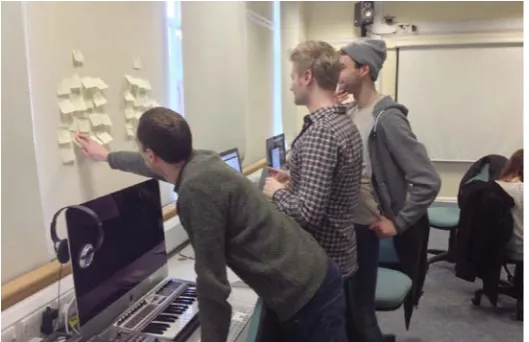
The Ideate step is characterized by 'going wide' with ideas, concepts and possible outcomes. During a timetabled tutorial session and starting with the "How Might We…" topics, students enjoyed generating plenty of ideas on post-it notes whilst deferring judgment on their suitability or feasibility until later (see Fig. 2). Students were then encouraged to continue with generating ideas in their spare time during the week, before the next timetabled session.
In that session, a structured idea filtering process was introduced where each stu-dent had three votes, selecting the ideas that were a) most likely to delight end users; b) the most rational and feasible given today's technology; and c) the most unex-pected. Ideas that received the most votes were carried forward into prototyping. Some examples:
1.Set challenges for the user to complete
2.Make it easy to share writing with trusted friends, and receive feedback quickly 3.Keep a timeline of writing activity
4.Remind the user when they have free time
5.Give personalized inspirations at opportune moments 6.Provide opportunities for discussion and mutual support 7.Remind the user to take breaks
[image:9.595.166.431.431.602.2]8.Introduce brain activities during rest periods 9.Disable other apps during work hours 10.Help organize work into manageable chunks
Fig. 2. Ideation: Sorting and selecting ideas written on Post-it notes
6.1 Prototype and Test
product design and software development [15]. Pedagogically, iterative design relates well to the cyclic concept of experiential learning [12]. Often, quite some effort goes into a first prototype before it is tested. Following the Design Thinking philosophy, however, students were encouraged to take a different approach (based on [3]): • Start building quickly and early, even if it is not quite clear yet what the
proto-type may end up as. This promotes experimentation.
• Keep fidelity low and do not spend too much time on any one prototype. This avoids emotional attachment to concepts that turn out to be unpromising.
• Identify what is being tested with each prototype – ideally it answers just one particular question. This avoids getting lost in complexity.
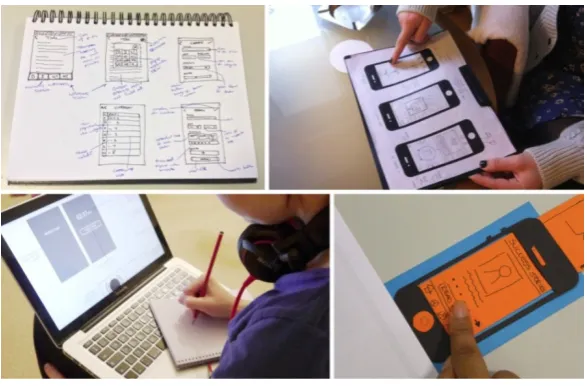
[image:10.595.151.445.310.503.2]• Build with the user in mind and be clear about which user behavior is expected and being tested. This helps focusing on receiving meaningful feedback.
Fig. 3. Examples of prototypes and user testing
Deciding when a prototype was ready for testing and when to stop adding details was not always easy, as this student reflection confirms:
“I found the ‘Prototype’ stage quite difficult initially because I imagined that they needed to be functioning things to be able to test them properly. When I tested them on X she was surprisingly open to the concept of what I was testing and her feedback was useful because it contradicted some of the ideas I had had to solve the problem."
Most Students, however, were already familiar with the general concept of proto-typing and keen to try out their ideas. Working together towards a common goal ap-peared to further motivate them, each having developed their own ideas to start with and then collaboratively improving these ideas:
6.2 Final product
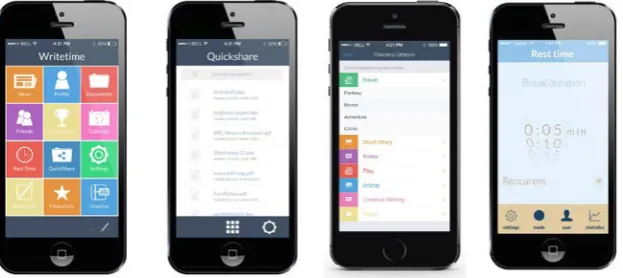
Many of the initial ideas did not make it into and through prototyping. This is a normal aspect of Design Thinking and students accepted that. For the design of the final product, students focused on six key features of the virtual writing coach app, which they named 'WriteTime'. Students also produced a promotional video (availa-ble at http://leedsbehaviourlab.org/news/teaching-design-thinking/):
1.Challenges – get daily challenges that provide a sense of continuous improvement; 2.Quickshare – share writing effortlessly and receive feedback quickly;
3.Calendar – identify free time that can be used for writing to keep the momentum; 4.Timeline – set goals, see progress and get reminders for milestones along the way; 5.Writing Tool – simple editor to write often and in quick bursts;
6.Rest Time – get regular breaks from writing and fill them with nurturing activities.
[image:11.595.147.459.322.461.2]
Fig. 4. Selection of app interface designs – see video for full UX
We would like to reiterate that the app was not actually developed. Testing was based on designs and user experience only, therefore no data about the efficacy of the behavior change intervention is available. This is not considered a weakness of the research, as the focus was on students’ engagement with the Design Thinking process.
7
Discussion
A key purpose of this paper was to examine how students responded to using the Design Thinking approach when creating a Behavior Change intervention app, and how perception of the role of a creative technology designer may be affected. Observ-ing the students throughout the 13 weeks revealed a number of thObserv-ings:
problem [20][7]. Through this lens, design seeks to find specific solutions rather than develop ideas further or empathize with end users, and students were indeed well trained to follow this ‘introvert’ approach. The same became evident during the Idea-tion phase when many students had to be repeatedly reminded that it is not about find-ing solutions just yet – a problem also observed by Lugmayr et al [14]. At the end of the course, the view of the role of designer appeared to have shifted however, as evi-denced by several self-reflection reports and the quote already shown above.
Attendance was consistently high throughout the course duration when compared to other courses. This may have been due to the intense group-work nature of the course which may motivate students and may also provide some degree of peer pres-sure to attend. None of the students reported negative impacts of group work, howev-er, and we would tentatively argue that the course program did indeed foster Situated Learning which according to Hung [8] can compel students to take part and ultimately learn more. Some lessons can be learnt regarding curriculum development for creative technology design courses:
Firstly, we believe that Design Thinking – or human-centered design in general – should be an integral part of the higher education curriculum for any design-oriented degree right from the start. Our perception was that by introducing this in the final year of study, we had to 'un-teach' some of the practices that students had come to take for granted, in particular the view of design as a linear process driven by the desire to manage it carefully, or what Howard et al [7] call 'engineering design'. As soon as end users join the design process as co-creators, more uncertainty is intro-duced and a robust process such as the d.school 5-step approach used here is required to maintain manageability, for novices and experienced designers alike.
Secondly, students need to feel empowered and supported to go outside of the higher education environment to talk to potential end users. Providing a good set of method cards helps, as does a practice-run in order to refine interview skills and raise awareness of why observing and talking to end users is critical to the design process.
Thirdly, it is important to create a relaxed, non-judgmental atmosphere for all idea generating activities so that new and unusual ideas can emerge. This is not a new insight [16] but it is worth reminding of in an education system that is more often than not focused on analytical thinking, solution finding and rigid processes and schedules. We conclude with the final reflections of a student on the Design Thinking course which encapsulates many of the aspects discussed above:
References
1. Brown, T.: Design Thinking, in Harvard Business Review, June edition, pp84-95 (2008) 2. Brown, T, Wyatt, J.: Design Thinking for Social Innovation, in Stanford Social Innovation
Review, 8(1), pp29-35 (2010)
3. d.school: Design Thinking Bootcamp Bootleg, Available from http://dschool.stanford.edu/wp-content/uploads/2013/10/METHODCARDS-v3-slim.pdf (2013)
4. Design Council UK: Design Methods for developing services. Available from https://connect.innovateuk.org/web/3338201/service-design-methods (2014)
5. Dunne, D., Martin, R.: Design thinking and how it will change management education: An interview and discussion. Academy of Management Learning and Education, 5(4), 512-523 (2006)
6. Fogg, B.J.: A behavior model for persuasive design. Proceedings of the 4th International Conference on Persuasive Technology. Claremont, California, ACM (2009)
7. Howard, T., Culley, S. Dekoninck, E.: Describing the creative design process by the inte-gration of engineering design and cognitive psychology literature, Design Studies 29 (2008) pp160-180
8. Hung, D.: Situated cognition and problem-based learning: implications for learning and in-struction with technology. J. of Interactive Learning Research, 13(4), 393-415 (2002)
9. IDEO: Design Thinking for Educators, v2. Available from http://www.designthinkingforeducators.com/toolkit/ (2013)
10. IDEO: Human-Centered Design Toolkit, 2nd Ed. Available from http://www.designkit.org/resources/1 (2014)
11. Jean, J., Marcus, A.: The Green Machine. in User Experience 8(4), 20-29 (2009)
12. Kolb, D.A.: Experiential Learning: experience as the source of learning and development, Prentice Hall, Englewood Cliffs, NJ (1984)
13. Lave, J., Wenger, E.: Situated Learning. Cambridge University Press (1990)
14. Lugmayr, A., Jalonen, M., Zou, Y., Libin, L., Anzenhofer, S.: Design Thinking in media management education - a practical hands-on approach. In Proceedings of 4th Semantic Ambient Media Experience (SAME) Workshop in Conjunction with the 5th International Convergence on Communities and Technologies, Brisbane, Australia (2011)
15. Nielsen, J.: Iterative User Interface Design. IEEE Computer 26(11), 32-41 (1993) 16. Osborn, A.F.:Applied Imagination: Principles and Procedures of Creative Thinking.
Scrib-ner, New York (1953)
17. Piaget, J.: The Origins of Intelligence in Children. Int. Univ. Press, New York (1952) 18. Polaine, A., Løvlie, L., Reason, B.: Service Design – From Insight to Implementation,
Rosenfeld Media, Brooklyn New York (2013)
19. Rittel, H., Webber, M.: Dilemmas in a General Theory of Planning, in Policy Sciences, 4 (1973) 155-179
20. Sas, C.: Learning approaches for teaching interaction design, in Inventivity: Teaching the-ory, design and innovation in HCI, Proc. of HCIEd2006, Limerick, Ireland, E.T. Hvann-berg, et al., Editors, pp. 53-59 (2006)
21. Stickdorn, M., Schneider, J.: This is Service Design Thinking, BIS, Amsterdam (2014) 22. Vargo, S.L., Lusch, R.F.: From goods to service(s): Divergences and convergences of
logics, Industrial Marketing Management, 37(3), 254–259 (2008)
23. Wendel, S.: Designing for Behavior Change. O’Reilly, Sebastopol, CA, USA (2013) 24. Withell, A., Heigh, N.: Developing Design Thinking Expertise in Higher Education, 2nd
![Fig. 1. The 5-step Design Thinking Process (adapted from [3])](https://thumb-us.123doks.com/thumbv2/123dok_us/28775.1004117/4.595.171.428.497.586/fig-step-design-thinking-process-adapted.webp)