A STUDY ON BRAND LOYALTY WITH SPECIAL REFERENCE TO
REFRIGERATORS
Dr. M. Rajesh
Asst. Professor, Dept. of Commerce, K.C.S. Kasi Nadar College of Arts and Science, Chennai, Tamilnadu, India – 600021.
ABSTRACT
Brand loyalty is positive feelings towards a brand and dedication to purchase the same
product or service repeatedly now and in the future from the same brand, regardless of a
competitor’s actions or changes in the environment. It can also be demonstrated with other
behaviors such as positive word of mouth advocacy. Brand loyalty is where an
individual buys products from the same manufacturer repeatedly rather than from other
suppliers. Businesses whose value rests in a large part on their brand loyalty are said to use
the loyalty business model. Loyal customers consistently purchase products from their preferred
brands, regardless of convenience or price. Companies often use different marketing strategies
to cultivate loyal customer, including loyalty programs (i.e. rewards programs) or trials and
incentives (such as samples and free gifts). This paper study about choose the reasons of the
product and also suggest improve the brand of the product.
Keywords: brand personality, devotion, customer relationship management.
I.INTDOUCTION
Brand loyalty in marketing, consists of a consumer’s devotion, bond, and commitment to
repurchase and continue to use a brands product or service over time, regardless of changes with
International Research Journal of Human Resources and Social Sciences Vol. 4, Issue 6, June 2017 Impact Factor- 5.414
ISSN(O): (2349-4085) ISSN(P): (2394-4218)
© Associated Asia Research Foundation (AARF)
commitment to remain in a relationship for a long period of time with a brand (So, Andrew &
Yap, 2013).
A critical factor of building brand loyalty is developing a connection or relationship
between the consumer and the brand. When an emotional relationship is created between the
consumer and the brand this leads to a strong bond and a competitive advantage for that
particular brand. Loyalty consists of both attitudinal and behavioral components. Attitudinal
loyalty relates to the customers willingness to purchase product or service from the brand at any
reasonable cost. Behavioral loyalty is the re-purchasing. Both behavioral and attitudinal
components are important. One example is that a consumer displays behavioral loyalty by
buying Coke when there is few alternatives available and attitudinal loyalty when they will not
buy an alternative brand when Coke is not available. The attitudinal component is psychological;
this leads to the behavioral action of repeat purchase. It is the attitudinal loyalty that drives most
loyalty behavior and ensures loyalty over time not just with one purchase. “Brand loyalty is
desired by firms because retention of existing customers is less costly than obtaining new ones.
Firms profit from having loyal customers” (Melnyk & Bijmolt, 2015).
II. REVIEW OF LITERATURE
There are many studies delving into brand loyalty or customer loyalty measured using the behavioral approach which attaches loyalty to repeat purchase. Bayus (1992) in a study of brand switching of home appliances and Fader and Schmittlein (1993) in his investigation into the advantage of high share brands in brand loyalty measured brand loyalty only by the behavioural aspect of brand loyalty (Choong 2010).
III. BACKGROUND OF THE STUDY
Brand Loyalty Factors
Quality Price
Great customer service Past interactions
Loyalty program or rewards Strong ethics
Creative marketing
Company culture; tied with,
Responding to customers on social networks Celebrity affiliation
IV.OBJECTIVES OF THE STUDY
To Study about brand loyalty of refrigerators in Chennai.
To find out brand preference and reasons for selecting the brand.
To suggest to improve the brand image particularly in refrigerators.
V.RESEARCH METHODOLOGY
SOURCES OF DATA COLLECTION
The primary data was collected through Questionnaire. The questions were in the form of multiple choices. The survey was conducted and the information was collected from 100 respondents.
AREA OF STUDY
VII.DATA ANALAYSIS AND INTERPREATION
Table no. 1. - Table showing gender classification of respondents
Gender No. of respondents Percentage
Male 31 31
Female 69 69
Total 100 100
Source: primary data
[image:4.612.157.454.306.426.2]The sample taken for study consists of both male and female customers, of which 31% were male and 69% were female. Therefore it can be concluded that most of the respondents are female.
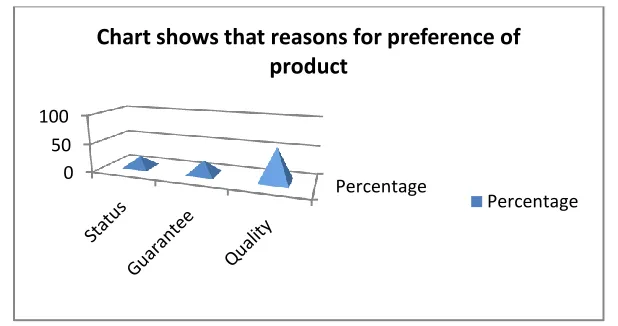
Table no. 2. - Table showing respondents reasons for preference of branded products.
Qualities No. of respondents Percentage
Status 19 19
Guarantee 23 23
Quality 58 58
Total 100 100
Source: primary data
Chart shows that Gender
Male
From the above tables shows that 19% of respondent preferred product status of the market, 23 % of respondent choose guarantee of the product and 58% of respondents preferred quality of the product.
[image:5.612.152.461.157.320.2]Source: primary data
Table no. 3. - Table showing brand preferred by respondents
Source: primary data
From the aforesaid table exhibits 52% of customers prefer LG, 21% prefer Panasonic, while 19% prefer Samsung and only 8% prefer Godrej. Most of the respondent preferred LG brand product.
Percentage 0
50 100
Chart shows that reasons for preference of product
Percentage
Brands No. of respondents Percentage
Godrej 8 8
LG 52 52
Panasonic 21 21
Samsung 19 19
VIII. FINDINGS
It is found that majority of respondents were female and also found Majority of the respondents are Homemaker.
Most of the respondents prefer only branded products in refrigerators. It is observed that most popular brand in refrigerators is LG.
It is observed that size, model, cooling capacity are mainly looked upon before a particular brand is selected in refrigerators.
IX. SUGGESTIONS
The companies should concentrate more on advertisements for promotion of sales and also concentrate promotional activities to attract new customers and also retain existing customers.
A company should have also concentrate on online sale. It helps to improve profitability of the organization.
A very good Customer Relation Management (CRM) to satisfy its customers and clients. It improves and maintaining quality of services.
X. CONCLUSION
Nowadays customer chooses their product quality, quantity, reasonable price, after sale service. Every company should maintain the brand image of the product and also create brand
0 10 20 30 40 50 60
Chart shows that brand preference
attributes like size and model are firstly looked upon before choosing any brand. It helps to customer purchases the same brands continuously purchase the product without any diversion.
REFERENCE
De Pelsmacker, P., Geuens, M., and Van den Bergh J. (2001), Marketing Communications, Pearson Education Limited, Essex, England.
Dick A. S., and Basu K., (1994), Journal of The Academu of Marketing Science, Vol; 22, pg 99 – 113.
Kuusik, Andres (2007). “Affecting customer loyalty: do different factors have various influences in different loyalty levels?”, The University of Tartu Faculty of Economics and Business Administration Working Paper, Iss. 58-2007, pp. 3-29.
WHEELER, Alina. Desing Brand Identity: an essential guide for the whole branding team. 3rd ed - Electronic Data - New York: Bookman, 2012.
Melnyk, V.; Bijmolt, T. (2015). "The effects of introducing and terminating loyalty programs". European Journal of Marketing. 49 (3): 398–419.
Pauwels-delassus, V.; Mogos Descotes, R. (2013). "Brand name change: Can trust and loyalty be transferred". Journal of Brand Management. 20 (8)
www.google.com
www.wikipedia.com
www.amazon.com
www.citehr.com