PII. S0161171204206287 http://ijmms.hindawi.com © Hindawi Publishing Corp.
BEHAVIOUR OF PASSAGE TIME FOR A QUEUEING
NETWORK MODEL WITH FEEDBACK:
A SIMULATION STUDY
BIDYUT K. MEDYA
Received 21 June 2002
The study of the queueing system presented in this note was motivated by its possible application to a multiprogramming computer system. The paper considers a closed network with two service centres with feedback. The steady-state behaviour of the passage time, the random times for a job to traverse a portion of the network, is examined through simulation. The model can be applied to a twin-processor multiprogramming computer system.
2000 Mathematics Subject Classification: 60K25.
1. Introduction. In this work, we deal with a two-station closed network where, after service completion at one centre, a customer may move either to the other centre or to the tail of the queue at the same centre. Feedback probabilities are specified for each centre. Also for each centre, we assume service times to be independent and exponen-tially distributed to ensure Markovian character.
This type of models arises in theoretical computer science, more specifically regard-ing multiprocessor multiprogrammregard-ing environments.
We can think of a computer system based onMparallel processors which can handle
Nstatistically identical jobs simultaneously. The jobs circulate among the processors completing identical partial processing. Such a system can be called anM-processor system withNdegree of multiprogramming. The processors are the service nodes and the programs are identified with the jobs. Thus we have a typical situation of closed network with feedback.
The augmented job stack process helps to identify the position of the process at any instant.
We study the behaviour of passage times which are the random times for a job to traverse a portion of the network.
We use the method of regenerative simulation to find the steady-state distribution of passage time and the distribution of the number of transitions constituting a passage time.
Steady-state distribution has been considered in Medya [2] along with supporting simulation studies.
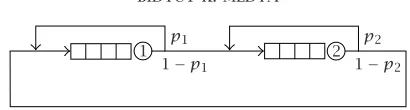
1 p1 1−p1
2 p2 1−p2
Figure2.1.Two-node closed network model.
closed network with feedback. A model with feedback at one node only [5] can be used for a multiprogramming system with single processor and single I/O channel. This model has been discussed in [4], so this model is a special case of the model which we have considered with the second feedback probability taken as zero.
2. The model. The type of model considered in this work is a queueing system con-sisting of two single-server service centres and a fixed number,N, of jobs (Figure 2.1). After service completion at centrei,i∈ {1,2}, a job moves instantaneously to the tail of the queue at centreiwith fixed probabilitypi(0≤pi<1)and with probability(1−pi), moves to the tail of the queue at centrei, wherei=2,1, fori=1,2, respectively. We assume that both queues are served according to a first-come first-served (FCFS) dis-cipline. We also suppose that all service times are mutually independent and that the service times at centreiare identically distributed as a positive random variable,Li,
i=1,2. In this work we assumeLito have exponential distribution with parameterλi. LetX(t)be the number of jobs waiting or in service at centre 1 at timet. The process {X(t):t≥0}is a generalised semi-Markov process (GSMP) with finite state space,S= {0,1,2,...,N}, and event set, E= {e1,e2}, where eventei can be defined as “service completion at centrei.” Fors∈S, the setsE(s)of events that can occur in statesare as follows. The evente1∈E(s)if and only if 0< s≤N, and the evente2∈E(s)if and only if 0≤s < N. Ife=e2, then the state transition probabilityp(s−1;s,e)=1−p1and
p(s;s,e)=p1when 0< s≤N; ife=e2, then p(s+1;s,e)=1−p2andp(s;s,e)=p2
when 0≤s < N. All other state transition probabilitiesp(s;s,e)are equal to zero. The model is appropriate for a twin-processor multiprogramming computer system whereNdenotes the degree of multiprogramming and programs can be either trans-ferred from one processor to the other or fed back to the same processor.
3. Augmented job stack process
Job stack. It is an enumeration by service centre of all the jobs of the network.
In our model the job stack process is calledZ(t), whereZ(t)is the number of jobs waiting or in service at centre 1 at timet. It is an irreducible continuous time Markov chain (CTMC) with finite state space [5, page 67].
The augmented job stack process for this model is
X(t)=Z(t),N(t):t≥0, (3.1)
whereZ(t)denotes the number of jobs waiting or in service at centre 1 at timetand
[image:2.468.130.335.51.106.2]BEHAVIOUR OF PASSAGE TIME 1269
The state space,G∗, is
G∗=(i,j):i∈ {0,1,...,N}, j∈ {1,2,...,N}. (3.2)
Passage time. Informally, passage times in a network of queues are the random
times for a job to traverse a portion of the network.
Passage times for the marked job are specified by means of four nonempty subsets (A1,A2,B1, andB2) of the state spaceG∗, of the augmented job stack processX. The setsA1,A2(resp.,B1,B2) jointly define the random times at which passage times for the marked job start (resp., terminate). The setsA1,A2,B1, andB2in effect determine when to start and stop the clock measuring a particular passage time of the marked job.
Here we consider the passage time,P, that starts when a job completes service at centre 2 (and joins the tail of the queue at centre 1) and terminates at the next such time the job completes service at centre 2 (and joins the tail of the queue at centre 1).
The passage time is specified by the sets
A1=B1=(i,N): 0≤i < N,
A2=B2=(i+1,1): 0< i≤N. (3.3)
Steady-state behaviour. Under fairly general conditions, which are satisfied
here, the passage times have a steady-state distribution, that is, ifTndenotes thenth passage time, thenTn⇒T for some random variableT. The distribution ofT will be referred to as the steady-state distribution of passage time.
4. Simulation. To simulate the process, the method of regenerative simulation (Shedler [5]) has been employed here.
Regenerative method for simulation analysis. We have seen that in the
presence of certain regularity conditions, a regenerative stochastic process{X(t):t≥ 0}has a limiting distribution provided that the expected time between regeneration points is finite. Furthermore, the regenerative structure ensures that the behaviour of the regenerative process in a cycle determines the limiting distribution of the process as a ratio of expected values. A consequence of these results is that a strongly consistent point estimate and asymptotic confidence interval for the expected value of the general (measurable) function of the limiting random variable can be obtained by observing a finite portion of a single sample path of the process. This comprises the regenerative method and is accomplished by simulating the process in cycles and measuring quan-tities determined by the individual cycles.
4.1. Simulation for the distribution of passage time. Here a sample path for the process is generated through simulation through a large number of cycles, where a cycle starts and ends with the state(1,1). Passage times are marked on the sample path. The parameters to be estimated,
Pn=P(n≤T < n+1)=EIAn
, (4.1)
where n=0,1,2,... and An = {n≤T < n+1}, together determine the probability distribution ofT. By the basic result of regenerative simulation (Shedler [5]), which is similar to the result in Medya [2], the strongly consistent estimator ofpnis
gAn
n∗
n=0g
An
, (4.2)
whereg(An)is the number of simulated passage timesTwithT∈[n,n+1)andn∗is a suitably chosen upper limit.
We have considered various cases, namely, number of jobs=2,5,10 and the combi-nation of(p1,p2)values:p1=p2=0.1;p1=p2=0.25;p1=p2=0.5;p1=p2=0.75;
p1=p2=0.9;p1=0.25,p2=0.75; andp1=0.1,p2=0.9.
Because of the symmetry, the last two cases are, respectively, equivalent top1=0.75,
p2=0.25 andp1=0.9,p2=0.1.
Results for passage time distribution. Figures4.1,4.2,4.3,4.4,4.5,4.6, and
4.7 represent the simulated steady-state distribution of the passage time in various cases. The summary statistics, namely, means, s.d.’s, logarithmic means[E(lnT )], and skewness and kurtosis coefficients are presented inTable 4.1. The result shows that for a fixed number of jobs andp1=p2, the mean and s.d. of the passage time increase
with the common value ofp1andp2. And for unequal values ofp1andp2, the greater one dominates.
For fixed values of p1 and p2, the mean and s.d. of the passage time are nearly proportional to the number of jobs. The same is true for the antilog of the logarithmic mean (i.e., geometric mean). Whenp1=p2, both skewness and kurtosis show very little variation, irrespective of the common value and the number of jobs.
When one ofp1 or p2 is large, skewness and kurtosis decrease as the number of jobs increases. In other cases, skewness and kurtosis increase with the number of jobs except forp1=p2=0.9,N=10.
For a fixed number of jobs, whenp1=p2, skewness and kurtosis increase with the common value ofp1andp2. Whenp1≠p2, we generally get larger skewness and kur-tosis.
BEHAVIOUR OF PASSAGE TIME 1271
N=2
N=5
N=10
Passage time
0 5 10 15 20 25 30 35 40 0
0.05 0.10 0.15 0.20 0.25
Probability
Figure4.1
N=2
N=5
N=10
Passage time
0 5 10 15 20 25 30 35 40 0
0.05 0.10 0.15 0.20 0.25
Probability
Figure4.2
N=2
N=5
N=10
Passage time
0 10 20 30 40 50 60 70
0 0.04 0.08 0.12 0.16
Probability
N=2
N=5
N=10
Passage time
0 20 40 60 80 100
0 0.02 0.04 0.06 0.08
Probability
Figure4.4
N=2
N=5
N=10
Passage time
0 50 100 150 200 250
0 0.02 0.04 0.06 0.08 0.10 0.12
Probability
Figure4.5
N=2
N=5
N=10
Passage time
0 20 40 60 80 100
0 0.02 0.04 0.06 0.08 0.10
Probability
BEHAVIOUR OF PASSAGE TIME 1273
N=2
N=5
N=10
Passage time
0 50 100 150 200 250
0 0.01 0.02 0.03 0.04 0.05
Probability
Figure4.7
Table4.1 Summary statistics for distribution ofT.
(p1,p2) Mean of
T s.d. ofT
N=2 N=5 N=10 N=2 N=5 N=10
(0.1,0.1) 3.33826 6.67818 12.24155 2.02782 3.15246 4.78688 (0.25,0.25) 4.02476 7.98108 14.68056 2.57387 4.38026 7.25242 (0.5,0.5) 6.03558 11.97407 22.10263 4.08600 7.64751 13.62768 (0.75,0.75) 12.01037 23.92743 43.84632 8.44603 16.99128 31.24527 (0.9,0.9) 29.98046 59.93902 99.99991 21.40377 44.80911 79.96751 (0.25,0.75) 8.68969 49.95054 39.96846 7.07903 16.14019 33.29985 (0.1,0.9) 20.04972 49.90799 97.97700 18.59241 46.38462 87.06717
(p1,p2) Logarithmic mean ofT
N=2 N=5 N=10
(0.1,0.1) 1.00642 1.79213 2.43716 (0.25,0.25) 1.18122 1.94203 2.58465 (0.5,0.5) 1.56428 2.29804 2.93345 (0.75,0.75) 2.22860 2.93506 3.54847 (0.9,0.9) 3.13099 3.81310 4.32806 (0.25,0.75) 1.85664 2.70072 3.38191 (0.1,0.9) 2.58013 3.48973 4.17065
(p1,p2) Skewness of
T Kurtosis ofT
N=2 N=5 N=10 N=2 N=5 N=10
N=2
N=5
N=10
Number of transitions
0 10 20 30 40 50
0 0.10 0.20 0.30 0.40
Probability
Figure4.8
N=2
N=5
N=10
Number of transitions
0 10 20 30 40 50
0 0.05 0.10 0.15 0.20 0.25 0.30
Probability
Figure4.9
the probability distribution ofM. The appropriate estimation formula forQn=P(M=
m)is
Qn=total number of passage times withtotal number of passage timesmtransitions, (4.3)
which is derived from the general result for strongly consistent estimators in regener-ative simulation. We have considered various cases as mentioned inSection 4.1.
Results for the distribution of number of transitions. Figures4.8,4.9,
4.10, 4.11, 4.12, 4.13, and 4.14represent the simulated steady-state distribution of the number of transitions making up a passage time. We note the oscillations in the distribution for the cases p1 =0.1, p2=0.9 and p1=0.25, p2=0.75, that is, the asymmetric cases (Figures4.13and4.14).
BEHAVIOUR OF PASSAGE TIME 1275
N=2
N=5
N=10
Number of transitions
0 20 40 60 80 100
0 0.04 0.08 0.12 0.16
Probability
Figure4.10
N=2
N=5
N=10
Number of transitions
0 40 80 120 160 200
0 0.01 0.02 0.03 0.04 0.05 0.06
Probability
Figure4.11
The result shows that for a fixed number of jobs andp1=p2, the mean and s.d. of the number of transitions increase with the common value ofp1andp2. And for unequal values ofp1andp2, the greater one dominates.
For fixed values ofp1 andp2, the mean and s.d. of the number of transitions are nearly proportional to the number of jobs. The same is true for the antilog of the logarithmic mean (i.e., geometric mean). Both skewness and kurtosis decrease with the increasing number of jobs in cases wherep1orp2or both are large. In other cases the variation is small.
N=2
N=5
N=10
Number of transitions
0 50 100 150 200 250 300 350 400 0
0.02 0.04 0.06 0.08 0.10
Probability
Figure4.12
N=2
N=5
N=10
Number of transitions
0 20 40 60 80 100 120
0 0.02 0.04 0.06 0.08 0.10
Probability
Figure4.13
N=2
N=5
N=10
Number of transitions
0 40 80 120 160 200
0 0.01 0.02 0.03 0.04 0.05
Probability
BEHAVIOUR OF PASSAGE TIME 1277
Table4.2 Summary statistics for distribution ofM.
(p1,p2) Mean of
M s.d. ofM
N=2 N=5 N=10 N=2 N=5 N=10
(0.1,0.1) 4.45201 11.09873 22.18072 1.34290 3.49283 6.54112 (0.25,0.25) 5.38323 13.31429 26.65159 2.26502 5.85343 11.55903 (0.5,0.5) 8.05452 19.94198 39.96466 4.37307 11.40223 22.55128 (0.75,0.75) 16.02196 39.87281 78.80769 10.18025 26.59799 50.94848 (0.9,0.9) 40.01549 99.56318 193.78700 27.03170 69.84216 129.39040 (0.25,0.75) 10.69827 26.50189 53.10912 7.38668 19.75484 41.64418 (0.1,0.9) 22.09698 55.39670 108.17150 18.96437 49.92718 92.77766
(p1,p2) Logarithmic mean of M
N=2 N=5 N=10
(0.1,0.1) 1.45449 2.36539 3.06337
(0.25,0.25) 1.60914 2.51012 3.20856
(0.5,0.5) 1.95500 2.85091 3.54938
(0.75,0.75) 2.57940 3.47319 4.15789
(0.9,0.9) 3.45405 4.34048 5.01357
(0.25,0.75) 2.17322 3.03959 3.70361
(0.1,0.9) 2.76815 3.63691 4.29958
(p1,p2) Skewness of
M Kurtosis ofM
N=2 N=5 N=10 N=2 N=5 N=10
(0.1,0.1) 1.60896 1.77780 1.76669 7.06338 7.94924 6.63456 (0.25,0.25) 1.60117 1.72102 1.85314 6.68347 7.01114 7.53302 (0.5,0.5) 1.44783 1.57360 1.40786 5.93274 6.53622 4.98711 (0.75,0.75) 1.43156 1.45874 1.09945 6.02005 5.86248 3.66994 (0.9,0.9) 1.40786 1.24161 0.75764 6.01493 4.48107 2.68169 (0.25,0.75) 2.03801 1.87816 1.66728 9.93744 8.15164 6.01406 (0.1,0.9) 1.96784 1.92967 1.37367 8.47793 8.12918 4.45402
5. Remarks. We have also looked at the above steady-state distributions from al-ternative angles. Distribution of the number M of transitions comprising a passage time can be evaluated directly through complete enumeration of cases though this is a heavily intensive data-storage process and difficult to carry out for cases where the distribution has a long right tail, that is, when at least one ofp1andp2is large.
Once the distribution ofMis known, the distribution of passage timeT can be ob-tained as a compound distribution.
Acknowledgment. The author is indebted to Dr. P. K. Sen, Department of
References
[1] J. Brandon and U. Yechiali,A tandem Jackson network with feedback to the first node, Queue-ing Systems Theory Appl.9(1991), no. 4, 337–351.
[2] B. K. Medya,Steady-state behaviour & simulation studies of a queueing network model, Sto-chastic Modeling Appl.4(2001), no. 1, 59–69.
[3] V. Nguyen,Fluid and diffusion approximations of a two-station mixed queueing network, Math. Oper. Res.20(1995), no. 2, 321–354.
[4] S. M. Ross,Applied Probability Models with Optimization Applications, Holden-Day, Califor-nia, 1970.
[5] G. S. Shedler,Regeneration and Networks of Queues, Applied Probability. A Series of the Applied Probability Trust, Springer-Verlag, New York, 1987.
[6] U. Yechiali, Sequencing an N-stage process with feedback, Probab. Engrg. Inform. Sci. 2
(1988), no. 2, 263–265.
Bidyut K. Medya: Department of Mathematics, Jadavpur University, Calcutta 700032, India