A STUDY OF EMOTIONAL INTELLIGENCE AND HUMAN CAPITAL
VARIABLES
Devender Singh Muchhal
ABSTRACT
Human Capital is the most important asset of any organization to fulfill majority of the
organizational goals. Present study has been designed to investigate the relationship between
the Human Capital variables and emotional intelligence of employees working in industrial
organization of steel and power sector. To collect the data standardized questionnaire
consisting of 19 items (Human Capital) and 15 items (Emotional Intelligence) were used. The
findings of the present study reveals that Human Capital variables & Emotional Intelligence
are significantly related and with each other.
Introduction
Emotional Intelligence:
Early theorists such as Thorndike (1920) and Gardner (1983) paved the way for the
current experts in the field of emotional intelligence. Each theoretical paradigm
conceptualizes emotional intelligence from one of two perspectives: ability or mixed model.
Ability models regard emotional intelligence as a pure form of mental ability and thus as a
pure intelligence. In contrast, mixed models of emotional intelligence combine mental ability
with personality characteristics such as optimism and well-being (Mayer, 1999). Two mixed
models of emotional intelligence have been proposed, each within a somewhat different
conception. Reuven Bar-On (1988) has put forth a model based within the context of
personality theory, emphasizing the co-dependence of the ability aspects of emotional
intelligence with personality traits and their application to personal well-being. In contrast,
Daniel Goleman (1998) proposed a mixed model in terms of performance, integrating an
individual's abilities and personality and applying their corresponding effects on performance
in the workplace (Goleman, 2001).
The concept of emotional intelligence (EI) has developed to be one of the most popular
psychological concepts. Salovey and Mayer (1990) introduced the concept of emotional
intelligence as a type of social intelligence, separable from general intelligence. According to
them, emotional intelligence is the ability to monitor one‟s own and others‟ emotions, to discriminate among them, and use the information to guide one‟s thinking and actions
(Salovey & Mayer, 1990). However emotional intelligence was made popular outside
academia by Daniel Goleman. In 1995, psychologist and journalist Daniel Goleman
Published Emotional Intelligence which became an instant best-seller.
Emotional intelligence became a well-known phrase in popular media circles (Matthews et
al., 2002). Goleman (1998) explains that emotional intelligence refers to the capacity for
recognizing our own feelings and those of others, for motivating ourselves, and for managing
emotions well in ourselves and in our relationships. Goleman (1998) views emotional
intelligence as separate from cognitive intelligence (measured by IQ tests) and
complementary to academic intelligence (measured by academic performance). Scholars tend
to view emotional intelligence as a factor which has a potential to contribute to more positive
attitudes, behaviors and outcomes (Carmeli,2003). Someone who possesses high emotional
intelligence is (a) more adept at perceiving, understanding, and managing emotions; (b) more
likely to solve emotional problems with less effort; (c) more open and amenable in social
interaction; (d) less prone to negative or problem behaviors; and (e)more proficient at
articulating goals (Mayer et al., 2004). On the other hand, Emotional Intelligence plays a
significant part in assisting the managers and employees to manage dynamic change in the
business environment ( Rafique et al, 2011).
The literature on Emotional Intelligence theory proposes three different models of the
construct (a) the mental ability or intelligence model ofMayer et al. (1994) based in an
understanding of brain function, (b)Bar-On„s model (1988) of Emotional Intelligence as an
assortment of personality traits or abilities, and (c) the performance based competency model
(Goleman 1995, 1998).The original model developed by Goleman (1995), was reviewed by
Goleman in1998 based on 200 competency models, he identified 25 social and emotional
competencies that most strongly predict superior performance in many occupations. He
organized these competencies into the five dimensions of Emotional Intelligence Goleman
(1995): self- awareness, self- regulation, self-motivation, social awareness, and social skills
(Titimaea, 2006).
Self Awareness:
The ability to understand one`s own emotions is the most essential of emotional intelligence
dimensions. Having high self-awareness allows people to know their strengths, weaknesses,
values , and motives . People with high self- awareness can accurately measure their own
others on how to continuously improve ; and are able to make sound decisions despite
uncertainties and pressures. They are able to show a sense of humor. A leader with good
self-awareness would recognize factors such as whether he or she was liked , or was exerting the
right amount of pressure on organization members.
Self Regulation:
The ability to control or redirect disruptive impulses and moods, and the propensity to
suspend judgment and to think before acting.
Self Motivation:
Self-motivation refers to being results oriented and pursuing goals beyond what is required .
Highly self –motivated people set challenging goals for themselves and others; seek ways to
improve their performance; and readily make personal sacrifices to meet the organization`s
goals. They harness their emotions and employ them to improve their chances of being
successful in whatever they are seeking to accomplish. They operate from hope of success
rather than fear of failure.
Social Awareness
Social awareness refers to having understanding and sensitivity to the feelings, thoughts, and
situations of others. This includes understanding another person`s situation, experiencing the
other person`s emotions, and knowing their needs by showing that they care. In addition ,
socially aware leaders have the ability to sense
Several measurement tools have been developed based on Goleman‟s model of emotional intelligence and it‟s corresponding competencies. Included among these are the
Emotional Competency Inventory (ECI; Boyatzis, 1994), the Emotional Intelligence
Appraisal (EIA; Bradberry et al., 2003), and, Chadha & Singh (2003) Emotional Quotient
measures three dimensions of Emotional Intelligence Emotional Sensitivity, Emotional
Competency and Emotional Maturity.
There is a large and growing body of evidence that demonstrates a positive linkage between
the development of human capital and organisational performance. The emphasis on human
capital in organisations reflects the view that market value depends less on tangible resources,
but rather on intangible ones, particularly human resources. Recruiting and retaining the best
employees, however, is only part of the equation. The organisation also has to leverage the
skills and capabilities of its employees by encouraging individual and organisational learning
Human Capital:
On the basis of above literature on human capital, the following variables has been taken in
the present study as below:
Human Capital Variables:
The brief description of human capital variables is mentioned below:
1. Collective Capability: Bontis (1998) describes Human Capital as the firm‟s collective
capability to extract the best solution‟s from the knowledge of the individuals.
2. Intellectual Agility: It enables one to change practices and to think of innovative solutions
to problems.
3. Employee‟s Attitude: It covers the behavioural component of the employee‟s innovative
solutions to problems.
4. Employee‟s Competence levels: Competence includes skills & education.
Literature Review:
Many researches have been conducted in relation to Emotional Intelligence & Human
Capital. A review of existing literature is mentioned as below:
Miller (1999) & Carmeli (2003) conducted a research on emotional intelligence &
performance, stated that emotionally intelligent leaders are thought to achieve greater overall
organizational performance. Stuart & Pauquet (2001) defined that emotionally intelligent
leaders uses emotions to improve their decision making & seems able to instil a sense of
enthusiasm, trust and cooperation within and amongst employees. Collins (2001) found that
managers having higher emotion management skills had subordinates having higher levels of
organisational commitment. Goleman (2001), Kanfer & Kantrowitz (2002), Wong & Law
(2002) stated that emotional intelligence is considered as being more important in influencing
leaders job success and performance than traditional general mental intelligence. Ashkanasy
& Daus, 2005; Locke, 2005 defined that emotional intelligence develops over a person‟s life span and individuals‟ ability to demonstrate emotionally competent behaviour which may be
enhanced through training. Emotional intelligence can contribute to developing those skills
and abilities that are linked with this aspiration (Orme & Langhorn, 2003). Personal
competencies play a very vital role in influencing the emotional intelligence of employees in
and performance of employees leading to task success. Lyons and Schneider (2005) found
that certain dimensions of emotional intelligence were related to more challenge and
enhanced performance, thereby increasing task success. Lopes et. al. (2006) found that
employees high on emotional intelligence received greater merit increases and held higher
company rank than their counterparts.
Bukh etal (2001) explained that “what is” stated that formal qualifications of the
employees such as level of education, work experience, organizational tenure, professional
certification to measure the human capital. Brooking & Moota (1996) used the level of
education, professional licenses/qualifications and work related knowledge to measure human
capital. Dainty and Moore (2003) stated that the comprehensive listings of
micro-competencies may be acceptable in an environment with stable jobs, companies and markets.
In a turbulent & dynamic setting such as the construction industry, it is never ending task to
manage such changes in micro-competencies. Cheng, Dainty and Moore (2005) suggested
that micro competencies are clear descriptions of work tasks managers should be competent
at and macro competencies are what enable managers to complete those tasks effectively.
Armstrong (2003) stated that competency assessment is perceived as a powerful tool to
underpin many contemporary human resource management practices. Also this type of
assessment can assist to define the job-role characteristics and desired levels of performance.
Rao (2007) also indicated that effective interpersonal skills contribute to better performance
of the managers, higher productivity and profitability of the organization. Also concluded that
whether it is a manager or leader or entrepreneur, possession of 23 interpersonal skills are an
imperative for achieving the organizational goals and objectives. Wah (1999) states that the
measurement factors of human capital are employee productivity, company investment in
training, employee education and credentials, professional background and years of working
experience. Edvinsson & Malone (1999) use indicators such as leadership, motivation and
empowerment index, number of employees, employee turnover rate, number of managers,
number of long-term full time employees, average age of employees, employee familiarity
with information technology, average number of days spent on training per year, number of
long term full-time employees left per year, percentage of managers with high education...etc.
In light of the above review, the present study was designed to investigate relationship
Objectives:
1. To study the nature pattern of relationship between Emotional Intelligence & Human
Capital Variables.
Methodology:
Sample:
The sample of 512 respondents were drawn from the state of Chhattisgarh from Steel and
Power Industries in Chhattisgarh by using by using convenient Sampling procedure. The age
of the respondents ranged between 21 to 55 years Majority of the respondents were BE/ B.
Tech qualified. To assess the score of respondents on Emotional Intelligence & Human
Capital variables, the following measures were used:
Tools:
A. Emotional Intelligence:
The questionnaire for Emotional Intelligence consisting of 15 items measuring three
dimensions of emotional intelligence (emotional sensitivity, emotional maturity, emotional
competency) & overall emotional intelligence by Chadha & Singh, 2003 was used.
Emotional Intelligence test was prepared by compiling 15 real life situations experienced by
individuals in their day to day life. The situations were selected to avoid response bias such
as faking good or social desirability tendency by the respondents. Each statement was
followed by 4 alternatives and the score were given from 0 to 20. The total score of 8
statements constituted the total score of emotional competence, similarly the total score of 4
statements constituted the score of emotional sensitivity and the total score of 3 statements
constituted the score of emotional maturity. Finally the total score of emotional competence,
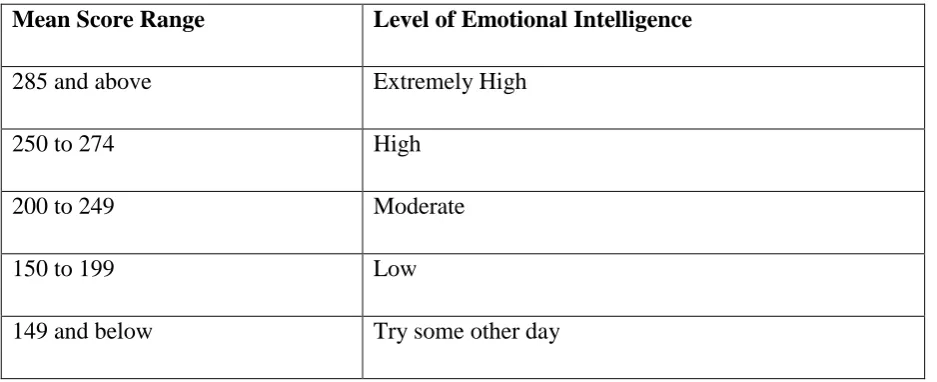
emotional sensitivity and emotional maturity was added to form the overall EQ score. Norms
Table 1: Shows norms of Mean score for Emotional Intelligence.
Mean Score Range Level of Emotional Intelligence
285 and above Extremely High
250 to 274 High
200 to 249 Moderate
150 to 199 Low
149 and below Try some other day
Statistical Analysis:
The obtained data were processed for the computation of Mean, Standard Deviation,
Skewness, Kurtosis, Pearson‟s Correlation.
B. Human Capital:
The questionnaire of Human Capital was used by taking items from Bontis scale of
Intellectual Capital. Out of 53 items of Intellectual capital scale, 19 items are of Human
Capital variables.
The responses were taken on 7 point Likert scale. Respondents answered on each item by
choosing one of the alternatives ranging from strongly disagree to strongly agree. Score of 1
of 7 was awarded on the basis of response to each item. These 19 items were grouped into 6
factors (variables of Human Capital) mainly Collective Capability; Intellectual agility;
employee‟s attitude; employee performance; Interpersonal skills & employees competence
levels.
Results & Analysis:
In order to fulfill the main research objectives of the present study, the obtained, data were
processed for the computation of means, Standard Deviations, Skewness, Kurtosis and
Pearson‟s correlation.
Descriptive Statistics:
Kurtosis describe the pattern of score of distribution. The scores of employees on 10
variables including 6 of Human Capital viz (Collective Capability, Intellectual agility,
employees attitude, employee‟s performance, Interpersonal skills & employees competence
levels) and 4 of Emotional Intelligence (i.e. emotional sensitivity, emotional maturity,
emotional competency & overall emotional intelligence) have been shown in table 2. All the
measures of emotional intelligence and two measures of Human Capital i.e. collective
capability and employees competence level are negatively skewed, where as other measures
of Human Capital are positively skewed.
Careful inspection of mean of Human Capital variables shows that employees working in
steel and power sector in the region of Chhattisgarh are scoring above then averageon all the
variables, suggesting thereby that they are better on almost all the variables of Human
Capital. Similarly, they also tend to be in moderate level of emotional intelligence (M = 215).
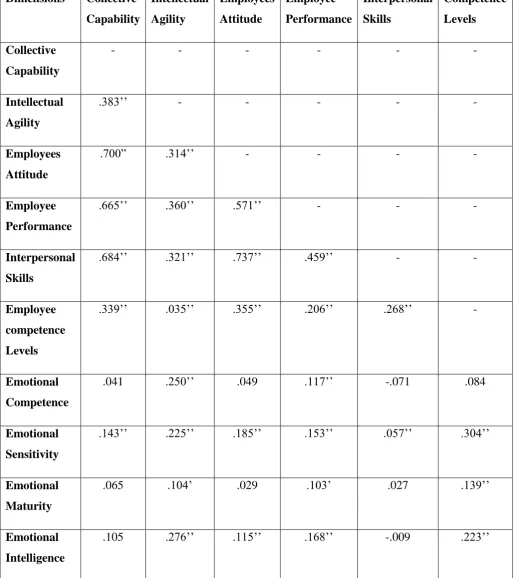
An inspection of correlation matrix table 3 reveals that interrcorrelation among human capital
variables range between 0.339 to 0.700. All the intercorrelations are positive and significant
at 0.01 level, Association among these measures show that all the measures share their
variances among themselves. Intercorrelation among the measures of emotional intelligence
range between 0.337 to 0.851. All the intercorrelation are positive and significant at 0.001
level. Inercorrelation between the 6 measures of Human Capital and four of emotional
intelligence range between -.07 to .304. Out of 24 intercorrelations 12 are significant at 0.01
level and 3 at 0.05 level. Collective capability a measure of human capital correlates with
emotional intelligence (.105 p< .001). Intellectual agility measure of human capital
correlates with emotional competence (.250 p< .001), Emotional Sensitivity (.225 p< .001),
Emotional Maturity (.104 p< .05) and emotional intelligence (.276 p< .001). Employees
attitude a measure of human capital aorrelates with emotional sensitivity (.185 p< .01) and
emotional intelligence(.115 p< .01) measures of intelligence. Employees performance the
measure of human capital correlates with emotional competence (.117 p< .01), emotional
sensitivity (.153 p< .01), emotional maturity (.103 p< .001) and emotional intelligence (.168
p< .01). Employees competence level correlates with emotional sensitivity (.034 p< .001),
Emotional Maturity (.139 p< .01) and emotional intelligence (.223 p< .001). The significant
intercorrelations between five measures of Human Capital viz. Collective capability,
intellectual agility, employee attitude, employee performance and employee competence
emotional intelligence. The non significant intercorrelations between Interpersonal skills a
measure of human capital and those of emotional intelligence reveal that Interpersonal skills
and dimensions of emotional intelligence are independent in nature and do not share their
variances.
Discussion:
The present study states that Human capital measure Collective Capability is found to have
positive & significant relationship with only emotional sensitivity measure and other
measures of emotional intelligence i.e. emotional competence, emotional maturity &
emotional intelligence are found to be at non significant level.
Intellectual agility, a measure of human capital is found to have positive and significant
relationship with all the measures of emotional intelligence (emotional competence,
emotional sensitivity, emotional maturity & emotional intelligence).
Employee attitude, a measure of human capital is found to have positive and significant
relationship with emotional sensitivity & emotional intelligence but other two measures
emotional competence & emotional maturity are having non significant relationship.
Employee Performance, a measure of human capital is found to have positive and significant
relationship with all the measures of emotional intelligence (emotional competence,
emotional sensitivity, emotional maturity & emotional intelligence).
Interpersonal Skills, a measure of human capital is found to have positive & significant
relationship with emotional sensitivity. The relationship with emotional maturity is non
significant. Despite of having positive and non significant relationship, the two measures
emotional competence & emotional intelligence are found to be negatively correlated.
Employee Competence level, a measure of human capital is found to have positive and
significant relationship with emotional sensitivity, emotional maturity & emotional
intelligence. Despite of having positive relationship with three measures a non significant
relationship with emotional competence is there. On the basis of above discussion that it is
concluded, that in steel & power sector industries of Chhattisgarh state, certain improvement
is required to develop effective human capital measure of the employees working in the
organization. Certain pervious studies were tried to relate/link competencies of employee &
other measures of human capital with emotional intelligence in view of performance of the
Descriptive Statistics:
Table 2: Shows Means, Standard deviations, Skewness & Kurtosis (N= 512) on
measures of Human Capital & Emotional Intelligence variables.
Dimensions Mean Standard
Deviation
Skewness Kurtosis
Collective Capability 31.9453 4.71714 -.148 .057
Intellectual Agility 21.8359 3.25745 .638 -.411
Employees Attitude 9.3750 2.01754 .008 .074
Employee Performance 14.7031 2.42091 .127 -.123
Interpersonal Skills 4.6250 1.15357 .061 -.227
Employee competence Levels 4.3125 1.26831 -.672 .480
Emotional Competence 120.1172 19.46913 -.538 -.082
Emotional Sensitivity 45.7031 13.54466 -.358 -.308
Emotional Maturity 49.2969 11.69967 -1.537 2.004
Table 3: Shows Correlations between measures of Human Capital and Emotional Intelligence variables. Dimensions Collective
Capability
Intellectual
Agility
Employees
Attitude
Employee
Performance
Interpersonal
Skills
Competence
Levels
Collective
Capability
- - - -
Intellectual
Agility
.383‟‟ - - - - -
Employees
Attitude
.700” .314‟‟ - - - -
Employee
Performance
.665‟‟ .360‟‟ .571‟‟ - - -
Interpersonal
Skills
.684‟‟ .321‟‟ .737‟‟ .459‟‟ - -
Employee
competence
Levels
.339‟‟ .035‟‟ .355‟‟ .206‟‟ .268‟‟ -
Emotional
Competence
.041 .250‟‟ .049 .117‟‟ -.071 .084
Emotional
Sensitivity
.143‟‟ .225‟‟ .185‟‟ .153‟‟ .057‟‟ .304‟‟
Emotional
Maturity
.065 .104‟ .029 .103‟ .027 .139‟‟
Emotional
Intelligence
References:
Armstrong, T. (2003). The multiple intelligences of reading and writing: Making the
words come alive. Alexandria, VA, USA: ASCD.
Ashkanasy, N.M. & Daus, C.S. (2005). Rumors of the death of emotional intelligence
in organizational behavior are vastly exaggerated. Journal of Organizational Behavior,
26, 441-452.
Bar-On, R. (1988). The development of a concept of psychological well-being.
Unpublished doctoral dissertation, Rhodes University, South Africa.
Bontis, N. (1998). "Intellectual Capital: An exploratory study that
develops measures and models”, Management Decision,
Vol.36No.2,pp.63-76.
Boyatzis, R.E. (1994). Stimulating self – directed change: A required MBA course
called Managerial Assessment and Development, Journal of Mnagement Education,
18(3): 304 – 323.
Bradberry, T., Greaves, J., Emmerling, R., Sanders, Q., Stamm, S., Su, L.D., & West,
A. (2003). Emotional Intelligence Appraisal Technical Manual. TalentSmart Inc.
Brooking, A. and Motta, E. (1996) „ A taxonomy of intellectual capital and methodology for auditing it‟, 17th
Annual National Business Conference, Mcmaster
University, Hamilton Canada, pp. 24- 26
Bukh, P.N., Larsen, H.T. and Mouritsen, J. (2001)‟constructing intellectual capital
statements, Scandinavian Journal of Management, Vol. 17, No. 1, pp 87 – 108.
Carmeli, A. (2003). The relationship between emotional intelligence and work attitudes, behaviour and outcomes: An examination among senior managers. Journal
of Managerial Psychology, 18(8), 788-813.
Cheng, M., Dainty, A. & Moore, D. (2003). The differing faces of managerial
competency in Britain and America. Journal of Management Development, 22(6),
527-537.
Collins, J. (2001). Level 5 leadership: The triumph of leadership and fierce resolve.
Harvard Business Review. Jan-Feb, 67-76.
Dainty, A. R. J., Cheng, M. L., & Moore, D. R. (2005). Competency-based model for predicting construction project manager‟ performance. Journal of management of in
Edvinsson, L. & Malone, M. S. 1999. Intellectual Capital, New York: HarperCollins
Publishing, Inc
Gardner, H. (1983). Frames of mind. New York: Basic Books.
Goleman, Daniel. 1995. Emotional intelligence: Why it can matter more than IQ, New
York:Bantam.
Goleman, Daniel. 1998a. Working with emotional intelligence. New York: Bantam.
Goleman. Daniel. 2001. An EI-based theory of performance. In Emotionally
intelligent workplace, ed. Cherniss, C., and Daniel Goleman, 27-44. California:
Jossey-Bass.
Jaeger, A.J. (2003). Job Competencies and the Curriculum: An Inquiry into Emotional
Intelligence in Graduate Professional Education. Research in Higher Education, 44(6),
615-639
Kanfer, R. & Kantrowitz, T.M. (2002). Emotion regulation: Command and control of
emotion in work life. In R.G. Lord, R.J. Klimoski, & R. Kanfer (Eds.), Emotions in
the workplace: Understanding the structure and role of emotions in organizational
behaviour ( pp 429-472). New York: Jossey- Bass.
Locke, E.A. (2005). Why emotional intelligence is an invalid concept. Journal of
Organizational Behavior, 26, 425- 431.
Lopes, P. N., Grewal, D., Kadis, J., Gall, M., & Salovey, P. (2006). Evidence that
emotional intelligence is related to job performance and affect and attitudes at work.
Psicothema, 18, 132-138.
Lyons, J. B. & Schneider, T. R. (2005). The influence of emotional intelligence on
performance. Personality and Individual Differences, 39(4), 693-703.
Matthews, G., Zeidner, M., & Roberts, R.D. (2002). Emotional intelligence: Science
& myth, Cambridge, MA: MIT Press.
Mayer, J.D. Stevens, A. (1994): An emerging understanding of the reflecting (meta)
experience of mood. A Journal of research in personality, 28, 351 – 373.
Mayer, J.D., Caruso, D.R., Salovey, P. (1999). Emotional intelligence meets
traditional standards for an intelligence. Intelligence, 27, 267-298.
Miller, M. (1999). Emotional intelligence helps managers succeed. Credit Union
Magazine, 65, 25-26.
Orme, G. & Langhorn, S. (2003). Lessons Learned from Implementing EI Program –
The Cutting Edge of Emotional Intelligence Programs. Competency and Emotional
Intelligence Quarterly: The Journal of Performance through People, Vol. 10, No. 2,
Winter, pp. 32-39.3
Rafiq, M., Naseer, Z., & Ali, B. (2011). Impact of Emotional Intelligence
onOrganizational Learning Capability . International Journal of Academic Research..
3(4).321-325.
Rao, MS, (December 2007), 2.2.5.1 “Interpersonal Skills & Organizational Commitment”, http:// Profmsrao.articles. articles base.com
Salovey, P. & Mayer, J.D. (1990). Emotional intelligence. Imagination, Cognition,
and Personality, 9, 185-211.
Singh, D. (2003).Emotional intelligence at work – A professional guide (2nd ed.)New
Delhi: Sage Publications
Stuart,A.D. & Pauquet, A. (2001). Emotional intelligence as a determinant of
leadership potential. Journal of Industrial Psychology, 27(3), 30-34.
Thorndike, R.K. (1920). "Intelligence and Its Uses", Harper's Magazine 140, 227-335. Titimaea.M.A.(2006). Emotional intelligence, management concept: a contributing
for effective service delivery. PP. 32-3 4.
Wah, L. (1999). Making Knowledge Stick. Management Review.
Wong, C. & Law, K.S. (2002). The effects of leader and follower emotional