THE IMPACT OF CCTV ON EFFECTIVE MANAGEMENT SPAN
CONTROL SYSTEM
Dr. E. Palanivel
Asst.Professor, Dept.of Commerce, K.C.S.Kasi Nadar College of Arts & Science, Chennai, Tamilnadu, India.
ABSTRACT
Closed-circuit television (CCTV), also known as video surveillance the use of video cameras to transmit a signal to a specific place, on a limited set of monitors. It differs from broadcast television in that the signal is not openly transmitted, though it may employ point to point (P2P), point to multipoint (P2MP), or mesh wired or wireless links. Though almost all video cameras fit this definition, the term is most often applied to those used for surveillance in areas that may need monitoring such as bars, banks, casinos, schools, hotels, airports, hospitals, restaurants, military installations, convenience stores and other areas where security is needed. Video telephony is seldom called "CCTV" but the use of video in distance education, where it is an important tool, is often so called.
Surveillance of the public using CCTV is common in many areas around the world. In recent years, the use of body worn video cameras has been introduced as a new form of surveillance. Video surveillance has generated significant debate about balancing its use with individuals' right to privacy even when in public.
Keywords: concierge, eradicating, hazards, immaculately
Inte rnational Research Journal of Management and Comme rce ISSN: (2348-9766) Impact Factor- 5.564, Volume 4, Issue 7, July 2017 We bsite- www.aarf.asia, Email : editor@aa rf.asia , ed itoraarf@g mail.co m
INTRODUCTION
The first CCTV system was installed by Siemens AG at Test Stand VII in Peenemünde,
Nazi Germany in 1942, for observing the launch of V-2 rockets. The noted German
engineer Walter Bruch was responsible for the technological design and installation of the
system.
In the U.S. the first commercial closed-circuit television system became available in
1949, called Vericon. Very little is known about Vericon except it was advertised as not
requiring a government permit.[12] Marie Van Brittan Brown invented the home security system. The patent was granted in 1969. Brown's system had a set of 4 peep-holes and a camera that
could slide up and down to look through each one. The system included a device that enabled a
homeowner to use a television set to view the person at the door and hear the caller's voice.
REVIEW OF LITERATURE
Senator Vanstone (2000) in a press re lease in July 2000 about the use of surveillance
cameras at docks to prevent the importation of illicit drugs, points out, "I want to stress that
cameras by themselves are not a magic solution and in many cases provide only indications of
possible illegal activity. Images on tape are generally effective as evidence only if used in
conjunction with other intelligence or detective work". Indeed, "the use of CCTV images as
evidence for court cases is open to question despite security industry assertions that such images
are straightforward portrayals of 'truth' and a number of wrongful convictions are said to have
been obtained through the use of such evidence " (Dee 2000). Courts in the USA states of
Hawaii and Indiana have ruled inadmissible videotape evidence obtained without a warrant
(ACLU News 1999).
At present there is no privacy legislation in place offering adequate and proper protection
from CCTV and thus there is little real protection from the exploitation and misuse of
surveillance material. (Dee 2000 & Davies 1997). Evidence of such misuse can be taken from
the experience of Bradford, UK, where the local council has had to make its CCTV footage
freely available to the public. Ostensibly to be used by members of the public to clear their own
names should the need arise, actual footage has been used by a British comedian in his Channel 4
creative short film" obtained by the public from CCTV cameras using the new B ritish Data
Protection Act which became law in March 2000 (KDIS Online 2001).
OBJECTIVES OF THE STUDY
1. To study about role of CCTV in control system.
2. To improve the public safety and property security.
3. To reduce the fear of the crime.
BACKGROUND OF THE STUDY MANNED GUARDING
Highly trained and skilled, experienced personnel ensure the security and safety of all
persons on site whilst delivering a high level of customer service. Our ultimate aim is to create a
warm and friendly environment.
With the option for both plain clothed and fully uniformed guards, allow each client to
focus their attention on running their core business, safe in the knowledge that the security of
their premises is in safe hands with an established industry specialist.
From static site officers to retail security personnel, each member of the team undergo rigorous
training in order to allow them to meet both are companywide and site specific standards. These
standards are maintained with regular on-site visits from mobile supervisors, identifying any
issues and eradicating them as and when they present themselves.
CONCIERGE SERVICES
Provide bespoke tailored concierge offerings for a range of clients. Fully uniformed and trained
in a variety of roles such as customer service and objection handling, a member of the concierge
team will reflect the professionalism of the clients' organization.
Taking a professional and proactive approach, each team member is friendly, immaculately
presented and selected based on their abilities, ensuring that the front of house remains at the
highest standard. Typical concierge duties include:
Reception duties
Property security
Regulating visitor parking
Are a registered principle key holder, which allows 'out of hours' work responsibilities to be
taken away from clients and left in the capable hands of ourselves.
With a large network of highly trained response officers, can respond to disturbances and alarm
activations in a quick and efficient manner.
In such cases, liaising with alarm companies and authorities is handled by a highly experienced
member of the team.
In addition to this, any emergency repairs will be handled and a full incident report is
documented and issued to the client. Being a forward thinking company, following any
emergency callout we Endeavour to provide clients with a solution to prevent any future
disturbances.
The level of response is not limited to just alarm activation. key holding duties can expand as
follows:
Plant machinery
Control system access
Perimeter detection systems
KEY HOLDING
Utilizing a fleet of vehicles, uniformed officers perform rigorous inspections to ensure our
client's premises are secure outside of core hours.
Crime prevention is one of the major benefits of utilizing a mobile, uniformed officer, but the
benefits stretch far beyond this.
Ensure that each patrol takes into account good housekeeping duties, helping to minimize the
costs associated with waste and loss. These essential activities may include:
Closing all access points
Switching off lights and/or equipment
Checking for potential fire hazards
Reporting obstructive fire exits
Reporting defective security devices i.e. locks, fences etc
With full SIA CCTV training, our officers can operate a client's CCTV system to ensure
maximum functionality. With continuous training provided upon request, can act as a client's
'eyes and ears' to ensure their property is safe 24 hours a day, 7 days a week.
Close working relationships with both clients and the loca l authorities ensures that are
perfectly placed to facilitate and manage any CCTV and surveillance requirements.
Each operative is fully registered under the Data Protection Act, allowing client discretion and
security at all times.
Reducing Risk
In order to meet and exceed requirements set by Health and Safety quotas, have implemented a
site specific Risk Assessment that gives our clients a snapshot of their business needs.
As a prerequisite to any of our services a full risk assessment is carried out, broadening the
tailored service for each client whilst identifying potential pitfalls and cost savings for their
business.
Carried out and prepared by a qualified Health and Safety consultant, an accurate and detailed
method statement can be provided in as little as 48 hours, including each detail and approach
needed.
Utilizing an independent risk assessment officer, deliver a fully comprehensive report which is
both easy to understand and simple to implement.
DATA ANALYSIS AND INTERPREATION
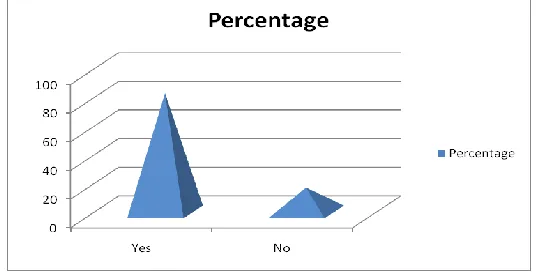
Table No.1. CCTV monitoring work useful to society
Particulars Respondents Percentage
Yes 83 83
No 17 17
From the above said table clearly shows that 83% of respondents are accept CCTV very
[image:6.612.190.458.80.216.2]useful to the society.
TABLE NO. 2. REASONS FOR USING MODERN CONTROL SYSTEM
Particulars Respondents Percentage
High safety 16 16
Morale pressure 17 17
Monitoring work 36 36
Evidence in future 21 21
Reduction of work burden 10 10
Total 100 100
From the above table shows explains 16% of the respondents using the CCTV for
high safety 36% of respondents for the purpose monitoring the daily work and 21% of
FINDINGS
No of peoples eager to install the system.
Versatile service 24x7 hours authenticated evidence proof in eye of law.
Moral pressure to the fraudulent people. 3600 of catching the movements of the peoples. Ensure the safety of highly important area.
SUGGESTIONS
CCTV protects high value of assets through effective control system.
People like to install because control system in clear. Monitoring system from the factory
or work station.
Instrument install in the right place and visible opt vision must matched Minute devices are quiet welcome with fair prices.
Hi – tech maintenance of premises compare to cost paid.
CONCLUSION
Hi tech control system is found in the innovation life moral pressure, public security,
discipline work or gained with support of the mechanical device. Control of human beings work
in a smart way and reach the destination, through empowering the span of control.
REFERENCE
1. Brown, B. (1995)Closed Circuit Television In Town Centres: Three Case Studies. Crime
Prevention and Detection Series Paper 73. London: Home Office. Browning, P. (2001)
2. Surveillance Cameras In Public Places - Refurbishment of Queens St Mall. 2 x e-mails to
Townsville City Council City Safe Officer, 12 February 2001. Crane P & Dee M Young
People, Public Space & NEW URBANISM. in Youth Studies Australia, v20, n.1, (2001)
3. Crane P & Dee M Young People, Public Space & NEW URBANISM. in Youth Studies
Australia, v20, n.1, (2001) p.11-18.
4. Tilley, N. (1999) Whys And Wherefores In Evaluating The Effectiveness Of CCTV.
International Journal of Risk, Security and Crime Prevention, Vol 2 No. 3 pp.175-185 V
5. anstone, A. (2000) Surveillance Cameras To Boost Australia's Fight Against illicit Drugs.
Media Release, Minister for Justice & Customs, Australian Federal Government. July
2000 (Available on the Internet: