ELECTRIC FIELD MODELING OF OUTDOOR INSULATOR FOR OPTIMIZED PERFORMANCE
MOHD HAYUMABDISSALAM BIN TALI @ RAZALI
A project report submitted in partial fulfillment of the requirement for the award of the
Degree of Master of Electrical Engineering
Faculty of Electrical and Electronic Engineering University Tun Hussein Onn Malaysia
ABSTRACT
ABSTRAK
CONTENTS
TITLE i
STUDENT’S DECLARATION ii
DEDICATION iii
ACKNOWLEDGEMENT iv
ABSTRACT v
CONTENTS vii
LIST OF FIGURES xi
LIST OF TABLES xii
LIST OF APPENDICES xiv LIST OF SYMBOLS AND ABBREVIATIONS xvi
CHAPTER 1 INTRODUCTION
1.1 Introduction 1
1.2 Problem statement 2
1.3 Objectives 3
1.4 Scope of the project 3
CHAPTER 2 REVIEW OF LITERATURE
2.1 Overview 4
2.2 Ceramic insulator 9
2.3 Electric field stress 10
2.4.1 Finite element method 14
2.5 Factors influencing the electric field stress on
insulator 18
2.5.1 Shape of insulator 18
2.5.2 Corona ring application 20
2.5.3 Permittivity of the material 22
2.5.4 Potential difference 23
2.5.5 External influences 23
2.6 Effect of electric field stress on insulator 24
2.6.1 Corona discharge 24
2.6.2 Flashover 25
CHAPTER 3 METHODOLOGY
3.1 Overview 27
3.2 Simulation process 29
3.2.1 Phase 1 30
3.2.2 Phase 2 30
3.2.3 Phase 3 31
CHAPTER 4 RESULT AND DATA ANALYSIS
4.1 Overview 32
4.2 Simulation of 132kV post insulator 32
4.2.1 Properties of materials 33
4.2.2 Boundary condition 34
4.2.3 Meshing 34
4.2.4 Electric field simulation 35
4.3 Effects of the distance between the first shed and
4.4 Effects of shed’s diameter 48
4.5 Effects of shed’s inclination angle 55
4.6 Effects of shed’s outer corner radius 61
4.7 Effects of end fittings design 67
4.8 Effects of modification on first shed 71
4.9 Proposed model 75
CHAPTER 5 CONCLUSION AND RECOMMENDATION
5.1 Overview 83
5.2 Conclusion 83
5.3 Recommendation and future works 85
LIST OF FIGURES
2.1 Typical constructions of ceramic type suspension insulators 10
a) Standard 10
b) Open profile (self-cleaning) 10
c) Anti-fog and for DC applications 10
2.2 Illustration of electric field 11
2.3 Triangular and tetrahedron shaped finite discrete elements. 16
2.4 a) Examples of the electric field distribution surrounding
the composite insulator end fitting of Design 1 20
b) Examples of the electric field distribution surrounding
the composite insulator end fitting of Design 2 20
c) Examples of the electric field distribution surrounding
the composite insulator end fitting of Design 3 20
2.5 a) Potential distributions on insulator with corona ring 21
b) Potential distributions on insulator without corona ring 21
2.6 Corona discharge activities on insulator 25
3.1 Overall flowchart of the project 28
3.2 Flowchart of the simulation process 29
4.1 a) Drawn model of 132kV post insulator 33
4.2 a) Boundary condition of the base model insulator at
voltage terminal 34
b) Boundary condition of the base model insulator at
ground terminal 34
4.3 Meshing of the insulator model 35
4.4 Electric field stress of 132kV post insulator 36
4.5 The line of measurement along the surface of porcelain of
132kV post insulator 36
4.6 Zone division of the 132 kV post insulator 37
4.7 Points of interest in Zone I 38
4.8 Points of interest in Zone II 38
4.9 Points of interest in Zone III 39
4.10 Electric field stress along the 132kV post insulator’s
surface 39
4.11 Electric field stress in Zone I 40
4.12 Electric field stress in Zone II 40
4.13 Electric field stress in Zone III 41
4.14 Distance between the first shed to bottom end fitting 42
4.15 Electric field stress in Zone I with different first shed to
bottom end fitting distance 42
4.16 Electric field stress in Zone II with different first shed to
bottom end fitting distance 43
4.17 Electric field stress in Zone III with different first shed
to bottom end fitting distance 43
4.18 Changes in electric field in Zone I as the distance between
4.19 Changes in electric field in Zone II as the distance between
the first shed and bottom end fitting was varied 46
4.20 Changes in electric field stress in Zone III as the distance
between the first shed and bottom end fitting was varied 47
4.21 Shed’s diameter of 132 kV post insulator 48
4.22 Electric field stress in Zone I with different shed’s
diameter 49
4.23 Electric field stress in Zone II with different shed’s
diameter 49
4.24 Electric field stress in Zone III with different shed’s
diameter 50
4.25 Changes in electric field stress in Zone I as the shed’s
diameter was varied 51
4.26 Changes in electric field stress in Zone II as the shed’s
diameter was varied 53
4.27 Changes in electric field stress in Zone III as the shed’s
diameter was varied 54
4.28 Inclination angle of 132 kV post insulator 55
4.29 Electric field stress in Zone I with different shed’s
inclination angle 55
4.30 Electric field stress in Zone II with different shed’s
inclination angle 56
4.31 Electric field stress in Zone III with different shed’s
inclination angle 56
4.32 Changes in electric field stress in Zone I as inclination angle
4.33 Changes in electric field stress in Zone II as inclination
angle was varied 59
4.34 Changes in electric field stress in Zone III as inclination
angle was varied 60
4.35 Shed’s outer corner radius of post insulator 61
4.36 Electric field stress in Zone I with different shed’s outer
corner radius 61
4.37 Electric field stress in Zone II with different shed’s outer
corner radius 62
4.38 Electric field stress in Zone III with different shed’s
outer corner radius 62
4.39 Changes in electric field stress in Zone I as shed’s outer
corner radius was varied 63
4.40 Changes in electric field stress in Zone II as shed’s outer
corner radius was varied 65
4.41 Changes in electric field stress in Zone III as shed’s outer
corner radius was varied 66
4.42 a) Bottom end fitting of base model 67
b) Top end fitting of base model 67
4.43 a) Bottom end fitting Design A 67
b) Top end fitting Design A 67
4.44 a) Bottom end fitting Design B 67
b) Top end fitting Design B 67
4.45 a) Bottom end fitting Design C 68
b) Top end fitting Design C 68
4.46 Electric field stress in Zone I with different end fittings
4.47 Electric field stress in Zone II with different end fittings
design 68
4.48 Electric field stress in Zone III with different end fittings
design 69
4.49 First shed Design A 72
4.50 First shed Design B (no shed). 72
4.51 Electric field stress in Zone I with different first shed
design 72
4.52 Electric field stress In Zone II with different first shed
design 73
4.53 Electric field stress In Zone III with different first shed
design 73
4.54 Proposed model of 132 kV post insulator 77
4.55 Electric field stress of base model of 132kV post
insulator 78
4.56 Electric field stress of proposed model of 132kV post
insulator 79
4.57 Electric field stress in Zone I 80
4.58 Electric field stress in Zone II 80
LIST OF TABLES
2.1 Journals referred in doing the project 5
2.2 Brief explanation on the numerical method to calculate
electric field 12
2.3 Relative permittivity of material 22
4.1 Dimension of 132kV post insulator 33
4.2 Relative permittivity of the insulator’s material 34
4.3 Electric field stress at points of interest for 1332kV post
insulator 41
4.4 Electric field stress at point A, B, C and D in Zone I 44
4.5 Electric field stress at point E, F, G and H in Zone II 45
4.6 Electric field stress at point I, J and K in Zone III 47
4.7 Electric field stress at point A, B, C and D in Zone I 50
4.8 Electric field stress at point E, F, G and H in Zone II 52
4.9 Electric field stress at point I, J and K in Zone III 54
4.10 Electric field stress at point A, B, C and D in Zone I 57
4.11 Electric field stress at point E, F, G and H in Zone II 58
4.12 Electric field stress at point I, J and K in Zone III 60
4.13 Electric field stress at point A, B, C and D in Zone I 63
4.14 Electric field stress at point E, F, G and H in Zone II 64
4.16 Electric field stress at point A, B, C and D in Zone I 69
4.17 Electric field stress at point E, F, G and H in Zone II 70
4.18 Electric field stress at point I, J and K in Zone III 71
4.19 Electric field stress at point A, B, C and D in Zone I 74
4.20 Electric field stress at point E, F, G and H in Zone II 74
4.21 Electric field stress at point I, J and K in Zone III 74
4.22 Dimension of proposed 132kV post insulator 76
4.23 Electric field stress at point A, B, C and D in Zone I 81
4.24 Electric field stress at point E, F, G and H in Zone II 82
LIST OF APPENDICES
APPENDIX TITLE PAGE
A Base model of 132kV post insulator 90
LIST OF SYMBOLS AND ABBREVIATIONS
kV - Kilo Volt DC - Direct Current
cm - Centimeter
CHAPTER 1
INTRODUCTION
1.1 Introduction
The reliability of the power networks and equipments is very important for the performance of an electric power system. High voltage power lines have been widely used to transmit the electric energy from the power stations to the consumers. Insulators are among the important devices of the electric power transmission systems. They are used to support and separate conductors at high voltage. The insulators need to withstand not only regular voltages and overvoltages, such as lightning and switching events, but also various environmental stresses such as rain, snow and pollution [1, 2]. Presently insulators adopted for transmission/distribution are made of ceramic, glass or polymeric type. Ceramic and glass insulators have been used for a long time and there is considerable experience in manufacturing, installation and their field performance is well known.
cause surface flashover on ceramic/glass insulator, in case of polymeric type insulator damage to the insulator sheath due to the corona discharge; hence grading devices need to be used to reduce the electric field to acceptable levels [3].
1.2 Problem statement
1.3 Objectives
The overall works of the project will stress on the study of the design of insulator. Several objectives are targeted from the work, such as:
To investigate the electric field performance related to the insulator design.
To propose an optimised design of insulator for controlling the electric field
stress.
1.4 Scopes of the project
The 132kV post ceramic insulator will be modelled using finite element method (FEM) based software, COMSOL Multiphysics. In summary, several works have been identified such as:
Literature review related to the work concept and the previous works by other
researchers.
Perform analytical study about the design of insulator.
Simulation and analysis works on the existing and proposing optimised
CHAPTER 2
REVIEW OF LITERATURE
2.1 Overview
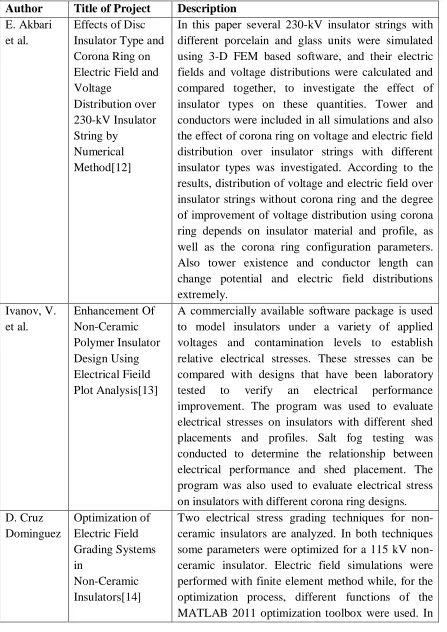
Table 2.1 Journals referred in doing the project Author Title of Project Description
E. Akbari et al.
Effects of Disc Insulator Type and Corona Ring on Electric Field and Voltage Distribution over 230-kV Insulator String by Numerical Method[12]
In this paper several 230-kV insulator strings with different porcelain and glass units were simulated using 3-D FEM based software, and their electric fields and voltage distributions were calculated and compared together, to investigate the effect of insulator types on these quantities. Tower and conductors were included in all simulations and also the effect of corona ring on voltage and electric field distribution over insulator strings with different insulator types was investigated. According to the results, distribution of voltage and electric field over insulator strings without corona ring and the degree of improvement of voltage distribution using corona ring depends on insulator material and profile, as well as the corona ring configuration parameters. Also tower existence and conductor length can change potential and electric field distributions extremely. Ivanov, V. et al. Enhancement Of Non-Ceramic Polymer Insulator Design Using Electrical Fieild Plot Analysis[13]
A commercially available software package is used to model insulators under a variety of applied voltages and contamination levels to establish relative electrical stresses. These stresses can be compared with designs that have been laboratory tested to verify an electrical performance improvement. The program was used to evaluate electrical stresses on insulators with different shed placements and profiles. Salt fog testing was conducted to determine the relationship between electrical performance and shed placement. The program was also used to evaluate electrical stress on insulators with different corona ring designs. D. Cruz Dominguez Optimization of Electric Field Grading Systems in Non-Ceramic Insulators[14]
the first case the optimized parameters were the relative permittivity of the material and the geometry of insulator on the energized side. The simulations were made under power frequency and under normalized lightning impulse. Modification of the shape next to the energized side consists of changing the inclination angle of the housing material. Furthermore, the corona ring position is optimized on the energized side of the non-ceramic insulator for comparison with the aforementioned method. According to the results, it was found that there are geometric parameters and material properties that minimize the value for the maximum electric field along the insulator surface.
Xinqiao Wu et al et al Calculation of Electric-field Distribution and Research on Characteristics of Shielding Ring along the Long-rod Post Porcelain Insulators Used in 1000kV System [15]
In this paper, the finite element method is used to calculate the three-dimensional electric-field distribution of long-rod post porcelain insulators used in 1000kV system. The electric-field distribution is simulated in the condition of varied position, varied major radius and varied section dimension of the shielding ring. The effect of these factors to the external insulation characteristics of post porcelain insulators is analyzed. The electric-field distribution at the line side and the grounding flange can be effectively improved by proper distribution of shielding ring and the optimization of the shielding ring structure. This provide calculation gist to improve the characteristics of shielding ring used in 1000kV long-rod post porcelain insulators and the reliability of safe operation in 1000kV system. Edward Niedospial et al Design and Application of Corona and Grading Rings for Composite
Insulators[16]
specific voltage, other critical characteristics include attachment type, mating feature, hot stick-able design, ordering, and packaging
Ayman H. El-Hag et al.
Effect of Insulator Profile on Aging Performance of Silicone Rubber Insulators in Salt-Fog [17]
The paper presents the results of the study on the influence of insulator profile on the aging performance of silicone rubber (SIR) insulators in salt-fog. The work is also extended to include commercial 15 kV class insulators with different profiles. Shed spacing, shed diameter, alternate shed design and shed shape are the parameters investigated in this study. The low frequency harmonics of the leakage current, early aging period (EAP), and equivalent salt deposit density (ESDD), are used to evaluate the aging performance of different designs. Insulator profile is shown to greatly influence the aging performance of SIR insulators. Shed shape proves to be the most important parameter to be considered in designing non-ceramic insulators profiles. Also, as the shed spacing decreases, the performance of SIR insulators improves. Simulation results using FEMLAB show that the electric field on insulators is below the corona onset at both dry and wet conditions. Dry band arcing is therefore the main electrical cause for aging in distribution class insulators and it is possible to improve the pollution performance of SIR insulators using appropriate profiles as suggested in this work.
B. Vancia et al
Electric Field Modeling of Non-Ceramic High Voltage Insulators [18]
effect of end-fitting geometry and corona ring geometry on the electric field at the live-end of high voltage ceramic insulators. Three different non-ceramic insulator types were compared, and their fields are shown. Also a number of different ring geometries were compared. The effect of changing ring cross-sectional shape, diameter, and placement along the insulator are shown. All of these were found to influence the electric field at the live end.
Yang Qing et al
New Optimization Method on Electric Field Distribution of Composite Insulator [19]
Due to the geometry configure of composite insulator, the electric field strength near the two ends of composite insulator is always strong. The high electric field strength can cause the partial discharge on the insulation material and the surface of the metal electrodes, and bring premature aging of the insulator. In this paper, a new optimization method on the electric field distribution of composite insulator is put forward, which is the combined use of composite insulators and several units of glass insulator. Based on the finite element method, a three-dimensional electric field calculation model of insulators in the transmission line is established. Then the optimization conditions of surface potential and electric field distribution of composite insulator with glass insulator installed in the high voltage end of composite insulator at different levels of voltage is studied. The results show that by this method, the electric field distribution near the ends of composite insulators is significantly reduced, which can prevent the partial discharge and the aging of the composite material.
W. Sima et al
Optimization Of Corona Ring Design For Long-Rod Insulators Using FEM Based Computational Analysis [20]
insulator surface, such that this maximum field is well below the corona inception level. The design parameters of the ring diameter, diameter of the ring tube, position of the ring in its vertical plane, and the maximum field that cannot exceed the corona inception level have been used in the optimization process.
W. Sima et al
Study On The Shape Of Suspension Insulators Influencing Development Of Discharge[21]
Based on complex charge simulations method, this paper presents three-dimensional electrostatic models of suspension insulator with clearing pollution dry belt and appearing local arc along insulator surface. By calculating the electric field of suspension insulator surface, analyze the shape of suspension insulators influence to local arc development. It is studied that the relation between the shape of insulator and the development of local arc. The process of local arc development, the edge of suspension insulator influence greatly on the development of local arc. The results can provide theory basis for informing the shape of insulator.
2.2 Ceramic insulator
shattered are therefore preferred for substation use since access for replacement may require a busbar outage [22]. The design and manufacturing of the ceramic insulators are being researched and improved in order to carter the needs of today’s power distribution and transmission system. However, limitations are given on their sheds design to meet the surface electrical leakage distance needed for higher voltage transmission. To smooth the surface of the insulator, glazing is used apart from increasing the mechanical strength and improving the surface’s hydrophobicity.
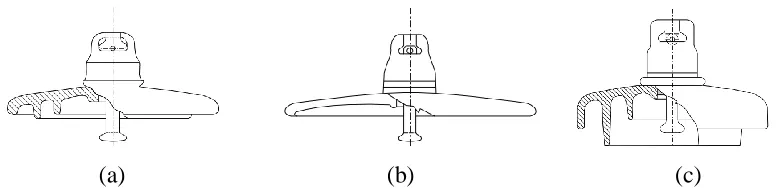
[image:25.612.136.525.236.330.2](a) (b) (c)
Figure 2.1 Typical constructions of ceramic type suspension insulators. (a) Standard. (b) Open profile (self-cleaning). (c) Anti-fog and for DC applications [34]
2.3 Electric field stress
It is important to understand the electric field intensity in high voltage engineering to design an insulator that could provide long and satisfactory performance. Electric stress is the stresses upon the dielectric by electric field which is produced due to the potential on the dielectric. The electric field intensity is the parameter used to determine the magnitude of the electric field stress on the dielectric. The performance of a dielectric depends strongly on the electric field distribution and the electric field stress.
electric field intensity is measured in its more common practical units of “Volt per meter” (V/m or kV/cm). The electric field intensity is often called as the electric field stress experienced by a dielectric.
Figure 2.2 Illustration of electric field
In Figure 2.2, the potential difference Uab between two points a and b having
scalar potential a and b in an electric field, , is defined as the work done by an
external source in moving a unit positive charge from b to a.
Uab = -
dx = ( a - b) (2.1)
The magnitude of electric field intensity is given by the rate of change of potential with distance. The maximum magnitude of the field intensity is obtained when the direction of is opposite to the direction in which the potential is increasing most rapidly,
= -
(2.2)
Equation (2.2) provides a physical interpretation of the process of finding electric field intensity from the scalar potential . The operator on by which is obtained is thus known as the gradient. The relationship between and is written as,
(2.3)
b
a
Uab
a
2.4 Numerical electric field analysis methods
A comprehensive reference book related to numerical electric field analysis methods is authored by Zhou [23]. There are several numerical analysis methods that are often used for the calculation of the electric field strength distribution along insulators. They are:
• charge simulation method (CSM) • boundary element method (BEM) • finite element method (FEM) • finite difference method (FDM).
The numerical electric field analysis methods can be divided into two categories: the boundary methods and the domain methods. The boundary methods include the CSM and the BEM. The domain methods include the FEM and the FDM. Table 2.2 shows a brief explanation of each numerical method used to approximate the electric field strength distribution.
Table 2.2 Brief explanation on the numerical method to calculate electric field
Method Description
CSM
placement of simulation charges. The other disadvantage is that it is difficult or impossible to calculate the electric field strength near very thin electrodes because the fictitious charges approximating the field must be usually inside the electrodes.
BEM
The BEM is based on the boundary integral equation and the principle of weighted residuals, where the fundamental solution is chosen as the weighting function. There are two kinds of BEM. One is called indirect BEM, the other is called direct BEM. In the indirect BEM, the potential is not solved directly. An equivalent source, which would sustain the field, is found by forcing it to satisfy prescribed boundary conditions under a free space Green function that relates the location and effect of the source to any point on the boundary. Once the source is determined, the potential or derivatives of the potential can be calculated at any point
FEM
The FEM is a numerical method of solving Maxwell’s equations in the differential form. The basic feature of the FEM is to divide the entire problem space, including the surrounding region, into a number of non-separated, non-overlapping subregions, called “finite elements”. This process is called meshing. These finite elements can take a number of shapes, but generally triangles are used for 2-D analysis and tetrahedron for 3-D analysis. Each element geometry is expressed by polynomials with nodal values as coefficients. The electric potential within each element is a linear interpolation of the potentials at its vertices. By using the weighted residual approach, the partial differential equations are reduced to a sparse, symmetric and positive definite matrix equation. Since the shape and the size of the elements are arbitrary, it is a flexible method that is well suited to problems with complicated geometry. The FEM analysis is effective for small problems that are closed bounded. If the problems are too large, a large number of finite elements are required, and the calculation becomes intensive.
with finite regular node. This method utilizes a truncated Taylor series expansion in each coordinate direction, and applied at a set of finite discretization points to approximate the partial derivatives of the unknown function. The partial differential equations are transformed into a set of algebraic equations. The FDM is suitable for obtaining an approximate solution within a regular domain. If a region contains different materials and complex shapes, the FEM is better than the FDM.
2.4.1 Finite element method
Finite Element Method (FEM) [25] in general is based on transforming the differential equations in integral form and then using an approximation. One way to transform these equations is to find a function that minimizes an energy integral. An easy way to calculate the electric field distribution is to calculate electric potential distribution initially and then calculate field distribution by subtracting gradient of electric potential distribution from it [26]. From equation (2.3),
From Maxwell’s equation,
(2.4)
where is the volume charge density, is the permittivity of dielectric material (ε
), is vacuum permittivity, (8.854 x 10⁻¹²) and is the relative permittivity of dielectric material. The Poisson’s equation can be obtained by substituting equation (2.4) into equation (2.3)
The Laplace’s equation can be obtained by making space charge = 0,
= 0 (2.6)
The basic approach of FEM for electric field estimation involves the factual characteristics of an electrostatic field that the total energy enclosed in the whole field region acquires a minimum value. In other words, the potential, under given conditions of electrode surface, should make the enclosed energy function to be at a minimum for a given dielectric volume “V”, therefore:
W = dV → minimum (2.7)
which is obtained by solving the basic potential equation (2.3). W is the electrical energy stored in the volume of dielectric under consideration.
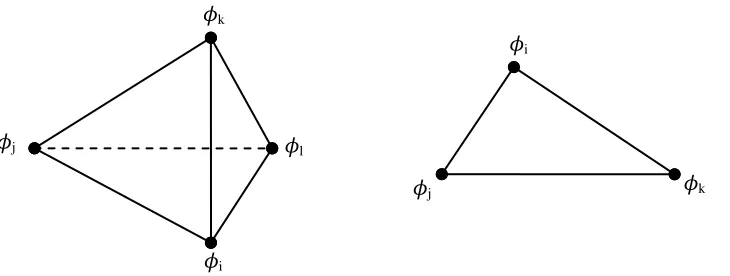
Hence, in this method the field between the electrodes under consideration is subdivided into finite number of discrete sized elements. The behavior of these elements is specified by a number of parameters, for example, the potential. The number of nodal points and elements established within the mesh are assigned identifying integer numbers. The shape of these discrete elements is suitably chosen to triangular to for two dimensional representations. For three dimensional field configurations, “tetrahedron”, a pyramid-like solid structure with four plane triangular faces, shown in Figure 2.3, is used.
Figure 2.3 Triangular and tetrahedron shaped finite discrete elements.
Consider an electrostatic field, undistorted by any space charge concentration, in a single isotropic dielectric between two electrodes. Then the potential would be determined by the boundaries, that is, the metal electrode surfaces. The above equation (2.7) for electrical energy W, stored within the whole region of such a Laplacian field is given in Cartesian coordinates as follows,
W =
dx dy dz (2.8)
For a small volume element dV = (dx dy dz), the expressions (1/2 ∆2 ) within equation
(2.8) represent the energy densities per unit volume in a particular direction.
For two dimensional case, it is assumed that the potential distribution does not change in the z direction. Then, the total energy WA stored within the area A per unit
length located between the two electrodesboundaries can be given by the equation (2.7)
WA = dA
And according to equation (2.8) in this case by,
k
i
j l
i
W = z
dx dy (2.9)
where z is a constant. W/z gives the energy densities per elementary area dA. Inside each sub-domain, a linear dependency of on x and y is assumed, which gives rise to the first order approximation,
(x, y)= = ae1 +ae2x +ae3y (2.10)
Where is the electrical potential of any arbitrary point inside each sub-domain, ae1, ae2,
ae3 are the computational coefficients for a triangle element e, and m is the total number
of triangle elements. Equation (2.10) implies that within the element the potential are linearly distributed and the field intensity is constant.
In order to minimize the energy within the field region under consideration, only derivatives of the energies with respect to the potential distribution in each element are of particular interest. For element under consideration, We is the energy enclosed within
the element, then the energy per unit length We/z in the direction z, denoted by W∆e can
be given as follows,
W∆e = = ∆e
(2.11)
The symbol ∆e represents the area of the discrete triangular element under consideration.
If we denote the total energy in the whole field of given elements by W∆, the relation for
minimizing the energy within the complete system can be given as,
= 0 (2.12)
= 0 = [H]{ } (2.13)
where the matrix [H] is known as the “stiffness matrix”. The above matrix is solved by iterative methods.
2.5 Factors influencing the electric field stress on insulator.
Previous studies proved that other design parameters than the creepage distance may be critical for the short and long term performance of insulators. This section provides brief explanation on the factors that affect the electric field stress on insulator.
2.5.1 Shape of insulator
The shape of the insulator plays a significant role in determining the electric field stress along the insulator. A good design of insulator must provide electrical field stress below ionization threshold. Weather shed profile and the end fitting design are the aspect of interest to control the electric field stress on insulator.
a) Weather shed profile
Chakravorti and Steinbigler [32] studied the relationship between the shape of a porcelain post-type insulator and the maximum electric field strength around it with or without pollution. The position of the maximum electric field strength is near the top triple junction region. The parameters studied in their work are the slope angle of the insulator weather shed, the shed radius, the core radius, the axial height, and the electrode radius. Their findings were as follows:
The higher slope angle does not yield notable reduction in the maximum electric
field strength.
Increasing the shed radius from 6 cm to 10 cm significantly lowers the maximum
electric field strength.
The increase of the core radius has little effect on the maximum electric field
strength reduction.
The higher the axial height, the lower the maximum electric field strength.
For a given insulator shape, increasing the electrode radius increases the
maximum electric field strength in clean conditions but reduces the maximum electric field strength in the presence of surface pollution.
b) End fitting design
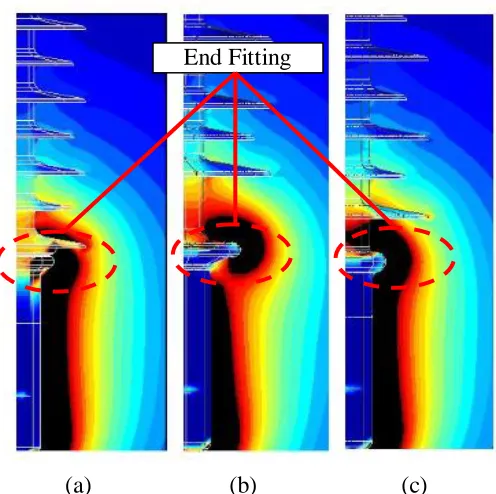
(a) (b) (c)
Figure 2.4 Examples of the electric field distribution surrounding the composite insulator end fitting of (a) Design 1 (b) Design 2 and (c) Design 3[28]
2.5.2 Corona ring application
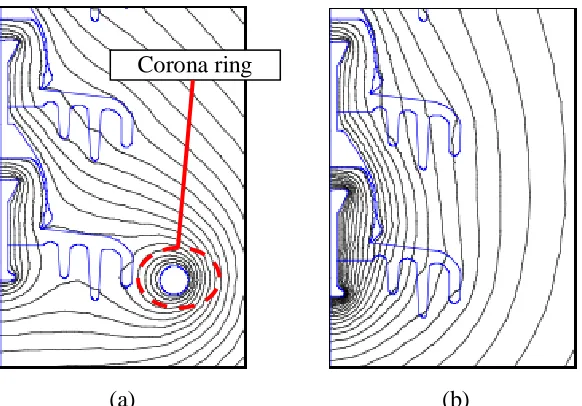
The function of the corona ring is to grade or disperse the electric field gradient, thus reducing the voltage stress on the rubber housing near the line end fitting. The corona ring can be attached to the composite insulator directly or as part of the hardware. When applied as part of the hardware, the grading device is commonly referred to as a Corona Shield. Corona rings are typically used to prevent inception of corona on hardware. Figure 2.5 shows the difference of the electric field distribution with the application of corona ring.
(a) (b)
Figure 2.5 Potential distributions on insulator (a) with corona ring and (b) without corona ring [27]
Suat İlhan and Aydoğan Özdemir [27] studied the effect of corona ring application to the electric field stress and potential distribution along insulator. They found that the usage of corona ring in an insulator string will significantly decrease the voltage percentage on the lowermost insulators and will slightly increase the voltage sharing on the uppermost insulators. That is, potential distribution will be more uniform with the help of corona ring. Furthermore, the maximum electric field strengths on the live end side will importantly decrease with the usage of corona ring. The value of this field strength depends on the corona tube settings. On the basis of vertical position of corona ring, electric field on the live end gets its minimum value. Moreover, the electric field on the corona ring surface can also change with the design parameters. Maximum electric field is on the outer radius of the ring. However, minimum electric field is on the inner radius of the ring.
Zhao and Comber [31] studied the electric field and potential distribution along non-ceramic insulators. The Coulomb electric field analysis software was used. The insulator, tower and conductors were considered in the calculation model. Results showed that the conductor length has significant “shielding” effect on the insulators; the maximum electric field strength decreases when the length of the conductor increases; and the tower structure in the vicinity of the insulator and the diameter and the location
of the grading ring are important in determining the maximum electric field strength along an insulator.
2.5.3 Permittivity of the material
Permittivity ( ) is a measure of how an electric field affects, and is affected by, a dielectric medium. The permittivity of a medium describes how much electric field, or more correctly, fluxes, is generated per unit charge. Less flux exists in a medium with a high permittivity due to polarization effects. Permittivity is directly related to electric susceptibility, which is a measure of how easily a dielectric polarizes in response to an electric field.
Kaana-Nkusi, Alexander and Hackam [29] calculated the voltage and electric field distribution along a post-type insulator shed. The system was modeled with 146 ring charges, with 30 charges modeling each electrode. Several criteria were applied in order to evaluate the quality of the calculation results, which included the potential error, the potential discrepancy, the normal electric flux density and the tangential electric field strength discrepancies. The calculation results showed that the maximum values of the electric field strength along the surface increased with higher dielectric permittivity of the insulating material. Decreasing the radius of curvature of the insulator shed increased both the normal and tangential components of the electric field strength. Table 2.3 shows some example of permittivity of material.
Table 2.3 Relative permittivity of material [36]
Material Relative permittivity
Air 1
Porcelain 5.0-7.0
Water 4.0-8.0
2.5.4 Potential difference
The potential difference applied on an insulator also affects the electric field stress on the insulator. The electric field is a measure of force per unit charge and the electric potential is a measure of energy per unit charge. Let say a work done in moving a unit test charge from point a to point b is the electric potential difference between the two points and is denoted by ∆Vand ∆d is the distance needed to move the charge. Therefore, the relation between potential difference and field strength can be given as
The negative sign indicates that the potential decreases in the direction of electric field.
2.5.5 External influences
insulator surface electric field greatly, and the occurrence of flashover is closely related to the distribution of the electric field and potential.
2.6 Effect of electric field stress on insulator
This section will describe about the effect of high electric field stress on insulator. Specifically, the event of corona discharge, flashover and discharge activity on the insulator will be discussed.
2.6.1 Corona discharge
Corona discharges occur on the surface when electric field intensity exceeds the breakdown strength of air, which are around 15 kV/cm. Atmospheric conditions which effect corona generation are air density and humidity. The geometry of insulator itself has a role in the initiation of corona activity. The corona generates ultraviolet light, heat, and gaseous by products (ozone, NO2). The corona discharges subject the insulator to severe electrical strains and chemical degradation. Continued degradation may render the ceramic insulator ultimately unusable. When corona generation occurs on a wet surface, this results in ‘wetting corona activity’. Wetting corona activity is the outcome of a non-uniform wetting causing high electric field. This activity depends on the type and magnitude of wetting as well as on the intensity of surface electric field. The magnitude of wetting depends on the surface characteristics (hydrophobic or hydrophilic) and on the type of wetting whether it is produced by rain, mist, fog or condensation. Magnitude of surface electric field depends upon the dimension of grading ring, its position and end fittings.
REFERENCES
[1] Andy Schwalm, “Insulators 101”, IEEE/PES 2010 Transmission and Distribution Conference and Exposition, 2010.
[2] Subba Reddy, B.; Ravishankar, K.V.; Sultan, N. A. et al, “Simulation of Potential and Electric Field for High Voltage Ceramic Disc Insulators”, 2010 5th International Conference on Industrial and Information Systems, (ICIIS
2010), pp. 526 – 531, 2010.
[3] Kojimi, S.; Oyama, M.; Yamashita, M., “Potential Distribution Of Metal Oxide Surge Arresters Under Various Environmental Conditions,” IEEE Trans. on Power Delivery, Vol. 3, No.3, pp 984-989, 1988.
[4] Phillips, A., “Electric Field Distribution And Their Impact On Transmission Line Composite Insulators”, IEEE Power Eng. Soc. (PES) Transmission and Distribution Conf. and Exposition (T&D), Charlotte, NC, pp. 1-3, 2012.
[5] Gorur, R. S.; Cherney, E. A.; Burnham, J. T., Outdoor Insulators: Ravi S. Gorur, Inc., ISBN 0967761107, 1999.
[6] Cigre working group 22.03, “Comparative Electric Field Calculations and Measurements on High Voltage Insulators”, Electra No. 141, pp. 6977, April 1992.
[7] Chakravorti, S.; Mukerjee, P. K., “Power Frequency And Impulse Field Calculations Around A HV Insulator With Uniform Or Non-Uniform Surface Pollution”, IEEE Trans on Dielectrics and Electrical insulation, Vol. 28, No.1, pp 43-53, Feb 1993.
[9] Andersen, O. W., “Finite element solution of complex electric fields”, IEEE Trans. on PAS, Vol. 96, No.4, pp 1156-1160, 1977.
[10] El Kishky, H.; Gorur, R. S., “Electric potential and field computation along ac HV insulators”, IEEE Trans. on Dielectrics ad Electrical Insulation, Vol.1, No.6, pp 982-990, Dec 1994.
[11] Cotton, H., The Transmission and Distribution of Electrical Energy: Hodder and Stoughton, ISBN 0340147717, 1978.
[12] E. Akbari et al, “ Effects of Disc Insulator Type and Corona Ring on Electric Field and Voltage Distribution over 230-kV Insulator String by Numerical Method”, Iranian Journal of Electrical & Electronic Engineering, Vol. 9, No. 1, March 2013.
[13] Ivanov, V. et al, “Enhancement Of Non-Ceramic Polymer Insulator Design Using Electrical Field Plot Analysis”, Electrical Electronics Insulation Conference, pp. 437-441, Sep 1995.
[14] Dominguez, D.C.; Espino-Cortes, F.P.; Gomez, P., “Optimization of Electric Field Grading Systems in Non-Ceramic Insulators”, Electrical Insulation Conference (EIC), pp. 231-234, June 2011 .
[15] Xinqiao Wu ; Zongren Peng ; Peng Liu ; Zhong Yu, “Calculation of Electric-field Distribution and Research on Characteristics of Shielding Ring along the Long-rod Post Porcelain Insulators Used in 1000kv System” Properties and applications of Dielectric Materials, 8th International
Conference, pp. 603-606, June 2006.
[16] Niedospial, E. , “Design and Application of Corona and Grading Rings for Composite Insulators”, Transmission and Distribution Conference and Exposition (T&D), IEEE PES, pp. 1-3, May 2012.
[17] El-Hag, A.H. ; Jayaram, S.H. ; Cherney, E.A. , “Effect of Insulator Profile on Aging Performance of Silicone Rubber Insulators in Salt-Fog”, Dielectrics and Electrical Insulation, IEEE Transactions, Vol 14, No. 2, pp.
352 – 359, April 2007.
[18] Saha, T. K.; Eleperuma, K.; Gillespie, T., “Electric Field Modeling of Non-Ceramic High Voltage Insulators”, University of Queensland & Powerlink. [19] Yang Qing; Wenxia Sima; Deng Jiazhuo; Yuan Tao; Chen Lin, “New
Electrical Insulation and Dielectric Phenomena (CEIDP) Annual Report
Conference, pp. 1-4, Oct 2010.
[20] Sima, W.; Espino-Cortes, F.P.; Cherney, E.A.; Jayaram, S.H., “Optimization of Corona Ring Design for Long-Rod Insulators Using FEM Based Computational Analysis”, Conference Record of the 2004 IEEE International Symposium on Electrical Insulation, pp. 480-483, Sept 2004.
[21] Wenxia Sima; Caixin Sun; Leguan Gu; Xinliang Jiang; Mingying Chen, “ Study On The Shape Of Suspension Insulators Influencing Development Of Discharge”, International Symposium on Electrical Insulating Materials (ISEIM), pp. 290-292, Nov 2001.
[22] Bayliss, C.; Hardy, B.,Transmission and Distribution Electrical Engineering 4th edition: Elsevier, ISBN 0080969135, 2011.
[23] Zhou P. B., Numerical Analysis of Electromagnetic Fields. Spinger-Verlag, Berlin, ISBN 0387547223,1993.
[24] Khan, M. J.; Alexander, P. H., “Charge Simulation Modeling of Practical Insulator Geometries,” IEEE Transactions on Electrical Insulation, Vol. EI-17, No. 4, August 1982, pp. 325-332.
[25] Arora, R.; Mosch, W., High Voltage and Electrical Insulation Engineering Volume 69 of IEEE Press Series on Power Engineering: John Wiley & Sons,
ISBN 1118008960, 2011.
[26] Muniraj, C.; Chandrasekar, S., “Finite Element Modeling For Electrical Field And Voltage Distribution Along The Polluted Polymeric Insulator”, World Journal of Modelling and Simulation, Vol. 8, No. 4, pp. 310-320,
March 2012.
[27] Suat Ilhan; Aydogan Özdemir, “Effect of Corona Ring Design on Electric Field Intensity and Potential Distribution Along an Insulator String,” IEEE ELECO, 2007.
[28] Phillips, A. J. et al, “Electric Field on AC Composite Line Insulators”, IEEE Transactions On Power Delivery, Vol. 23, No. 2, pp. 823-830, April 2008.
[29] Kaana-Nkusi, S.; Alexander, P. H.; Hackam, R., “Potential and Electric Field Distributions at a High Voltage Insulator Shed,” IEEE Transactions on Dielectrics and Electrical Insulation, Vol. 23, No. 2, pp. 307-318, April
[30] Gutfleisch, F.; Singer, H.; Forger K.; Gomollon, J. A., “Calculation of High Voltage Fields by Means of the Boundary Element Method”, IEEE Transactions on Power Delivery, Vol. 9, No. 2, pp. 743-749, April 1994.
[31] Zhao, T.; Comber, M. G., “Calculation of Electric Field and Potential Distribution Along Non-Ceramic Insulators Considering the Effects of Conductors and Transmission Towers,” IEEE Transactions on Power Delivery, Vol. 15, No. 1, pp. 313-318, January 2000.
[32] Chakravorti, S.; Steinbigler, H., “Boundary-Element Studies on Insulator Shape and Electric Field around HV Insulators with or without Pollution”, IEEE Transactions on Dielectrics and Electrical Insulation, Vol. 7, No. 2,
pp. 169-176, April 2000.
[33] COMSOL, “Introduction to COMSOL Multiphysics”, May 2013.
[34] Edmund Kuffel, Walter S. Zaengl, John Kuffel, High Voltage Engineering Fundamentals: Butterworth-Heinemann, ISBN 0750636343, 2000.
[35] Schumann, U. et al, “FEM Calculation and Measurement of the Electrical Field Distribution of HV Composite Insulator Arrangements”, 39th CIGRE Session, August 2002.
[36] Clipper Controls, “Dielectric Constant Value,” [Online] Available from: http://www.clippercontrols.com/pages/Dielectric-Constant-Values.html#V [Accessed 26 Septemner 2013].