Journal of Chemical and Pharmaceutical Research, 2014, 6(5): 492-498
Research Article
CODEN(USA) : JCPRC5
ISSN : 0975-7384
E-Learning system architecture based on Private Cloud for university
Wang Shunye
1, Liu Dayong
1and Zhang Zijuan
21
Department of Computer Science and Technology, Langfang Teachers University, China
2
Department of Information Science and Technology, Northwest University, China
_____________________________________________________________________________________________
ABSTRACT
Education has been gradually expanded, and each of a component of the education has changed slowly. It is becoming completely associated with the Information Technology on the data exchange, communication and collaboration. Cloud computing as combination of existed technology is a model for enabling convenient, on-demand network access to a shared pool of configurable computing resources. The education based on cloud computing it provides a new solution to establish a unified, open and flexible network teaching platform and reduce the hardware input. In this paper, we research the definition of cloud computing, discuss the main existed cloud provider in the world such as Microsoft, Google, Amazon, IBM and so on, analyze the development of the cloud computing in education, propose a new E-learning architecture based on private cloud, present the expected benefits from the proposed architecture. The education institution can use from the cloud computing provider to increase the benefits of students, teachers and administrators through the E-learning architecture.
Key words: Cloud computing; cloud computing provider; private cloud; E-learning architecture
_____________________________________________________________________________________________
INTRODUCTION
Education is an important component on our life because it equips us with all that is needed to make our dreams come true. Now, more and more conventional education models are not meeting with the requirements of the development of the social progress and the education. It is not able to catch up with the changes of learning demand in time. The arising of the network influences the education system. It brings various opportunities to learn knowledge. Education has been gradually expanded. E-learning is appearing.
However, in the tradition classroom education, knowledge is the center. And teacher is the leader. She knows the level of comprehension of each student, and answers students’ questions immediately. Tradition education also is good at creating favorable environment in teaching and studying, creating favorable relationship between teachers and students. It has many problems in the procedure. Student who depends on teachers and class heavily is lack of active, independence and creation in learning. It is equally to every student in the class. So it ignores the personality and requirement of each student. And in traditional web-based e-learning mode, system construction and maintenance are located in interior of educational institutions or enterprises, which results in a lot of problems existed, such as a lot of investment needed, but without capital gains to return, without development potential and staying power [1].
Cloud computing is an emerging Internet-based computing paradigm, with its built-in elasticity and scalability, for delivering on-demand information technology services to users in a pay-user-use basis, in similar fashion as already done for other utilities ( i.e., water, electricity, etc. ). It is a confluence of business developments and the follow existing information technology: virtualization, grid computing, utility computing and web services [2].
Cloud computing has become a research hopspots in recent years. It includes two aspects: the theory technology about cloud computing and the application of cloud computing. It can be applied in many fields, such as healthcare, social and government activities, economics, especially in education. In both academia and industry, cloud computing has been recently attracting significant momentum and attention as one of those opportunities that could prove to be of immense benefits and empowering in some situation. There are four main factors which attract the attention in education based cloud computing. Firstly, it decreases in hardware and software cost, increases the computing power and storage capacity. Secondly, the huge data size appear which is in exponentially growing in scientific or educational instrumentation/simulation and Internet publishing and archiving. Thirdly, more and more wide-spread adoption of services in cloud computing and Web 2.0 applications appear around our life [3]. Fourthly, the smartphones which are used in education based on cloud computing are the basic necessity for students. In the education and learning arena, this will be called “Education and Learning as a Service” (ELaaS).
The structure of the rest of the paper is as follows. Section II properly defines cloud computing. Many cloud computing providers is discussed in Section III. Section IV analyzes the development of the cloud computing in educational. A new architecture is proposed in Section V. Section VI shows the expected benefits from the proposed architecture. Finally, the concluding and the next work are given in Section VII.
CLOUD COMPUTING
So far, there seems no exact definition about cloud computing. A study of McKinsey (the global management consulting firm) found that there are 22 possible separate definitions of cloud computing [4]. In fact, there is no common standard or definition for cloud computing. In essential cloud computing is can be defined as providing resources and capabilities of Information Technology (IT, e.g., applications, storages, communication, collaboration, and infrastructure) via services offered by cloud computing providers. In this paper the National Institute of Standards and Technology (NIST) definition is adopted. NIST defines “Cloud Computing” as a model for enabling ubiquitous, convenient, on-demand network access to a shared pool of configurable computing resources (e.g., networks, servers, storage, applications and services) that can be rapidly provisioned and released with minimal management effort or service provider interaction [5]. This cloud model promotes availability and is composed of five essential characteristics, three service models, and four deployment models [6]
The five essential characteristics are [6]: on-demand service, where a consumer can unilaterally provision computing capabilities as needed automatically without requiring human interaction from each service's provider; ubiquitous network access, where the capabilities are available over the network and accessed through standard mechanisms, promoting the use of heterogeneous thick or thin client platforms such as mobile phones, laptops, and PDAs; location independent resource pooling, where the provider's computing resources are pooled to serve multiple consumers using a multi-tenant model, with different physical and virtual resources dynamically assigned and reassigned according to consumers demands; rapid elasticity, where the capabilities can be rapidly and elastically provisioned, in some cases automatically, to quickly scale out, and rapidly released to quickly scale in; and measured service, where the cloud service providers automatically control and optimize resource use by leveraging a metering capability at some level of abstraction appropriate to the type of service.
Cloud Computing is composed three service models from low to top layer. They are Infrastructure as a Service (IaaS), Platform as a Service (PaaS), and Software as a Service (SaaS).
Infrastructure as a Service (IaaS): Infrastructure layer corresponds to IaaS infrastructure services. It is the lowest layer of the network. Users can household to provide standard services, including computing power and storage resources. It turn the memory, storage and computing power into a virtual whole resource pool for the entire industry to provide the required of computing power and storage resources [7]. Amazaon EC2 is an example of IaaS [8].
Platform as a Service (PaaS): PaaS that made a higher level of abstraction on the base of IaaS layer provides a development environment, test environment, server platforms and other services. Users can develop applications based on Internet and other servers service providers’ infrastructure, then share it to other users. Google App Engine is the example for PaaS.
hardware, operating platform, and is responsible for the implementation of all post-maintenance and other services. Compared with the traditional method of service, SaaS not only reduces the cost of traditional software licensing, and vendors deploy application software on a unified server, eliminating the end-user's server hardware, network security devices and software upgrade and maintenance expenses, the customer does not need other IT investment in addition personal computers and Internet connections to obtain the required software and services [9]. SalesForce.com, Google Mail, Google Docs are examples for SaaS.
The deployment models defined by the cloud are public cloud, private cloud, hybrid cloud and community cloud [8]. Public Cloud: One of the leading forms of the current computing deployment model. Mainly used by the general public cloud consumer and the policy, value and costing are defined by the service provider. The popular public cloud services are Amazon EC2, S3, Google App Engine, and Force.com. Private Cloud: This is a cloud model for a single organization and managed by the organization or a third party. The infrastructure can be located on premise or off premise. Academic institutions build private cloud for research and teaching purpose. Hybrid Cloud: It is a combination of two or more clouds viz., private, community or public. In order to optimize the resource and to utilize core competency of the public cloud organizations use the hybrid cloud. Hybrid cloud is the combination of public and private cloud. Community Cloud: Several organization of same group shares their cloud resources and jointly constructs the policies and requirements. The infrastructure of the cloud can be hosted by a third-party vendor or within one of the organizations in the community.
Cloud computing faces five major challenges that need to be addressed: security, interoperability, availability, performance, and data migration. The security is concerned about data privacy, confidentiality, and network traffic isolation through partitioning, whereas interoperability must support customer choice and additional agility (for example, in workload mobility). Service level agreement (SLA) should address performance, availability, latency and QoS (quality of service) issues. On the other hand, the problem of migrating data between cloud, both public and private, is probably the biggest challenge [10].
CLOUD COMPUTING PROVIDERS
Now, the main cloud computing service provider in education includes Microsoft, Google, Amazon, IBM, Salesforce and HP.
Microsoft Education Cloud
The Microsoft educational cloud enables researchers to flow workloads across the infrastructures and complement their existing IT assets with Web-based services [11]. Microsoft cloud services for education offers great programs such as Microsoft Live@edu at no cost to education accounts. Additionally, all services offer greater financial flexibility to educational institutions and enable lower costs to develop, scale, operate, and migrate the systems that are distributed between the cloud and the datacenter [12].
Google Education Cloud
Google Apps Education (GAE) in cloud computing available at no cost to colleges, universities and educationally focused groups. GAE includes the following applications: Google Mail, Google Sites, Google Video for education, Google Calendar, Google Talk and Google Docs Package Each of these applications is entirely web-based, although there are client applications that supply additional functionality. Because all of these applications are web-based, each Google App is inherently cross platform; a modern cloud computing web browser might be supported by the computing platform to provide compatibility, scalability and essentially virtualized models [13].
Amazon Web Services (AWS) Cloud
AWS has provided the universities and institutions of all sizes with an infrastructure web services platform in the educational cloud. With AWS students, researchers and faculty can requisition compute power, storage, number of users and other services-obtaining access to a suite of elastic IT infrastructure services as an education demand. With AWS, they have the flexibility to select whichever development service or model of programming makes the most sense for finding the solutions for any problem. With AWS, they can take advantage of Amazon global computing infrastructure that is the backbone of Amazon multi-billion retail business and transactional enterprise that is scalable, flexible, reliable, and secure distributed computing infrastructure has been ameliorated for over a decade [14].
IBM Cloud Academy
computing. The higher educational institutions pursue cloud computing initiatives, develop skills and share best practices for reducing operating costs while improving quality and access to education [15].
Salesforce.com Education Cloud Platform
The Salesforce.com platform provides all the tools needed for the educational institutions to instant scalability, ease of configuration and support for multiple functional roles. It enables comprehensive oversight of operations and applications allowing students, researchers and faculty to track, analyze and refine every aspect of their efforts. The Salesforce.com platform can also assists educators manage their services more efficiently from application to graduation while tracking individual details such as study abroad term, participation in campus organizations, study groups and other operations [16].
HP Cloud Computing
HP Cloud System is the product of HP’s experience in delivering industry and education-leading automation, application management, and converged infrastructure capabilities. It enables clients such as students, faculty and researchers to build, manage, and consume cloud services across private clouds, public clouds, and traditional IT environments-without having to know, or care, whether those services come from HP Cloud System’s own “on premises” resources or from the public domain [17].
CLOUD COMPUTING IN EDUCATION
According to [4], the potential of cloud computing for improving efficiency, cost and convenience for educational sector is being recognized by a number of US educational establishments. In China, Prof. Li proposed the Cloud Computing Assisted Instruction which is called CCAI in 2008[18]. Educational institutions are also beginning to use lower level cloud service for purposes such as data storage. This may be attractive where data security is of lower concern such as where video and audio is provided as open educational resources. Another use of cloud computing which is beginning to emerge in education is for the hosting of institutional learning management systems (LMSs) in the cloud [19,20].
The three service models differ in the type and extent of resources accessed and managed by users. Connecting to the cloud and using “hidden” resources enables sharing of information always and everywhere, great application scalability, service availability anytime and anywhere, data security, storage, backup copies, and more [21]. The potential benefits of adopting cloud computing can be assessed in both the financial savings and resource management perspectives [22].
At the initial stage of the cloud computing in education special in a university for deployment, pubic cloud which store many public education resources will build for students who learn search for basic knowledge of that field. And private cloud (also called internal cloud or corporate cloud) is a marketing term for a proprietary computing architecture that provides hosted services to a limited number of people behind a firewall. It is managed by a university and benefits everyone in this university including managers, teachers and students. Primary reason for implementing private cloud is to maximize and utilize existing in-house resources. Secondary reasons include the data privacy and trust for security. Finally, data transfer cost and to have full control over mission-critical activities behind the firewalls.
And then many universities and colleges which are in the same city or province will construct the community cloud. It integrates more resources (physical or virtual) from different university. At this time, more teachers from different university will provide services for more students at the same time. It also provides the academic environment for teachers. At any stage, whether the private or the community cloud, they all can develop a hybrid cloud called as “educational cloud”, in which they can share all the resources from the various universities. Private cloud makes use of the local network whereas the educational cloud makes use of public network to access the services provided by the cloud.
Fig.1: The deploy model of cloud computing in education
The development of the cloud should meet the expected demand for the infrastructure needed to balance the amount of cloud: too few computing resources, the request from the user must wait for the release of resources or reject those requests until more hardware is added to the environment. Too much computing resources, hardware costs and other expenses will be denied cost-cutting promises of cloud computing [7]. This procedure is analogous to the telephone and network, which are developed from the local to universal.
PROPOSED E-LEARNING ARCHITECTURE BASED ON PRIVATE CLOUD
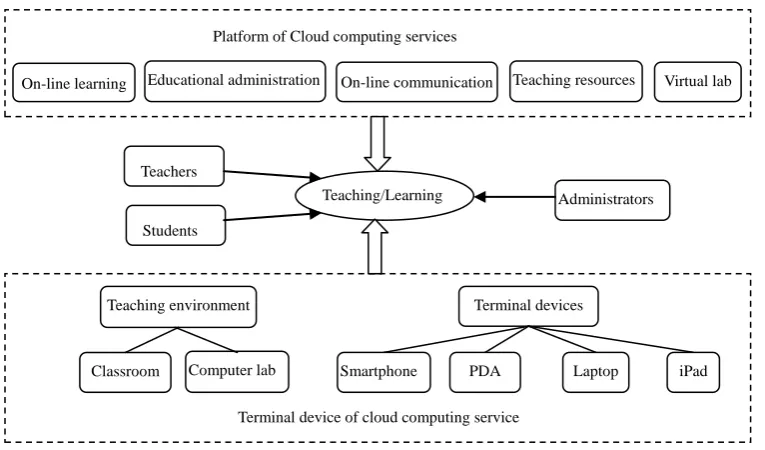
This platform based on private cloud is used by administrators, teachers and students. In order to realize the demand analysis, it includes five systems, educational administration, on-line learning, teaching resources, virtual lab, on-line communication. Fig. 2 shows the proposed architecture.
Fig. 2: Proposed E-Learning architecture based on private cloud
Educational administration: It includes the administration of students’ information, teachers’ information, courses’ arrangement and other daily management. It helps the university’s administrator to understand the situation at real time. It also does statistics based on many teaching data.
On-line learning: This system is the most important part in E-learning. It mainly provides services for teachers and
On-line learning Educational administration
Platform of Cloud computing services
On-line communication Teaching resources Virtual lab
Terminal device of cloud computing service Terminal devices
iPad Laptop
PDA Smartphone
Teachers
Students
Administrators Teaching/Learning
Computer lab Teaching environment
[image:5.595.118.501.453.678.2]students. The student selects a course and gets materials concerning on it. The system can trace the learning behavior in real time and conduct the evaluation of teaching and controlling of learning. It also need job management and test management. It provides data mining from the significant information through correlations, and recommends related content or correlated curriculum. So it creates a personalized learning environment.
Teaching resources: This includes abundant of materials in education, such as educational lectures, advanced knowledge, reference documents, videos, audios. It also can collect more materials that are asked by students through search engine from the Internet. So the arrangement is becoming the important part.
Virtual lab: In the virtual lab, students can ask for hardware such as routers, the updated software, the computational ability and storage capability through cloud computing platform. It will reduce the complexity that the lab assistant no need to install and maintenance and cost which includes purchase and maintenance. In the lab, the students who reside in different place can use different terminal devices to cooperate with each other to finish the experiment. This is good at enhancing the independence and innovation for students’ development. The cloud will keep the intermediate procedure if they do not accomplish the experiment at a time, and allow access at anytime from anywhere next time. This ensures the continuous in experiment.
On-line communication: With the help of mobile technology, students can ask questions at any time through any terminal and get answers immediately. They communicate between teachers and students or student themselves with their understanding of the knowledge. It helps teachers to know the master degree about students. According to the feedback the course content as well as the progress may at any time adjust through the communication on-line, and make the course more effectiveness than ever before.
For example, a university student whose major is computer science taking a college data mining course could access a cloud from door room, view teaching video about the k-means algorithm, obtain a physical or virtual server (with the necessary storage) and a copy of MATLAB or SPSS software, and then do homework or a class project with another student whose major maybe is statistics in the same university. Likewise, the teacher accesses the same cloud to request one virtual machine running the same uninstalled software that is needed, instructs each student at the same time and answers the questions that the student encounters, as part of his or her classroom instructional activities.
EXPECTED BENEFIT FROM THE PROPOSED ARCHITECTURE The intended advantages derived from the proposed architecture are as follows.
Virtualization: Virtualization is the most important characteristics of this type of architecture. It is managed, migrated, and backup through virtualization platform. Each application such as the use of virtual hardware resource and the data, the virtual learning group and experiment partner all includes the virtual theme.
Collaborative learning: Cloud computing provides remote collaboration possibility for students. It breaks the limitation of classroom, realizes real time communication between teachers and students or students and students through virtualization technology, realizes cooperation at any place in the same assignment.
Personalized learning: CCAI is satisfied the needing of diversity in education. The diversity of students corresponds to the diversity of learning context. The architecture traces the learning behavior, analyzes the learning context, mines all the useful information and then recommends the resources that the student will be interest. So a personalized learning platform is with high efficiency and intelligence.
Computational ability and storage capability: E-learning architecture based on private cloud locates the computing and data in a large number of distributed computers. The learning and the virtual lab both need powerful cloud service through the Internet.
Cost: The major advantage of the E-learning based cloud computing is providing easy access to costly software running on high performance processors to rural students at institutions which lack of facilities. Considerable investment would be required to implement this architecture, but the benefits would easily justify the cost.
CONCLUSION
new solution to establish a unified, open and flexible network teaching platform and reduce the hardware input. In this paper, we research the definition of cloud computing, discuss the main existed cloud provider in the world such as Microsoft, Google, Amazon, IBM and so on, analyze the development of the cloud computing in education, propose a new E-learning architecture based on private cloud, present the expected benefits from the proposed architecture. In the education field, the private cloud is chosen firstly, and then expended to the community cloud. The existed public cloud is accessed at any time. The proposed architecture includes educational administration, on-line learning, teaching resources, virtual lab, on-line communication. And the users can benefit it in five aspects, such as virtualization, collaborative learning, personalized learning, computational ability and storage capability, cost. Future research will include two aspects. The first is a study regarding the attitude and strategy for migration to the proposed architecture based on clouds. The second is the migration from E-learning to Mobile–learning (or M-Learning) which is a challenge in education.
Acknowledgments
This work was supported in part by the Youth Educational Reform Foundation of Langfang Teachers University in 2013(2013033). I also thank to my family especially my little son.
REFERENCES
[1]Md,Anwar Hossain Masud, Xiaodi Huang, World Academy of Science, Engineer and Technology, pp:74-78, 2012(62)
[2]Mohssen M. Alabbadi, 14th International Conference on Interactive Callorative Learning (ICL2011), pp:589-594, 21-23 Sep2011
[3]Ajith Singh. N, M.Hemalatha, International Journal of Information and Communication Technology Research, pp:97-101,vol 2 No.2, 2012
[4]Sultan, N.,International Journal of Information Management , pp:109-116, 2010 (30) [5]Mell, P., &Grance, T. The NIST Definition of Cloud Computing. retrieved 2 11, 2011 [6]P. Mell and T. Grance, The NIST Special Publication 800-145 (Draft), January 2011
[7]Deepanshu Madan, Ashish Pant, International Journal of Advanced Research in Computer Science and Software Engineering, vol 2, no 2, Feb 2012
[8]Mr. RambumarLakshminarayanan, Dr. Binod Kumar, Mr. M. Raju, cloud computing benefits for educational institutions
[9]M.V. Luis, R. M. Luis, C. Juan, L. Maik. Computer Communication Review, vol.39, pp.50-55, 2009 [10]G. Lin, D. Fu, J. Zhu, and G. Dasmalchi, IT Professional, Vol. 11, No. 2, pp. 10-13. March/April 2009 [11]Microsoft, Cloud Computing Web Site. Cloud Computing in Education.
[12]Microsoft, Education all inCloud Computing from Microsoft - Empowering Education through Choice. [13]Herrick, R. SIGUCCS09, October 11-14, 2009
[14]Amazon Web Services (AWS) Web Site. What is AWS? A comprehensive cloud computing platform. [15]CJB, R. and Evans, N. 11th DIS Annual Conference , 2-3 September, 2010
[16]Salesforce.com foundation, Higher Education. The Real-Time Cloud for Higher Education.
[17]HP cloud system. Simply the most complete cloud system for enterprises and service providers. Hewlett-Packard Development Company2011.
[18]Li Jiahou, Cloud Computing Assisted Instruction, Shanghai education press,2010 [19]Zhang Huainan, Yang Cheng, Distance Education in China , pp: 20-26, 2013(1)
[20]E. KreljaKurelović, S. Rako, J. Tomljanović, Cloud Computing in Education and Student’s Needs,pp: 856-861MIPRO2013/CE
[21]Bronzin, T., Kaldi, V., Mobilnost u oblaku, Infotrend, 186,2011
[22]Lin, A., Chen, N., International Journal of Information Management, 2012