Journal of Chemical and Pharmaceutical Research, 2014, 6(6):1663-1670
Research Article
ISSN : 0975-7384
CODEN(USA) : JCPRC5
Parameters optimization and semi-active control of suspension based
on the road friendliness
Yao Jingjing
Chongqing College of Electronic Engineering, Chongqing, China
_____________________________________________________________________________________________
ABSTRACT
This paper reported on the parameters optimization and semi-active control of suspension for a case study of heavy duty truck, in order to improve the road friendliness of commercial vehicle. In which, the effects of the suspension parameters on the road friendliness and the ride comfort were investigated based on an established dynamic model of 1/4 vehicle. Based on which, a semi-active control of suspension was studied based on adjustable damping shock absorber, concerning both the road friendliness and ride comfort. The results showed that the optimal fuzzy controlled semi-active suspension can significantly reduce the road damage coefficient and, to some extent, improve the vibration comfort, compared to the passive suspension.
Keywords: road friendliness; ride comfort; optimization; optimal fuzzy control
_____________________________________________________________________________________________
INTRODUCTION
Since larger trucks may have much greater damage on road than that of other vehicles, heavy traffic has been proved to be a main factor of the road damage. Recently, many researches were focused on the road friendliness. A profound study on the passive suspension system was reported by Cole, in which numerical analysis of the parameters of road friendliness were conducted at different combination of suspension stiffness and damping. Based on which, an optimization design of passive suspension system was also performed[1]. Yi et al., found that the road friendly of vehicles can be effectively improved by using the semi-active suspension, through the comparison of different suspension types[2]. It was also found from the simulation analysis that the road friendliness can also be significantly improved by active suspension[3]. Good effect of active and semi-active suspension on road friendliness and ride comfort was also reported by Chen, in which, an comparison between semi-active and active ceiling control and passive suspension was employed[4]. Clearly, the key to improve the road friendliness of the engineering vehicles lies in the proper selection of suspension parameters. By which, the road damage caused by vehicles can be reduced by decreasing the vehicle dynamic load, as well as improving the vibration comfort of the vehicle.
In this paper, a parameters optimization and semi-active control of suspension was employed on a case study of heavy duty truck, for the consideration of road friendliness. The main focuses were on the establishment of a dynamic model of 1/4 vehicle using Simulink, the investigation of the effects of suspension parameters on the road friendliness and vibration comfort, and the optimization of the suspension stiffness and damping with the goal of improving the road friendliness. Based on which, concerning both the road friendliness and vibration comfort, a semi-active suspension control was studied based on the damping adjustable shock absorber.
EXPERIMENTAL SECTION
1 The establishment of a vehicle kinetic model
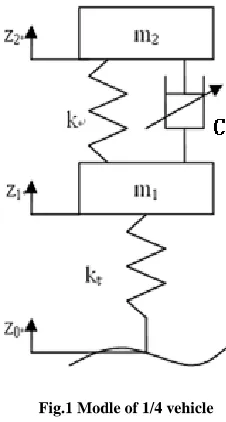
vehicle model is selected as the research object. 1/4 vehicle model is set up as shown in Fig. 1. In the model, tire damping was ignored.
Fig.1 Modle of 1/4 vehicle
Fig. 1, m1 and m represent the weight of the wheel and the body of the vehicle, respectively. 2 z0 z and 1 z 2
represent the vertical displacement of the road excitation, wheel and body of the vehicle, respectively.kand k t
represent the equivalent stiffness of the suspension and the tire, respectively.
The motion differential equations of the present suspension model can be written as
(
)
(
) (
)
1 1 2 1 t 1 0 2 1
m z&& =k z −z −k z −z +c z& −z&
(
) (
)
2 2 2 1 2 1
m z&& = −k z −z −c z& −z& (1)
Select system state variable and output variable, i.e.,
(2)
Combining with the differential equation and road input of vehicle model, the system state space equation can be expressed as:
X AX BU
Y CX DU
= +
= +
&
(3)
where, Ais the system matrix; B is the control matrix; Cis the output matrix, it is a unit matrix; Dis the
transfer matrix, it’s a zero matrix; U =[u z&0]Tis damping force matrix and road input matrix.
2 Optimization of suspension parameters 2.1 evaluation indexes
The evaluation index of road friendliness and vehicle ride comfort is various. Commonly used road friendliness evaluation index has three kinds: the dynamic load coefficient, the dynamic load stress factor and the 95 percentage fourth power aggregate force. Many studies have shown that the first and second indicators exaggerate the road fatigue damage. the British scholar through in-depth study, considering the correlation of dynamic load and space repeatability, put forward the 95 percentage fourth power aggregate force index [5], which improve the evaluation accuracy of the road fatigue damage caused by vehicle, so the paper selects this index to evaluate road friendliness. For the 1/4 vehicle model, road damage coefficient is
4 4
65
.
1
1
A A
m
J
=
+
σ
(4)1 0 2 1 1 2
[ ]T
X z z z z z z
Y X
= − −
=
[image:2.595.243.356.104.315.2]In the formula,
σ
A4is the standard deviation of 4 times the power and force of tires, (unit is 4N
); 4A
m
isaverage of tire’s fourth power aggregate force (unit is
N
4).Vehicle ride comfort evaluation method mainly has ISO2631, absorption power, K coefficient method and so on, weighted acceleration root mean square value has been widely accepted and used. This paper use body vertical acceleration as the comfort evaluation index.
2.2 The influence of suspension parameters on vehicle performance
Commercial vehicle ride comfort and road friendliness are important indicators to evaluate them performance. Suspension spring stiffness and shock absorber damping all have great influence on vehicle ride comfort and road friendliness. A large number of experiments show that, within a certain range, the vehicle's road friendliness has a higher sensitivity to damping coefficient change than stiffness. Therefore, we use the suspension damping coefficient as a variable in the simulation, in order to conclude that road friendliness relationship with the change of damping coefficient[5].
In this paper, the rear axle unilateral parameters of a heavy commercial vehicles is choosed to establish 1/4 vehicle model, the specific parameters are shown in table 1. Tab.1 The simulation parameters
parameter m2 /kg m1 /kg k /N·m-1 kt /N·m-1 c0 /N·s.m-1 n0/Hz v0/ m·s-1 G0/ m3·cycle-1
value 15986 2140 1780000 7840000 117000 0.01 20 64e-6
According to the formula (1), establish dynamics model of 1/4 vehicle model in the Matlab/Simulink. Input is the pavement excitation, Output is the root mean square value of vehicle body acceleration and road damage coefficient.
The vehicle at a speed of 20 m/s over B level road when simulating, B level road use random white noise with a low pass filter to simulate, the formula is:
0 0 0 0
2
2
q
&
= −
π
n v q
⋅ +
π
n
G v w
⋅
(5)In the formula, n is the cutoff frequency; 0 G is the road roughness coefficient; 0 v is the speed; w is the road input 0
white noise signal;
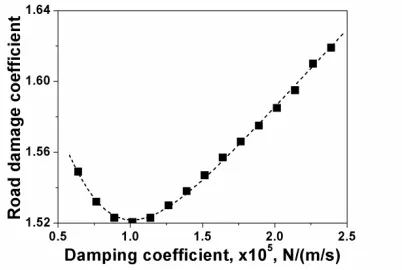
The damping is respectively reduce 0.2, 0.4, 0.6, 0.8 times, and magnified 1.2, 1.4, 1.6, 1.8, 2 times, then we fit the results of simulation and obtain the change rule of road friendliness and ride comfort with the change of damping coefficient, as shown in figure 2 .
Fig.2 The change rule of road friendliness with damping
Figure 2 show that with the damping coefficient increasing, road damage coefficient of vehicles is decreased first and then increased, thus is can be seen, reduce damping coefficient appropriately will improve vehicle ride comfort and road friendliness in a certain extent.
2.3 suspension parameters optimization
[image:3.595.209.410.516.651.2]objective function, to obtain optimized the optimized suspension damping and stiffness by genetic algorithm, which can make the road damage coefficient is minimal.
Optimization algorithm on the suspension parameters matching has been more used in recent years. We choose more island genetic algorithm to implement single objective optimization problem in this paper. Optimization model is established based on the Isight software, the design variables, target, constraints, and initial value also was defined. Isight provides rich optimization algorithm and various agency model method, and a good visual function, suitable for optimization design of engineering systems and comprehensive system analysis
The damping values range was determined according to a partial heavy trucks frequency, heavy trucks loaded with partial frequency between 1.7 to 2.17 Hz, damping optimization range according to the same as the stiffness ratio[6]. The initial value of optimized variables and scope as shown in table 2.
Tab.2 The range of optimize variables
variable Lower limit initial value Upper limit
K/N.m-1 890000 1780000 3560000
C/N.s.m-1 58500 117000 234000
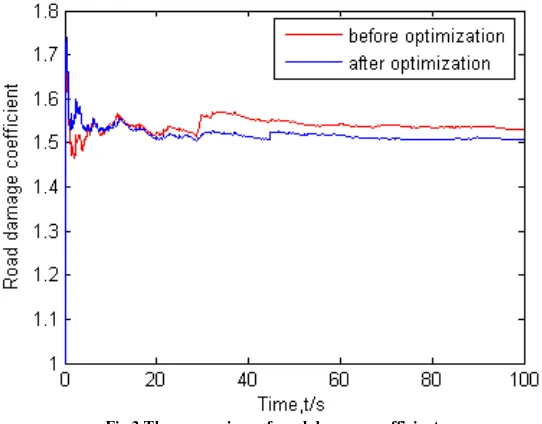
The suspension stiffness is 126300N.m-1 and damping is 91600 N.s.m-1 after optimization, stiffness and damping are decreased.
[image:4.595.170.441.343.555.2]Figure 3 is the comparison of road damage coefficient before and after optimization, as the figure shown, the road friendliness evaluation index is decreased which can reduce the damage to the road by vehicle.
Fig.3 The comparison of road damage coefficient
3 the design of optimal fuzzy controller for semi-active suspension
The Semi-active suspension can adjust suspension damping according to the vehicle vibration when driving, so as to effectively reduce the road damage by heavy truck.
Fig.4 The stuck of optimal fuzzy control strategy
In figure 4, F is the optimal damping force and re F is the actual damping force. Dampingr C adjusted by the
fuzzy controller, making F near r F as much as possible. re
3.1 The design of optimal controller
The optimal control is to make the system work according to certain control rule, which can make a certain indicator of the system performance to achieve the optimal under certain significance. The control goal is to make the vehicle to get good road friendliness, and also consider the riding comfort of vehicle. The decrease of the vehicle dynamic load can obviously improve the road friendliness, vehicle body vibration acceleration, suspension dynamic deflection and tire dynamic displacement can be used to evaluate the riding comfort and handling stability of vehicle.
So the vehicle dynamic load, the vehicle body vibration acceleration, tires dynamic displacement and the suspension dynamic deflection were choosed as the system output. Tthe semi-active suspension LQG integrated performance index functional scheme as follows:
(
)
22 2 2 2
1 2 2 1 0 3 2 1 4 1 0
0
lim 1 ( ) ( )
T
t T
P q z q z z q z z q k z z dt T
→∞ ∫
= && + − + − + − (6)
In the formula, q1、
2
q 、
3
q 、
4
q
are the weighted coefficient of the vehicle vertical acceleration, tire dynamic displacement and suspension dynamic deflection and wheel dynamic load.The expression of z&&2get by solving the system movement differential equation, then plug into the performance
index functional,
P
was rewritten into a standard form:(
)
0
lim 1 T T T 2 T
T
P X QX U RU X NU dt T
→∞ ∫
= + + (7)
In the formula, Qis the state weighted matrix; Ris the the weighted matrix of control; Nis the cross weight matrix.
According to the optimal control theory, the optimal control rule of the system is:
KX
U=− (8)
) (
1
P B N R
K = − T + T is the optimal feedback gain matrix of the system; P is the only positive definite solution for
Ricatti equation PA+ATP−PBR−1BTP+Q=0.
(9)
Assumes that the weighting coefficient of the vertical acceleration is W1, its subjective weighting proportion coefficient is 1, and it is the quantitative standard, other subjective weighting proportion coefficients is obtained according to the formula:
1
, (
1, 2, 3, 4)
ii
W
i
W
γ
=
=
(10)Select the root mean square value of each performance index as the basis, process them with the same scale quantization. The scale of quantitative ratio of the vertical acceleration is 1, the weighted coefficient of other performance index is obtained
2 2 2 z i i
σ
β
σ
=
&&(11)
The total weighted coefficient of the indexes is obtained according to the formula:
i i i
q
= ×
γ β
(12)The parameter were plug into those formula, then calculate A, B, Q, R, N. Using the linear quadratic optimal controller design function LQR( A, B, Q, R, N) , obtained the optimal feedback gain matrix K
K=-665740 -124100 97800 -234600
3.2 The design of fuzzy controller
The structure of the fuzzy controller is two inputs and single output. Tow input are the error e and its change rate
ec between the actual damping force and the optimal damping force, output is the shock absorber damping
coefficient C. The input choose Guassmf type membership function, output choose Trimf type membership function. In fuzzy, to fuzzy, input and output are both seven language values, they are positive big (PB), the positive median (PM), is positive small (PS), zero (Z) and negative small(NS), negative median (NM) and negative big (NB), fuzzy comprehensive domain are [6, 6].
The fuzzy controller used the Mandani reasoning method. The principle of fuzzy rules is: when the error is big, the control quantity is selected to eliminate the error as soon as possible; When the error is small, the control quantity is selected to prevent overshoot, give priority to with system stability, the fuzzy rules in table 3.
Tab.3 The fuzzy rules
NB NM NS Z PS PM PB
NB NB NB NB NM NS NS Z
NM NB NB NM NS NS Z PS
NS NB NM NS NS Z PS PM
Z NM NS NS Z PS PS PM
PS NM NS Z PS PS PM PB
PM PB NS Z Z PS PS PM PS PM PM PB PB PB PB PB
RESULTS AND DISCUSSION
The simulation and the result analysis of semi-active suspension control
Selecting the optimized suspension stiffness and damping, the semi-active suspension control model is established in Simulink. Then do a performance comparison between the semi-active suspension and the passive suspension vehicle. The road damage coefficient comparison of optimal fuzzy control suspension and passive suspension as
e e
1 1 3 1 / 2
1 2 2 1 / 2
1 / 3 1 / 2 1 1 / 5
2 2 5 1
shown in figure 5. It can be seen from the diagram, the optimal fuzzy control suspension vehicle road friendliness is obviously improved, compared with the passive vehicle, the root-mean-square value of road damage coefficient J was reduced by 11.8%.
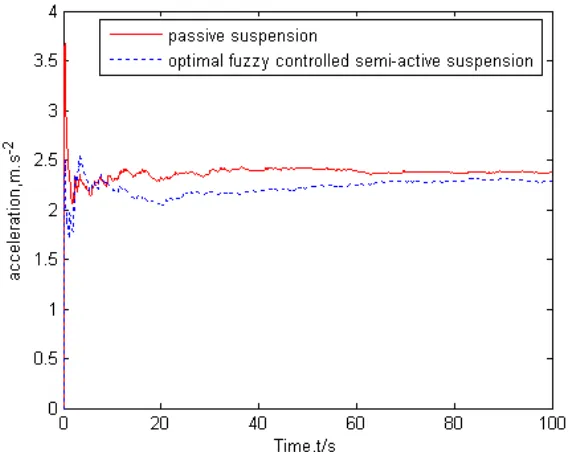
[image:7.595.173.440.164.353.2]Figure 6 is the root-mean-square value of vehicle body vertical acceleration comparison of the optimal fuzzy suspension control and passive suspension, as the figure shown, the vehicle body vertical acceleration amplitude is also decrease.
Fig.5 The road damage coefficient comparison of optimal fuzzy control suspension and passive suspension
Fig.6 The ride comfort comparison of optimal fuzzy control suspension and passive suspension
In this paper, the control objective is improving the vehicle on road friendliness, the key performance indicator lowering road damage coefficient. It can be seen from the simulation results, compared with the passive suspension, the vehicle road friendliness is better for the optimal fuzzy control, and the tyre dynamic load is reduced, the vehicle driving security and ride comfort also have improved.
Therefore, select this control method can greatly increased road friendliness on the premise of vehicle driving security and ride comfort.
CONCLUSION
[image:7.595.163.449.377.603.2]friendliness and vibration comfort, and used the optimization method to optimize the suspension stiffness and damping with the goal of improving the road friendliness, the results showed that the optimized suspension for road friendliness has certain improvement.
2) A semi-active control of suspension was studied based on adjustable damping shock absorber, concerning both the road friendliness and ride comfort. The results showed that the optimal fuzzy controlled semi-active suspension can significantly reduce the road damage coefficient and, to some extent, the tyre dynamic load is reduced, improved the vibration comfort, compared to the passive suspension.
REFERENCES
[1] Cole D J. Proc. Inst. Mech. Engrs. (S0954-40070).1996, 210(2),95-107.
[2] Yi K, Hedrick K. The use of semi-active suspension to reduce pavement damage. Journal of ASTM, Special
Technical Publication CA, USA: Berkley University, 1990.
[3] Yan Tianyi Liu Dawei, Chen Huanming etc. Chinese Journal of Mechanical Engineering. 2007,42(7),163-167;
[4] Chen Yikai, He Jie etc. Journal of Jiangsu University(Natural Science Edition). 2009,30(5),251-255.
[5] Valasek M, Kortum W, Sika Z, Magdolen L, Vaculin O. Control Engineering (S0967-0661), 1998, 6(6),735-744. [6] Zhang Zhifei, Liu Jianli, Xu Zhongming. Automotive Engineering.2012