Journal of Chemical and Pharmaceutical Research, 2014, 6(7):679-684
Research Article
CODEN(USA) : JCPRC5
ISSN : 0975-7384
Social group recommendation using topic models
1
Jing Wang and
2Hui Zhao
1
Xidian University, Xi’an, China
2Xi’an Jiaotong University, Xi’an, China
_____________________________________________________________________________________________
ABSTRACT
In this paper, we take the user influence and their relationship into account to propose a new group recommendation method, which utilizes the topic oriented analysis to calculate the user influence on specific topic and to construct topical sub-groups. Based on these topical sub-groups, different user factors are used to depict the topical sub-group characteristics more properly and to calculate the user influence (including individual and social) on the topical sub-groups. Experimental results demonstrate the effectiveness and efficiency of the proposed method, and also show that the proposed method can improve the prediction accuracy of the group recommendation.
Key words: Group recommendation; topic oriented; user influence analysis; social networks
_____________________________________________________________________________________________
INTRODUCTION
Nowadays, social networks[1,2] are commonly used in our life and work, such as Facebook, Twitter, and MySpace. They provide invaluable contextual information concerning the preferences of individuals, e.g. their favorite books, music, movies, and restaurants, as well as their relationships with the others. In social networks, we know that the users have impact on each other. This is usually referred to emotional infection, which is proportional to the trust between the people, the more the people you trust, the greater influence he/she is on you.
With the development of social network services [2,3] like micro-blogging, many recommendation systems have recommend item to a group of users, called as group recommendation system. However, we know that the social network services always contain large amounts of information on different topics. For example, some users are interested in sports, so they will talk about or discuss NBA in social networks; while other people may be interested in movies, they will discuss more about directors or actors. Of course, user may have more than one interests and hobbies. We can know that a user may have different influences on different topics. There has been some researches show that the user influence in social may be different from different topics. For example, in social networks, A can have high influence to B about NBA, but B may have even higher influence to A on movies. So the recommendation system will not recommend appropriate items to user without topical user influence analysis in large-scale social networks.
In this paper, we take the user influence and their relationship into account to propose a new group recommendation method, which utilizes the topic oriented analysis to calculate the user influence on specific topic and to construct topical sub-groups. Based on these topical sub-groups, different user factors are used to depict the topical sub-group characteristics more properly and to calculate the user influence (including individual and social) on the topical sub-groups.
RELATE WORKS
SOCIAL RECOMMENDATION
to find a model (static or dynamic), which modeling for the user’s influence as well as for user’s behavioral influence. Goyal’s method can handle large social network, but it ignores behavior correlation between users and the node attributes of user itself. To address this situation, Provost, etc. proposed social behavior tracking, mainly studying how to modeling with the social network structure, user attributes and user behavior [5]. Xiang etc. proposed a latent variable model, which is based on the similarity of user’s profile and user interaction activity-based strength of the relationship. The purpose of the proposed model is to find a strong relationship among the user network [6].
GROUP RECOMMENDATION
With the emergence of group behavior, there are some studies for group recommendation. Reference [7] proposed an algorithm to recommend appropriate and novel content to groups of people. Based on the Power Balance Map and the Behavioral Tendency of each group, the algorithm recommends new content in or near high-density areas on the group’s feature space. Reference [8] took the advantage of differences and the correlation of the dependencies between users in the group into consideration to formalize the notion of a consensus function, which achieves a balance between an item’s aggregate relevance to the group and individual member’s disagreements over the item. They designed and implemented efficient threshold algorithms to compute group recommendations.
TOPIC LEVEL RECOMMENDATION
Reference [9] presented a novel approach iTop to discover topic-centric interaction based communities on Twitter. They evaluated the discovered communities along three dimensions: graph based (node-edge quality), empirical-based (Twitter lists) and semantic based (frequent n-grams in tweets), to discover topic-centric, interaction based communities on Twitter. Reference [10] discussed how they can extend probabilistic topic models to analyze the relationship graph of popular social-network data, so that they can “group” or “label” the edges and nodes in the graph based on their topic similarity. They first applied the well-known Latent Dirichlet Allocation (LDA) model and its existing variants to the graph-labeling task and argued that the existing models do not handle popular nodes (nodes with many incoming edges) in the graph very well. They then proposed possible extensions to the model to deal with popular nodes.
THE DEFINITION OF INFLUENCE TOPIC MODEL THE MODEL DEFINITION
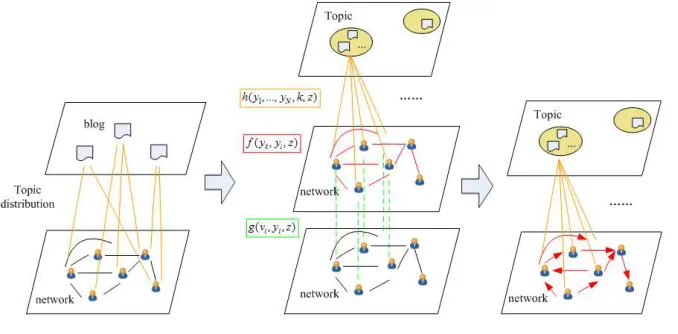
How to leverage both node-specific topic distribution and network structure to quantify social influence? In another word, a user’s influence on others not only depends on their own topic distribution, but also relies on what kinds of social relationships they have with others. The goal is to design a unified approach to utilize both the local attributes (topic distribution) and the global structure (network information) for social influence analysis.
Definition (1): Given a network
G
=
( , )
V E
,where V is the set of nodes (users, entities) and E is the set of directededges, 2) T-dimensional topic distribution T
v
R
θ
∈
for all node v in V , how to find the topic-level influence network( ,
)
z z z
G
=
V E
for all topics 1≤ ≤z T? HereV
z is a subset of nodes that are related to topic z andE
z is the set of [image:2.595.141.480.535.702.2]pair-wise weighted influence relations over
V
z.Fig. 1: The topic-level influence network
definition of improved TFG model as following. Joint Distribution definition:
1
1 1 1 1 1
1
( , )
( ,...,
, , )
( ,
, )
(
,
, )
kl
N T N T T
N i i k l
k z i z e E z
P V Y
h y
y
k z
g v y z
f y y z
Z
= = = = ∈ ==
∏∏
⋅
∏∏
⋅
∏∏
(1)where
V
=
[ ,...,
v
1v
N]
andY
=
[ ,...,
y
1y
N]
corresponds to all observed and hidden variables, respectively;g
( )
⋅
and( )
f
⋅
are the node and edge feature functions;h
( )
⋅
is the global feature function; all these functions will be introduced detailedly in later. Z is a normalizing factor.FEATURE COMPUTATION
Given a social network
G
=
( , )
V E
, the goal is to find topic-level user influence. Based on the characteristics of the group, we can reflect different influence for the different types of groups on the theme of social.In this paper, we use four modules to represents the characteristics of the group, defined as: Leader, Expert, Social and Similarity. The four modules mainly are divided into two dimensions:(a) Leader and Expert describe the single-user, and the Social and Similarity describe relationship between different users.
(b) Leader and Similarity describe user influence depend on the content, while the Leader and Social are based on social structure.
According to the different of group's activities or group gathering, some modulesmay be more important than the others. For instance, in certain cases, for the characterization of the group, Expert is more important.
NODE FEATURE FUNCTION DEFINITION
Node feature function
g v y z
( , , )
i i is defined as distribution calculation for nodev
i specific to topic z. Their quantitative calculations include: the user's behavior on the micro-blogs,UM v z
( , )
and the user’s influence on thegroup,
UG y
( )
i . Therefore, we can obtain the following equation.( ,
i i, )
( )
i( , )
ig v y z
=
UG y
⋅
UM v z
(2)In the micro-blog, a user can publish, brows, or follow micro-blogs, so we can get users’ influence related with his published micro-blogs. The more micro-blogs the user publishes, the more active the user will be. We get the user activity
UM v z
( , )
by following formula:, , ( , )
( )
( , ) (1 ) ( , )
i j i j i j
z z
i v v v v v v j
v B u
UM v z d d A UM v z
⊆
= + −
∑
(3), ,
' ' i j i i j
i i
AT v v v z z
v v AT
v z v z
M
C
d
M
C
T
α
α
+
=
⋅
+
∑
∑
(4)( ,i j) 1 N
v v u n n
A a a
=
=
∑
, au =n Tu (5)In Equation (4), ,
i j
z v v
d
is probability of userv
i forward the userv
j ’s micro-blogs on topic z, where,
i j i
v v v
M
∑
M
represents the probability of userv
i forward the userv
j ’s micro-blogs;' '
(
v zATi) (
v zATi)
z
C
+
α
∑
C
+
T
α
represents the probability of userv
i on topic z;i
AT v z
C
stands for total number ofusers assigned to topic z, α is the Dirichlet distribution over parameters. In Equation (5), ( , )
i j
v v
A
is ratio of the value ofUM
, the user v assigned to the user u, which depend on the user u’s user activity and account of his all friends activity.u
more objective portrayal of the user's level of activity.
UG y
( )
i stands for the user’s influence on the group, which introduce the different group feature to users’ behavior for the micro-blogs.exp
( )
i(
leader( )
ert( ))
u G
UG y
desc
u
desc
u
∈
=
∑
+
(6)max(
)
( )
(
|
|)/ |
|
u leader
u u G
N
desc
u
N
G
∈
|
|
=
∑
(7)expert
( )
u G udesc
u
=
∑
∈|
M
| | |
G
(8)where
|
N
u|
refers to the number of friends of user u in the group, and|
M
u|
is the number of the user’s favoritemicro-blogs on topic z;
|
G
|
refers to the number of all members in the group.EDGE FEATURE FUNCTION DEFINITION
Edge feature function
f y y z
(
k,
l, )
is defined as the edge of the input network specific to topic z:similar social
(
k,
l, )
( , )
k( , ) {
l(
(
kl, )
(
kl))}
u G
f y y z
UM v z UM v z
desc
y
z
desc
y
∈
=
⋅
⋅
∑
+
(9)similar
(
, )
(
, )
( )
klkl y G kl
desc
y
z
=
∑
∈Fr y
z
|
Pairs G
|
(10)social
(
)
(
)
( )
klkl y G kl
desc
y
=
∑
∈Ps y
|
Pairs G
|
(11)where,
Fr y
(
kl)
stands for the number of favorite micro-blogs of the userv
kandv
l on topic z;y
klis the edgebetween
v
kandv
l;UM y
(
kl, )
z
represents the probability ofv
l’s micro-blogs followed by userv
k;Ps y
(
kl)
isthe number of same friends of
v
kandv
l in the group;|
Pairs G
( ) |
refers to the number of all friend members in the group.GLOBAL FEATURE FUNCTION DEFINITION
Global feature function
h a
(
=
y
1,...,
y
N, , )
k z
is a feature function defined on all nodes of the input network to topic z:' '
' '
(
,
, , )
n
WT AT
kj yj
i i i i i WT AT
k j yj
k j
C
C
P z
j x
y
w
k z x
C
V
C
T
β
α
β
α
+
+
=
=
|
=
=
+
+
∑
∑
(12)where,
z
i=
j x
,
i=
y
n represents the i-th word in article, assigned to the j-th topic and y-th author;w
i=
k
meansthat i-th word is the k-th word in dictionary. In addition
z x
i,
i refer to the rest of the i-th for topic and authorassignments.
C
kjWTis the total number assigned to topic j before assigning word k;C
yjAT is the total number for authorn
y
assigned to topic j.After get the probability of a word belonging to a topic, we can get which topic the micro-blog is belonging to.RESULTS
DATA SETS
Table 1: keywords of the topics
topic1:
“Obama” topic 2: “Family” topic 3: “Military Operations”
topic 4: “Imprisonment”
presid (0.0146) obama (0.0143) govern (0.0113) countri (0.0103) offici (0.0094) secur (0.0092) militari (0.0082) year (0.0080) minist (0.0079) state (0.0077)
women (0.0272) school (0.0160) children (0.0157)
year (0.0149) old (0.0149) woman (0.0126) men (0.0124) man (0.0121) girl (0.0109) student (0.0103)
cia (0.0130)
report (0.0112) million (0.0107) work (0.0103) compani (0.0100)
money (0.0095) oper (0.0093) blackwat (0.0082) use (0.0077)
state (0.0071)
prison (0.0194) court (0.0137) case (0.0104) charg (0.0099) releas (0.0092) detaine (0.0083) tortur (0.0080) alleg (0.0072) investig (0.0069) guantanamo (0.0061)
After data preprocessing, we get a small social group (as whole group) from this data set composed of 21 users, 172 relationships and more than 500 blogs with 4 topics. On average, each user has 2 interested topics, 10 friends and 25 blogs. Then we classify it into four sub-groups by topic. Table 1 shows the name of the topics and keywords.
EVALUATION MEASURES
In group recommendation system, recommendation quality metrics commonly use group mean absolute error(GMAE). The smaller the GMAE is, the better recommendation is.
| ( , ) ( , ) | | |
m M
GMAE=
∑
∈ pred G m −r G m M (13)where,
|
M
|
is the size of the test set. In our experiments, to evaluate our proposed methods for group recommendation, we predict an item to a topical sub-group compared with the whole group. In order to verify the effectiveness of the improved model TFG, we use the user preferences found in testing for the accuracy by the follow four algorithms, and thenwe compare the actual user rate with the results of the test. Table 2 shows the results comparisons.①Base Line method(TFG): The algorithm ignores the influence among users.
②Social Model method: it only considers the user influence based on node feature function.
③Link Model method: it only considers the user influence based on edge feature function.
④Full Model method: it considers various topics based on global feature function.
⑤Proposed model: combining the methods of .
Table 2: Comparison of GMAE results
Methods GMAE
Topic1 Topic2 Topic3 Topic4 whole group ① 1.1354 1.1157 1.1403 1.1890 1.5369 ② 1.0166 0.9531 0.8487 0.9899 1.4832 ③ 1.0348 0.9742 0.9562 0.8795 1.4634 ④ 0.9241 0.8557 0.9797 1.1407 1.3945
⑤ 0.8231 0.8145 0.7846 0.8056 1.2715
we also can see that all our methods (②③④) are much better than TFG on all topics. This confirms that four user modules can calculate the user influence on the topical sub-groups more accurately. The all-factors achieve even better result compared to others, which prove that it can depict the topical sub-group characteristics more properly.
CONCLUSIONS
In this paper, we proposed a new group recommendation method based on the topic oriented user analysis to obtain the user influence on specific topic. Furthermore, four user modules are used to calculate the user influence (including individual and social) on the topical sub-groups, which can depict the topical sub-group characteristics more properly. At last, we give our group recommendation algorithm utilizing user influence on specific topic and user modules, and the experimental results show that our method outperforms than the others.
As for future work, we intend to improve our method by using more sensible functions to formalize the user influence on specific topic and topical sub-group. Moreover, we will evaluate our method with real groups and data.
Acknowledgments
This research project was promoted by The National Natural Science Foundation of China (No. 61202177); The Fundamental Research Funds for the Central Universities.
REFERENCES
[1]S Aral; D Walker, Science, vol.337, no.6092, pp.337-341, July 2012.
[2]Q Gao; F Abel; GJ Houben; Y Yu, A comparative study of users’ microblogging behavior on Sina Weibo and
Twitter. User Modeling, Adaptation, and Personalization, pp.88-101, 2012.
[3]H Kwak;C Lee;H Park; S Moon, What is Twitter, a social network or a news media?. Proceedings of the 19th
International Conference on World Wide Web, pp.591-600, 2010.
[4]A Goyal;F Bonchi; LV Lakshmanan, Learning influence probabilities in social networks. Proceedings of the third
ACM International Conference on Web Search and Data Mining, pp.241-250, 2010.
[5]F Provost;B Dalessandro;R Hook;X Zhang;A Murray,Audience selection for on-line brand advertising:
privacy-friendly social network targeting. Proceedings of the 15th ACM SIGKDD International Conference on
Knowledge Discovery and Data Mining, pp.707-716, 2009.
[6]R Xiang;J Neville; M Rogati, Modeling relationship strength in online social networks. Proceedingsof the 19th
International Conference on World Wide Web, pp.981-990, 2010.
[7]S Seko;T Yagi;M Motegi;S Muto, Group recommendation using feature space representing behavioral tendency
and power balance among members. Proceedings of the fifth ACM conference on Recommender Systems, pp.101-108,
2011.
[8]AY Sihem; R Senjuti Basu; C Ashish; D Gautam; Y Cong,Group recommendation: Semantics and efficiency.
Proceedings of the VLDB Endowment,vol.2, no.1, pp.754-765, 2009.
[9]D Correa;A Sureka;M Pundir,iTop: interaction based topic centric community discovery on twitter. Proceedings of
the 5th Ph. D. workshop on Information and knowledge, pp.51-58, 2012.