Journal of Chemical and Pharmaceutical Research, 2014, 6(12):748-753
Research Article
ISSN : 0975-7384
CODEN(USA) : JCPRC5
Study of stability constants of complex of
N-benzothiazol-2-yl-3,5-disubstituted pyrazolines with some transition metal ions
A. G. Gotmare*, A. S. Burghate and S. A. Wadhal
Post Graduate Department of Chemistry, Shri Shivaji Science College, Amravati, Sant Gadge
Baba Amravati University Amravati, Maharashtra, India
_____________________________________________________________________________________________
ABSTRACT
The proton-ligand and metal-ligand stability constants of the complexes of Cu(II), Ni(II),Co(II) with 1-Benzothiazol-2-yl-3-(2-hydroxy phenyl)-5-(4-methoxy phenyl) pyrazoline (L1), 1-Benzothiazol-2-yl-3-(2-hydroxy phenyl)-5-phenyl pyrazoline (L2), 1-Benzothiazol-2-yl-3-(2-hydroxy phenyl)-5-(4-chloro phenyl) pyrazoline(L3), 1-Benzothiazol-2-yl-3-(2-hydroxy-5-methyl phenyl)-5-(4-methoxy phenyl) pyrazoline (L4), 1-Benzothiazol-2-yl-3-(2-hydroxy-5-methyl phenyl)-5-(4-chloro phenyl) pyrazoline(L5) and 1-Benzothiazol-2-yl-3-(2-hydroxy-5-methyl phenyl)-5-phenyl pyrazoline(L6) have been determined by pH-metric method in medium of 80% acetone-water mixture at 0.1M ionic strength and at (30± 0.1)0C temperature.
Keywords: Proton-ligand and metal-ligand stability constants, pH-metric study, N-Benzothiazol-2-yl-3,5-disubstituted pyrazolines, Cu(II), Ni(II), Co(II).
_____________________________________________________________________________________________
INTRODUCTION
The stability of coordination compounds in solutions is determined by knowing the value of stability constant. A stability constant is an equilibrium constant for the formation of the strength of the interacting reagents which is responsible for the formation of complex.
Transition metal possess a characteristics property of formation of metal complexes or metal coordination compounds. The metal ion coordinate with a variety of molecular species to form complexes which possess different physicochemical properties hence having wide applications in purification of water, extraction of metals, in medicines etc.
A nitrogen containing 5-membered heterocyclic compounds are pyrazolines, benzothiazolyl and benzimidazolyl are substituted derivatives with wide application in pharmaceutical chemistry[1],[2]. Numerous pyrazoline derivatives have been found to possess considerable biological activities like antimicrobial[3]-[5], anti-inflammatory[6],[7]activities.
anticancer[12], antitumor[13], antidiabetic[14] and their metal ion complexes have special importance in biochemical systems.
From this, it can be predicted that these compounds may be used in pharmaceutical industries where the physical properties of compounds with different solvents may be required[15]. Literature survey reveals that stability constants of various compounds were studied[16-23]. The present paper gives the idea about the stability constants of transition metal ions Cu(II), Ni(II), Co(II) with 1-Benzothiazol-2-yl-3-(2-hydroxy phenyl)-5-(4-methoxy phenyl) pyrazoline (L1), 1-Benzothiazol-2-yl-3-(2-hydroxy phenyl)-5-phenyl pyrazoline(L2), 1-Benzothiazol-2-yl-3-(2-hydroxy phenyl)-5-(4-chloro phenyl) pyrazoline(L3), 1-Benzothiazol-2-yl-3-(2-hydroxy-5-methyl phenyl)-5-(4-methoxy phenyl) pyrazoline (L4), 1-Benzothiazol-2-yl-3-(2-hydroxy-5-methyl phenyl)-5-(4-chloro phenyl) pyrazoline(L5) and 1-Benzothiazol-2-yl-3-(2-hydroxy-5-methyl phenyl)-5-phenyl pyrazoline(L6) in 1:1 ratio at (30± 0.1)0C temperature. For this study 80% acetone-water mixture were used as solvent. The ionic strength was maintained constant at 0.1 M.
EXPERIMENTAL SECTION
The pH-metric study of proton-ligand and metal-ligand stability constants were calculated by pointwise calculation method and half integral method.
N-Benzothiazol-2-yl-3,5-disubstituted pyrazolines i.e. Ligands (L1 to L6) containing only one replaceable hydrogen H+ ion from the phenolic –OH group and can be written as
HL H+ + L-
K’ =
The proton-ligand stability constants can be determined by using Irving-Rossetti expression.
nA = γ –
Where, γ – denotes the number of replaceable protons. N - is the concentration of NaOH
E0 – concentration of acid TL0 – concentration of ligand
V0 – initial volume of solution
V1,V2 – volume of alkali during acid and ligand titration.
Similarly, metal-ligand stability constants can be derive by
n = [
Where, N,E0,Vo – denotes as above nA- proton-ligand stability constants
Tm0 – concentration of metal ion
V2,V3 – volume of alkali during ligand and metal ion titration.
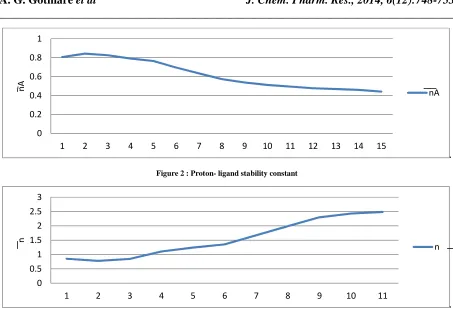
Both the constants were calculated by plotting graphs against pH values by half integral and point wise calculation methods.
dissolving the requisite quantities in distilled water. The standard NaOH solution was prepared by Vogel’s method[24].
The pH-metric titrations were carried out at (30± 0.1)0C. The pH of the solution was measured with a EQUIPTRONICS microcontroller pH meter (Model EQ-621) equipped with a combined electrode & magnetic stirrer. The instrument was calibrated before each titration with an aqueous standard buffer solution of pH 4,7,9 prepared from Qualigens buffer tablets. All the weighing were done on electric balance (Contech CB-Series with accuracy ±0.001) .
The pH-metric titrations were carried out by following ways :
1) Acid titrations : HNO3(0.1M)
2) Acid + ligand titrations : HNO3(0.1M) + ligand(0.01M) + metal ion (0.01M).
The ionic strength of all the solution was maintained constant by adding appropriate amount of KNO3 solution. All
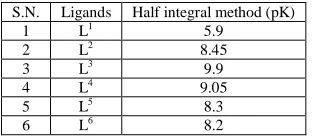
the titrations were carried out in 80% acetone-water mixture & the reading were recorded for each 0.5ml addition by using Calvin-Bjerrum pH-metric titration technique [25], [26]. The graph of volume of alkali (NaOH) against pH were plotted. From the pH values, proton-ligand stability constants were calculated by using Irving-Rossetti method[27]. The values of proton-ligand stability constants are given in table-1.
RESULTS AND DISCUSSION
The complexes of s- and p- block elements are almost colorless. But the transition metal complexes are generally colored. Color of a species is associated with the promotion of an electron from one energy state to another. The energy required to do this is obtained by absorbing the light of a particular wavelength. In transition elements, there are partially filled d levels. These d levels are split into different energy levels depending upon the geometry of the complex. Thus there is the possibility of promoting one electron from one d level to another d level. This transition is known as d-d transition. This corresponds to a small energy difference resulting in absorption of light of higher wavelength in the visible region and the complex appear colored.
On the basis of nature of ligands , ligands having different splitting ability. The ligands are arranged in the order of their increasing splitting ability. This series is called spectrochemical series. According to this series NO3- is an
intermediate field strength ligand, still forming the stable complexes with transition metals.
[image:3.595.221.379.557.625.2]In the present study, the formation of complex was confirmed by the color changes from colorless to yellow or green at the time of titration. During titration, the color changes were due to the simultaneous formation of 1:1 and 1:2 complex by the ligand with metal ion.
Table 1 : Proton-ligand stability constants (pK) of ligand L1to L6 at 0.1 M ionic strength and at (30±0.1oC) temperature in 80%
acetone-water medium
S.N. Ligands Half integral method (pK)
1 L1 5.9
2 L2 8.45
3 L3 9.9
4 L4 9.05
5 L5 8.3
6 L6 8.2
In the result of proton-ligand stability constants, variations are obtained in the values. This may be due to the intermolecular interactions like solute-solvent and solvent-solvent interactions as the solvents are polar in nature.
According to Irving-Williams series[28], metal-ligand stability constants of complexes follows the order
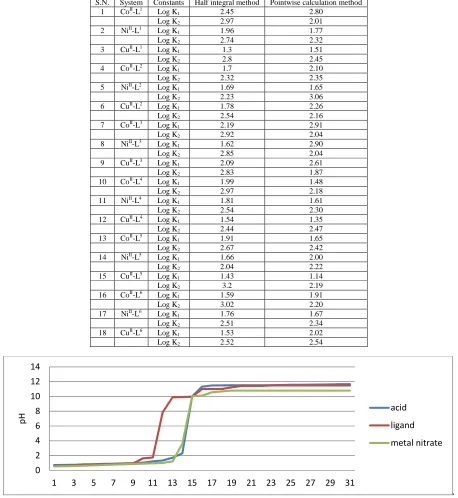
This order is obeyed by metal complexes with ligand L1 , L4 and L6 while other ligands are not follow this pattern because of some facts like differ in electronic structure of metal ions ,ionic radius, nature of ligands involved in dπ -pπ interactions, nature of solvent etc.
Table 2 : Metal-ligand stability constants of complexes Co(II), Ni(II), Cu(II) with ligand L1 to L6 in 80% acetone-water medium
S.N. System Constants Half integral method Pointwise calculation method
1 CoII-L1 Log K
1 2.45 2.80
Log K2 2.97 2.01
2 NiII-L1 Log K
1 1.96 1.77
Log K2 2.74 2.32
3 CuII-L1 Log K1 1.3 1.51
Log K2 2.8 2.45
4 CoII-L2 Log K
1 1.7 2.10
Log K2 2.32 2.35
5 NiII-L2 Log K
1 1.69 1.65
Log K2 2.23 3.06
6 CuII-L2 Log K1 1.78 2.26
Log K2 2.54 2.16
7 CoII-L3 Log K
1 2.19 2.91
Log K2 2.92 2.04
8 NiII-L3 Log K
1 1.62 2.90
Log K2 2.85 2.04
9 CuII-L3 Log K
1 2.09 2.61
Log K2 2.83 1.87
10 CoII-L4 Log K1 1.99 1.48
Log K2 2.97 2.18
11 NiII-L4 Log K
1 1.81 1.61
Log K2 2.54 2.30
12 CuII-L4 Log K
1 1.54 1.35
Log K2 2.44 2.47
13 CoII-L5 Log K1 1.91 1.65
Log K2 2.67 2.42
14 NiII-L5 Log K
1 1.66 2.00
Log K2 2.04 2.22
15 CuII-L5 Log K
1 1.43 1.14
Log K2 3.2 2.19
16 CoII-L6 Log K1 1.59 1.91
Log K2 3.02 2.20
17 NiII-L6 Log K
1 1.76 1.67
Log K2 2.51 2.34
18 CuII-L6 Log K
1 1.53 2.02
Log K2 2.52 2.54
.
Figure 1 : pH-Metric titration curve
0 2 4 6 8 10 12 14
1 3 5 7 9 11 13 15 17 19 21 23 25 27 29 31
p
H
[image:4.595.69.527.169.667.2].
Figure 2 : Proton- ligand stability constant
.
Figure 3 : Metal-ligand stability constant
CONCLUSION
The N-benzothiazolyl-2-yl-3,5-disubstituted pyrazolines act as multidentate ligands and results in the simultaneous formation of 1:1 and 1:2 complexes with transition metal ions Co(II),Ni(II),Cu(II).
Acknowledgement
The authors are thankful to the Principal, Shri Shivaji Science College, Amravati for providing necessary facilities during this work.
REFERENCES
[1]A.W.Wakode; A.S.Burghate; S.A.Wadhal, Indo Amc. J.Pharma. Res.,2014, 4(10), 5010-5016
[2]Ö.D.Can; Ü.D.Özkay; Z.A. Kaplanclkll and Y. Öztürk, Arch. Pharm. Res., 2009, Vol 32, No 9, 1293-1299 [3]A.Sahoo; M. Parida; B.N.Sinhna;Venkatesan, J.,Int.J.Res.Pharma.& Chem., 2011,1(3)
[4]B.K.Sarkar; R.Patel; U.Bhadoriya; J. Adv.Pharma. Ed. & Res., 2011, 1(5), 243-250 [5]J.V.Phirke; Y.K. Meshram, IJSR, 2014, 3(9)
[6]6)S.K.Sahu; M.Banerjee; A.Samantry; C.Behera; M.A.Azam, Trop.J.Pharma.Res., 2008,7(2),961-968 [7]M.Amir; S.Kumar, Ind. J. Chem., 2005,44B, 2532-2537
[8]8)Y.S.Chovatia; S.P.Gandhi; P.L.Gorde; S.B.Bagade, Ore.J.Chem., 2010, 26(1), 275-278 [9]9)S.Y.Hassan, Molecules, 2013 18,2683-2711
[10]A.Ozdemir; G.Turan-Zitouni; Z.A.Kaplancikli, Turk.J.Chem., 2008,32,529-538 [11]M.A.Ali; M.Shaharyar; A.A. Siddiqui, Eur.J.Med.Chem., 2007, 42, 268-275
[12]M.Emayavaramban; N.Santhi; C.Gopi; C.Manivannan; A.Raguraman; Int.Letters Chem., Phy & Ast., 2013, 9(2), 172-185
[13]P.J.Jainey; J.K.Bhat, J. Young Pharma., 2012, 4(2), 82-87 [14]K.Divekar; S.Swamy; V.Murugan, eIJPPR, 1-13
[15]R.S.Talegaonkar; A.S.Burghate, J.Ind.Chem.Soc., 2012, 89, 1585-1589
[16]M.A.Rahaman; A.A.Siddiqui; Int.J.Pharma.Sci.and Drug Res., 2010,2(3),165-175
0 0.2 0.4 0.6 0.8 1
1 2 3 4 5 6 7 8 9 10 11 12 13 14 15
n
A
nA
0 0.5 1 1.5 2 2.5 3
1 2 3 4 5 6 7 8 9 10 11
n
[17]A.B.Patil, Rasayan J.chem, 2012, 5(4),490-492
[18]B.C.Khade; P.M.Deore; B.R.Arbad, Int.J.chem.Res, 2010, 2(2),1036-1041
[19]S.D.Thakur; D.T.Mahajan; K.P.Munot; R.D.Deshmukh; M.S.Tihile, Der.Pharma.Chem.,2011 3(6),382-389 [20]S.D.Dhage; M.B.Swami, IOSR J. App.chem., 2012,2(6),36-38
[21]A.A.Zaid; M.Farooqui; D.M.Janrao,Asian J. Bio. Chem. Pharma.Res., 2011,1(4),22-27 [22]A.Ramteke; M.Narwade, Arch.App.Sci.Res., 2013,5(1),231-237
[23]A.Avdeef; K.J.Box; J.E.A.Comer; M.Gilges; M.Hadley; C.Hibbert; W.Patterson; K.Y.Tam, J.Pharm & Biomed. Ana., 1999,20,631-641
[24]M.Calvin; K.W.Wilson, J.Am.chem.soc., 1945, 67,2003
[25]J.Bjerrum,’Metal Ammine formation in Aqueous solutions’, P.Hasse & son, Copenhagen,1941 [26]H.M.Irving & H.S.Rassotti, J.Chem.soc., 1954,2904
[27]A.I.Vogel, ‘A text book of quantitative inorganic analysis’, Revised ed., 1978, 304