International Journal of Emerging Technology and Advanced Engineering
Website: www.ijetae.com (ISSN 2250-2459,ISO 9001:2008 Certified Journal, Volume 2, Issue 12, December 2012)
430
Optimization of Operating Hardening Parameters and Hence
Hardness Profile of Traction Gears
Mr. Pramod Singh
1, Mr. Rohit Rajvaidya
2, Pankaj Kumar
31
Deputy Manager, Bharat Heavy Electricals Limited, Bhopal
2Asst. Professor, Department of Mechanical Engineering, UIT, Barkatullah University, Bhopal 3Student, Master of Technology, Department of Mechanical Engineering, UIT, Barkatullah University, Bhopal
Abstract – Bharat Heavy Electricals Limited (BHEL), Bhopal manufactures a wide variety of traction equipment for railway , viz action motors, alternators and generators. The heavy duty gear wheels and pinions, used in various types of traction motors ( viz165 , 253 BX/AZ , TM4939 etc ), are manufacture by BHEL . The manufacturing procedure of gear wheels include hardening to 415 HV minimum. The gear wheels were being hardened by conventional hardening process know as water Quenching process. This include heating of gear wheels quenching and tempering to achieve the required hardness. BHEL Bhopal at present is manufacturing 1500 to 1800 traction heavy duty gears per annum. Heavy duty gears usually work under most severe conditions as such the gears should possess high strength and good wear resistance. But in actual practices some difficulties arise while hardening process such as non-uniform hardness and hence cracking of gears, non-uniform temperature profile, distortion of teeth, etc. Optimization here refers to the experimental analysis according to which it was found economical and productive to switch over to induction hardening of gears instead of conventional hardening. The various pros and cons were analyses and finally induction machine has been imported and commissioned .The induction hardening resulted in hardening of gear flanks in the range of 44 to 52 Rc and a case depth of 1.5 to 3 mm. The operating parameters under consideration for hardening were Operation frequency, A.C power, Heating time and Temperature.
Keywords- Optimization, Hardness profile, Traction Gears, Wear Resistance, Strength, Hardness Pattern.
I. INTRODUCTION -TRACTION GEARS
As evident by its name the term traction gear is concerned with relative load carrying capacity or traction for a given size of the gear. The load capacity is the permissible horse-power or torque of the pinion or of the gear wheel . The load capacity is limited either by consideration of surface stress ( conventionally referred to as wear or the bending strength ). Heavy duty gears usually work under most severe conditions of service and hence it is mandatory that they should posses following properties –
1. High strength
2. High wear resistance
Heavy traction gears manufactured by BHEL for type 165 motors and 253 BX/AZ motors along with their specifications are shown in table 1.1.
Specification BX 253 AZ TYPE 253
No. of Teeth 65 91 92
Form Special Special Special
Module 11.25 7.094 7.094
Pressure Angle 20 25 25
Tooth Thickness 14.68 8.71 8.71
Depth (mm) 7.455 4.67 4.67
Chord Diameter (mm)
224.03 263.805 268.00
Base Circle Dia. (mm)
689.526 585.053 591.05
Table 1.1 – Specifications of gears manufactured by BHEL.
material for traction heavy duty gear
BHEL mainly use plain carbon steels for manufacturing traction heavy duty gears . The properties of steels vary rather widely depending on composition and heat treatment . Some interesting general principle can be noted which are :-
1. The steel used for gears contain carbon varying from 0.2 to 0.6 % .
2. All the steel could be heat treated to obtain desired hardness.
3. All the steel except AISI 1020 could be heated to 350 BHN.
4. The hardness of a steel is generally a function not of its composition but of its heat treatment.
5. It is true that the max. obtainable hardness for a given steel is determined by its composition. 6. The UTS of steel is a very direct function
International Journal of Emerging Technology and Advanced Engineering
Website: www.ijetae.com (ISSN 2250-2459,ISO 9001:2008 Certified Journal, Volume 2, Issue 12, December 2012)
431
7. The yield strength of steels tends to rangefrom above 60 % of TS in a low hardness steels to 90 % of the TS for a high hardness steel .
II. SPECIFICATION OF GEAR MATERIAL
BHEL uses plain carbon steel to manufacture traction gear of 165 motors , 253 BX/AZ motors. The specification of material is as per BHEL specification number AA19335 which is nearly equivalent to IS:2004 CL-4 & JIS-G-4051 grade S 45- C . The mechanical properties of material and their values are being shown in table 2.1.
Mechanical Property Value Ultimate Tensile Strength 63 kgf/sq.mm
Yield Point 32.63 kgf/sq.mm
[image:2.612.66.269.394.470.2]Hardness 170 – 210 BHN
Table 2.1 – Mechanical properties of material of gears
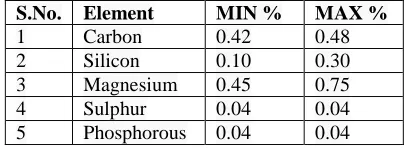
The constituent percentage in the material used for gears has been shown in table 2.2.
S.No. Element MIN % MAX %
1 Carbon 0.42 0.48
2 Silicon 0.10 0.30
3 Magnesium 0.45 0.75
4 Sulphur 0.04 0.04
5 Phosphorous 0.04 0.04
Table 2.2 – Constituent percentage in material
III. MANUFACTURING PROCEDURE FOR TRACTION
HEAVY DUTY GEARS
Forged blanks are received in normalize condition from various indigenous / foreign suppliers . After acceptance of blanks the manufacturing procedure of traction gear is as follows :
1. Rough turning 2. Finished turning 3. Teeth cutting
4. Trimming and stamping 5. Heat treatment
6. Shot blasting 7. Turning
8. Bore grinding 9. Teeth grinding 10. Testing
IV. OBJECTIVE
The objective of this thesis is
1. To study and optimize the operating parameters of induction hardening , so as achieve the required hardness profile in gear wheels .
2. To compare the convention hardening ( i.e. water quenching ) process to induction hardening process with regards to durability and serviceability of gear . Since heavy duty gear wheels are subjected to various severe stresses , the servicibility of gear wheels can be determined only after these have been out in actual operation . However since the actual service results of water quenching gear are entirely satisfactory , the comparison of hardness profile of the two type of gear i.e. water quenching gear and induction gears serve the purpose of determine the durability and servicibility .
In order to optimize the operating parameters for induction hardening , various trials were conducted by varying the operating frequency , the heating time , temperature , the % of power input etc . Finally by hit and trial runs ,when the results seemed to be satisfactory the gear wheels were subjected to hardness and crack detection tests . Further more gears wheels were induction hardened at the optimized parameters , so as to observe the repeatability and capability of induction hardening process .
V. EXPERIMENTAL SETUP
International Journal of Emerging Technology and Advanced Engineering
Website: www.ijetae.com (ISSN 2250-2459,ISO 9001:2008 Certified Journal, Volume 2, Issue 12, December 2012)
432
Courtesy: BHEL, BhopalVI. RESULTS
1. Hardness pattern on tooth of water quenched gears
Sample No. 1 (A8261)
S.no. Crest (mm) Flank (mm)
1 0.5 530
2 1.5 511
3 2.5 479
4 3.5 475
5 4.5 420
6 6.0 380
7 7.0 350
8 8.0 300
9 0.5 516
10 1.5 492
11 2.5 466
12 4.0 400
13 5.0 360
[image:3.612.62.277.129.336.2]14 6.0 320
Table 6.1 - Hardness Pattern of A8261 (Sample no. 1)
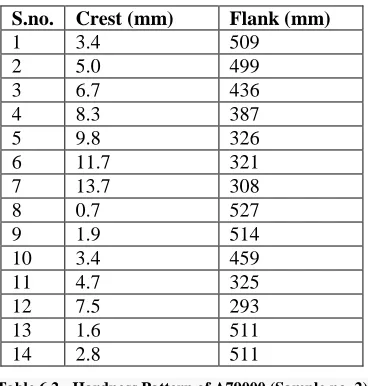
Sample No. 2 (A79000)
S.no. Crest (mm) Flank (mm)
1 3.4 509
2 5.0 499
3 6.7 436
4 8.3 387
5 9.8 326
6 11.7 321
7 13.7 308
8 0.7 527
9 1.9 514
10 3.4 459
11 4.7 325
12 7.5 293
13 1.6 511
[image:3.612.353.537.154.347.2]14 2.8 511
Table 6.2 - Hardness Pattern of A79000 (Sample no. 2)
Optimization
The parameters which govern the hardness profile of induction hardening are as follows -
1. Induction coil 2. Operating frequency 3. Heating time & temperature 4. A.C power input
The machine has been designed to suit requirements of various traction gear. Further the inductor coil have also been supplied by the supplier of the machine so as to meet the specific requirements . Inductor coil for 165 traction gear is a four turn coil . Inductor coil is specific and cannot be varied trial tests for optimization have been conducted by varying .
1. Frequency 2. Power input 3. Heating time
International Journal of Emerging Technology and Advanced Engineering
Website: www.ijetae.com (ISSN 2250-2459,ISO 9001:2008 Certified Journal, Volume 2, Issue 12, December 2012)
433
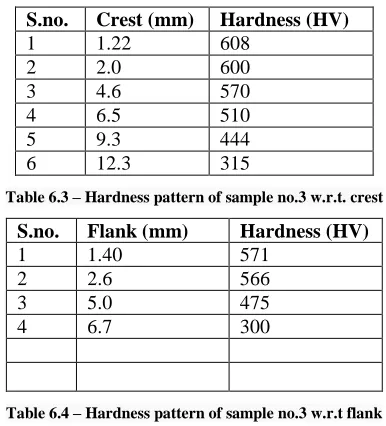
2. Hardness pattern on tooth of induction hardened gearsSample no. 3
S.no. Crest (mm) Hardness (HV)
1 1.22 608
2 2.0 600
3 4.6 570
4 6.5 510
5 9.3 444
[image:4.612.340.549.127.396.2]6 12.3 315
Table 6.3 – Hardness pattern of sample no.3 w.r.t. crest
S.no. Flank (mm) Hardness (HV)
1 1.40 571
2 2.6 566
3 5.0 475
[image:4.612.71.264.167.380.2]4 6.7 300
Table 6.4 – Hardness pattern of sample no.3 w.r.t flank
3. Optimization of tempering cycle
Tests were conducted at various temperatures keeping time constant at 4 hrs. So temperature where subjected to side hardness tests at 4 points ( 2 point where taken on the motor side and 2 on the non motor side ) has been obtained. The test data has been shown in table 6.5 .
S.no. Temp. (oC) Time (Hrs.) Rockwell Hardness
1 220 4 55,56,56,55
2 300 4 53,52,53,53
3 320 4 49,50,51,51
Table 6.5 – Trial test data for tempering of gear wheels
Courtesy: BHEL (Bhopal, Induction Coil)
VII. CONCLUSION
[image:4.612.45.290.474.536.2]International Journal of Emerging Technology and Advanced Engineering
Website: www.ijetae.com (ISSN 2250-2459,ISO 9001:2008 Certified Journal, Volume 2, Issue 12, December 2012)
434
The envisaged tangible benefits are as follows - 1. Saving of over 87 lacks per annum on accountof elimination of heat treatment rejections . 2. Saving of over 4800 man-hours per annum on
account of rejection in heat treatment cycle by almost 6 - 7 hr per gear .
The envisaged intangible benefits are as follows - 1. Better , quality of gears on account of higher
and uniform hardness.
2. Increase in productivity hence increase in production rate .
REFERENCES
[1 ] Johnson, F., “Metal Working and HT Manual” PAUL ELEK [2 ] Michale, G.W., “Precision Gearing” JOHN WILEY AND SONS [3 ] Chironis, “Gear Design” McGRAW HILL BOOK CO. [4 ] ASTM, “Metal Hand Book” ASTM
[5 ] Dr. Khanna, O.P., “Material Science and Metallurgy” DHANPAT RAI PUB.
[6 ] Fitzgerald, C., “Case Hardening in a Home Garage” HEMMINGS [7 ] Dudley, D.W., “Gear Hand Book” McGRAW HILL BOOK CO. [8 ] Higgins, Raymond A. (1983). Part I: Applied Physical
Metallurgy (5th ed.). Hodder & Stoughton. pp. [9 ] Roy F. Dunlap (1963). Gunsmithing. Stackpole Books.
[10 ]Davies, John; Simpson, Peter (1979), Induction Heating Handbook, McGraw-Hill
[11 ] Rapoport, Edgar; Pleshivtseva, Yulia (2006), Optimal Control of Induction Heating Processes, CRC Press
[12 ]Rudnev, Valery; Loveless, Don; Cook, Raymond; Black, Micah (2002), Handbook of Induction Heating, CRC Press
[13 ] Material science ,r.s khurmi ,Dhanpatrai pub.
[14 ]Giacovazzo, C; Monaco HL, Viterbo D, Scordari F, Gilli G, Zanotti G, and Catti M (1992).Fundamentals of Crystallography