Scholarly Research Journal for Humanity Science & English Language, Online ISSN 2348-3083, SJ IMPACT FACTOR 2016 = 4.44, www.srjis.com
UGC Approved Sr. No.48612, OCT- NOV 2017, VOL- 4/24 https://doi.org/10.21922/srjhsel.v4i24.10321
Copyright © 2017, Scholarly Research Journal for Interdisciplinary Studies MARKETING OF ACADEMIC LIBRARY RESOURCES AND SERVICES
Raysh Thomas
Guest Librarian, Mar Thoma College for Women, Perumbavoor, Kerala
Marketing is important for any organization that provides services to consumers. Marketing allows an organization to inform, remind, or persuade the consumer by sharing information about goods or services, community involvement, or societal impact. Simply stated, these efforts encompass anything libraries do to let the community know who they are, what they do, and what they offer. The goal of marketing is to keep the product in the minds of the customer: in the case of libraries it is to keep the customer aware of the library, to provide them with knowledge about the library’s physical features, resources, services, programs, and events, and to let them know about the benefits libraries offer. Marketing benefit the library by increasing usage, educating users, and increasing or at least maintaining a positive perception of the library. This paper discusses about functions ,elements, different strategies of marketing, marketing mix, market segmentation and web marketing in detail. Keywords: Marketing mix, market segmentation, web 2.0.social networking sites (SNS),twitter, face book
1. INTRODUCTION
Marketing is an approach to achieve users‟ satisfaction. The idea of applying the concept of
marketing in academic libraries started taking momentum during 1969 to 1973 when a series
of articles were published by eminent scholars in the field. Marketing and promotion is vital
for libraries to enhance their reputation and usage. Library professionals‟ positive attitude
towards marketing is a prerequisite for a successful plan and execution to market library
products and services. The methods of marketing have changed from print media to social
media. For example, Wiki, blog, Facebook, Twitter, Flicker, YouTube, instant messaging,
etc., can be used to foster the usage of library sources and services. Libraries are under
tremendous pressure to cope with users‟ demands, and it is the need of the hour that the
libraries adopt tools and techniques for marketing to satisfy the diverse user groups.
Non-print materials are more prevalent and digitised material is the new trend. Tools and
techniques have given an opportunity to promote effective use of library resources.
Raysh Thomas
(Pg. 6468-6488) 6469
Copyright © 2017, Scholarly Research Journal for Interdisciplinary Studies 2. CONCEPT OF MARKETING
The UK Chartered Institute of Marketing defines marketing as “the management process that
identifies, anticipates and satisfies customer requirements profitably”.
In the context of libraries, marketing means sufficient change in the traditional attitude of
librarians towards acquisition, organization, processing and retrieving information. The basis
of library services should be to help its users to solve their information gathering and
processing needs. The academic library must adjust its services, policies, and procedures to
the requirements of the users.
3. LINKING MARKETING WITH LIBRARY AND INFORMATION SERVICES
At first sight it may appear that „marketing‟ and „libraries‟ belong to different worlds. Thus,
much of the debate surrounds just how marketing fits into library and information services.
Many a times, marketing is considered an additional burden by LIS professionals. Many feel
that marketing is not a natural activity for LIS professionals. If marketing is not seen as a
natural consequence of what librarians do everyday, everytime, then marketing is
misunderstood and misplaced.Most libraries take decisions about the location of the library,
opening hours,planning a new facility or service, offering services according to users/ user
groups,making free or priced services, etc. From the above discussion it is clear that
marketing decisions are taken in libraries in day-to-day functioning
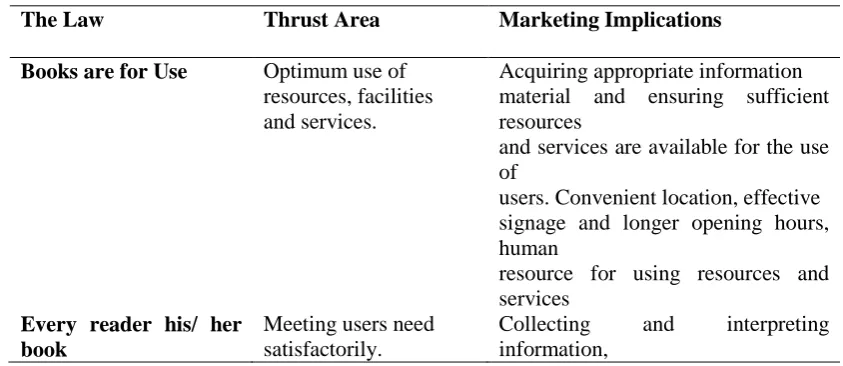
The philosophy of libraries revolves around the Five Laws of Library Science.Many authors
find these laws closer to modern marketing principles. The following Table: 3.1demonstrates
[image:2.595.85.507.562.745.2]the laws with their thrust areas and simplistic marketing implications
Table 3.1 : Five Laws of Library Science and Marketing Implications
The Law Thrust Area Marketing Implications
Books are for Use Optimum use of
resources, facilities and services.
Acquiring appropriate information material and ensuring sufficient resources
and services are available for the use of
users. Convenient location, effective signage and longer opening hours, human
resource for using resources and services
Every reader his/ her book
Meeting users need satisfactorily.
Collecting and interpreting
Raysh Thomas
(Pg. 6468-6488) 6470
Copyright © 2017, Scholarly Research Journal for Interdisciplinary Studies
understanding the needs of users and
matching them with the
organisational resources.
Every book its Reader Reaching out to
users.
Publicising value and benefits, promotional campaign, advocacy, public
relations, personal communication, etc
Save the time of User User benefits and
preferences.
Repackaging information into
appropriate
form, availability of information when
they need. Ensuring quality of services
and products. Library is a growing
organism
Adapting to future user needs
Mobilising resources, dealing with uncertainty about future user needs, new
services, new customer groups, etc.
4. NEED FOR MARKETING
Invariably, within an academic institution, the potential as well as actual users are unaware
of the services library is providing to them. They feel satisfied by whatever services and
facilities they are getting from their library, and are unwilling to explore further than what
they are receiving.
As library professionals, we also make assumptions about what our users want and need, and
accordingly continue to provide services that we feel we should deliver, regardless of their
value to our users.
In order to create awareness among users about library services, and perhaps also to create
desire for these services, build understanding of the value of the services, increase the level of
usage, and expand the user base, a successful marketing strategy is necessary.
In recent years, the need for marketing of library services has gone beyond the traditional
approach particularly since marketing has spread to non-profit organizations like libraries and
information centres. Kotler argues that marketing need was felt and marketing philosophy has
been successfully applied to nonprofit and public organizations.
Marketing is considered essential for the following reasons:
1. The libraries invest huge funds on collection, processing, and storage of information
Raysh Thomas
(Pg. 6468-6488) 6471
Copyright © 2017, Scholarly Research Journal for Interdisciplinary Studies
by implication is wastage of precious funds. In view of the increasing cost of information
there is need for the promotion and use of information resources.
2. The needy users have casual or almost need perception because of which they do not
demand and use information resources. In view of the inadequate resource utilization,
information marketing is essential to facilitate need perception of the needy and thereby
create demand.
3. Information is considered as the fifth need of man; hence users must be conscious of their
needs for information. Lack of realization of this aspect puts one to disadvantage and
deprivation of proper information use. Marketing of information based services will eliminate
these lacunas and make the needy an information rich user.
4. The information providers must not confine themselves to their corners; they must come
out and promote their services effectively to ensure their optimum use.
5. As marketing creates and increases demand for library and information services, the image
of library and status of information providers (librarians) will improve as well.
5. FUNCTIONS OF MARKETING
Marketing being a management function, business organizations create customer interest in
their products and services. In the same way, it is appropriate to libraries as well. Its functions
include such tasks as analysis, planning, implementation, and control. These are briefly
mentioned below:
5.1.Analysis
The foremost task before the marketers is to undertake analysis of the customers, markets,
and competitors. Such an analysis helps to investigate specific market and customer needs to
target the appropriate customer groups. It is also important to know the strengths and
weaknesses of an academic library by using SWOC analysis. The strength (S) of a library lies
in its ability to satisfy customers; while weakness (W) being the internal factor reduces the
ability to meet the user requirements at larger level. Opportunity (O) lies in the potential to
improve the ability for user satisfaction; while Challenges (C) can reduce the ability of the
Raysh Thomas
(Pg. 6468-6488) 6472
Copyright © 2017, Scholarly Research Journal for Interdisciplinary Studies 5.2.Planning
Under the planning stage setting of objectives, making choice of target markets, marketing
strategies, etc are covered. Development of long range marketing plans, new products and
services development, etc are included to reach out to library users.
5.3. Implementation
This stage includes such activities as recruiting staff, allocating tasks, making budgets, and
organizing such activities as will lead to promote library services.
5.4.Control
Progress is evaluated against objectives and targets in this stage. But if need arises corrective
measures are also taken to exercise control over the marketing of library services and
products as follows:
a. Performance standards are set
b. Progress of marketing goals is measured
c. Results compared with the standards
d. Changes are made to stay on track
6. MARKETING STRATEGY
Broadly speaking, a marketing strategy is a process that can allow an organization to
concentrate its limited resources on the greatest opportunities to increase use of services and
products and achieve a sustainable advantage.
According to Philip Kotler, a marketing strategy should be centred around the key concept
that customer satisfaction is the main goal.
6.1.Marketing Strategy in Academic Libraries
As the marketing strategy focuses on user needs and wants the producers also produce such
products and services as would be meeting their information needs. To develop a marketing
strategy for libraries and information centres, they would use certain analyses and tools. The
main components in any strategic plan are as mentioned below:
6.1.1. Market Analysis The market analysis will help in knowing the potential markets where
exchange may take place. For library and information services, the market constitutes of end
users like the clients, the parent institution, the government, and other funding agencies. Once
the market is identified, its size may also be determined which is likely to affect the demand
Raysh Thomas
(Pg. 6468-6488) 6473
Copyright © 2017, Scholarly Research Journal for Interdisciplinary Studies
6.1.2. User Analysis User analysis will help the library staff to know about library users in
detail. It will be established as to which user group or/and individuals shall be making use of
information services and products. The users can even be further categorized to make the
services more useful to them.
6.1.3. Organizational Analysis Library being an organization in itself, knows well its market
of users. Accordingly, it designs its services to offer to different user segments. This analysis
would be based on the available resources, attitude of authorities, experience of staff, and so
on. Such an organizational analysis helps the library to know its strong points which it may
ultimately turn into opportunities of marketing its services and products
6.1.4. Competitive Analysis
In this competitive world, libraries also need to know, like other organizations, about their
potential competitors in similar other institutions. Libraries, for example college libraries,
compete with one another in getting more and more amount of grants for fresh acquisitions,
more staff, more equipments, and above all for providing more services. While understanding
competitive analysis the user segment as well as information services/ products of
competitors must be evaluated. Such an analysis will help to compare user needs and wants,
and thereby designing library services.
7. ELEMENTS OF MARKETING
Saracevic and Wood have identified the following elements of marketing as essential for
marketing the library services and products:
7.1.Market Research and Analysis
It implies research into analysis of information needs and wants of different segments of
potential users, their communication patterns and habits, economic and other constraints, and
other characteristics which influence the choice of an information product or service. Such an
analysis of the market is deemed to be essential before venturing into marketing any product
or service. It helps in knowing the actual or potential user of the organization.
Librarians have the option of following any of the available market analyses tools: exchange
system analysis, image analysis, user satisfaction studies, product life cycle and product
portfolio matrix. Such an analysis may help to determine as to which library services are
declining in use or which are performing better. Librarian can accordingly review them for
Raysh Thomas
(Pg. 6468-6488) 6474
Copyright © 2017, Scholarly Research Journal for Interdisciplinary Studies
This would include suggestions on alternate information products and services that would
satisfy needs and wants of each user segment. It would also include evaluation of usage of
library services. Market research, like any other research, is a combination of (i) assumptions,
(ii) facts, figures and observations, and (iii) human imagination and judgment.
7.2. Product/Service Development and Targeting
Development of a product/service has to be targeted to the needs and wants of given segment
of users. It also involves consideration of alternatives, determination of the criteria and
procedures for selection and evaluation, analysis and synthesis, and overall production and
delivery of service.
7.3. Costs and Pricing
Information processing involves costs, there is no such thing as “free” in the present times of
market economy. The costs and pricing of information products and services, therefore, need
to be worked out. Cost of information refers to all expenditures incurred in production and
delivery of products and services. Various pricing schemes, such as marginal cost, cost
recovery, past prices, variable price, cost plus benefit, etc. can be used.
7.4. Promotion
Promotion of a library service/product should be considered in terms of communication to
and with specific user segment, and not just an announcement. Library services can be
promoted by means of brochures, pamphlets, posters, guides, handbooks, advertising,
publicity, exhibitions and demonstrations, and personal approach, etc. promotion should be a
continuous activity based on an optimal mix of different approaches.
7.5. User Education
The aims of user education are to:
1. Communicate about a service or products and how it fits in a broader framework and
concern of users.
2. Explain the basics of its structure and function, limitations and problems.
3. Explain in detail its benefits.
4. Explain in detail the way it can be accessed and used.
5. Explain clearly direct and hidden costs, requirements, conditions of use, etc.
Raysh Thomas
(Pg. 6468-6488) 6475
Copyright © 2017, Scholarly Research Journal for Interdisciplinary Studies
The main role of user education is to ensure the credibility of the service /product and trust, in
its worth and to increase understanding, know-how and skills in using information.
7.6. Dissemination
Dissemination pertains to the conveying of information to users through given channels, and
includes the spreading about, distribution and delivery of information services/products.
Some of the important channels for dissemination include:
1. interpersonal delivery
2. group personal delivery
3. strategic placement
4. in-house dissemination
5. local depositories
6. mass media
7. broadcasting/telecasting
8. mail
9. telephone
10. computer networks
7.7.Evaluation of Services and Products
Evaluation of academic library services and products are required on a continuing basis. It
should be based on users‟ criteria placing value on the following:
1. Quality of information provided (i.e. precision, accuracy, credibility, recency),
2. Scope of information provided (i.e. completeness, comprehensiveness, and coverage of
topics),
3. Appropriateness to user needs (i.e. fitting the need, level, language, sophistication,
information overload, understandability, ease of use, etc.),
4. Hassle in getting the information (i.e. time lag, paper work, ease of access, red tape, etc.),
5. Costs (i.e. direct price paid, hidden costs, etc.).
8. MARKETING MIX
The marketing mix is a business tool used in marketing and by marketing professionals which
today being used in libraries to providing quality services globally .Library and information
centres are required to choose appropriate programmes relating to marketing mix so as to
Raysh Thomas
(Pg. 6468-6488) 6476
Copyright © 2017, Scholarly Research Journal for Interdisciplinary Studies 8.1. Elements of Marketing Mix
The traditional 4Ps need to be artfully blended to get maximum benefit out of it. In the
present day client oriented market philosophy, the four Ps can be translated into 4Cs of
marketing as mentioned below:
1. Product --- Customer needs and wants
2. Price--- Cost to user
3. Place--- Convenience
4. Promotion--- Communication
8. 1.1. Product
Product is the first and most important element of the marketing mix. Kotler said that “A
product is anything that can be offered to a market to satisfy a want or need”. A product
includes physical goods, services, experiences, events, persons, places, properties,
organizations, information, and ideas. The credibility of the product will make the reputation
of the library as a source of up-to-date information, knowledge, learning facilities and
assistance. The understanding of the customers‟ specific requirements and the environment in
which they are operating is essential in developing a product and service which is likely to be
accepted by them.
8.1.2. Price
All information processing involves costs, but all information services or products may not
involve a price for a customer. Saracevic and Wood refer costs to “all expenditure incurred in
production and dissemination of products or services”. Pricing, therefore, is the key
component in not only determining the price to be charged to the users but also, as stated by
Sue Henczel, “in establishing the overall value of a product. From the customer viewpoint
price is cost or the amount charged for the benefit of using a product or service.
In the emerging market economy, library and information professionals are also considering
pricing their services and products. There is a general feeling that: i. Library users will not
realize and recognize the value of a service/product unless it is priced. ii. The budgets are
shrinking, and the governments are impressing upon more and more organizations to become
financially self-supporting. Library professionals may, therefore, consider of cost based
Raysh Thomas
(Pg. 6468-6488) 6477
Copyright © 2017, Scholarly Research Journal for Interdisciplinary Studies 8.1.3 Place
The significance of place for a library was made amply clear in Ranganthan‟s laws for library
science, when he emphasized the need of establishing a library at a central place in an
institution or a convenient place in the society. If it is not so conveniently located its services
are not likely to be used most effectively. But in the present computerized environment,
where LANs and WANs are becoming common, howsoever inconveniently a library is
located its online services and resources are likely to be easily accessible to the users
.Similarly, an electronic database can be accessed and used anywhere in the world provided
there is network connectivity.
But as of now Indian academic libraries have to achieve much in terms of computerization,
LANs, etc. their location assumes much significance in rendering easy, efficient and effective
services. In addition to „Place‟, other important components in this regard are opening hours,
rules for lending documents, help from library staff, signage, and so on.
i. Sign System The importance of signposting is evident from the fact that once inside the
library, a user generally looks for various signs to locate his/her area of interest. Van Allen
has rightly said: “A good sign system can communicate the intentions, the spirit and the theme of the library as well as directions”. Most of the directional type enquiries, which
consume a lot of time, shall not arise at all if there is a good sign system. However,
signposting should be clear, easy to read, and noticeable.
8.1.4. Promotion
Promotion refers to communication with customers, i.e., it starts with the understanding and
targeting customers. Sue Henczel believes that success in an organization lies in knowing
who the customers are, what they require, and most importantly, how you can provide it to
them in way that makes it valuable to them. Information about the products and services
(brochures, web sites, etc.) can then focus on not only the services offered but also on the
solutions provided to their problems.
Various methods of promotion form part of promotion. Kotler and Keller have listed some of
the methods for promoting products and services.
8.1.4.1 Advertising
It includes all forms of paid, non-personal communication and promotion of products,
Raysh Thomas
(Pg. 6468-6488) 6478
Copyright © 2017, Scholarly Research Journal for Interdisciplinary Studies
flyers), non-print (radio), electronic (television, cinema,social media), outdoor advertising
(posters, bus/rail sides), in-house newsletters, professional society journals, and so on. The
advantage of advertising is that it reaches out to a large number of people. However, it does
not have a mechanism of providing any feedback.
There are examples of libraries and information centres in India where they frequently
advertise their services in newspapers with a view to bring in awareness among the target
user groups.
i. Library Guides
A library guide is the most basic form of promotion, although its range and style will vary
from one institution to another. It usually provides an outline of the more important services:
hours of opening, borrowing and copying facilities, enquiry services, etc. There may be
either one single such „guide‟ for all types of users, or if possible, more guides can be
produced for specific groups of users such as post graduates, undergraduates, research
students, faculty, etc. But cost in terms of money and manpower has to be balanced against
the apparent benefits.
ii. Newsletters and Leaflets
Newsletters and leaflets are not only good but effective means of information
communication. In a library, a newsletter can be used to introduce new features, new
services, new web sites, new journals and e-journals, online services, new databases, new
products, etc. which may be of use to the users. A short but crisp newsletter should be
produced regularly so as to make impact on different user segments. Leaflets can be
displayed on notice boards in and outside the library at some prominent place to make them
more visible.
If not feasible and economical, an alternative would be to prompt administration for a
column in the campus newsletter or magazine whether produced by the institution or students
or both. This is a more economic way of making users aware of the library services.
8.1.4.2. Sales Promotion
Displays of products and services help in creating an atmosphere to encourage utilizing fully
the resources of an academic library. Many libraries have floor space for regular displays to
Raysh Thomas
(Pg. 6468-6488) 6479
Copyright © 2017, Scholarly Research Journal for Interdisciplinary Studies
immediately on receipt in library may attract the attention of many a user. The importance of
library resources and their purpose immediately gets noticed.
8.1.4.3. Personal Selling
Personal contact is regarded quite effective method for promoting library products and
services. The simple courtesy of meeting the potential users with smile, politeness, attitude,
etc. cost nothing but give much of the needed light hence help in establishing a good
reputation of providing good services. The manner of library professionals in person or on
telephone, will impact users‟ rating of the library and its services. Personal skills of well-trained staff and personal contact with users lead to „word of mouth reference‟ which proves
most effective promotional method in attracting other potential customers. A satisfied user
can bring to the library few more new customers who might not be so responsive to other
promotional methods.
i. Customer Events
Customer events in this regard are significantly essential, and may include training sessions,
workshops, user group meetings, etc. It is believed that in any personal meetings with clients
or prospective clients, spend more time listening and less in talking, and focus on motivating
them. Also try to find out their future possible needs to understand how to develop services
accordingly.
8.1.4.4. Public Relations Public relation goes beyond publicity. Its primary purpose is to
disseminate information about a product or service to groups and individuals. Public
relations people try to maintain good relationship with all the prospective customers. They
work closely with news and information media and arrange press conferences, meetings,
contests, and other events that will draw attention of prospective customers to products and
services. Such persuasive activities are likely to create a readiness in the clients and/or
potential customers to hear the message.
8.1.4.5. E-mail and listservs When the library has a large number of users on e-mail, it is
easier way of reaching to them about a new service, or old but in improved version, quickly
and economically. This method of targeting users is more precise than most other techniques,
Raysh Thomas
(Pg. 6468-6488) 6480
Copyright © 2017, Scholarly Research Journal for Interdisciplinary Studies 8.1.4.6. Internet
In the emerging electronic environment, Internet has the power to improve the reputation
and image of an academic library, and offers the opportunity to enhance its services as well.
It may take little more time to set up library and information services on the Internet, but
once maintained it can help greatly in increasing levels of user satisfaction. An academic
library may develop its Web home page and use it as a new promotional tool advertising
in-house services and products as well as electronic information resources.
Promotion may, therefore, be regarded as anything which communicates positive
information about an academic library. Gavin Rea says that the success or failure of that
promotion will depend on how well it is targeted and executed. It must also be considered
whether the promotion activities satisfy a particular demand of the users. It may, however, be
pointed out that promotion needs to concentrate only on those library services where there is
either no demand or it is dormant or possibly falling. Kotler has well said that “Marketing management‟s task is to influence the level, timing, and character of demand in a way that
will help the organization achieve its objectives”.
8.2. Seven Ps Model
Many thinkers in the management field have not been fully satisfied with the 4Ps model of
marketing. They argue that while the 4Ps can remain the backbone elements of marketing
mix, but for assuring quality service some more issues need to be included. They suggest
three additional elements, viz., People, Physical Evidence, and Processes making it a 7Ps
model, thereby requiring a more direct contact of providers and recipients, visible nature of
service, and so on.
8.2.1 People
People are the most important element of any service or experience. People in an
organization, working frontline as well as backstage, and those who deliver service,
considerably influence customer perception of a product and service. It is, therefore,
important the people in the library must be carefully selected, properly trained and motivated
to deliver services to users. Here, two important facets of library staff need to be given due
importance:
Raysh Thomas
(Pg. 6468-6488) 6481
Copyright © 2017, Scholarly Research Journal for Interdisciplinary Studies
ii. Friendliness: it requires helpfulness, attentiveness and friendliness of the staff to the
clients.
8.2.2 Physical Evidence
As there are no physical attributes to a service, it is the environment in which the services are
delivered, and includes any tangible commodities that facilitate performance and
communication of the services. Physical evidence should, as far as possible, consist of the
delivery of services so as to provide maximum customer satisfaction in ambient conditions in
a library. It may consist of the following:
i. Appearance: it includes the décor and image of the library and its staff.
ii. Atmosphere: it should be welcoming and friendly.
iii. Cleanliness: stock and study areas should be clean, tidy, well-lighted, properly stacked
book shelves, etc.
iv. Comfort: it covers physical comfort and general ambience, spacious layout of reading
areas, etc.
8.2.3 Process
There are a number of perceptions of the concept of process. It, however, includes the
procedures, mechanism and flow of activities that produce the outputs in the form of
products and services and deliver them to clients. This shift from evaluating outputs only to
evaluating the processes, though a recent phenomenon, but organizations are slowly moving
toward it. Processes help in control of services and bring uniformity in their delivery. These
procedures and activities, therefore, need to be carefully designed to provide quality services.
At least two points need consideration:
i. Reliability: it means dependability and efficiency of the service.
ii. Communication: it means how well library staff communicates; the clarity of signs
and guiding in communicating various stacks and reading areas, etc.
With the application of tools of information technology in academic libraries the processes
can be refined and high quality services at lower per capita cost can be delivered to users.
9. MARKET SEGMENTATION
According to Kotler and Keller, the process of division of market into distinct identical
Raysh Thomas
(Pg. 6468-6488) 6482
Copyright © 2017, Scholarly Research Journal for Interdisciplinary Studies
segmentation. The heterogeneous market is divided into homogeneous groups to serve them
better.
In most of the academic libraries, the clientele are considerably of diverse nature. They can
be divided into simple segments of faculty, research students, postgraduates, undergraduates,
and non-teaching staff. Now some more categories have also been added to them which
include part-time students, distance education learners, on self-supporting courses, on a
university franchised course, etc. All of this will affect the need for and use of various library
services.
9.1 Methods of Segmentation
Various methods and bases of market segmentation are available, but Kotler and Keller have
classified them in the following four categories:
9.1.1 Geographical Segmentation The market is divided into different geographic areas such
as region, country, state, district, town, and other population clusters. In the context of
libraries geographical segmentation help to determine the type, size, opening hours, services,
etc to be provided to different clientele. Academic libraries may look out for various places
within the organization to spread awareness and communicate about new or improved
services.
9.1.2 Demographic Segmentation
In this segmentation the grouping of clients is based on such variables as gender, age,
family, income, education, etc. that helps to determine about their information needs and
usage of services. The needs of postgraduates are different from those of undergraduates as
well as the faculty and should be given due consideration while providing them the services.
9.1.3 Psychographic Segmentation
The term psychographics was coined by Emanuel Demby to describe the use of
psychological, sociological, and anthropological factors for market segmentation. Customers
may be divided on the basis of their attitude, lifestyle, personality traits, values, etc. Kotler
and Keller believe that customers within the same demographic segment exhibit quite
different psychological profiles. Those users who have been using library services earlier
Raysh Thomas
(Pg. 6468-6488) 6483
Copyright © 2017, Scholarly Research Journal for Interdisciplinary Studies 9.1.4 Behavioural Segmentation
In this segment customers are divided into groups on the basis of their knowledge, attitude,
usage, response to a service, etc. Different customer groups expect different benefits from
the same service or product. As such their behavior will also be different, like they could be
regular users, potential users, distance learners, etc. Library services and products also
provide different level of information need satisfaction to different user segments according
to their knowledge, and other variables.
It can be said from the above that the end user is all important in all types of segmentation.
The strength of market segmentation lies not in the product or service but in the end user.
The librarians of all types of academic libraries have a common objective of targeting and
serving the end user with a mission. Library services and products should therefore be
designed to meet the needs of all as well as individual user in different segments.
9.2 Strategies for Market Segmentation
The study of market segmentation explains that all library users are unique as individuals
asking for a particular library/information service/product. However, there remain some user
markets unattended to but the library can serve them effectively as well. Bryson suggested
the following three strategies to be adopted for targeting them.
9.2.1 Undifferentiated Marketing
In undifferentiated marketing the service provider ignores segment differences and goes
after the whole market with one offer which he believes will satisfy a large number of
customers as they have identical needs. In academic libraries only those products and
services need to be developed and delivered which appeal to maximum number of users. All
users are treated similarly, and every user is offered the same products, i.e., books, journals,
bibliographies, databases, etc. Similarly, every user is offered the same services, i.e., lending
service, reference service, interlibrary loan, online service, etc.
9.2.2 Differentiated Marketing
In differentiated marketing, a firm operates in several market segments and designs different
products for each segment. Similarly, in the field of librarianship, an academic library may
develop separate services specifically designed for each of smaller user segment in view of
Raysh Thomas
(Pg. 6468-6488) 6484
Copyright © 2017, Scholarly Research Journal for Interdisciplinary Studies
information needs of each of these user segments are being met by the service delivered. If
not, library may design a new service for such a user segment.
9.2.3 Concentrated Marketing
It refers to a situation where the firm concentrates on different clusters of customers. In
concentrated marketing, a library attempts to provide in-depth services in specialized areas.
The library in such a situation purposefully concentrates on a small number of target users
and actively meets their specific needs. Information products and services are developed to
meet the exclusive needs of that segment of users. Provision of selective dissemination of
service (SDI) is a typical example of this type of library marketing.
It is obvious from the above discussion that for segmentation to be useful, the segments must
be relevant, accessible, sizable, measurable and profitable to the academic libraries.
10. CREATING A MARKETING PLAN
In order to fulfill the main objective of an academic library, viz., providing reference and
information services to its users, it requires a different approach. To promote the use of
valuable information resources, it must “shift from product or service orientation to customer or need orientation”.
Marketing of information products and services provides libraries with the tools for
collecting and analyzing useful data about information needs of customers. It is further
synthesized and thereby assists in developing and delivering appropriate products and
services. It is argued that “needs assessment is central to any programme of product
development and essential to establish the targets for any marketing process”. The need to
develop customer-centred and strategic market planning has now become part of effective
library management. Therefore, creating a marketing plan may be a good starting point for
marketing the academic library and its services. A marketing plan, according to Henczel, can
be a wonderful tool for communicating with administration about library vision for
enhancing library products, image and capabilities. The modern academic libraries can
become market-oriented organizations and fulfill their objectives.
11.WEB MARKETING OF LIBRARY AND INFORMATION SERVICES
Information at your door step is now changing its paradigm to bring library promotional
activit ies at social web pages where even the library catalogue can be browsed. Social media
Raysh Thomas
(Pg. 6468-6488) 6485
Copyright © 2017, Scholarly Research Journal for Interdisciplinary Studies
increasing focus and it is undisputed that SNS such as Facebook,twitter are the most visited
places by the users for their updates.The transient society is on moving wheels that are
heading towards digital environment where virtual li braries are gammg more importance
with web based services. The applications of web 2.0 have brought revolutionary changes in
information business.Social media has been successfully exploiting these applications for the
process of information exchange. As Mishra (2010) denotes, librarians and information
professionals must integrate web 2.0 to effectively market and advertise their services for
competition for customers, competition for resources, maintain relevance, promote an
updated image, visibility, valuable community resource, rising expectations and survival.
Social Networking Sites (SNS)
SNS arc boon for library professionals to publicize their services and products. It acts as an
online marketing tool for making of traditional library services widely. It helps to share
resources and also facilitates group communication among the library users.
11.1. Linkedln
Enables patrons to connect with subject specialists in their particular field of interest. Library
profess ionals can use this platfonn to render specialized services such as Selective
Dissemination of Information (SDI). Linkedln also facilitates to create professional
connections among the library professionals.
LinkedIn can be an effective marketing channel with proper planning and implementation.
11.2. Ning
Being an online platform, Ning facilitates people to create custom social network where
community web pages can be created and be connected through network. Communities on
Ning can associate with online services like Facebook, Twitter. People can create their own
social network to build up discussion on a particular topic. Ning has a potential to converge
the information professional together and thereby the marketing of information among the
libraries would be much effective than ever. It works like a bridge connecting librarians with
users and library associations.
11.3. Facebook
The most popular and successful of its kind as it is very user friendly and interactive website
for connecting library services to the users. Many applications like JSTOR search, World Cat
Raysh Thomas
(Pg. 6468-6488) 6486
Copyright © 2017, Scholarly Research Journal for Interdisciplinary Studies
information need. This new channel of communication helps to keep more general topics for
discussion there by supporting research and teaching and extend their services to more users.
Better and faster distribution of library news letter,uploading brochures about academic
activities such as schedules of conference, seminars can be done in no time on Facebook.
11.4. Twitter
It is a kind of micro blogging application where short messages can be sent to the destination.
Twitter has become an important feature on the social media landscape and it has been an
increasingly popular social networking tool for libraries to reach out to their patrons (Sewell,
2013). It helps to keep staff and users informed of the events and programs of library,
workshops, new arrivals and new services through short messages either through web or
through SMS using a mobile phone with a limitation of 140 characters. Marketing act ivities
happen at its best way as it facilitates the real time communication. which can also be
instrumental in online reference service. Modem libraries are finding exemplary marketing
strategies to engage with their followers on twitter that is resulting in increased number of
patterns. Twitter post can be linked to the home page of the library,blog posts, wiki, online
archives for detailed information.
11.5. Flickr
This application facilitates sharing images of library. Cover page and content page images of
new arrivals of books and journals can be diffused among the users community through
Flicker. Academic events such as seminars, workshops and conferences through images may
be shared to public for the awareness. Libraries can use Flickr to upload library images and
the pictures of different services offered .
11.6. You Tube
A popular audio visual application where videos can be uploaded, searched. accessed and
downloaded throughout the world. Video clippings of Documentary films of libraries and
information centers give use rs a grid view of intact collection and environment of the library.
The users can even comment on the video which may be considered for the feedback. Library
products such as e-Ieaming tutorials are promoted through virtual tour.YouTube can also be
Raysh Thomas
(Pg. 6468-6488) 6487
Copyright © 2017, Scholarly Research Journal for Interdisciplinary Studies 11.7. Slides hare
It is a platform for slide hosting service. It allows users upload files privately or publiciy
which can be viewed by users.Slideshare has been playing a vital role in the field of
education and e learning. Sharing ideas, conducting research, connecting with others have
been much effective through slideshare. Anyone can view presentations & documents on
topics that interest them,download them and reuse or remix for their own purpose.Presenting
prepared slides that contain information about library products and service will notify every
user who visits and shares.
11.8. Del.icio. us
It is a social book. marking service that facilitates discovering, gathering and sharing
bookmarks. Delicio.us has created a platform for the users where users share web resources
in an effective manner. It also a means of organizing the huge stock of information a user
come across in his daily life by book rnarking them from difference sources like LinkedIn
and Facebook for future use. A detailed document on library services offered and their
usefulness can be created online and bookmarked which itself would be an activity of library
marketing. The link can be tagged at later stages for keeping everyone in the community
informed of the latest updates.
12. Conclusion
This paper describes the concept of marketing which could be said to be the efforts to bring
in new customers or programmes to create more demand for existing services. In view of the
changing outlook of library clients towards information resources and services, the need for
marketing is highlighted. It further discusses the various functions of marketing, such as
analysis, planning, implementation, and control which help in creating customer interest in
library services. To achieve this objective, a marketing strategy needs to be developed for
academic libraries which should centre around customer satisfaction of the services
provided. It describes the four main elements of marketing mix, popularly known as 4Ps,
which has been further extended to 7Ps model and given its relevance to academic libraries
and their services. Also discusses about the concept of market segmentation as the division
of market into distinctive groups of users who may require different library services. It
describes various methods of segmentation which have their advantages in providing
Raysh Thomas
(Pg. 6468-6488) 6488
Copyright © 2017, Scholarly Research Journal for Interdisciplinary Studies
satisfaction. Based on all the elements of marketing, it makes a case for marketing plan for
academic libraries to implement it for enhancing the usage of library services and improving
the image of library.
REFERENCES
Kotler, Philip and Keller, Kevin L. Marketing Management, 13th ed. New Delhi: Prentice-Hall of India, 2008
Bhat, Ishwara M. “Marketing of Library and Information Services at British Council Library Network in India”.DESIDOC Bulletin of Information Technology, 18 (3) May 1998: 29-33.
Bryson, Jo. Effective Library and Information Centre Management. Bombay: Jaico Publishing House, 1996.
Cronin, Blaise. The Marketing of Library and Information Services. London: ASLIB, 1981.
Goi, Chai Lee. “A Review of Marketing Mix: 4Ps or More?”. International Journal of Marketing Studies, 1 (1) May 2009: 2-15.
Gupta, D. K. and Jambekar, A. “Developing a Customer-Focus Approach to Marketing of Library and Information Services”. DESIDOC Bulletin of Information Technology, 22 (3) May 2002: 5-14.
Henczel, Sue. “Marketing Information Services: Packaging, Promoting, Persuading”. Quantum Whitepaper 8.10.04 Leadership Series: Marketing.
Jain, Abhinandan, et al. Marketing Information Products and Services…, 2nd ed. New Delhi: Tata McGraw-Hill,
Kotler, Philip. Marketing for Nonprofit Organizations. 2nd ed. Englewood Cliffs: Prentice –Hall, 1982.
Ranganathan, S. R. Reference Service, 2nd ed. Bombay: Asia Publishing House, 1961.
Rea, Gavin. “Promoting the Library Services”. In Chris Pinder and Maxine Melling (Eds): Providing Customer-Oriented Services in Academic Libraries. London: Library Association Publishing, 1996.
Saracevic, T. and Wood, J. B. Consolidation of Information: A Handbook on Evaluation, Restructuring and Repackaging of Scientific and Technical Information. Paris: UNESCO, 1981.
Sewa Singh. Information Analysis, Consolidation and Repackaging. New Delhi: Atlantic, 2014. Chan, C. (2012). Marketing the academic library with online social network advertising. Library
Management, 33(8/9),479-489.
Sewell, R.R. (20 13 ). Who is following us? Data mining a library's Twi tter followers. Library Hi Tech, 31 (1 ), 160-1 70