PERFORMANCE ANALYSIS OF FINGERPRINTING
ALGORITHMS USED IN WLAN POSITIONING
SYSTEM
Nicholaus R. Mrindoko*, Stanley L. Tito**, Francis A. Ruambo**
*
Computer Engineering Department, Mbeya University of Science and Technology **
ICT Department, Mbeya University of Science and Technology
Abstract- The accuracy of indoor positioning based on wireless local area network (WLAN) fingerprints depends on the
algorithms used. Choice of which algorithm to use in positioning is a challenge. This study aims to compare the Euclidian distance (deterministic algorithm) and probability density function (probabilistic algorithm) in their accuracy. The signal samples were collected from the modelled study area using android mobile phone. Then, the samples were analyzed to compare their performance in a specific environment. Comparisons were made with respect to the number of access points, number of reference points and number of samples.The experimental results show that, the probabilistic method has higher accuracy when adopting the signal relation than deterministic algorithm.
Index Terms- Probabilistic Algorithm; Fingerprints; Indoor Positioning; Deterministic Algorithm; WLAN
I. INTRODUCTION
ocalization services (LS) depends on the choice of adequate algorithm to provide estimated accuracy in the region of
localization. The Global Positioning System (GPS) can provide sufficient localization services in large cases. Unfortunately
GPS suffers in indoor localization due to severe multipath and barrier attenuation [1]. As an alternative answer for indoor
solution, [2],[3] recommended localization move towards using received signal strength indication (RSSI) in WLAN. The reality
behind, is due to the growing availability of open and private WLAN and increasing demand of indoor localization[1].
Localization system for the indoor positioning should be adequate and realistic to various algorithms with measurable localization
accuracy. The essential problem that affects the accuracy of the RSSI based localization system is the choice of algorithm to be
used to calculate position from fingerprint database [1]. The localization accuracy necessary in mobile devices like smart phone
relies greatly on the algorithm used during position calculation stage. If the sufficient algorithm is used in positioning stage, the
position accuracy increases also. This implies that, the positioning system is affected by positioning algorithm. Currently, there is
a conflict concerning the choice of algorithm which can be used for RSSI fingerprint database [4]. Subsequently, there are many
algorithms with various considerations and more algorithms will be established consistently. Thus, it is important to understand
how algorithm affects the indoor positioning accuracy.
The understanding of accuracy relying on algorithm is important for location determination [5]. The particular algorithm is
currently used to determine the location. However, the considerable study in [1] revealed that, the different algorithm may change
localization system accuracy. On the other side, most existing data were collected and analyzed by considering one algorithm in
position calculation stage. The same number of samples, reference point and access points (APs) can be used in offline and online
phase. However accuracy varies as the algorithm changed. Thus, the different positioning algorithm would affect the indoor
localization application. The study results are evidently shown in section 4. This has motivated the current study in performance
analysis of fingerprinting algorithms used in WLAN positioning system.
The paper consists four sections. Subsequently after this brief introduction, Section 2 presents the measurement setup and
positioning algorithm. Section 3 presents the related work. Section 4 investigates the performance of the algorithms on indoor
positioning accuracy while section 5 concludes the paper.
II. EXPERIMENT SETUP
The examination was conveyed basing on precise measurements of the WLAN RSSI using Android smart phones and Wi-Fi
detection software. One Android smart phone namely; HUAWEI Y330-U11 equipped with one RSSI collecting application
software was used to collect samples of RSSI information from APs at the Computer laboratory room in the Institute of Science
and Technology, Mbeya University of Science and Technology (MUST). The dimension of the room is nearly 8 m × 5 m. Four
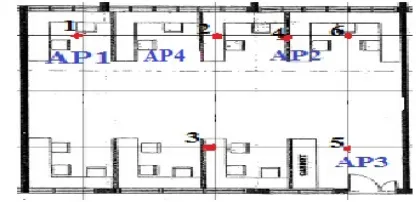
wireless APs located at height of 2.0 m above the floor was deployed as shown in Fig. 1. The four APs have the same models and
of the same vendor. As appeared in Fig. 1, a small area is defined as a grid of 6 points (the solid red dots in Fig. 1). The minimum
distance between two successive reference points known as grid spacing was estimated at a distance of 0.5 to 1 meter. Six
estimation places as appeared in Fig. 1 meant as 1, 2, 3, 4, 5, and 6 were gathered the RSSI information. The 1, 2, 3, 4 up to 6 represent
[image:2.612.228.436.362.463.2]point 1, point 2 up to point 6 respectively.
Figure 1: Location of four APs and the measurement points in the Computer laboratory room
III. POSITIONING ALGORITHMS
A. Deterministic technique
The use of nearest neighbour techniques is quite common with WLAN fingerprinting systems. Essentially, the idea is to calculate the distance in signal space between pre-gathered, locations tagged fingerprints in a database and a runtime fingerprint to find the closest match. Different NN techniques differ in the distance computation methods used. Three representative methods are outlined hereunder.
Euclidean Distance: This method used in [6] and other Wi-Fi location fingerprinting systems uses equation 1 to compute from the database the distance between fingerprints, each with an associated location and denoted by L, with a runtime fingerprint M. In equation 1, n is the number of APs considered in the fingerprints. In our study, this is the total number of APs in the area with the default unique fingerprint definition. And liis the mean RSSI value of APiin the fingerprint from the database, whereas miis the AP i’s mean RSSI in the runtime fingerprint.
𝐸𝐸𝐸𝐸𝐸𝐸𝐸𝐸𝐸𝐸𝐸𝐸𝐸𝐸(𝐿𝐿,𝑀𝑀) =�∑𝑛𝑛𝐸𝐸=1(𝐿𝐿𝐸𝐸− 𝑀𝑀𝐸𝐸)2 (1)
Mahalanobis Distance: Mahalanobis distance is also another NN method considered in the WLAN fingerprinting literature [7]. It is more sophisticated compared to the previous two methods and accounts for correlations between compared vectors. An interesting feature of Mahalanobis distance is that it is based on assumptions of stable patterns of RSSI distributions and it also puts into consideration variance in RSSI as done in probabilistic techniques [8], [9]. Mathematically, Mahalanobis distance calculation is shown by equation 3 where L is the covariance matrix of L and M of the same distribution.
𝑀𝑀𝑀𝑀ℎ𝑀𝑀𝑎𝑎𝐸𝐸𝐸𝐸𝐸𝐸𝐸𝐸(𝐿𝐿,𝑀𝑀) =�(𝐿𝐿 − 𝑀𝑀)𝑇𝑇𝐿𝐿−1(𝐿𝐿 − 𝑀𝑀) (3)
Localization deterministic approach utilized as part of our experiment relies on Euclidian NN technique. It is mobile supported solution, which implies that versatile station gives measured information to the server, which processes its position. Equation 1 is the Euclidean distance mathematical formulae utilized for this study. The location of the mobile user is estimated by averaging the coordinates of the minimum Euclidean distance as it is shown in equation 1.
B. Probabilistic method
The method commonly considers positioning as a classification problem. Assuming that there are n reference points: L1, L2 L3...Ln and S is the examined signal strength vector. Define P((Li|s)) as the probability of the user in location Li , the decision rule can be obtained:
Choose L1, if P((Li|S))> P((Lj|S)), for j = 1,2…,n, j≠ i (4) According to Bayes rule, it is known that P((Li|S))= P((S�Lj)) P(S) / P(Lj). If assuming all the test points have equal probability to be accessed and there is no prior knowledge about whether they are available P(Li)= P(Lj) for i, j = 1, 2,3,..n), the decision rule can be transformed to:
Choose Li , if P((S|Li))> P((S�Lj)), > , for j = 1,2…,n, j≠ I (5) Localization probabilistic approach utilized as part of our experiment relies on normal difference probability density function (PDF). It calculates probability density function values of each common relation that is found between user retrieved beacons and database beacons. Then for every position, it sums up that probability density function values and divides it with the amount of relations with respect of discarding positions that have fewer relations compared to receive signal. The resultant value is not the probability per se, because in continuous normal distribution, probability of a single point is zero. Equation 6 and 7 demonstrates probabilistic mathematical formulae utilized for this study.
𝐹𝐹(𝑧𝑧) =𝑒𝑒
(−�𝑧𝑧−�µ𝑥𝑥 −µ𝑦𝑦 ��
2
2�𝛿𝛿𝑥𝑥2−𝛿𝛿𝑦𝑦2� )
�2𝜋𝜋�𝛿𝛿𝑥𝑥2−𝛿𝛿𝑦𝑦2�
(6)
𝑃𝑃(𝐿𝐿) =∑𝑛𝑛𝐸𝐸=1𝐹𝐹(𝑧𝑧𝐸𝐸)
𝑛𝑛 (7)
IV. RELATED WORK
V. ANALYSIS OF THE RESULTS
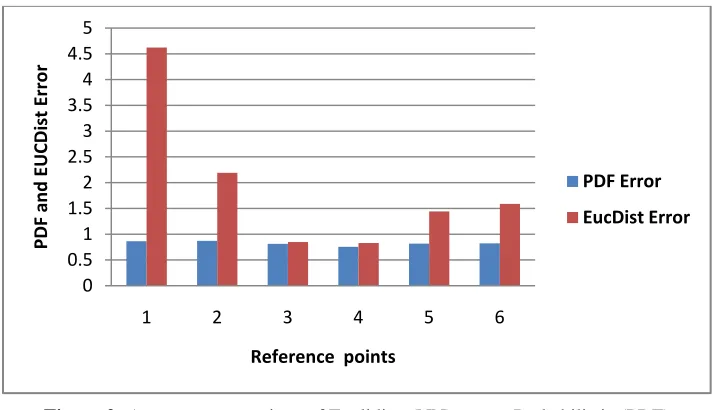
The experiment aims to compare performance accuracy between two fingerprint algorithms (deterministic and probabilistic). It is necessary to note that the set up was the same between offline and online phase. This comparison was examined histogramically and statistically. In the experiment, radio map was created by using four (4) APs. Results of the experiment are shown in Table 1and Figure 2.
PD F 0 .1 352 51 0 .0 592 83 0 .1 174 47 0. 09 9 83 0 .0 865 35 0 .0 995 59 0 .0 831 11 0 .1 295 88 0 .1 540 95 0. 10 9 14 0 .1 868 65 0 .1 013 56 0 .0 513 26 0. 24 5 07 0 .1 739 62 0 .0 884 96 0 .1 026 32 0 .1 158 73 0 .1 826 13 0 .1 383 32 0 .1 227 19 0 .1 216 01 0. 09 0 85 0 .1 784 58 E u cl id ia n 4 .6 216 88 2 .2 978 25 2 .2 978 25 0 .8 284 25 1 .4 422 21 1 .5 874 51 Re f. P o in t
[image:4.612.139.495.360.565.2]1 2 3 4 5 6
Table 1: Estimated results for Euclidian (NN) versus Probabilistic (PDF) algorithm
Figure 2: Accuracy comparison of Euclidian (NN) versus Probabilistic (PDF)
From Figure 2 it can be seen clearly that, the probabilistic (PDF) has small error compared Euclidian (NN). Both algorithms have shown lower localization error in reference point 4. Though, it is clear that lower localization error in probabilistic was obtained at the point with the higher probability of being selected as the correct location. Achieved estimated results are shown in Tab. 1.
VI. CONCLUSION
This paper examines the effect of algorithm in fingerprinting based localization. It is apparent that positioning error significantly depends on algorithm utilized in fingerprint positioning systems. Therefore, the algorithm utilized in fingerprinting localization has serious impact on positioning accuracy. In general, the probabilistic method has the higher accuracy when adopting the signal relation
0 0.5 1 1.52 2.53 3.54 4.55
1 2 3 4 5 6
PD F an d EU CD is t E rro r
Reference points
To future, it is important to find the best among deterministic algorithms for proper accuracy comparison with probabilistic algorithm. Such setup will help to come up with the best fingerprint positioning algorithm. Other objective is to propose distribution of radio guide points, which can help to minimize localization error.
REFERENCES
[1] N. R. Mrindoko and L. M. Minga, "A Comparison Review of Indoor Positioning Techniques," International Journal of Computer (IJC), vol. 21, pp. 42-49, 2016.
[2] Z. Farid, R. Nordin, and M. Ismail, "Recent Advances in Wireless Indoor Localization Techniques and System," Journal of Computer Networks and Communications, vol. 2013, 2013.
[3] M. G. Madhan, U. Susaritha, R. Ragupathi, and A. P. Thomas, "Rssi Based Location Estimation in A Wi-Fi Environment: an Experimental Study," ICTACT Journal on Communication Technology, vol. 5, 2014.
[4] R. Harle, "A survey of indoor inertial positioning systems for pedestrians," Communications Surveys & Tutorials, IEEE, vol. 15, pp. 1281-1293, 2013. [5] B. Dawes and K.-W. Chin, "A comparison of deterministic and probabilistic methods for indoor localization," Journal of Systems and Software, vol. 84, pp.
442-451, 2011.
[6] P. Bahl and V. N. Padmanabhan, "RADAR: An in-building RF-based user location and tracking system," in INFOCOM 2000. Nineteenth Annual Joint Conference of the IEEE Computer and Communications Societies. Proceedings. IEEE, 2000, pp. 775-784.
[7] K. Kaemarungsi and P. Krishnamurthy, "Analysis of WLAN’s received signal strength indication for indoor location fingerprinting," Pervasive and mobile computing, vol. 8, pp. 292-316, 2012.
[8] P. C. Mahalanobis, "On the generalized distance in statistics," Proceedings of the National Institute of Sciences (Calcutta), vol. 2, pp. 49-55, 1936.
[9] H. Shin and H. Cha, "Wi-Fi fingerprint-based topological map building for indoor user tracking," in 2010 IEEE 16th International Conference on Embedded and Real-Time Computing Systems and Applications, 2010, pp. 105-113.
[10] Z. Kai, L. Binghao, A. Dempster, and C. Lina, "A Comparison of algorithms adopted in fingerprinting indoor positioning systems," in Proceedings of the International Global Navigation Satellite Systems Society Symposium, 2013.
[11] R. Ma, Q. Guo, C. Hu, and J. Xue, "An improved WiFi indoor positioning algorithm by weighted fusion," Sensors, vol. 15, pp. 21824-21843, 2015. [12] R. Battiti, M. Brunato, and A. Villani, "Statistical learning theory for location fingerprinting in wireless LANs," 2002.
AUTHORS
First Author – Nicholaus R. Mrindoko, Lecturer, MUST and [email protected].
Second Author – Stanley L. Tito, Lecturer, Mbeya University of Science and Technology (MUST) and [email protected]. Third Author – Francis A. Ruambo, Lecturer, Mbeya University of Science and Technology (MUST) and [email protected].