The Minimal System of Defining Relations of
the Free Modular Lattice of Rank 3 and Lattices
Close to Modular One
Alexander G. Gein
,
Mikhail P. Shushpanov
∗Ural Federal University, Russia
∗Corresponding Author: [email protected]
Copyright © 2014 Horizon Research Publishing All rights reserved.
Abstract
We construct the system of 11 defining relations for the 3-generated free modular lattice. This system is proved to be minimal. Systems of defining relations for lattices close to modular one are studied.Keywords
Free modular lattices, Defining relations1
Introduction and Statement of
Results
Recall that the rank of a free algebra of a variety is the number of its free generators. LetAdenote the free lattice of rank 3 in the variety of the modular lattices and let F be the free lattice of rank 3 in the variety of all lattices. Let f, g, h be free generators of F, and let ϕ be a homomorphism from F onto A. Then the elements a = ϕ(f), b = ϕ(g), and c = ϕ(h) are free generators of the lattice A. Defining relations of the lattice A in the variety of all lattices are considered in [1] and [2]. Namely, one of the results of [1] can be interpreted as the statement that the lattice A can be defined by 21 relations. In [2] it was noted that the set of these relations is not a minimal set, namely, 15 from these 21 relations were selected and the 15 they were proved to form a minimal set of the defining relations of
A. Note that in [1] it was presented the set of 7 defining relations of the free distributive lattice of rank 3. In [3] this set is proved to be minimal.
The main result of the present paper is that we have found a set of 11 defining relations for the latticeA. Note that this set is not a subset of the defining relations from [1].
We list these relations:
(a∨b)∧(a∨c)∧(b∨c) = = ((a∧(b∨c))∨(c∧(a∨b)))∧
∧((b∧(a∨c))∨(c∧(b∨a)))∧
∧((a∧(c∨b))∨(b∧(a∨c)))
(1)
(a∧b)∨(a∧c)∨(b∧c) = = ((a∨(b∧c))∧(c∨(a∧b)))∨
∨((b∨(a∧c))∧(c∨(b∧a)))∨
∨((a∨(c∧b))∧(b∨(a∧c)))
(2)
(a∨(b∧c))∧(b∨c) = (a∧(b∨c))∨(b∧c) (3) (b∨(c∧a))∧(c∨a) = (b∧(c∨a))∨(c∧a) (4) (c∨(a∧b))∧(a∨b) = (c∧(a∨b))∨(a∧b) (5) (a∨b)∧(a∨c) =a∨((a∨b)∧(a∨c)∧(b∨c)) (6) (b∨a)∧(b∨c) =b∨((a∨b)∧(a∨c)∧(b∨c)) (7) (c∨a)∧(c∨b) =c∨((a∨b)∧(a∨c)∧(b∨c)) (8) (a∧b)∨(a∧c) =a∧((a∧b)∨(a∧c)∨(b∧c)) (9) (b∧a)∨(b∧c) =b∧((a∧b)∨(a∧c)∨(b∧c)) (10) (c∧a)∨(c∧b) =c∧((a∧b)∨(a∧c)∨(b∧c)) (11)
Denote the set of these relations by ρ.
Theorem 1. The lattice generated by the elements
a,b,csubject to the defining relationsρis isomorphic to the free modular lattice of rank 3. If a setσof relations is strictly contained in ρ, then the lattice generated by
a,b,csubject to the defining relationsσis not modular. In light of this theorem there is natural interest in lattices generated by a, b, c subject to one or another subset σ of the defining relations from the set ρ. In particular, how much they differ from the free modular lattice of rank 3. In the following theorem the answer is given forσconsisting of relations (1) and (2).
Theorem 2. The lattice generated by the elements
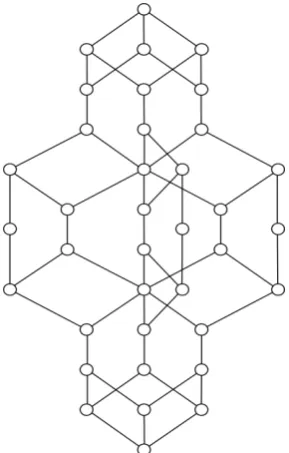
a, b, c subject to the defining relations (1) and (2) is isomorphic to the lattice represented on Figure 1.
In reality, Theorem 2 makes it easy to get a description of the lattice generated by the elementsa,bandcsubject to a setσ of relations when{(1), (2)} ⊂σ⊂ρ.
Figure 1. The lattice which is close to modular one
2
Proofs
Let a, b, c be any elements of a lattice. Further we use the following notation:
a1= (a∨(b∧c))∧(b∨c); (12)
a2= (a∧(b∨c))∨(b∧c); (13)
b1= (b∨(c∧a))∧(c∨a); (14) b2= (b∧(c∨a))∨(c∧a); (15)
c1= (c∨(a∧b))∧(a∨b); (16)
c2= (c∧(a∨b))∨(a∧b); (17) t= (a∨b)∧(a∨c)∧(b∨c); (18)
s= (a∧b)∨(a∧c)∨(b∧c). (19) Lemma 1. The following inequalities hold in any lattice:
s≤a2≤a1≤t;
s≤b2≤b1≤t;
s≤c2≤c1≤t.
Proof. The distributive inequality [5, Lemma I.4.9] shows that
(a∨(b∧c))∧(b∨c))≤(a∨b)∧(a∨c)∧(b∨c), i.e. a1≤t. Passing on to the dual lattice we gets≤a2. At the same time, sinceb∧c≤b∨cthe same inequality shows that
(a∧(b∨c))∨(b∧c)≤(a∨(b∧c))∧(b∨c), i.e. a2 ≤a1. Consequently, the inequalities s ≤a2 ≤ a1≤t hold in any lattice.
Other inequalities can be derived by cyclic substitutions of elementsa,bandc.
Lemma 2. LetLbe a lattice generated bya,b,c. If relation (2) holds for elementsa,b,c then
(a∨(b∧c))∧(c∨(a∧b) =s; (a∨(b∧c))∧(b∨(a∧c) =s; (b∨(a∧c))∧(c∨(a∧b) =s.
Proof. It is clear thata∨(b∧c)≥sandc∨(a∧b)≥s, therefore (a∨(b∧c))∧(c∨(a∧b)≥s. But from (2) it follows that (a∨(b∧c))∧(c∨(a∧b)) ≤ s, hence the first equality holds. Other equalities are derived by cyclic substitutions of elementsa, bandc.
From (1) the statement dual of Lemma 2 is proved similarly.
LetLdenote the lattice generated bya,b,c. And the defining relations (1) and (2) holds for elementsa, b,c
inL. Let us consider the following subsets of the lattice
L:
M1={a∨b∨c, a∨c, a∨b, b∨c,(a∨b)∧(a∨c),
(a∨c)∧(b∨c),(a∨b)∧(b∨c), a∨t, c∨t, b∨t, t};
M2={a∧b∧c, a∧c, a∧b, b∧c,(a∧b)∨(a∧c),
(a∧c)∨(b∧c),(a∧b)∨(b∧c), a∧s, b∧s, c∧s, s};
Ma={a∨(b∧c), a, a1, a2, a∧(b∨c)};
Mb={b∨(a∧c), b, b1, b2, b∧(a∨c)};
Mc={c∨(b∧a), c, c1, c2, c∧(b∨a)}.
Lemma 3. The setM1∪M2∪Ma∪Mbis a sublattice of the lattice L.
Proof. Since the setM1∪M2∪Ma∪Mb is self-dual and relations (1) and (2) are dual to one another it is sufficient to check on the closure of this set under the op-eration∧. Also it is clear that we have to consider those pairs of elements that are not known to be comparable. The check will be performed in several steps.
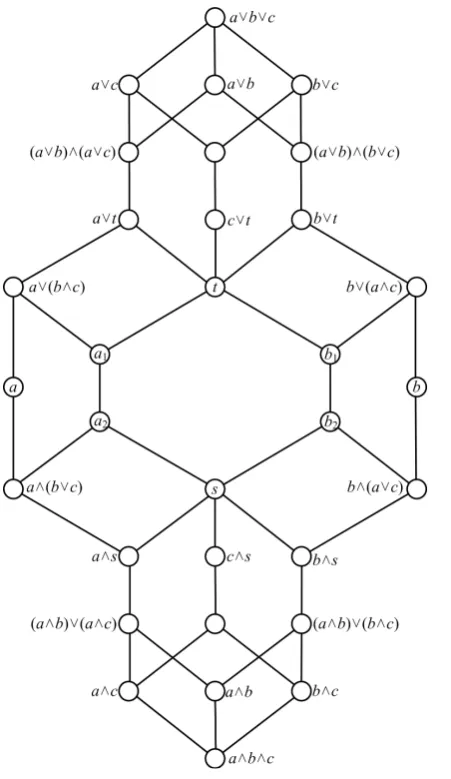
The setM1∪M2∪Ma∪Mbis shown on the Figure 2. Here we don’t denote the elements (b∨c)∧(a∨c) and (b∧c)∨(a∧c) to do not overload the figure. Ifx≥y
for somexandy from the latticeLthey are joined by a line and the elementxis above thany. The inequalities between a1 and a2, b1 and b2, c1 and c2, t and s have
been proved in Lemma 1. Other inequalities are well known or checked easy. But we do not guarantee as yet that all elements shown in this diagram are different.
Let us carry out the necessary calculations.
1) (a∨c)∧((a∨b)∧(b∨c)) =t. It means thatx∧y=t
for any elementxfrom the interval [t, a∨c] and for any elementy from the interval [t,(a∨b)∧(b∨c)].
2) (a∨(b∧c))∧(b∨c) =a1. Then (a∨(b∧c))∧x=a1
for any elementxfrom the interval [a1, b∨c].
3)a∧x=a∧(b∨c) for any elementxfrom the interval [a∧(b∨c), b∨c].
4) (a∨(b∧c))∧(b∨(a∧c)) =sby Lemma 2. It means that the set{a∨(b∧c), a1, a2, s, b2, b1, b∨(a∧c)}is closed
under the operation∧.
5) The equality (a∨(b∧c))∧(b∨(a∧c)) = simplies (a∨(b∧c))∧b=s∧b. Then the set{a∨(b∧c), a1, a2, s, b∨s, b∧(a∨c), b}is closed under the operation∧. 6)x∧y=a∧bfor any elementxfrom the interval [a∧b, a] and for any element yfrom the interval [a∧b, b]. 7) a∧(c∧s) = a∧c. It means the closure of the set
{a, a∧(b∧c), a∧s,(a∧b)∨(a∧c), a∧c,(a∧c)∨(b∧c), c∧s}
under the operation∧.
8) (b∧c)∧x = a∧b∧c for any element x from the interval [a∧b∧c, a].
The roles ofaandbinM1∪M2∪Ma∪Mb are inter-changeable, and so are the roles ofa,bandcinM1∪M2. Hence the verifications made above suffice to claim the closeness of the setM1∪M2∪Ma∪Mb under the
oper-ation∧.
with binary operation∗and let{Ki|i∈I}be a family of subsets of the algebraU. Suppose that for any pair of subsetsKi andKj (which are not necessarily different) from this family, their unionKi∪Kj is closed under this operation. Then∪{Ki |i∈I} is also closed under the operation ∗ too. Indeed, if x, y ∈ ∪{Ki | i ∈ I} then there exist i and j that x ∈ Ki and y ∈ Kj. Hence
[image:3.595.70.296.159.549.2]x∗y∈Ki∪Kj⊆ ∪{Ki |i∈I}.
Figure 2. The setM1∪M2∪Ma∪Mb
Lemma 4. The set M1∪M2∪Ma∪Mb∪Mc is a sublattice of the latticeL.
Proof. LetP =M1∪M2∪Ma, Q=M1∪M2∪Mb
and R=M1∪M2∪Mc. By Lemma 3 the setsP∪Q, P∪R, Q∪R are closed under∧ and∨. Consequently the set P∪Q∪R is closed under these operations too, i.e. this set is a sublattice of the latticeL.
Below we will use the following remark well known from general algebra. Let L1 and L2 be lattices with the same set of generating elements and let τ1 and τ2
be sets of defining relations, respectively, for these lat-tices. In this case ifτ1⊆τ2then the identity mapping of generating elements of latticeL1on generating elements of latticeL2 can be continued to a surjective homomor-phism ofL1 onL2.
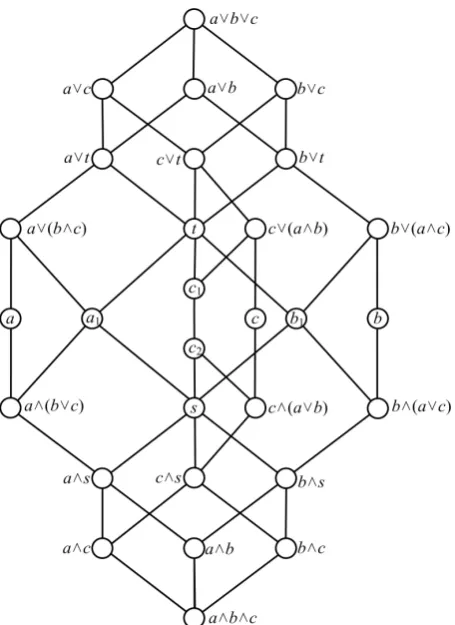
Before proving Theorem 2 let us consider the lattice which is mentioned in this theorem. For convenience we denote it by L1. It has 37 elements. Also it is
obvi-ous that this lattice is generated by three elements. On Figure 3 we have denoted them as a, b and c. Other
elements of the lattice have been evaluated by this gen-erators and they have been marked by corresponding formulas apart from elements c ∨(a∧b), c∧(a∨b), (a∨c)∧(b∨c) and (a∧c)∨(b∧c). As abovea1, a2,
b1,b2,c1,c2,t and s denote the elements with respect to formulas (12) — (19).
Of course, for some elements of L1 we can write also other variants of their representations by the generating elementsa,bandc. For example,t=a2∨b2=a2∨c2= b2∨c2. Each of these equations is a certain relation
between the generating elements a, b, c of the lattice
[image:3.595.320.540.207.593.2]L1.
Figure 3. The setM1∪M2∪Ma∪Mb∪Mc
Let τ denote the set of all relations of the generated elements a, b and c of the latticeL1.
Proof of Theorem 2. LetL2 be a lattice generated by elements a, b and c with the defining relations (1) and (2). The lattice L1 is the homomorphic image of the latticeL2 since relations (1) and (2) are contained inτ. Consequently there are at least 37 different elements in the lattice L2.
In the same time by Lemma 4 the set
M1∪M2∪Ma∪Mb∪Mc
is a sublattice of the lattice L2. This sublattice
con-tains the elementsa,bandc, henceL2contains at most
37 elements. It means that the lattices L1 and L2 are
Proof of Theorem 1. LetL3 be the lattice generated by elementsa,bandcwith the defining relationsρ. Let
ϕbe the identity mapping from the generating elements
a,b,c ofL2 onto the generating elements a,b,c ofL3. Since the relations (1) and (2) are contained in ρ, the mapping ϕ can be continued to a surjective homomor-phism fromL2 ontoL3. This homomorphism identifies elements at least in 9 pairs: a1anda2,b1andb2,c1and c2 because (3) — (5) are true,a∨tand (a∨b)∧(a∨c), b∨t and (b∨a)∧(b∨c), c∨t and (c∨a)∧(c∨b) because (6) — (8) are true, and also three pairs of dual elements because (9) — (11) are true. This means that the number of elements ofL3 is at most 28.
[image:4.595.305.533.72.385.2]Also all relations fromρare true for any modular lat-tice (e.g. [5]). Therefore there exists surjective homo-morphismφfrom latticeL3onto latticeAthat contains exactly 28 elements. Consequentlyφis an isomorphism. For the proof of the second statement, for any setσof defining relations obtained fromρby removing one of its elements we construct a non-modular lattice satisfying the relations inσ. For example, the lattice in Figure 4 satisfies the relations (2) — (11) but it does not satisfy the relation (1).
Figure 4. The lattice which does not satisfy the relation (1)
The lattice in Figure 5 is not modular and satisfies the relations (1), (2), and (4) — (11) but it does not satisfy the relation (3).
The lattice in Figure 6 satisfies the relations (1) — (7) and (9) — (11) but it does not satisfy the relation (8). The element (b∨c)∧(a∨c) is not denoted to do not overload the figure.
All other examples can be obtained from the ones pre-sented in Figures 4 — 6 by a suitable renaming of ele-ments and passing, if necessary, to dual lattices. To show independence of the relation (3) from the other 10 relations it is possible to give an example of lattice with a smaller number of elements (for example, such as in [4]). But the lattice of Figure 5 is the lattice generated by the elements a, b, c subject to the defining relations (1), (2), (4) — (11). That is why it is interesting. The proof is similar to the proof of Theorem 1 using the re-sult of Theorem 2. In this regard Figure 6 gives the lattice generated by the elements a, b, c subject to the defining relations (1) — (7), (9) — (11).
Using Theorem 2 it is easy, in the same way, to obtain the lattice generated by the elementsa, b, c subject to
[image:4.595.74.254.344.515.2]Figure 5. The lattice which does not satisfy the relation (3)
[image:4.595.304.533.453.772.2]the set of defining relationsσwhere {(1),(2)} ⊂σ⊂ρ.
3
Discussion
We note that in connection with this paper it would be interesting to find out whether there exists a set of defining relations for the free modular lattices of rank 3 in which the number of relations will be less than 11.
Although the defining relations (1) and (2) gives the nonmodular lattice it is finite. Whether the lattice gen-erated by the elements a, b, c subject to the defining relations (2) — (11) finite? It is natural to expect a negative response but it is unknown to us.
Lemma 2 shows that the relation (2) considered as the identity is equivalent to the identity (x∧y)∨(x∧z)∨ (y∧z) = (y∨(x∧z))∧(z∨(x∧y)) In turn this identuty is equivalent to the modularity of a latiice. Indeed if
x≤ythen (y∨(x∧z))∧(z∨(x∧y)) =y∧(z∨x) and (x∧y)∨(x∧z)∨(y∧z) =x∨(y∧z). It means that the modularity follows from the identity. Conversely if a lattice is modular then the equalities (x∧y)∨(x∧z)∨(y∧ z) = (y∧(z∨(x∧y))∨(x∧z) = (y∨(x∧z))∧(z∨(x∧y)) follow from inequalities y∧y ≤ x and y ∧z ≤ z ≤ z∨(x∧y). In the same time the varietyV generated by the free modular lattice of rank 3 is a subvariety of all modular lattices. This variety is clear to be contained in the varietyW generated by the lattice on Figure 1. Since the lattice on Figure 1 is close to the free modular lattice of rank 3 we can expect that in the lattice of varieties the interval [V,W] is not very long.
Acknowledgements
We would like to express our thanks to Lev Shevrin for the discussions that contributed to significant improve-ments of the text.
REFERENCES
[1] O. Ore. Remarks on structures and group relations, Vierteljahrsschrift der Naturforschenden Gesellsachaft in Zurich 85 (32), 1 - 4 (1940).
[2] Z. Ladzianska. Modular substructures of an structure, Mat. ˇcasop. 24 (1), 81 - 83 (1974).
[3] M. Kolibiar. Distributive sublattices of a lattice, Proc. Amer. Math. Soc. 34 (2), 359 - 364 (1972).
[4] A.G. Gein, M.P. Shushpanov. Defining relations of a free modular lattice of rank 3 - Russian Mathematics, N 10 (2013), pp. 59 - 61.