Journal of Chemical and Pharmaceutical Research, 2013, 5(12):560-564
Research Article
CODEN(USA) : JCPRC5
ISSN : 0975-7384
Application of information fusion technologies for multi-source data
Wu Hao, Seng Dewen, Fang Xujian and Xu Haitao
School of Software Engineering, Hangzhou Dianzi University, Hangzhou, China
_____________________________________________________________________________________________
ABSTRACT
The advances in the application research of information fusion technologies in traffic data are reviewed. Based on the idea of the Internet of Things, this paper studies the multi-source information fusion technologies of urban public traffic data, including GIS data, GPS data, bus RFID data, public bike RFID data, MIS systems data, graphics data, etc. A framework for building traffic information fusion system for complex multi-source public traffic data is presented and described in detail. Based on the internet of vehicles, berths, stop signs, gas stations, service stations, collection boxes and other hard wares, we select and apply the appropriate information fusion technologies for the urban public intelligent transportation systems for the whole process of maintenance, operations, and scheduling, emergency treatment. A case study with real data derived from Hangzhou city of China demonstrates the effectiveness and efficiency of our approach.
Key words: Information fusion; traffic data; intelligent transportation systems
_____________________________________________________________________________________________
INTRODUCTION
Urban traffic is the lifeblood of the city life. Smooth or not of the urban traffic is an important indicator for measuring the progress of civilization of a city. With the continued rapid development of the economy, the process of urbanization is constantly moving forward. The cities have been expanding, and the people's living standards are of greatly and steady improvement. With travel motorization rate of the residents steady enhanced, car which was seen as a luxury in the past have gradually entered the ordinary families. We are ushered in for the automotive mass consumption stage. Although road construction has also been a substantial increase in mileage, the city's traffic does not improve greatly. Traffic congestion has become increasingly serious, and driving hard has become a common problem of most cities [1-5].
Think of ways to solve the increasingly serious problem of traffic congestion have gained more and more attention. The construction of roads and other infrastructure is the traditional way to solve this problem, but the city was crowded, and the available geographic space is limited. Infrastructure construction speed cannot be compared with the motor vehicle growth rate. In addition, the traffic system is a complex system, so problems cannot be got rid of only from the vehicle or from the road. In this context, intelligent transportation systems (ITS) use high technology to solve the traffic problems emerged based on the synthesized consideration of the transportation infrastructure, traffic participants, and transportation means [6]. With the development of sensor technology and information technology, the access to a large number of real-time traffic information is possible. Multi-source information processing has become a very important aspect of intelligent transportation research [7].
environment factors [9-11]. These detectors are usually installed on the main roads of the city, so the entire road network traffic information is difficult to fully acquire, so they cannot meet the actual needs of the current ITS applications.
Floating car data (FCD) technology as a low-cost, high coverage of mobile real-time traffic information collection method, has gained more and more attention in the ITS field in recent years. City taxi floating car technology has been widely used in the acquisition and application of the cities in a wide range of road traffic information. City bus floating car data resources are mainly used for electronic bus stop system and bus intelligent scheduling system. With the development of the Internet of Things, Radio Frequency Identification (RFID) technology continues to mature. RFID technology can achieve non-stop long-range automatic identification, real-time fixed point collection of public transportation vehicles in or out of the station and quickly determine the location of the public transport vehicles by information collection points. It has the advantages of stable, reliable, low bit error rate. Many cities used the RFID technology in intelligent transportation systems [12-16].
Because of their respective strengths and weaknesses in the practical application, using only FCD technology or RFID technology is not very satisfactory. Affected by the free parking of floating cars and the positioning accuracy of the Global Positioning System (GPS), the detection accuracy of FCD is not high enough. Based on the experience of a number of cities, FCD detection accuracy is generally less than 85%. RFID can only be carried out for data acquisition at a fixed point. Capital investment will be quite large for intensive installation of data acquisition equipments, and the maintenance costs are very high. If the data acquisition devices are too few, the sensing range does not have comprehensive coverage, and will not be able to achieve the perception of vehicles on the roads of real-time status information.
Therefore, we use the multi-source traffic information fusion technologies to overcome the uncertainties and limitations of a single sensor. Comprehensive utilization of the multiple detections means to take full advantage of multi-sensor data resources of different time and space to get consistency explanation and description of the bus dynamic data, and then to get a comprehensive and accurate understand of dynamic data. In this paper, we study the key problems in the public traffic dynamic data acquisition and fusion, and provide a good understand of the data for the building a real-time, accurate and intelligent public transport information service system.
INFORMATION FUSION TECHNOLOGIES
Information integration is the merging of information from heterogeneous sources with differing conceptual, contextual and typographical representations. It is used in data mining and consolidation of data from unstructured or semi-structured resources. Typically, information integration refers to textual representations of knowledge but is sometimes applied to rich-media content [17]. In the geospatial domain, information fusion is often synonymous with data integration. In these applications, there is often a need to combine diverse data sets into a unified (fused) data set which includes all of the data points and time steps from the input data sets [18]. The fused data set is different from a simple combined superset in that the points in the fused data set contain attributes and metadata which might not have been included for these points in the original data set.
Information fusion which is a related term involves the combination of information into a new set of information towards reducing uncertainty. Information fusion is a new multi-source information processing technology [19]. It is based on a variety of information resources detection, correlation, estimation and multi-level, multi-interface synthesis process, in order to obtain accurate estimates of the state and property, as well as a complete, real-time situation and assessment. This definition is basically a description of the expected functions of information fusion technology. From the study or activity conducted by the people in the range of information fusion, information fusion can be broadly summarized for such a process, i.e., the data and information from multiple sensors, in accordance with the established rules, analysis, synthesis for a fully intelligence, and on this basis, to provide users with the demand for information, such as decision-making tasks, track and classification. Therefore, simply said, the basic purpose of the information fusion is to obtain more reliable information than from any single input data through the synthesis [20-23].
Fig. 1: Information fusion hierarchy for multi-source traffic data
APPLICATION AND CASE STUDY
Traffic flow information fusion can be divided into two categories: the status information fusion of the traffic flow and the characteristics information fusion of traffic flow. The characteristics of the traffic flow information fusion is characterized by the joint recognition that the original data will be processed for feature extraction, data correlation and normalization, and then analysis and synthesis, then a comprehensive evaluation of the measured object will be achieved. This type of fusion will maximum give feature information required for decision analysis, so most applications of information fusion research carried out in the level. Based on information fusion framework, we will get two sets of time continuous and content complete data results from the processed traffic flow data. With the data association unit matching the pairs, the same period, the same section of the real-time traffic flow data will be divided into a group, and then access to the computing fusion unit. In this process, the data during fusion has been paired and continuous before the calculation. City road network traffic flow data has a massive, time-varying characteristic. Continuous traffic flow information fusion algorithm must be able to quickly and reliably handle the massive information fusion.
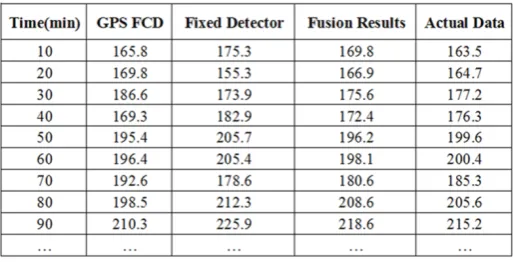
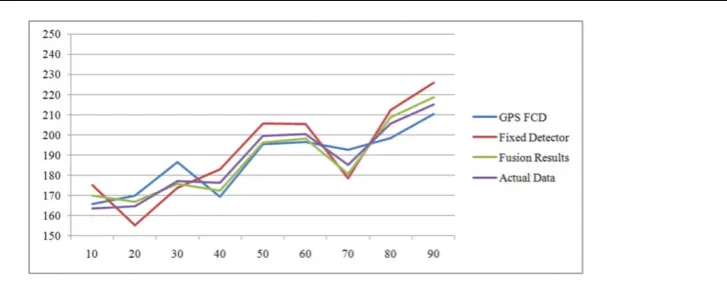
In our study, we derived real traffic data form Hangzhou city of China. The detected data are obtained from GPS FCD and fixed detector. The fusion data and actual data are partly shown in Table 1. The comparison of run time of GPS, fixed detector, fusion results and actual values is shown in Fig. 2.
Table 1. Validation data of bus run time
[image:3.595.184.441.509.640.2]Fig. 2: Comparison of run time of GPS, fixed detector, fusion results and actual values
Through the analysis of the above data, we can reach that the floating car, fixed detector, and information fusion are three ways to obtain the run time data. The relative average errors are 8.62%, 7.15% and 3.96% respectively. By contrast, we can find that information fusion of multi-source data is closer to the actual values. Therefore, the approach presented in this paper will actually improve the estimation accuracy.
In our approach, information fusion is mainly used in the following aspects: Vehicle location: access to vehicle location information through a single source of data source; Vehicle identification: including traffic access division and the safe operation status confirmation for the beyond boundary vehicles; Vehicle tracking application: identification of travelling locus of the vehicle by the fusion process of the traffic information acquired by the multi-source data source; Vehicle navigation: based on the confirmation of the trajectory of the vehicle, and the existing road network, speed, status quo road network traffic flow parameters, future road network traffic flow status parameter estimation as the necessary boundary conditions to achieve real-time vehicle navigation; Traffic control: to obtain the traffic flow through the traffic detector information, and to use the traffic control to undertake the task of data processing. With the traffic flow increases, there is great demand for the use of information fusion technology to automate image forming to improve control efficiency.
CONCLUSION
Intelligent transportation system as a new way to solve traffic problems has become a consensus. Detector technology has been widely used in the application and promotion of intelligent transportation system so that people can get a lot of traffic data, which making it possible to solve many traffic problems. In our study, we take the multi-source traffic flow data as research object. Through the data mining and fusion of these data, we get the effective traffic information, which can be effectively alleviating the increasingly grim city traffic situation. Fuzzy rough set theory is used to remove redundant traffic flow data. We present the contradictory evidence synthesis formulas to achieve the conflicting evidence digestion and integration and take the advantages of fuzzy likelihood measure method to complete the basic probability function to obtain evidence synthesis process. The method is fully taken into account the traffic flow information conflict contradiction between the fuzziness and multi-source information, and improves the utilization of the current methods of detection data. Real traffic data from Hangzhou city was combined with the traffic flow information fusion processing technologies. The fusion results from multi-source traffic flow data demonstrate the effectiveness and efficiency of our approach.
Acknowledgments
The authors wish to thank the National Natural Science Foundation of China for contract 61100194, the foundation of education department of Zhejiang province of China for contract Y201120520 and the research foundation of Hangzhou Dianzi University for contract KYS105612008 and YB1205, under which the present work was possible.
REFERENCES
[1]Arora A.. Traffic Engineering and Control, v 53, n 10, p 375-378, November 2012.
[2]Korhonen T., Salminen, R., Karila A.. IET Intelligent Transport Systems, v 6, n 1, p 18-28, March 2012. [3]B. Chen and H. H. Cheng. IEEE Trans. Intelligent Transportation Systems, vol.11, no.2, pp.485–497, 2010. [4]Seng Dewen. Applied Mechanics and Materials, v. 189, p. 482-485, 2012.
[9]Prashant T., Kavita D., Manish S.. International Journal of Soft Computing and Engineering, v.2, July 2012. [10]LIN T. Y. Granular Computing: From Rough Sets and Neighborhood Systems to Information Granulation and Computing in Words. European Congress on Intelligent Techniques and Soft Computing, Heidelberg, Germany, pp.1602-1606, September 8-12, 1997.
[11]Seng Dewen. Applied Mechanics and Materials, v. 189, p. 478-481, 2012. [12]Zadeh L A. Fuzzy Sets and Systems, 1997, 90(2): 111-127.
[13]Seng Dewen. Applied Mechanics and Materials, v. 189, p. 457-460, 2012.
[14]Seng Dewen, Shu Yueqing. Advances in Intelligent Systems and Computing, p. 401-408, 2013.
[15]Yao Y Y. Perspectives of granular computing. IEEE Conference on Granular Computing, pp.85- 90, 2005. [16]Seng D. Framework and Key Technologies for the Construction of a Virtual Mine. International Conference on Multimedia Technology, 2010.10.
[17]Seng D, Chen W. 3D Visualization and Interaction Technologies Applied in the Modeling of Geological Bodies. 2010 International Conference on Computer Application and System Modeling, 2010.10.
[18]Zhang Q, Ma Z.K, Wang L. Pattern Recognition Letters, v.34, n.2, pp.185-193, January 15, 2013. [19]Du P. J, Liu S.C., Xia J. S. Information Fusion, v.14, n.1, pp.19-27, January 2013.
[20]Shang L., Liu G.H., Zhang R. Acta Astronautica, v.85, pp.33-40, 2013.