students in the private rented sector
What are the issues?
ts
in
th
e P
riv
at
e R
en
te
d S
ec
to
r:
W
ha
t a
re
th
e I
ss
ue
Author’s Acknowledgment
The Centre for Housing Research would like to thank the many people who assisted in the completion of this study. We would especially like to thank the members of the Steering Group who oversaw the study: Eoin O’Sullivan and Maire O’Mahony (PRTB), Cian Ó’Lionáin and Aidan Brennan (DEHLG), John Rigney (Department of Education and Science) and Anthony Muldoon (USI).
Thanks are also due to Kieran Rose of Dublin City Council, Andrea Cesati of HKR Architects and Declan Brassil of Declan Brassil & Co. for the information they provided.
We would like to thank the team who carried out the research – those who undertook the student surveys and entered the data: Maura Gallahue, Ivor Kelly, Ailish Short, Orla Hill, Frank Groome, Lisa Mulhall, Laura Kelly, Gillian Kingston; John Humphries who undertook some of the research on the supply of college-provided accommodation; and Candy Murphy of CMAdvice Ltd who carried out the international review.
Finally we would like to thank the participating colleges for granting us access for the student surveys and most importantly the students who participated in the surveys for their time and support.
© Private Residential Tenancies Board
O’Connell Bridge House Dublin 2
www.prtb.ie
April 2009
The views expressed in this report are those of the authors and do not necessarily reflect those of the PRTB or the Centre for Housing Research. This document is not intended to be a legal interpretation of any existing legislation or to be a legal instruction in relation to procedure.
In 2006 the Private Residential Tenancies Board entered into a partnership arrangement with the Centre for Housing Research and the Centre is managing a number of research projects on behalf of the PRTB.
Information on the Centre is available at www.chr.ie
All rights reserved.
preface 6
section one
Introduction and Overview 8
section two
Review of Student Accommodation in Ireland 10
section three
Survey of Students in the Private Rented Sector 19
section four
Review of Student Accommodation in Europe 43
section five
Key Findings, Conclusions and Recommendations 70
references 80
appendix one
Students in the Private Rented Sector (PRS) Survey 82
appendix two
list of tables
2.1 Number of students in various types of accommodation 2006–2007 11
2.2 Information on Dublin area colleges and their
provision of accommodation (2008) 15
3.1 Institutional breakdown of students who completed the short survey 22
3.2 Courses undertaken by short survey students 22
3.3 Short survey response to ‘Why are you not living in the private
rented sector?’ 23
3. Respondents from outside the island of Ireland 23
3.5 Respondents with origins on island of Ireland 2
3.6 Respondents’ college, year and full/part-time status 2
3.7 Responses to question ‘How long have you been renting
your current accommodation?’ 26
3.8 Perception of ease or difficulty in finding accommodation and the
length of time it took to find this accommodation 27
3.9 Reasons respondents thought their property search was difficult 27
3.10 ‘Which of these statements is correct for you?’ 29
3.11 Satisfaction/Dissatisfaction considered against stated preferences 30
3.12 Relative importance of five factors influencing
choice of accommodation 31
3.13 Opinion of cost of accommodation related to
accommodation preferences 33
3.1 Student consideration of accommodation quality when choosing
where to live and the quality of their current accommodation 3
3.15 Consideration of safety as an influence on accommodation selection
and perceived safety of current accommodation 3
3.16 Influence of proximity to college when choosing accommodation
and perception of commuting time 35
3.17 ‘How would you describe finding your current
accommodation?’ – by college 39
list of figures
3. 1 Number of accommodation occupants (including respondent) 28
.1 Percentage of students in different forms of accommodation
in a number of European countries (2007) 5
.2 Maximum or fixed student fees and average living costs in
European countries (per student and month) 6
.3 Types of support for accommodation awarded to students enrolled for a first qualification (ISCED 5) in a public or
government-dependent private institution, 2005 8
. Criteria governing the award of support specifically for the accommodation of students (ISCED 5) by type of support
(in kind or in cash) 2005–2006 9
.5 Number of places in public service accommodation for students
(ISCED 5) enrolled for a first qualification and rent levels (PPS €),
public or government-dependent private sectors, 2005–2006 50
.6 Annual amounts of cash support (PPS €) awarded specifically for
accommodation to students enrolled for a first qualification (ISCED 5)
in a public or government-dependent institution, 2005–2006 51
.7 Accommodation provision in London (September 2007) 62
.8 Rank top 20 commercial operator/investors ‘completed beds’
in Sept 2007 and in pipeline ‘Total beds’ 6
6
Preface
Many students studying away from home rely on the private residential sector for accommodation. For some, this can be their first real experience of living independently. Good quality, affordable accommodation, convenient to college can be an important factor in a student’s quality of life and their likelihood of completing their studies. It is also an important factor in attracting students from abroad to come to study here in Ireland. Students’ experiences in the sector are therefore important to trace and understand.
It was with this in mind that the Department of the Environment, Heritage and Local Government, the Department of Education and Science, the Union of Students in Ireland and the Private Residential Tenancies Board came together and requested the Centre for Housing Research to undertake this piece of research of students’ experiences of the private rented sector.
The results of the survey of over 1,300 students in five Dublin colleges show high levels of satisfaction – almost nine-out-of-ten students reported that they were satisfied or very satisfied with their accommodation and only one-in-twenty described their relationship with their landlord in negative terms. A shorter survey of students not living in the private rented sector, however, found that about half would prefer to do so and cost was the main reason given for not renting. A second feature of the study was a review of student accommodation in Europe. This section points out that students are increasingly being recognised as a distinct and growing sub-sector of the private rented market.
Going forward, students’ experiences in the private rented sector are likely to remain positive – rent levels have become more affordable in recent months and the new Housing (Standards for Rented Houses) Regulations have increased the minimum standards required. Increased enforcement of standards by local authorities is a third positive development.
It is important nonetheless not to become complacent and new initiatives are required to ensure students and their landlords are aware of their respective rights and responsibilities when renting. The recently prepared PRTB leaflet on How to be a Good Tenant / How to be a Good Landlord is a timely source of information for students and landlords as preparations for a new academic year get underway. The research committee would like to thank the researchers, Noelle Cotter of the Centre for Housing Research and Candy Murphy of Candy Murphy and Associates, for undertaking this work, the participating colleges for granting campus access to the fieldworkers and the many students who completed questionnaires. Dr Eoin O’Sullivan,Research Committee Private Residential Tenancies Board
Cian Ó Lionáin,Department of the Environment, Heritage and Local Government
John Rigney,Department of Education and Science
8
Section One
Introduction and Overview
Following a meeting between the Union of Students in Ireland and the Minister for the Environment, Heritage and Local Government in October 2007 it was agreed that the issue of student accommodation in Ireland merited further examination. The Minister for Education and Science and the Minister for the Environment, Heritage and Local Government agreed to support such a study. The Private Residential Tenancies Board (PRTB) which has a mandate for research on the private rental sector led the study, which was carried out on their behalf by the Centre for Housing Research.
rationale for research
According to the student representative bodies, accessing accommodation is an ongoing concern for students attending third-level institutes, particularly in Dublin. It was decided therefore to concentrate the study on the greater Dublin area (GDA), while reviewing both the national and European context in which issues regarding student accommodation arise.
aim of the study
To review issues affecting the supply and access to student accommodation in Ireland in a European context
To explore through primary research the specific situation of students in the Greater Dublin area
To make recommendations based on these findings.
•
•
objectives
To review trends in student numbers and student accommodation
To review current policy and practice on student accommodation in Ireland
To provide quantitative data on the accommodation requirements/choices of students and on the cost and quality of such accommodation in Dublin and to identify any particular areas of concern for students living in the private rented sector
To review the provision of student accommodation across the European Union and to identify examples of good practice
To identify any areas of concern in the short, medium and long term and to recommend any actions required to address them.
methodology
Overview of the student population and of their accommodation options
Analysis of available secondary data on student accommodation issues
Review of policy and practice in the area of student accommodation in Ireland
Survey of a sample of 1,300 students in the GDA in five different third-level institutes
Review of student accommodation in Europe and related initiatives
Identification of key issues and recommendations on actions required to address them.
•
•
•
•
•
•
•
•
•
•
10
Review of Student Accommodation in Ireland
introduction
This section of the study examines available data on the student population and reviews identified issues in the provision of student accommodation. It also reviews policy and practice in this area. Estimates of the current level of provision of college-based accommodation in Dublin are made and trends in the provision of the private rented accommodation sector are reviewed.
student profile and accommodation situation
The Higher Education Authority records that of the 84,263 full-time students attending universities in the Republic of Ireland1 in the academic year 2006– 2007, 68,039 of these were undergraduate, with the remaining being full-time postgraduate enrolments. As can be seen from Table 2.1, 13 per cent of these students were living in college accommodation (either on or off campus), and 27 per cent were living in rented accommodation. Although no students were living in lodgings or hostels, a not unsubstantial number of full-time university students classified their accommodation as ‘other’ or did not specify their accommodation type, and 44 per cent were living at home.
1 These HEA figures relate to students attending UCD, UCC, NUIG, TCD, NUIM, DCU, UL, NCAD, RCSI, St Patrick’s
The Department of Education and Science2 states that in this same academic year (2006–2007) there were 138,362 students in different forms of third-level education, and 53,358 of these were in Institutes of Technology or technical colleges. The Department of Education and Science estimates that the student population will reach 170,000 by 2013, an increase of 31,638 or 22 per cent over seven years.
Taking these figures into consideration, it can be seen that there is a substantial and growing body of students in Ireland. Added to this, Ireland and Irish colleges are increasingly encouraging international students to choose Ireland for their studies. International students bring important economic and other benefits. They are estimated to spend €154 million in direct fees, and €181 million off-campus (International Education Board, Ireland, 2006). A Higher Education Authority report released in July 2008 (National Plan for Equity of Access to Higher Education 2008–2013, p.36) discusses changes in participation rates by children from different social groups between 1998 and 2004. It was observed that children from lower-middle-class families had not increased their representation in third-level institutions to the same extent as children from other social groups. The given reason for this is that these families were just above the income threshold for grants and yet did not have sufficient income to pay the associated costs. The report states that despite the abolition of fees, families must provide an average annual maintenance cost of €7,000 to put a student through third-level education. The expense of maintaining a student away from the parental/guardian’s home contributes significantly to these costs.
Thus the demand for student accommodation is likely to increase – among both national and international students. This has implications both for campus accommodation and for the private rented sector, while the cost of providing such accommodation is likely to place significant burdens on many of the families concerned.
College Own Parental Rented
accommodation Unspecified Other home home accommodation Total
Population 11,07 6,535 1,59 3,587 37,38 23,837 8,263
[image:12.637.82.543.103.188.2]% 13 7 1 27 100
Table 2.1 Number of students in various types of accommodation 2006–2007
Source: HEA website
12
accommodation issues for students
In 2007 the Union of Students in Ireland identified obtaining accommodation as a core problem for students around the country and undertook to make student accommodation a key campaign focus. The most severe problem was recorded as occurring in Dublin (USI annual report, 2007–2008). A 2007 study by the Centre for Housing Research (Coates and Feely, 2007) involving interviews with local authority housing inspection staff discovered that there was a higher incidence of non-compliance in bedsits3 and older properties. These are the areas of the rental property market that students are likely to access. The Eurostudent Survey II 2003–2004 (Darmody et al., 2005) documented students’ experiences in terms of their accommodation situation, sources of income, expenditure levels and overall well-being in Ireland (N=3,900). This survey recorded that the highest proportion of full- and part-time students lived in rented accommodation (39 per cent), seven per cent lived in college residences and four per cent in lodgings/digs. Satisfaction with accommodation was lowest among those living in private rented accommodation; with the highest proportion of expenditure going on accommodation.
The survey found that 54 per cent of students received indirect support from their families, subsidising their accommodation or other expenses. The average family subsidy for students in rented accommodation was found to be €95.69, of a total average monthly accommodation cost of €388.63. For students in lodgings or digs, the average family subsidy was €108.02, of a total average monthly cost of €381.11. Students who lived in university-provided accommodation attained the highest family subsidies (average €200.54 per month), but were also paying on average more per month for this form of accommodation – €418.85. Students received money from employment and from student grants, as well as from their parents.
In the same survey, 24 per cent of full-time students described their financial situation as good; however, a further 19 per cent reported it as bad. The latter 19 per cent were also the students who worked longer hours. Employment outside of course commitments was more likely among students whose parents had lower levels of education.
This study allowed room for qualitative commentary, and accommodation was cited as a frequent complaint among student respondents. The availability and standard of accommodation was criticised, as was the cost of living in cities, particularly Dublin. One respondent said:
Accommodation is so expensive in Dublin that I have been forced to live at home. I therefore spend up to two hours travelling to college every morning and the same home (p.86).
Commuting was found to constitute a sizeable proportion of student outgoings in this survey – 32 per cent of (full- and part-time) students spent between €51 and €100 per month on travel and, overall, students spent on average 4.5 hours per week travelling to and from college. Students living with their parents spent the most on transport; students living in their own households spent marginally less, with the least amount spent by students living in institutionally-provided accommodation (e.g. student halls).
3 Bedsits will be phased out under the Housing (Standards for Rented Houses) Regulations 2008. See page 17 for further
This brief overview of the Irish student population shows that demand for student accommodation is likely to expand in the future, creating demand for reasonably priced accommodation within close proximity to institutional settings. This may put pressure on accommodation costs in these areas which may in turn create further difficulties for students struggling to manage their coursework and employment. Students who live further away from their place of study to keep costs down may face significant commuting costs. Furthermore, while students who were most satisfied with their accommodation were those who lived with their parents this may not be an option for the majority of students. Students who were least satisfied with their accommodation were those who lived in the private rented sector and available research indicates that standards of accommodation in this sector may be relatively poor.
policy initiatives
The government has taken a number of initiatives to support the provision of student accommodation in Ireland.
The 1999 Finance Act introduced the Section 23 Relief Scheme for certain types of development in Ireland (relevant legislation contained in Chapter 11 of Part 10 of the Taxes Consolidation Act 1997). Among the forms of building works against which owners could seek relief was student accommodation. A full deduction of expenditure on construction, conversion or refurbishment could be offset against all Irish rental income. The scheme applied to capital expenditure incurred between 1 April 1999 and 31 July 2006, and was extended to 31 July 2008 under the Finance Act 2006 in accordance with certain conditions. However, there was a gradual reduction in the amount of expenditure qualifying for relief after 31 December 2006. Expenditure incurred in 2006 could qualify in full without restriction, but this was reduced to 75 per cent of expenditure incurred in 2007 and to 50 per cent of expenditure incurred between 1 January 2008 and 31 July 2008.
The same Finance Act also provided for Section 50 – a scheme of tax relief for rented residential accommodation for third-level students; this was very similar to the Section 23 relief. Section 50 allowed for the full deduction of the construction cost of the unit (less site cost) available against all Irish rental income. If rental income deduction was not fully utilised in year one, then the balance could be carried forward and offset against future Irish rental income.
1
Sections 23 and 50 also provided for a certain quality of accommodation. Study bedrooms were to be grouped into house units, with a minimum of three bed spaces per unit, and a maximum of eight bed spaces ranging from a minimum gross floor area space of 55 square metres to a maximum gross floor area of 160 square metres. It was detailed that study bedrooms should have common entrance halls and a shared living/kitchen area space of a reasonable size to accommodate appropriate furniture which should be detailed in the planning layout. Minimum sizes per number of bed spaces sharing kitchen areas, living spaces and bedrooms were provided for in this scheme and basic facilities were also outlined. Kitchen units including sinks, cookers and fridges were provided for and bedrooms had to include desk space and storage as well as internet services. Minimum sizes for bathrooms and in particular ensuites for students with disabilities were accounted for. One out of every 50 bedrooms or part thereof availing of this scheme were to be appropriate for students with a disability and buildings generally were to be compliant with Part M of the building regulations, as well as any other usual standards regarding buildings and associated works.
A 2006 report to the Department of Finance by Indecon which reviewed such tax incentives found that the number of bed spaces developed or under construction between 1999 and 2004 stood at 15,317. Indecon’s research also showed that the proportion of students residing in student accommodation approved under the scheme rose by 16.6 per cent, with a fall of 20.1 per cent in students living in other accommodation provided by the market, between 2000 and 2005. Indecon found that 44 per cent of third-level institutions that had availed of Section 23 believed that there was now an excess supply of accommodation available in the market. A further third believed there was an adequate supply and 22.2 per cent thought there was a shortage of supply. All of the institutions surveyed that did not avail of the Section 23 tax incentive thought there was an adequate supply of accommodation.
Indecon surmised that this had been a successful scheme, achieving its stated objective, however at a high cost to the Exchequer and at a time of significant increase in the wider private rented property market to which students would have access. Therefore, Indecon concluded that there was no economic or social justification for further supports in the student accommodation area, and recommended that there should not be an extension of the capital allowances for student accommodation for projects that had not lodged full planning applications by December 2004. However, Indecon did not comment on the stock distribution across the country.
analysis of college-provided
accommodation in dublin
College Average rent Number On-campus Off-campus Tot al Bed per person with priv ate accommoda tion accommoda tion units sp aces per month ba throom Priority given to… UCD 2,38 units 180 units 2,56 2,577 € 50 1,176
(1) Special needs students (2) International students (3) Irish students not from Dublin () First years
DIT None 700 units 700 700 Max. € 600 700 DCU 980 units None 980 980 € 7 .1 732
3% available for special needs students First years with 500+ points guaranteed accommodation (1) Final year students (2) 2nd/3rd years
St P atrick’s 230 units None 230 230 € 360 –
Special needs students
College Griffith 600 units None 600 600 € 512 300
Special needs students
College NCI 286 units None 286 286 € 289 286 R CSI 90 units none 90 90 – 90 TCD 4 700 units 1,008 units 1,708 Table 2.2
Information on Dublin area colleges and their provision of accomm
odation (2008)
4 T
16
This table indicates that there are 5,463 bed spaces in Dublin colleges. However, at the moment student-specific college accommodation is provided for only nine per cent of the student population in Dublin, with the remainder of students living either with parents/guardians or in the private rented sector.
future plans for college-based
student accommodation
University College Dublin plans to create 10,000 more units in its forthcoming campus redevelopment and Trinity College Dublin recently advertised that it is seeking 1,000 new student residential units by September 2010 (Sunday Tribune, 26 April 2009). Dublin Institute of Technology is also planning to create more units when it moves to its Grangegorman campus – but the number of units has not yet been decided. In light of DIT’s proposed move, DIT carried out its own survey of students with regard to accommodation and associated preferences in early 20085
. Students were most influenced by the price and location of accommodation, with security also being a concern. Students were asked if they would consider living in block-booked off-campus accommodation, and 76 per cent stated they would.
There are plans underway for providing student-specific accommodation in central Dublin. The most advanced projects are in the planning permission process – two of which would be non-college specific, i.e. the students could be from any third-level institution – and the National College of Art and Design is planning to build accommodation for its own students.
There are other proposed projects, but the three that are the closest to coming on stream are as follows:
The Digital Hub project is a multi-use development with three buildings for student accommodation providing a total of 650 bed spaces, with an estimated rental cost of €180–€200 per week. Students would each have their own single bedrooms. They would have communal living areas, but each student would have his/her own fridge and cooking facility. This development is speculative, i.e. there is no operator assigned for this project. Completion is intended for late 2009–early 2010.
Ely Property Group is planning a phased development in Dublin’s Cork Street which it would also operate. This development could eventually provide over 1,000 bed spaces and would include an aparthotel element. This aparthotel would be aimed at postgraduate students and rooms would effectively look like studio apartments with no shared facilities. When not being used by students, outside of term-time, the operator could provide these rooms for visitors to Dublin. There would be a facility for joining neighbouring rooms to accommodate families outside of term-time. It would take approximately two years for this development to be available to Dublin’s students.
Neither of these developments would be gated communities and the intent would be to integrate them with the current surroundings and promote regeneration of the area.
•
•
5 O’Connor and Russell DIT Student Engagement and Satisfaction Survey 2007–2008 DIT internal document kindly made available
The National College of Art and Design on Dublin’s Thomas Street surveyed its students and found that 800–1,000 students would be interested in living on campus. There are plans to provide 200–240 bed spaces, to be built on site by a private consortium that would lease the site, develop the property and manage the completed buildings for a specified time period.
There is another potential student accommodation development in the Newmarket area in Dublin 8 which could provide 2,000 units on a non-specific college basis, to be run by a private operator. This project is in the very early stages of planning.
This review of student accommodation indicates that only a small proportion of students in Dublin currently live in college-based accommodation. While there are a number of plans to increase provision of specialist student
accommodation, led both by colleges and by private developers, the fact remains that most students in Dublin will continue to depend on the private rental sector for their accommodation unless they are living ‘at home’.
trends in the private rental sector in dublin
rental levels
The Daft Rental Report Quarter 2, 2008, with an introduction by the President of the USI, stated that the average rent in Dublin’s city centre at that time was €1,300, despite rents falling 3.4 per cent around the city since the first quarter of 2008 (in this period the only rent increase was in North County Dublin where rents were up 1.6 per cent). The Daft Report Q3, 2008 stated that rents across the country were at their lowest since August 2006, and that since the summer of 2008 rents have dropped by three per cent across the country. South County and West County Dublin’s rents fell by five per cent in the twelve months to November 2008 and they are expected to fall further. The Daft Rental Report Q1, 2009 reveals that rents have fallen again by more than five per cent. Daft’s figures reflect the asking price for a property on its website and also do not necessarily represent all available rental properties in the country. The asking price may differ from the rent agreed between a landlord and tenant – the latter may be in a better position to renegotiate in light of the current market. Falling rents in combination with an influx of new properties (the total stock of rental properties in Q2 of 2008 was twice the number at the same time the previous year) could result in students in 2008–2009 being in a more desirable position with regard to renting than in the recent past.
accommodation standards
18
The regulations will come into effect in their entirety for new lettings from the beginning of February 2009. Existing rental properties will be excused from three articles in these regulations until February 2013, to allow for improvements. These three articles relate to sanitary and laundry facilities, fixed heating appliances and cooking and food storage facilities.
The regulations effectively mean that bedsits – a form of accommodation frequently associated with student accommodation – will be phased out and that students are likely to have the opportunity to live in better quality accommodation in the future.
summary
This review of trends in student numbers indicates that student numbers in Ireland are growing and are likely to continue to grow in the future, fuelled by an increasing policy focus on attracting international students to Ireland. The demand for student accommodation is therefore likely to expand in the future, creating extra demand for reasonably priced accommodation within close proximity to institutional settings. This review has shown how these trends may put pressure on accommodation costs in these areas which may in turn create further difficulties for students struggling to manage their coursework and employment. Students who live further away from their place of study, in an effort to keep costs down, may face significant commuting costs. Furthermore, while students who were most satisfied with their accommodation were those who lived with their parents this may not be an option for the majority of students. Students who were least satisfied with their accommodation were those who lived in the private rented sector, and available research indicates that standards of accommodation in this sector may be relatively poor.
However, while student bodies have identified student accommodation as an on-going concern for students in terms of supply, cost and quality, available research also indicates that places for students in specialist accommodation have increased and are likely to continue to increase in certain key locations in the future, due in part to government incentives to encourage construction of student accommodation, and that supply problems have reduced in recent times. While Irish students will continue to depend largely on the private sector for accommodation, such accommodation may become less costly and is likely to be of a higher standard in the future.
Survey of Students in the Private Rented Sector
introduction
The focus of this part of the research was on the Greater Dublin Area as this is the area with the largest student population and is considered to be the area with the most intense competition for private rented accommodation. However, students’ unions all over Ireland were contacted and given the opportunity to make submissions regarding the private rented sector for students in their area. Five students’ unions made contact, and all five were very positive about the private rented sector in their area, with Athlone IT students’ union reporting that there was a surplus of private rented accommodation despite the absence of college-provided accommodation.
20
The survey of students in the Greater Dublin Area aimed to explore students’ preferences, choices and accommodation situations. The research questions to be answered were:
What type of accommodation do students in third-level education require and how does this compare with what they actually access?
What is the current availability of accommodation both on- and off- campus for students in the Greater Dublin Area?
What is the level of student satisfaction with their accommodation in the private rented sector?
What is the general profile of this section of the private rented sector in terms of price, quality and accommodation type?
The results are presented below, following an outline of the methods use.
methods
Between 14 October 2008 and 21 November 2008, the Centre for Housing Research undertook on-campus surveys with students in regard to their current accommodation and their preferences. Seven fieldworkers familiar with survey design and administration were recruited to survey 1,000–1,500 third-level students in the Greater Dublin Area. Five sites were selected. These were:
Institute of Technology Tallaght (ITT). ITT was established in 1993, and currently has 4,000 undergraduate and over 100 postgraduate students. ITT is located in the Dublin suburb of Tallaght in the south of the city.
Dublin Institute of Technology (DIT). Cathal Brugha Street, Kevin Street, Bolton Street, Aungier Street, Mountjoy Square. DIT was established as an autonomous institution in 1992, and currently has approximately 20,000 students. DIT does not have a central campus, but is based in various locations around Dublin’s city centre. The institute is in the planning stages of centralising its campus in Grangegorman, also in Dublin’s city centre.
Dublin City University (DCU). DCU enrolled its first students in 1980, and currently has approximately 10,000 students (inclusive of 2,500 distance education students). DCU is located north of Dublin’s city centre in the Santry area.
University College Dublin (UCD). UCD was established in 1854 and currently has 20,573 students. The campus is based four kilometres from Dublin city centre in the suburbs of the south of the county. However, it has additional buildings in the city centre and close by the main campus in Blackrock.
Trinity College Dublin (TCD). TCD was established in 1592 and had 15,492 registered students in the academic year 2006–2007 (10,689 undergraduates and 4,803 postgraduates). Eighty-four per cent of Trinity’s students in the year 2006–2007 were Irish and the remainder were international admissions (10 per cent EU). The campus is based in Dublin city centre, with some additional buildings outside of the city centre.
•
•
•
•
•
•
•
•
These sites were selected to reflect a range of type of institution, geographical location and student number.
Two types of questionnaires were completed in face-to-face interviews on these five campuses. A longer survey was administered to students who were living in the private rented sector according to a given definition (see appendix 1) (n=1,383). A shorter questionnaire was administered to students who were not living in the private rented sector (n=740). The short survey took under a minute to complete; the longer survey took approximately ten minutes (copies of both questionnaires are provided in the appendices).
The fieldworkers received a 90-minute training and information session and a pilot took place in ITT, following which some minor alterations were made to the questionnaire.
At the pilot stage it became apparent that ITT differed from the other campuses as a large numbers of students were found to be living with their parents/ guardians6
. However, 85 questionnaires were completed in ITT. It should be noted that the suburban nature of the Tallaght area may not be fully reflected in the survey findings. DIT was over-sampled as it is a similar type of institution and has a very large student population offering a wide range of courses that might not be available in all ITs outside Dublin, thereby attracting a student population in need of accommodation.
Among the other colleges a good spread of students across years was achieved without specific targeting. Fieldworkers conducted the surveys in public areas in various parts of the campuses to ensure a good spread of student course-type.
results of the short survey
In total 740 students completed the short survey, which was administered to those who were not living in the private rented sector. Forty-one per cent of these students were in first year (n=308), 26 per cent in second year (n=199), 18 per cent were in third year (n=134), nine per cent in fourth year (n=67) and the remaining four per cent were postgraduates (n=30)7.
The breakdown of respondents by type of institution is shown in Table 3.1:
6 It is possible that an institution such as Tallaght tends to attract students from the local area and fewer students from
outside Dublin necessitating accommodation in the private rented sector. Students from outside Dublin may choose to attend their local IT and live with their parents/guardians to save the expense of living in Dublin and away from the family home.
22
where students Lived
The vast majority of students not living in the private rented sector were found to be living with their parents/guardian (n=609). Of the remainder, 80 were living in college-provided accommodation, 28 were renting from their families or a friend, 18 were owner-occupiers, three students were renting social housing and one student was living in army barracks.
When asked why they chose this form of accommodation, students generally responded that it was because it was convenient, practical and what they could afford.
There was an almost even divide among students in terms of whether they would prefer to be living in the private rented sector, with just over half (51 per cent) stating that they would prefer to be in the private rented sector and just under half (49 per cent) stating that they would not prefer this type of accommodation. Respondents who stated they would rather be in the private rented sector were asked why they were not doing so. Affordability was the main reason given (n=260), referred to by over half of the respondents. Additionally, 164 students stated that they felt there was no point renting as their family/guardian home is close to college, 30 stated they could not find anywhere suitable to rent in terms of proximity to college and 24 students stated they could not find anywhere suitable to rent in terms of quality of accommodation. This information is summarised in Table 3.39
[image:23.637.213.505.108.253.2].
Table 3.1 Institutional breakdown of students who completed the short survey
Table 3.2 shows the breakdown of courses undertaken by these students.
Full-time Part-time Total
ITT 109 1 110 (15%)
DCU 151 1 152 (20.8%)
UCD 119 1 120 (16.%)
TCD 16 – 16 (20%)
DIT 200 2 202 (27.7%)
Total 725 5 730 (100%)8
8 There were ten missing responses to this question. Throughout, missing data are excluded from figures and tables.
9 Students were allowed to select multiple categories, and 46 students stated both that they could not afford to rent and that
[image:23.637.112.549.339.416.2]there was no point as their family/guardian home is close to college.
Table 3.2 Courses undertaken by short survey students (n=698)
Information
Arts/Humanities Business Technology Science Vocational
number 239 226 28 102 103
summary
These findings indicate that half of students currently living at home would prefer to be renting their own accommodation and just half of these do not rent because the cost is prohibitive. A very small number refer to lack of suitable accommodation close to college or to problems relating to the quality of available accommodation.
results of survey of students living in the private
rented sector (‘long survey’)
description of respondents
The longer survey of students in the private rented sector involved 1,383
respondents – 721 male respondents (52.3 per cent) and 658 female respondents (47.7 per cent)10. The average age of respondents was 20.73 with the majority of respondents being between the ages of 18 and 23 (1,033, 75.6 per cent). Fifty-six respondents were age 30 or over.
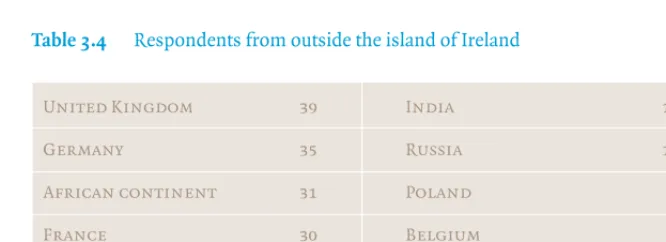
[image:24.637.198.529.112.228.2]Sixteen per cent of respondents were from outside Ireland. As Table 3.4 shows these students come from a very wide range of countries, including China, USA, African Continent and Russia.
Table 3.3 Short survey response to ‘Why are you not living in the private rented sector?’
I cannot afford to rent 260
There is no point because my family/guardian home is
close to college 164
I cannot find anywhere suitable to rent in terms
of proximity to college 30
I cannot find anywhere suitable to rent in terms of
quality of accommodation 24
10 In four cases, the respondent’s gender was not recorded
Table 3.4 Respondents from outside the island of Ireland
United Kingdom 39
Germany 35
African continent 31
France 30
China 23
USA 17
India 12
Russia 10
Poland 8
Belgium 7
Canada 6
The Netherlands 5
[image:24.637.209.542.611.732.2]2
college and year of study
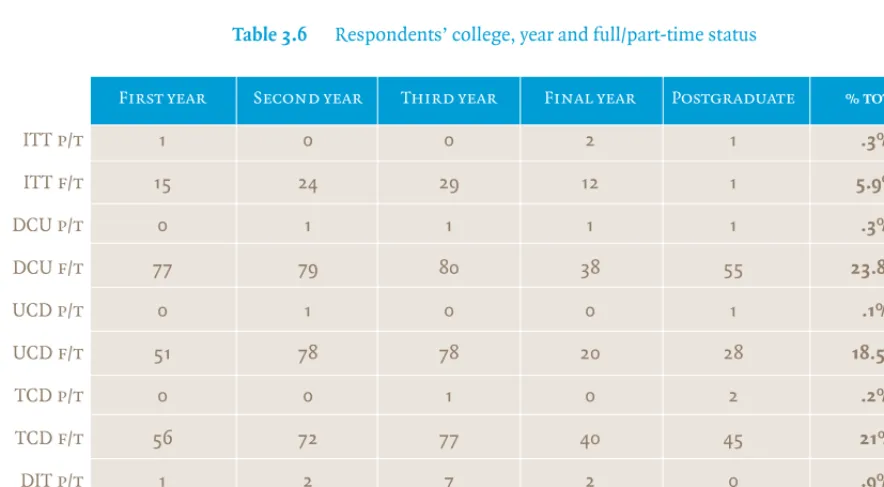
[image:25.637.196.523.112.395.2]Table 3.6 shows the breakdown of respondents by college (full-time or part-time) and year of study.
Table 3.5 Respondents with origins on island of Ireland
Dublin 163
Wexford 78
Meath 72
Cork 60
Kildare 58
Cavan 44
Carlow 44
Louth 49
Monaghan 42
Northern Ireland 41
Donegal 40
Wicklow 34
Galway 33
Tipperary 31
Kilkenny 31
Mayo 30
Waterford 26
Westmeath 25
Longford 23
Roscommon 23
Offaly 21
Laois 21
Limerick 20
Sligo 19
Clare 19
Kerry 16
Leitrim 14
[image:25.637.91.533.519.762.2]Total 1,077
Table 3.6 Respondents’ college, year and full/part-time status
First year Second year Third year Final year Postgraduate % total
ITT p/t 1 0 0 2 1 .3%
ITT f/t 15 2 29 12 1 5.9%
DCU p/t 0 1 1 1 1 .3%
DCU f/t 77 79 80 38 55 23.8%
UCD p/t 0 1 0 0 1 .1%
UCD f/t 51 78 78 20 28 18.5%
TCD p/t 0 0 1 0 2 .2%
TCD f/t 56 72 77 0 5 21%
DIT p/t 1 2 7 2 0 .9%
DIT f/t 71 93 11 67 56 29%
This shows a reasonable spread across year of study, with 20 per cent in their first year, 14 per cent in their final year and 13 per cent being postgraduates. The majority of respondents were arts/humanities students (n=493, 35.7%), a further 285 (13.8%) were students of business, 277 (20%) were pursuing vocational studies, 256 (18.5%) were science students and 70 (5.1%) were information technology students.
financial issues
Three hundred and nineteen students were in receipt of a grant at the time of surveying. Seventy-five of these students (23 per cent) described finding accommodation difficult, as what was on offer was too expensive.
Almost 20 per cent (263 students) stated that they paid fees; (although it was specified that this should not refer to registration fees it is likely that some students did confuse their registration fees with college fees). The range of fees was €800–€20,339 with an average fee of €6,231. There were two students paying €20,000 and over and they were both from the USA. Forty-two per cent of students who were paying fees were postgraduates (n=113), and overall a majority of students (n=161) who were paying fees were over age 23.
employment
Respondents were asked about their employment status – 646 students (46.8%) said they did not work at all, 592 (42.9%) did part-time work, 109 (7.9%) did occasional work and 33 (2.4%) were in full-time employment.
Student wages varied between a minimum of €50 per month and a maximum of €3,500 per month (mean €581.42). Male students’ average earning per month after tax was reported to be €651.91 compared to €505.95 reported by female students.
There were very few part-time students in the sample (n=25) but they did not, as might be expected, work full-time and four part-time students did not work at all. Ten full-time DCU and ten full-time DIT students balanced their courses with working full time.
current accommodation
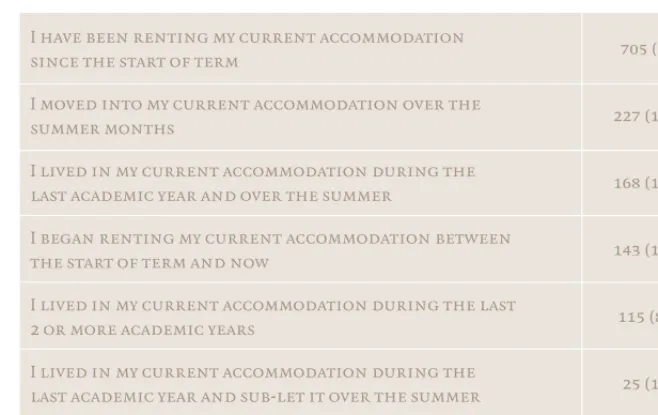
Over half of the respondents (n=705, 51%) had begun renting their
26
Respondents were asked to select one response to best describe how they sourced their accommodation, and were provided with room to state an ‘other’ way. The two most common ways of sourcing this accommodation were found to be online (n=705, 51%) and through friends or word-of-mouth (n=460, 33.3%). A further 86 respondents (6.2%) found their accommodation via a newspaper advertisement, 58 (4.2%) found it through their college accommodation office, while 38 (2.8%) found their accommodation through the students’ union. The less common ways of finding accommodation were through an agency (n=24, 1.7%) and an advertisement on a university notice board (n=7, 0.5%). Students therefore were more likely to find accommodation using resources unconnected with their college.
When asked ‘How long did it take you to find your accommodation?’ 1–2 weeks (n=333, 24%) was the most frequent response, but a similar number said it took less than a week (n=315, 22.8%). A further 273 students (19.8%) took 3–4 weeks to find their accommodation, and 261 students (18.9%) stated that someone else found their accommodation on their behalf. A small number of students were waiting a longer time period before finding their current accommodation; 153 students (11.1%) reported that it took them 1–2 months to find their accommodation, and a further 46 (3.3%) reported that it took them more than 2 months.
The time it took to find accommodation does not appear to be influenced by where a student was from; in other words, students not from Dublin did not take any longer to find accommodation than students who were based in Dublin.
This question does not gauge the intensity with which accommodation was pursued so the follow-up subjective question was intended to explore the difficulty or ease with which the student experienced this property search. Six hundred and fifty-four respondents (47.3%) found their property search very easy or easy, 277 (20%) stated it was neither easy nor difficult, 356 (25.8%) stated it was difficult and 95 students (6.9%) stated they found this property search very difficult.
[image:27.637.202.531.124.331.2]As would be expected, people who responded that they found their search easy or very easy tended to find that accommodation in a shorter timeframe; and students who responded that their search was difficult or very difficult tended to state that it took them a longer time to find their current accommodation. This is documented in Table 3.8.
Table 3.7 Responses to question ‘How long have you been renting your current accommodation?’
I have been renting my current accommodation
since the start of term 705 (51%)
I moved into my current accommodation over the
summer months 227 (16.4%)
I lived in my current accommodation during the
last academic year and over the summer 168 (12.1%)
I began renting my current accommodation between
the start of term and now 143 (10.3%)
I lived in my current accommodation during the last
2 or more academic years 115 (8.3%)
I lived in my current accommodation during the
last academic year and sub-let it over the summer 25 (1.8%)
Table 3.8 Perception of ease or difficulty in finding accommodation and the length of time it took to find this accommodation
Someone else < a week 1-2 weeks 3-4 weeks 1-2 months 2+ months
Easy/
very easy 218 237 15 33 11 0
Difficult/ very
difficult 20 26 8 15 12 2
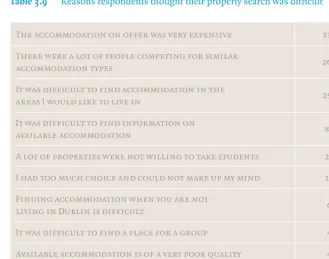
Students were then asked why they described this property search as difficult; they could make multiple selections from a list and also provide their own independent reasons. These responses are recorded in Table 3.9.
There were also a small number of single response reasons:
Difficult to find accommodation when you are on rent allowance
I did not want to share a room
Room price went up for couples
Problems with estate agents
Language barrier a problem
•
•
•
•
•
Table 3.9 Reasons respondents thought their property search was difficult
The accommodation on offer was very expensive 331
There were a lot of people competing for similar
accommodation types 268
It was difficult to find accommodation in the
areas I would like to live in 254
It was difficult to find information on
available accommodation 82
A lot of properties were not willing to take students 24
I had too much choice and could not make up my mind 10
Finding accommodation when you are not
living in Dublin is difficult 6
It was difficult to find a place for a group 4
Available accommodation is of a very poor quality 4
I wanted a shorter lease than properties were
[image:28.637.201.531.346.605.2]28
Difficulty in finding flatmates
Did not want to live in digs
References were required
Pets not allowed
Sexuality narrowed property choices
These findings reveal that a third of respondents found it difficult or very difficult to get accommodation. The main reasons given for this were cost, competition for available accommodation or lack of accommodation in the preferred area.
type of accommodation
The majority of the students interviewed said they lived in house-share accommodation (n=665, 48.1%) or apartment blocks (n=535, 38.7%), 120 (8.7%) lived in accommodation that was part of a multi-unit house, 36 (2.6%) were in digs and 27 (2%) lived in bedsits.
The majority of students shared their accommodation with six or fewer people; however, this number did stretch to 24 in one case. Twenty-four students shared their accommodation with six other people (1.8%) and 12 students shared with seven other people (0.9%).
As figure 3.1 shows the most common response for number of accommodation unit occupants (including respondent) was four (n=439, 32.1%). There were 346 students (25.3%) in accommodation that had a total of three occupants, 211 students (15.4%) had a household size of five, 176 students (12.9%) shared with one other person, 102 respondents (7.5%) had a household size of six. Forty-six students (3.4%) lived alone or were in digs.
Students who were in digs were not asked about numbers in the property unit, as this would include the property-owner and, potentially, their extended family – these students were only asked about how many people they shared their bedroom with. Nineteen students in digs had their own room, 10 students shared with one other person, one student shared the bedroom with three people and three students shared their digs bedroom with four people.
•
•
•
•
[image:29.637.200.505.633.774.2]•
Figure 3.1 Number of accommodation occupants (including respondent)
Living Alone Two Occupants Three Occupants Four Occupants Five Occupants Six Occupants
Of the 46 students who lived alone, as mentioned, 19 of these were in their own bedroom in digs, 15 were in bedsits, nine were in apartments, and two were living in accommodation in multi-unit houses – possibly similar to bedsits. One person reported living alone in a house-share form of accommodation. This is possibly an incorrect answer or the individual was waiting for new tenants. Students were asked how many people shared each bedroom in the household up to a maximum of five bedrooms. It was uncommon to have more than two students sharing a bedroom. A single-occupancy bedroom was the most common response. The only outlier was one student who reported sharing a bedroom with seven other people.
These findings indicate as expected the tendency of students to live in house-sharing accommodation, with an average of four occupants in each accommodation.
satisfaction with accommodation
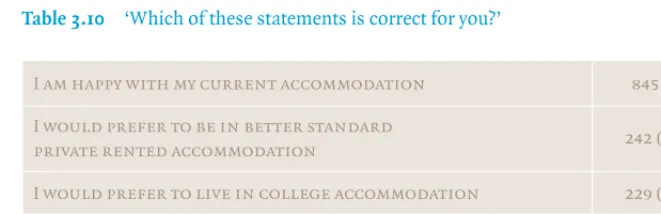
Students were asked about how satisfied they were with their current accommodation and as Table 3.10 shows most (62 per cent) said they were generally happy with their accommodation. However, 242 students (17.8 per cent) did express a preference for better quality accommodation in the private rented sector.
These findings indicate that almost a third of respondents would prefer to be in alternative accommodation, with 16.8 per cent stating that they would prefer to live in college accommodation.
why accommodation was chosen
This section documents the factors that influenced respondents’ choice of accommodation. The information will be used to indicate how students’ preferences match with the reality of their current accommodation.
[image:30.637.200.531.422.529.2]Respondents (n=1,378) were either very satisfied (n=328, 23.8%) or satisfied (n=894, 64.9%) with their current accommodation. Only a small number of students stated they were either not particularly satisfied (n=145, 10.5%) or dissatisfied (n=11, 0.8%).
Table 3.10 ‘Which of these statements is correct for you?’
I am happy with my current accommodation 845 (62%)
I would prefer to be in better standard
private rented accommodation 242 (17.8%)
I would prefer to live in college accommodation 229 (16.8%)
I would prefer to live with my family/guardian
30
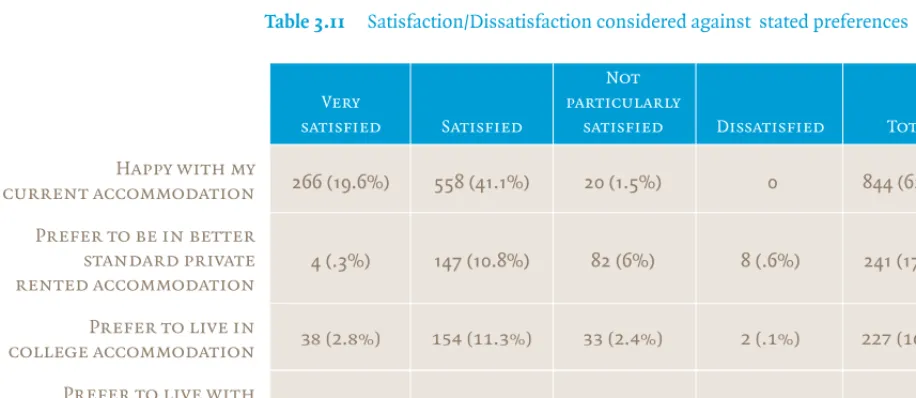
When these satisfaction/dissatisfaction responses are considered against stated preferences (see Table 3.11) it can be seen that, as would be expected, students who were very satisfied or satisfied with their current accommodation also stated that they were happy with their current accommodation. However, a small number (n=20) of students who were not particularly satisfied with their current accommodation stated that they were happy with their current accommodation. Students across the satisfaction/dissatisfaction continuum, when they did not state that they were happy with their current accommodation, generally stated that they would prefer if their accommodation was of a better standard, or that they could live in college-provided accommodation.
These findings can be interpreted in the context of research carried out by Charbonneau et al. (2006) who in their research on student preferences noted that students, as with the larger population, may have a list of preferences with regard to their accommodation. These may include, for example, proximity to campus, occupancy numbers, style of housing, and facilities. However, when choosing accommodation students may make compromises to acquire more of one attribute at the expense of another. For example, students might choose accommodation that is a very short walking distance to campus although it is more expensive and of poorer quality than other available accommodation further away from campus. Similarly, it is likely that although students may have been happy with their current accommodation, they may not have been particularly satisfied and would have preferred if all their original criteria were fulfilled.
factors affecting choice of accommodation
[image:31.637.72.530.439.638.2]Students were asked to rate the importance of five factors in terms of influencing them when choosing accommodation. These were: cost, quality, size, proximity to college and personal safety. Students were also given the opportunity to mention any other factors that would influence their choice of accommodation. Table 3.11 Satisfaction/Dissatisfaction considered against stated preferences
Not
Very particularly
satisfied Satisfied satisfied Dissatisfied Total
Happy with my
current accommodation 266 (19.6%) 558 (1.1%) 20 (1.5%) 0 8 (62.1%)
Prefer to be in better standard private
rented accommodation (.3%) 17 (10.8%) 82 (6%) 8 (.6%) 21 (17.7%)
Prefer to live in
college accommodation 38 (2.8%) 154 (11.3%) 33 (2.4%) 2 (.1%) 227 (16.7%)
Prefer to live with
family/guardian 10 (.7%) 28 (2.1%) 8 (.6%) 1 (.1%) 47 (3.5%)
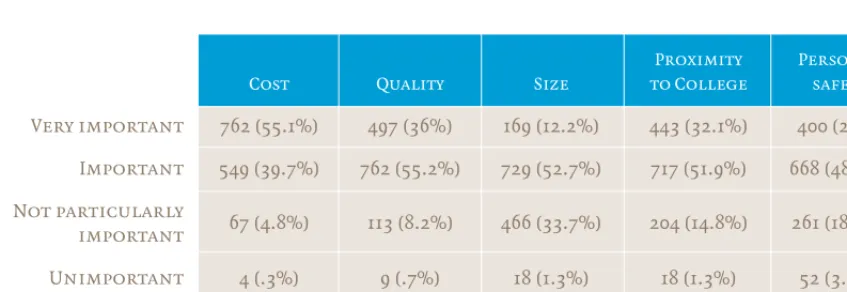
Of these five factors, cost was considered the most important factor influencing choice of accommodation, with over 50 per cent of respondents stating that cost was very important. The quality of the accommodation and its proximity to college were also deemed important, rated as very important by 36 per cent and 32 per cent respectively. Personal safety and the size of the accommodation were considered less important factors. See Table 3.12 for respondents’ rating of influential factors.
Female respondents rated personal safety somewhat more highly than their male counterparts. Two hundred and forty-nine female respondents thought that personal safety was a very important influencing factor when choosing accommodation, while 149 male respondents similarly rated it. Equal numbers of females and males rated personal safety as an important factor when choosing accommodation, suggesting that the gender divide in prioritising personal safety may not be as defined as it seems at first glance. However, of those who rated personal safety as not particularly important or unimportant, males were three times more likely to do so than females.
A total of 285 students mentioned other factors influencing their choice of accommodation. The most common such factor cited was who they would be living with (n=84). Transport was also a concern; 29 respondents cited transport links as influential when selecting their accommodation, and 22 respondents stated that the availability of car parking would influence their choice. Local amenities (n=22) and the area (n=18) were factors for other students. Internet access was important for 12 students, and there were multiple other reasons cited on an individual basis.
rental levels
[image:32.637.111.535.223.369.2]On average, students individually paid €108.23 per week in rent and the average weekly rent for the entire unit was €382.16. Students in digs were not asked this latter question, and 315 students did not know the total amount paid for their accommodation – this would suggest that students pay their landlords individually rather than as a household.
Table 3.12 Relative importance of five factors influencing choice of accommodation
Proximity Personal
Cost Quality Size to College safety
Very important 762 (55.1%) 497 (36%) 169 (12.2%) 443 (32.1%) 400 (29%)
Important 549 (39.7%) 762 (55.2%) 729 (52.7%) 717 (51.9%) 668 (48.4%)
Not particularly
important 67 (4.8%) 113 (8.2%) 466 (33.7%) 204 (14.8%) 261 (18.9%)
Unimportant 4 (.3%) 9 (.7%) 18 (1.3%) 18 (1.3%) 52 (3.8%)
32
These average rents compare favourably with the price of college-provided accommodation. For students in UCD, average rent in the private rented sector is approximately €18.69 more per month than for on-campus accommodation. Over the year, students in TCD would pay on average €1,050.20 more than if they were living in college-provided accommodation; however, the caveat here is that the annual cost of €5,000 for TCD accommodation (figure provided by TCD students’ union) would not include the summer holidays which the average annual cost in our survey would include. DCU’s average rent in the private sector is €14.14 less than for on-campus accommodation per month and DIT’s private rental sector average was considerably less than the maximum price of college-provided accommodation.
There were 548 students (39.9%) who paid their rent through their bank accounts. Of the remainder, 429 (31.3%) said they did not receive receipts from their landlord and did not have a rent book, while 395 students (28.8%) said either they had a rent book or they got receipts from their landlord.
It was uncommon for rent to include bills; only 262 students stated that their rent included bills. Students were not asked what bills were included. Twenty-five students stated that meals were included in their rental of digs. Students were asked if their parents or a guardian helped to pay for their accommodation, and 883 students stated this was the case, representing two-thirds of total respondents.
Students were then asked how much their parents/guardians contributed per month to their living expenses (the broader term ‘living expenses’ was used, as parents/guardians might not strictly allocate money for rent). Where students stated that their parents/guardians paid for all of their living expenses, the per month figure for their rent was used. On average parents/guardians gave these students €476.17 for their living expenses. The average real total for parental contributions towards their children in college would be higher if students had been able to quantify the amount of ‘all’ their living expenses. In other words, the figure given here is more conservative as, when students stated their parents paid ‘all’ their living expenses, only the rent figure was entered into the dataset. Overall, students felt that their accommodation either was good value for money (n=432, 31.2%) or the cost was about right for what they were getting in return (n=729, 52.7%). However, 222 students (16.1%) thought that their accommodation was poor value for money.
As would be expected when students’ opinions on the cost of their
Of the 1,311 students who stated that cost was very important or important when selecting accommodation, 28.7% (n=397) thought that their accommodation was good value for money and a further 51% (n=705) felt that the cost was about right for what they were getting in return. The remaining 15.2% thought that their current accommodation was poor value for money.
There appeared to be an inverse relationship between the individual per week cost of accommodation and the perceived importance of cost. Students who stated that cost was very important in influencing their choice of accommodation paid an average of €105.39 per week in rent; students who stated that cost was important paid an average of €110.06 per week in rent; students who stated that cost was not particularly important paid €121.73 on average per week in rent. Students who regarded cost as unimportant in choosing their accommodation, of whom there were only four students, paid an average of €172.86 per week in rent.
Students who received a grant and perceived cost to be very important paid an average of €103.90 per week; those who thought cost was important paid €109.03 per week. Students who received a grant and thought rent was not particularly important paid an average of €91.82 per week in rent.
[image:34.637.74.535.114.281.2]Overall students felt that quality was very important or important when choosing accommodation (n=1,259). These students were generally happy with the actual quality of their accommodation; 1,092 students (79.1%), who had stated that quality was either very important or important when choosing accommodation, also stated that their current accommodation was either very good or good quality. There were 159 students (11.5%) who rated quality as very important or important and who also stated that their accommodation was not in good condition. A further seven students (0.5%) stated that although they rated quality of accommodation as very important or important, they believed their current accommodation to be in bad condition. See Table 3.14 for details. Table 3.13 Opinion of cost of accommodation related to accommodation preferences
Good value About right Poor value Total
Prefer college
accommodation 66 133 30 229
Prefer to live
with family 17 18 12 47
Prefer better standard
rental accommodation 29 119 94 242
Happy with current
accommodation 310 451 84 845
3
Table 3.14 Student consideration of accommodation quality when choosing where to live and the quality of their current accommodation
Not
Very particularly
important Important important Unimportant Total
Very good quality 133 (9.6%) 12 (9%) 19 (1.%) 1 (.1%) 277 (20.1%)
Good quality 306 (22.2%) 529 (38.3%) 65 (.7%) 2 (.1%) 902 (65.%)
Not good condition 53 (3.8%) 106 (7.7%) 28 (2%) (.3%) 191 (13.8%)
Very bad condition (.3%) 3 (.2%) 1 (.1%) 2 (.1%) 10 (.7%)
Total 496 (35.9%) 762 (55.2%) 113 (8.2%) 9 (.7%) 1,380 (100%)
Students took personal safety into account when choosing accommodation – 1,068 students stated that it was either important or very important. Of these students who rated personal safety as influencing their choice of accommodation, 1,008 believed that their current accommodation was either very safe or somewhat safe. A further 76 and 8 students thought that their current accommodation was not particularly safe or totally unsafe respectively.
There were 1,160 students who stated that proximity to college was either a very important or important factor in influencing their accommodation choice. Of these 1,160 students, 1,051 thought that their commuting time to college was either good or reasonable. Only 106 of the 1,160 students stated that their commuting time was either bad or terrible. See Table 3.16 for details.
Table 3.15 Consideration of safety as an influence on accommodation selection and perceived safety of current accommodation
Not
Very Very particularly
important Important important Unimportant Total
Very safe 206 (1.9%) 25 (17.8%) 83 (6%) 19 (1.%) 553 (0.1%)
Somewhat safe 169 (12.2%) 388 (28.1%) 161 (11.7%) 25 (1.8%) 73 (53.8%)
Not particularly safe 20 (1.%) 33 (2.%) 17 (1.2%) 6 (.%) 76 (5.5%)
Totally unsafe (.3%) 2 (.1%) – 2 (.1%) 8 (.6%)
[image:35.637.141.531.451.592.2]Table 3.16 Influence of proximity to college when choosing accommodation and perception of commuting time
Not
Very Very particularly
important Important important Unimportant Total
Good
commuting time 238 (17.3%) 317 (23%) 71 (5.1%) 9 (.7%) 635 (6%)
Reasonable
commuting time 171 (12.%) 325 (23.6%) 105 (7.6%) 5 (.%) 606 (3.9%)
Bad
commuting time 27 (2%) 63 (.6%) 22 (1.6%) 3 (.2%) 115 (8.3%)
Terrible
commuting time 6 (.%) 10 (.7%) 6 (.%) 1 (.1%) 23 (1.7%)
Total 442 (32.1%) 715 (51.8%) 204 (14.8%) 18 (1.3%) 1,379 (100%)
time taken to get to college and method used
The majority of the surveyed students (91.8%) got to college in less than 45 minutes; 580 students (41.9%) took 15–30 minutes to commute to college, 421 students (30.4%) commuted to college in under 15 minutes and it took 269 students (19.5%) 31–45 minutes to get to college. It took a further 78 students (5.6%) 46–60 minutes to get to college, and 35 students (2.5%) were commuting for over an hour.
The Dublin Transportation Office ‘Travel to Education Survey’ (September 2007) stated that 47 per cent of third-level students’ commute time to college was less than 30 minutes, with 23.8 per cent of students having a journey time of over one hour. It is likely that the difference between the DTO figures and figures from this sample occurs because students in this sample were in the private rented sector and are more likely to locate closer to their college, while the DTO survey would include students living in their parents/guardians’ homes, which could potentially be further away from the college.
Students were asked about the principal way they commuted to college – walk, bicycle, own motorised transport, or public transport. However, students may use a combination of these – for example, students could state that they principally cycle to college but on a rainy day or a day they are running late they might use public transport. Most students either principally walked to college (n=625, 45.2%) or used one form of public transport (n=467, 33.8%); 166 students (12%) cycled to college, 73 (5.3%) drove to college, 46 (3.3%) used more than one form of public transport (e.g. two buses, or a train and a bus). Six students (0.4%) got to college by moped or motorcycle.