Kumamoto University
Kumamoto, JapanDiagnosis, Classification and Prognosis of
Rotating Machine using Artificial Intelligence
A dissertation submitted in partial satisfaction of the requirements for the degree
Doctor of Philosophy in Computer Science and Electrical Engineering
by
Abd Kadir Bin Mahamad
Table of Contents
1 Introduction. . . . 1
1.1 Research Problem . . . 1
1.2 Research Topic . . . 2
1.3 Objective . . . 3
1.4 New Contribution . . . 3
1.5 Significance . . . 4
1.6 Literature Review . . . 5
1.6.1 Pre-prosessing stage . . . 6
1.6.2 Features Extraction . . . 6
1.6.3 Features Selection . . . 9
1.6.4 Fault Diagnosis Methods . . . 10
1.7 Structure of Thesis . . . 17
2 Optimizing Feedforward Neural Network (FFNN) and Elman Network (EN) with Genetic Algorithm for Fault Diagnosis . . . . 18
2.1 Introduction . . . 18
2.2 Methodology . . . 22
2.2.1 Vibration Signal . . . 22
2.2.2 Pre-processing Stage . . . 23
2.2.3 Features Extraction . . . 25
2.2.5 Feedforward Neural Networks (FFNN) . . . 29
2.2.6 Elman Network (EN) . . . 30
2.2.7 Optimizing FFNN with GA (FFGA) . . . 33
2.2.8 Optimizing EN with GA (ENGA) . . . 36
2.3 Results and Discussion . . . 38
2.4 Graphical User Interface of IMB failure . . . 41
2.5 Conclusion . . . 42
3 Fault Diagnosis and Classification using Artificial Intelligent Meth-ods . . . . 53
3.1 Introduction . . . 53
3.2 Methodology . . . 56
3.3 Artificial Intelligent Methods; FFNN, EN, RBFN, AND ANFIS . 56 3.3.1 Radial Basis Function Network (RBFN) . . . 56
3.3.2 Adaptive Neuro-Fuzzy Inference System (ANFIS) . . . 57
3.3.3 Fault Classification using AI Methods . . . 60
3.4 Fault Classification Results . . . 62
3.5 Conclusion . . . 64
4 Artificial Intelligence of Rotating Machinery for Fault Prognosis 66 4.1 Introduction . . . 66
4.2 Review of Rotating Machinery Fault DAP . . . 67
4.2.3 Acoustic Emission to Ease the Task of Condition Monitoring 70
4.2.4 Definition of Distress and Decibel (dB) level Reading . . 71
4.3 Methodology . . . 73
4.3.1 Experimental Rig . . . 73
4.3.2 Elman Network Model [90] . . . 78
4.4 DAP of Bearing Failure . . . 79
4.5 Results and Discussions . . . 81
4.6 Conclusion . . . 84
5 Predicting Remaining Useful Life of Rotating Machinery Based ANN . . . . 85
5.1 Introduction . . . 85
5.2 Experimental Setup . . . 88
5.3 The proposed ANN RUL prediction method . . . 91
5.4 Result . . . 97
5.5 Conclusions . . . 100
6 Conclusions and Future Work. . . . 101
6.1 Conclusions . . . 101
6.2 Future Work . . . 103
List of Figures
1.1 Fault diagnosis process . . . 5
2.1 A diagram of experimental rig . . . 22
2.2 (a) Raw data, (b) power spectrum, and (b) envelope spectrum of vibration data during pre-processing stage . . . 24
2.3 Block diagram of FFNN . . . 30
2.4 Block diagram of Elman network . . . 31
2.5 The flowchart to determine the optimum weights and biases for ANN using GA . . . 34
2.6 Result of distance evaluation technique . . . 38
2.7 Performance result of FFNN . . . 44
2.8 Performance result of FFGA . . . 45
2.9 Performance result of EN . . . 46
2.10 Performance result of ENGA . . . 47
2.11 Training error of FFNN, FFGA, EN and ENGA networks . . . 48
2.12 Validation error of FFNN, FFGA, EN and ENGA networks . . . . 49
2.13 GUI flow chart . . . 50
2.14 GUI of IMB failure . . . 51
2.15 Evaluation Result of IMB Failure with (a) Normal,(b) Inner Fault, (c) Outer Fault, and (d) Ball Fault Conditions . . . 52
3.1 Block diagram of RBFN . . . 57
3.3 Proposed model of IMB fault classification . . . 61
3.4 Performance of training error of IMB fault classification for (a) FFNN, (b) EN, (c) RBFN, and (d) ANFIS, with (i) normal con-dition, (ii) inner fault, (iii) outer fault, and (iv) ball fault conditions 63 3.5 Performance of validation error of IMB fault classification for (a) FFNN, (b) EN, (c) RBFN, and (d) ANFIS, with (i) normal con-dition, (ii) inner fault, (iii) outer fault, and (iv) ball fault conditions 64 4.1 A graph of Distress level versus percentage life of bearing . . . 72
4.2 A graph of dB level versus percentage life of Bearing . . . 73
4.3 Experimental rig . . . 74
4.4 (a)Ball bearing UC206D1 and (b) MHC memo [103] . . . 75
4.5 Location of AE sensor . . . 76
4.6 (a) Distress and (b) dB level versus data observation in days . . 78
4.7 Proposed method of ANN (a) diagnosis and (b) prognosis . . . 80
4.8 Training performance of training and validation for diagnosis of bearing failure . . . 82
4.9 Training performance of training and validation for prognosis of bearing failure . . . 83
5.1 Bearing test rig . . . 89
5.2 Vibration Signal . . . 90
5.3 Structure of the proposed ANN model . . . 93
5.4 (a) RMS and (b) kurtosis value . . . 94
5.6 Result of (a) training and (b) validation . . . 98
List of Tables
2.1 Features extraction from time domain . . . 26
2.2 Features extraction from frequency domain . . . 27
2.3 Performance of validation error in order to select threshold value of Ja . . . 39
2.4 Performance of training and validation error of FFNN, FFGA, EN and ENGA . . . 39
3.1 Target of Classification Output . . . 60
3.2 Training and validation error of proposed model; where H.N is Hidden Node, s is spread and cr is a cluster radius . . . 62
4.1 MSE of Training and Validation . . . 81
5.1 Results of parameter estimates . . . 92
Acknowledgments
Vita
1977 Born, Muar, Johor, Malaysia.
Feb 1997 – Oct 1997
Industrial Internship, Sony Electronics Malaysia Sdn. Bhd., Malaysia.
1998 Diploma in Electronic Engineering, Kota Bharu Polytechnic, Malaysia.
Jul 1998 – Oct 1998
Equipment Maintenance Technician, Intel Technology Sdn. Bhd., Malaysia.
Troubleshooting and repairs on Eaton Compact 2 Oven to pro-duce Intel Pentium 3.
2002 Bachelor of Science of Electrical Engineering, Universiti Teknologi Malaysia, Malaysia.
2005 Master of Electrical Engineering , Kolej Universiti Tun Hussein Onn, Malaysia.
Jun 2004 – Oct 2004.
Technician, Tumin Electronics Service, Malaysia.
Troubleshooting and repairing radio, TV and electrical and electronic appliances.
Oct 2004 – March 2005.
Engineer, Pioneer Technology Sdn. Bhd., Malaysia. Personal in-charge for solder analysis.
March 2005 – Present
Tutor, Computer Engineering Department, Universiti Tun Hus-sein Onn Malaysia, Malaysia.
Publications
Journals;
1. “Elman Network using Genetic Algorithm for Bearing Failure Diagnosis of Induction Motor”, IET Electric Power Applications, accepted.
2. “Fault Classification Based Artificial Intelligent Methods of Induction Mo-tor Bearing”, International Journal of Innovative Computing, Information and Control, in press.
3. “Predicting Remaining Useful Life of Rotating Machinery Based Artifi-cial Neural Network”, Computers and Mathematics with Applications (El-sevier), in press.
4. “Development of ANN for Diagnosing Induction Motor Bearing Failure”, IEEJ Transaction on Industrial Applications, 130(7) pp. 838–846 (2010). 5. “Diagnosis and Prognosis of Bearing Failure in Rotating Machinery using
Acoustic Emission and Artificial Neural Network”, IEEJ Transaction on Industrial Applications, 130(4) pp. 443–449 (2010).
Conferences;
1. “Fault Classification Performance of Induction Motor Bearing Using AI Methods”, 5thIEEE Conference on Industrial Electronics and Applications,
Taichung, Taiwan (2010), in CD.
2. “Prediction of Remaining Useful Life of Rotating Machinery subject To Condition Monitoring”, 3rd Global Conference on Power Control and
Op-timization, Gold Coast, Australia (2010), in CD.
3. “Fault Classification of Induction Motor Bearing using FFNN”, Interna-tional Student Conference on Advanced Science and Technology, ICAST, Seoul, Korea, pp. 301–302 (2009).
4. “Improving Elman Network using Genetic Algorithm for Bearing Failure Diagnosis of Induction Motor”, 7th IEEE International Symposium on
Di-agnostics for Electric Machines, Power Electronics and Drives, France, pp 1–6 (2009).
5. “Improving FFNN for Bearing Failure Diagnosis of Induction Motor by Using GA”, 3rd International Conference on Advanced Power System
Au-tomation and Protection, Korea (2009), in CD.
6. “Artificial Neural Network for Diagnosis and Prognosis of Bearing Faults”, International Student Conference on Advanced Science and Technology,
7. “Development of Artificial Neural Network Based Fault Diagnosis of In-duction Motor Bearing”, 2nd IEEE International Conference on Power and
Energy, Johor Bharu, Malaysia, pp 1387– 1392(2008)
8. “Artificial Neural Network Based Bearing Failure Diagnosis for Induction Motor”,International Conference on Electrical Engineering, Okinawa, Japan (2008), in CD.
9. “MISO and MIMO Structures Based on ANN for Diagnosing Induction Motor Bearing Failure”, IEEJ Technical Meeting Power and Energy, Ku-mamoto, Japan, pp. 7–12 (2008).
10. “Particle Swarm Optimization and Levenberg Marquart Algorithm based Neural Network Training for Fault Diagnosis”, International Student Con-ference on Advanced Science and Technology, ICAST, Kumamoto, Japan, pp. 123–124 (2008).
Poster;
Abstract of the Dissertation
Diagnosis, Classification and Prognosis of
Rotating Machine using Artificial Intelligence
by
Abd Kadir Bin Mahamad
Doctor of Philosophy in Computer Science and Electrical Engineering Kumamoto University, Kumamoto, Japan, October 2010
Professor Takashi Hiyama, Supervisor
CHAPTER 1
Introduction
1.1
Research Problem
Nowadays, the modern rotating machinery industries is rapidly increasing in com-plexity, which demand the system to operate in higher reliability, safety, lower cost of production and maintenance. Therefore accurate fault diagnosis of ma-chine failure is required. Mama-chine fault diagnosis has evolved from the early time whereas the maintenance is only applied after the fault has occurred in the machine. Then it evolved to become as preventive maintenance in the last few decades before the industries used condition based maintenance which is practised till date. Preventive maintenance is defined as the performance of maintenance before the system face any degradation. Meanwhile condition based maintenance is refered as maintenance action taken based on the information acquired from the target measurement. The effectiveness of this maintenance is measured based on accurate diagnostic strategies which is met. The diagnosis strategies and tech-niques are still being explored by many researcher, some of them as in [1]–[8]. Several researchers are not just concern to diagnose the machine failure but also to prognose the remaining useful life of machine [9]–[19]. These techniques create new dimension to machine fault diagnosis in order to improve the reliability of the rotating machine.
used, as was published in [20]–[22]. The magnitude of vibration level is increase proportionately following the degradation increment on machine failure. This vi-bration signal can be analysed using signal processing. The features from vibra-tion signal can be extracted through time, frequency and time frequency domain. Many features can be extracted through those processes such as maximum, mini-mum, root mean square (RMS), kurtosis, skewness, variance and crest factor [23]. However not all features is significant to represent the degradation information of machine failure. Therefore, it is essential to select only significant features and ignore the rest. This process is called as features selection.
In fact in complexity of modern rotating machinery, it requires more param-eters to be taken into account to make diagnosis system more reliable and effi-cient. The parameters such as current, temperature, voltage or acoustic should be considered as significant parameters. This issue is still being studied by many researchers as essential topic to be addressed.
This thesis propose the method for fault diagnosis, classification and prognosis of rotating machinery which use appropriate features sets, that can improve the accuracy and reliability of machine failure. In this research, we will just consider the vibration and acoustic signals to detect the machine failure due to limited data resources.
1.2
Research Topic
The research topic of this thesis is “Diagnosis, Classification and Prognosis of Rotating Machine using Artificial Intelligence”.
model, therefore the selection of the features is very important. This research explore the possibility of improving this matter by using AI models such as ar-tificial neural network (ANN), fuzzy logic, genetic algorithm (GA) and hybrid systems.
1.3
Objective
The objectives of this research are stated as follows;
1. Development of effective features for AI model.
2. Development of diagnosis, classification and prognosis methods based AI techniques for rotating machine failure.
In order to provide effective features, it is required to establish many features during feature extraction. But the most important thing is providing the useful features during features selection. In this research for features extraction, features from time and frequency domain will consider. Meanwhile for feature selection, the distance evaluation technique will be used due to it simplicity.
On the other hand, in the development of diagnosis, classification and prog-nosis of rotating machinery failure, the AI techniques will be used. For these purpose three different sets of data will be used for diagnosis, classification and prognosis of machine failure.
1.4
New Contribution
The new contributions are stated as follows;
assist with ANN for diagnosis and classification of rotating machinery fail-ure.
2. Introduce the hybrid techniques, which optimize the ANN with GA for training process.
3. Introduce ANN to prognose the rotating machinery using acoustic emission measurement data.
4. Introduce ANN method to predict remaining useful life (RUL) of rotating machinery reliability using actual and fitted measurement data.
1.5
Significance
The significance of this research can be described as follow;
1. The effective features selection can improve the optimization of input data. The distance evaluation techniques assisted with ANN can be used to select the very significant features to diagnose and classify the rotating machine failure.
2. The proposed method to optimize the ANN with GA can improve the ro-tating machine failure diagnosis.
3. The method to prognose the rotating machine failure can contribute to low maintenance cost and improve the machine operation time.
1.6
Literature Review
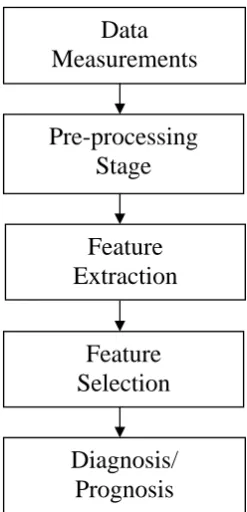
In this section the general literature review on diagnosis of machine failure is presented. Machine fault diagnosis can be defined as a process to determine whether a machine/system has a fault or not. On the other hand, the objective of prognosis system is to predict the RUL of a failure machine. Basically the machinery fault diagnosis process can be simplified as in Fig. 1.1.
Machinery fault diagnosis include many different measurements; mechanical measurements [21], [24], electrical measurements [25] and tribology [26]. Mechan-ical measurements typMechan-ically include vibration, acoustic emission and temperature. While electrical measurements include current, and voltage. Tribology is more concerned with machinery lubrication and oil debris.
Due to development of advance technology of measurement equipment and
Data Measurements
Pre-processing Stage
Feature Selection
Diagnosis/ Prognosis
[image:19.595.261.385.382.639.2]Feature Extraction
modern computer, the information/data from condition monitoring of machinery becomes vital. Thus this trend makes data fusion essential. Data fusion is defined as a technique to incorporate data from multiple sources to increase the accuracy of diagnosis and prognosis system.
1.6.1 Pre-prosessing stage
Usually the raw data need to be pre-processed before it can be applied for fault diagnosis. This process can reduce the dimension of raw data, which the signal is turning into information. Data sources from rotating machine usually are non-linear, heterogeneous and distributed. Handling proper data preprocessing can improve the performance of fault diagnosis, since the data may have difference in measurements scales, accuracies and uncertainties. For multiple data fusion, the data need to be transformed into time space reference. For this work the special data management procedure is needed to make it accomplished. This transfor-mation process usually takes into account the process such as time propagation, data association and data alignment.
1.6.2 Features Extraction
In order to achieve good performance of machine fault diagnosis, largely depend on appropriate features extraction and features selection techniques. The selec-tion of vital features from targeted machine is the main contribuselec-tion to increase the effectiveness of fault diagnosis process.
factor are selected as statistical features extraction [23].
Standard deviation is to measure the dispersion of data sets from its mean. The more spread of data produce higher deviation. Mean and standard deviation can be described as in (1.1) and (1.2).
xm= 1
K
K
k=1
x(k) (1.1)
xstd=
K
k=1(x(k)−xm)2
K−1 (1.2)
where x(k) is a signal series for k = 1,2,· · · , K and K is the number of data points.
RMS can be used as parameters or features to measure overall power content of the signal. This feature is important for time domain features extractions especially in order to detect imbalance problem in rotating machine. RMS is not suitable to use as a feature to detect specific component failure, as it is not sensitive towards incipient machine fault. RMS can be defined as;
xrms=
K
k=1(x(k))2
K (1.3)
Skewness use the normalized third central moment, which is defined as;
xskew=
k
k=1(x(k)−xm)3
(K−1)xstd3 (1.4)
This feature measure the symmetry, that is the distribution of the data at the left and right sides from the centre point.
peaks in data and it uses the normalized fourth of central moment.
xkurto=
k
k=1(x(k)−xm)4
(K−1)xstd4 (1.5)
There are others time domain features analysis which include maximum and minimum values. The maximum value can be defines as;
xmax =max(x(k)) (1.6)
and the minimum value as;
xmin=min(x(k)) (1.7)
Crest factor computes the ratio of the peak level of data over the RMS level. Therefore the results from the crest factor show the peak of data corresponding to an increase in crest factor value. This feature is suitable to use for detection of impulsive vibration change in rotating machine fault. Crest factor can be defined as;
CF = xmax
xrms (1.8)
Typically, time domain features analysis contains the information describing the condition of machine especially during short duration of detection. But these features are not directly noticed, particularly if the machine is still in early stage of faulty.
to reveal the fault sign from machine failure as demonstrated in [27] and [23] . Usually Discrete Fourier Transform (DFT) is employed to convert the signal from time domain to frequency domain. Then to compute the DFT signal, the Fast Fourier Transform (FFT) is utilized. Enveloping method such as High Frequency Resonance Techniques (HFRT) is subsequently used to eliminate the unnessecary frequency from the faulty machine [23].
1.6.3 Features Selection
The task of fault diagnosis of modern machine has become difficult due to the growing complexity of machine design. But with the development of advance sen-sor technology and signal processing techniques, many features can be extracted from targeted machine for fault diagnosis purposes.
Normally, fault diagnosis has uncertainties characteristic. The uncertainties information can be reduced by using multiple source of information. It means that the fault diagnosis capability can be improved by feeding inputs with multiple features. The problem may exist with the increase of features that can increase the difficulty of data analysis. It is unnecessary to employ all the features for fault diagnosis purposes. Some features can contribute significant information of faulty sign while some only contribute less information. Thus, it is necessary to have appropriate feature selection to increase the accuracy of fault diagnosis process.
Various methods can be used for feature selection. Basically the feature se-lection is done by the following two basic aspects.
the features which gave the good evaluation are selected as salient features.
2. By evaluating the features based on other evaluation measurement such as distance, information, dependency and classification error rate obtained during measurement.
Various methods can be used for feature selection such as modified distance discriminant technique [28], distance evaluation technique [29]–[31], neural net-work [32], J48 decision tree algorithm [33] and discrete wavelet [34]. The selection of features selection is essential to increase the accuracy of fault diagnosis system.
1.6.4 Fault Diagnosis Methods
Many fault diagnosis have been applied for fault diagnosis such as AI technique, signal processing, model based, and hybrid methods. Detail explaination is stated below;
1.6.4.1 Artificial Intelligent
Neural network (NN) is widely used for fault diagnosis [1], [26], [35]–[44], due to it ability to do classification and prediction. As one type of AI technique, NN has the ability to learn the new knowledge; same manner like the human gain their new knowledge through learning. This process can be realized by adjusting weights value of the neurons. It can be manipulated as multi input and multi output system, in which the NN can solve, complicated multiple object problems like multiple fault in rotating machine.
new knowledge of the trained neural network is stored in distributed way of the weights. Typically NN has good fault tolerance performance and function approx-imations. The Feedforward Neural network (FFNN) for instance can be used as NN model that can approximate any nonlinear function with high accuracy.
The basic processing in NN is a neuron. The neurons produces an output corresponds to a weighted sum of numbers at inputs which is a nonlinear function. The function of output can be defined as
Y =f
m
i=1
wixi
(1.9)
where xi is the input, which i = 1,2,3,· · · , m and Y is an output. f is the nonlinear function and wi is the weight, i= 1,2,3,· · · , m.
There are many nonlinear function used in NN. One of them is sigmoid func-tion, which can be defined as;
f(t) = 1
1 +e−ct (1.10)
where cis constant parameter.
Basically, there are many types of NN available and can be used for fault diagnosis. The FFNN, recurrent neural network (RNN) and radial basis function (RBF) network [40] are among most frequently used for specific purposes. For every NN they have their own configuration and structures. Once the structure is confirmed, the network can be trained to find its optimized parameters. The parameters include number of layers, the number of neurons and its weights.
interconnection strengths, which are known as the weights. Thus, it is very im-portant to choose the sufficient training data set in order to obtain the optimal performance of neural network. That means the training data set should cover all the information to represent the behaviour of fault diagnosis.
1.6.4.2 Signal Processing
Signal processing is the other method, which is successfully applied as in [2], [5], [6], [20], [21], [45]–[59]. This technique fully depend on digital signal processing, which requires to determine the failure boundary. That means, when the signal from targeted machine pass outside the bounds, it can determine as faulty con-dition. Vibration signal is the paramount and efficient signal in order to use as indicator for this matter.
Wavelet analysis is one of the signal processing method that is widely used in past research [2], [45]–[48], [52], [53], [56]. Wavelet analysis has special advantages over common signal processing method such as FFT. The wavelet transform has excellent performance to detect transient signal and flexibility in time and frequency resolution [45]. The Continuous Wavelet Transform (CWT) can be performed based on many types of wavelet basis, which means it may produce different results even using the same signal [52]. Therefore, selection of wavelet transform is vital in order to find the optimum wavelet parameter.
demonstrated the wavelet transform to process the vibration signal and to gen-erate features vectors. Then, an adaptive neural fuzzy inference system (ANFIS) was used as diagnostic classifier. Ref. [59] present a novel technique of gear fault diagnosis using autocorrelation of continuous wavelet coefficients (ACWC). In conventional continuous wavelet coefficients (CWC), it encompasses too much data in each scale which can however cause information loss while resampling. This proposed technique was introduced to eliminate the drawback of CWC. Other wavelet application was reported using complex Morlet continuous wavelet transform as in [48].
Other signal processing methods have also been applied for fault diagnosis. In [51], the empirical mode decomposition (EMD) was used to process nonlin-ear and non-stationary signal from fault machine. They claimed, EMD showed satisfactory performance in minimizing energy leakage. Then, [49] proposed en-semble empirical mode decomposition (EEMD), which is an improved method of EMD. This technique can be applied by adding finite white noises to targeted signal, which can eliminate the mode mixing problem, as encountered in EMD technique.
1.6.4.3 Fuzzy Logic
The fuzzy logic is one of the common intelligent techniques that have been used for fault diagnosis. In [3] a fuzzy logic system was used to interpret vibration signal from motor bearing. The processed signal from the frequency spectrum of vibration signal, which input to fuzzy logic decision system make the fault diag-nosis systems, gave excellent results. This technique can be improved accordingly by optimizing it with combination of other intelligent method or optimization al-gorithm. For example in [28] they proposed modified Fuzzy ARTMAP, which is described by the weighted Manhattan distance to achieved good performance of bearing fault diagnosis. Then in [29], they continue their work with proposes im-proved Fuzzy ARTMAP, in which this technique is incorporated with Yu’s norm algorithm.
In order to improve classification performance of ANFIS system, Yaguo Lei et al [31] proposes multiple ANFIS model which combines with genetic algo-rithm (GA). The results show, better classification performance compared to the individual classifiers of ANFIS model.
1.6.4.4 Model Based Methods
In some journal, the researchers propose techniques for fault diagnosis as a system model. For instance in [6], they analyzed the dynamic system of rotor bearing system by utilizing the response surface method analysis which consider effect of bearing design and operating parameters. Meanwhile in [57] presented a com-bined gear and bearing dynamic model for a gearbox test rig in the presence of faults. In this model it takes into account the slippage in the bearings, the Hertzian contact and the nonlinearity of the bearing stiffness in time variant.
N. Sawalhiet al [58], then shown the result of their model to examine a fault in the inner and outer race of rolling element bearings in the presence of gear interaction. They compared the simulated and actual signal from test rig for inner and outer fault, which the diagnosis technique react in same way for both signals.
1.6.4.5 Hybrid Methods
region. Meanwhile GD algorithm is good to fine tune in determining the optimal solution for final result. B. Samantha et al [61] presented to compare 3 types of artificial neural network, which are multilayer perceptron (MLP), radial basis function (RBF) and probabilistic neural network (PNN). All these networks are optimized using genetic algorithm to find the optimum of hidden node and the input features. The same approach was applied by Abhinav Saxena et al [62] but they just considered MLP as a suitable NN for their work.
Besides above techniques, there are several other techniques which were suc-cessfully applied to diagnose machine failure. In [8], Gaussian Mixture Models (GMM) and hidden Markov Models (HMM) were used to classify faults of rotat-ing machinery. These techniques were selected since both methods are applied successfully to analyze signals which have large variability. However, from the result they concluded that HMM outperforms GMM in classification of bearing faults. In [63], nonlinear characteristic of vibration signal is rearranging into re-constructed phase space (RPS) in which the phase trajectory of different kinds of signal will demonstrate different structure. To describe the phase trajectory of different signal, Gaussian mixture model (GMM) is utilized. GMM is used to fit the distribution of phase trajectory for every fault signal. The maximum likelihood (ML) Bayesian classifier then is utilized to realize the classification of vibration signal. The advantage of this method is that all parameters are obtained to analyze in time series directly.
but they propose SVM as a classifier to compute optimum wavelet signal decom-position level. The results achieved from the proposed method show it practical to be used for multi-fault diagnosis.
1.7
Structure of Thesis
This thesis is constructed into 6 chapters. Chapter 1 presents the research prob-lem, research topic, objectives, new contribution, significance of the research and general literatures review, which covers the approaches that employed for diag-nosis, classification and prognosis of rotating machinery failure.
Chapter 2 presents the development of optimizing ANN with GA for fault di-agnosis of rotating machinery failure, while Chapter 3 describes the development of AI techniques for diagnosis and classification of machine failure. Furthermore Chapter 4 explain the development of prognosis system in which the acoustic emission measurements data was used to prognose machine failure.
Chapter 5 presents a method to improve the prediction accurancy of RUL from rotating machinery. To achieve this objective, the ANN model uses time and fitted measurements Weibull hazard rates of RMS and kurtosis from its present and previous points as input and normalized life percentage as output.For this scheme the monitoring data from University of Cincinnati of NASA Ames Prognostics Data Repository was used.
CHAPTER 2
Optimizing Feedforward Neural Network
(FFNN) and Elman Network (EN) with Genetic
Algorithm for Fault Diagnosis
2.1
Introduction
Fault diagnosis system can be defined as systems that has a capability to de-tect and diagnose faults occurred [65]. A ‘fault’ itself is defined as something that abnormally happens in a system. Therefore, early detection or diagnosis of failure from the system in industries is essential in order to prevent production volume into becoming low and which may affect the production profit, safety issues and other negative implications. This issue is significant to the induction motor bearing (IMB) failure which is one of the most regular components used in industries, thus the diagnosis system towards this component contributes to overall high output production.
will be extracted from the raw signal. This process is done through features extraction and/or features selection.
Normally, fault diagnosis can tell the ‘cause and effect’ relationship of system variables through the salient parameter from features selection. In this process, the input of model comes from the parameter or state that may contribute to the change at output. Therefore the selection of parameter for input is important in order to make the model to perform very well. Thus, many researchers proposes to overcome IMB failure by comparing the behaviour of IMB during normal and failure condition. One of the popular techniques in this matter is by using ANN as in [65], [37], [76]– [79].
In 2004, Yang et al [38] proposed ART-Kohonen neural network as a new ANN model. They focused on to overcoming the stability-plasticity problem. This problem happens to the system which is unable to learn from a new data because it was trained ‘offline’. To overcome this problem, the adaptive resonance theory (ART) networks were developed. This network is an ANN self organizes mapping and successfully proved in real time training and classification. The Kohonen neural network (KNN) also self organizes mapping of two-layer neural network that implements a non-linear projection from high-dimensional input data into low-dimensional array of neurons. The incorporation of these two net-works can learn the additional training data without forgetting the pattern of previous training data, thus becomes the solution of stability-plasticity problem.
using orthogonal wavelet function as a solution, since wavelet has been realized in time and frequency domain. WNN can give a good performance in approxi-mation function even against rapidly changing signal, thus it is suitable for fault diagnosis of rotating machinery.
In order to provide practical application of machine fault diagnosis it requires to develop a software or tool for the user or operator to easy determine the condition of particular machine. For instance, Bayir [80] proposed the graphical user interface (GUI) software for fault diagnose of serial wound starter motors using Learning Vector Quantization (LVQ) neural network. The voltages and currents are acquired from the starter motor via data acquisition card before they transfer to the GUI program. They claimed that this program can be used for real time fault diagnosis in service shop of starter motor manufactures. The main drawback of this GUI, it required the expert operator such as supervisor or engineer with knowledge about motor starter operation to run this GUI.
Andhare and Manik [81] presented results of experiments to diagnose of defect in tapered roller bearing using vibration monitoring. A Matlab based GUI was made use of the time domain parameters to diagnose defect at bearings. They concluded that parameters like time waveform, form factor, parameter K and ceptrum are good indicators for tapered roller bearings but parameters such as kurtosis, form factor and skewness are good indicators for roller bearings. How-ever this GUI is just operating in time domain. For bearing failure diagnosis it is important to take into account the frequency domain parameters as the important parameters to determine types of bearings failure.
[37], [76]–[79] to diagnose machine failure, and one paper as in [82] proposed EN for this purpose. To improve the performance of both networks its is utilized using GA to find the optimum weights and biases before it can be used during training process. The performance of the optimum network is measured based on the minimum validation error produced from the network during IMB failure diagnosis.
The structures for FFNN allow the information to flow in one direction from input layer to output layer. On the other hand, EN allows the information to flow in both directions, which are from input layer to output layer and vice versa [83] . The main problem of FFNN is that it requires the large numbers of input neurons [83] and not suitable to use for time series data. Therefore, EN is the option, since they have not suffered from the problems above. However this network is not extended like FFNN due to it’s complexity in structures and learning algorithm [84]. For FFNNs, the backpropagation algorithm is utilized as an effective learning algorithm in solving many problems. This algorithm is not working well with EN due to it’s complexity in state space.
The selection of FFNN is due to its wide application in many fields area. Meanwhile, for EN is due to its ability to store information for future references and to learn temporal patterns. The successfulness in determining faulty condi-tions from IMB, helps industries to do further investigacondi-tions on the root causes of this particular manner. Moreover, this method can ensure the production operation is monitored and will be alerted before IMB completely fails.
user only needs to load a desired signal into it to observe the shape of a raw signal, power spectrum and envelope spectrum. The status of a bearing condition will be shown in the left bottom of the GUI.
2.2
Methodology
2.2.1 Vibration Signal
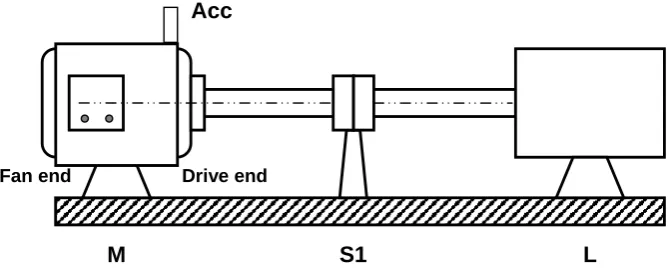
The methodology used to diagnose IMB failure is shown as in Fig. 2.1. The vibration data used in this work is obtained from the Case Western Reserve University website [85]. The apparatus involved in these experiments are 2 hp, 3 phase induction motor (M), accelerometer (Acc), dynamometer (L), and torque transducer (S1). An accelerometer is mounted onto the motor housing at the drive end of the induction motor. The bearing’s type used is deep groove ball bearing with an inside diameter of 0.9843 inches, outside diameter of 2.0472 inches, ball diameter of 0.3126 inches, pitch diameter of 1.537 inches and speed of about 1800 rpm. The vibration signal is collected at 12 kHz samples per second from the experimental rig.
Acc
M S1 L Drive end
[image:36.595.156.491.484.623.2]Fan end
The bearings are tested under four different loads (0, 1, 2, and 3 hp). Each de-fect bearing is tested with dede-fect sizes of 0.007, 0.014, and 0.021 inches in which, every single point fault is introduced to the test bearing using electro-discharge machining (EDM). There are four different types of operating conditions obtained from experimental rig, which are from normal condition, inner race fault condi-tion, outer race fault condition and ball fault condition. As a result, a total of 48 datasets can be obtained from this experiment.
2.2.2 Pre-processing Stage
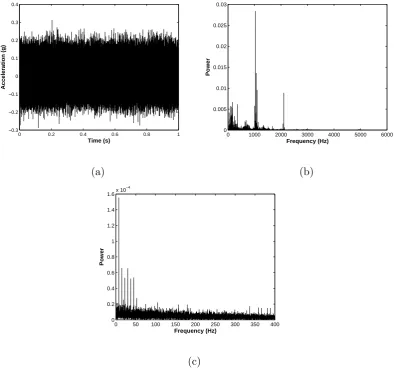
During pre-processing stage, the vibration signals from a bearing are being con-verted from time domain to frequency domain through the FFT. This signal is then converted to power spectrum in order to measure the power of a signal at a particular frequency.
0 0.2 0.4 0.6 0.8 1 −0.3 −0.2 −0.1 0 0.1 0.2 0.3 0.4 Time (s) Acceleration (g) (a)
0 1000 2000 3000 4000 5000 6000
0 0.005 0.01 0.015 0.02 0.025 0.03 Frequency (Hz) Power (b)
0 50 100 150 200 250 300 350 400 0 0.2 0.4 0.6 0.8 1 1.2 1.4 1.6x 10
−4
Frequency (Hz)
Power
[image:38.595.132.527.167.545.2](c)
References
[1] C. Chen and C. Mo: “A Method for Intelligent Fault Diagnosis of Rotating Machinery”, Digital Signal Processing, 14, pp. 203–217 (2004)
[2] J. Rafiee, M.A. Rafiee, and P.W. Tse: “Application of Mother Wavelet Func-tions for Automatic Gear and Bearing Fault Diagnosis”, Expert Systems with Applications,37, pp. 4568–4579 (2010)
[3] G. Goddu, B. Li, M.Y. Chow, and J.C. Hung: “Motor Bearing Fault Diagno-sis by a Fundamental Frequency Amplitude Based Fuzzy Decision System”, IEEE Industrial Electronics Society Conference, 24, (1998)
[4] E. Zio and G. Gola: “A Neuro-Fuzzy Technique for Fault Diagnosis and its Application to Rotating Machinery”, Reliability Engineering & System Safety, 94(1), pp. 78–88 (2009)
[5] T. Karacay and N. Akturk: “Experimental Diagnostics of Ball Bearings using Statistical and Spectral Methods”, Tribology International, 42, pp. 836–843 (2009)
[6] P.K. Kankar, S.P. Harsha, P. Kumar, and S.C. Sharma: “Fault Diagnosis of a Rotor Bearing System using Response Surface Method”, European Journal of Mechanics A/Solids,28, pp. 841–857 (2009)
[7] Q.J. Guo, H.B. Yu, and A.D. Xu: “A Hybrid PSO-GD Based Intelligent Method for Machine Diagnosis”, Digital Signal Processing, 16, pp. 402–418 (2006)
[8] F. V. Nelwamondo, T. Marwala, and U. Mahola: “Early Classifications of Bearing Faults using Hidden Makrov Models, Gaussion Mixture Models, Mel-Frequency Cepstral Coefficients and Fractals”,International Journal of Innovative Computing, Information and COntrol,2(6), pp. 1281–1299 (2006) [9] Y. Li, S. Billington, C. Zhang, T. Kurfess, S. Danyluk and S. Liang: “Adap-tive prognostics for rolling element bearing condition”, Mechanical Systems and Signal Processing,13, pp. 103–113 (1999)
[10] Y. Li, T.R. Kurfess and S.Y. Liang, “Stochastic prognostics for rolling ele-ment bearings”, Mechanical Systems and Signal Processing,14, pp. 747–762 (2000)
[12] Z. Tian, “An Artificial Neural Network Method for Remaining Useful Life Prediction of Equipment Subject to Condition Monitoring”, Journal of In-telligent Manufacturing, (2009)
[13] G. Vachtsevanos and P. Wang, “Fault prognosis using dynamic wavelet neural networks, AUTOTESTCON Proceedings”, IEEE Systems Readiness Technology Conference, pp. 857–870 (2001)
[14] B. Satish and N. D. R. Sarma: “A fuzzy BP approach for diagnosis and prognosis of bearing faults in induction motors”, IEEE Power Engineering Society General Meeting, 3, pp. 2291–2294 (2005)
[15] H. Liao, W. Zhao, and H. Guo, “Predicting Remaining Useful Life of an Individual Unit using Proportional Hazards Model and Logistic Regression Model”, Reliability and Maintainability Symposium, pp. 127–132 (2006)
[16] V.T. Tran, B.S. Yang and A.C.C. Tan, “Multi-step ahead direct prediction for the machine condition prognosis using regression trees and neuro-fuzzy systems”, Expert Systems with Applications,36, pp. 9378–9387 (2009) [17] I.J. Jozwiak, “An Introduction to the Studies of Reliability of Systems using
the Weibull Proportional Hazards Model”, Microelectronics and Reliability,
37, pp. 915–918 (1997)
[18] Z. Tian, D. Lin and B. Wu, “Condition based Maintenance Optimiza-tion Considering Multiple Objectives”, Journal of Intelligent Manufacturing (2009)
[19] D. Banjevic, and A.K.S. Jardine, “Calculation of Reliability Function and Remaining Useful Life for a Markov Failure Time Process”, IMA Journal of Management Mathematics, pp. 115–130 (2006)
[20] Z. Kiral and H. Karagulle: “Simulation and Analysis of Vibration Signals Generated by Rolling Element Bearing with Defects”, Tribology Interna-tional, 36, pp. 667–678 (2003)
[21] S. Orhan, N. Akturk, and V. Celik: “Vibration Monitoring for Defect Diag-nosis of Rolling Element Bearings as a Predictive Maintenance Tool: Com-prehensive Case Studies”, NDT&E International,39, pp. 293–298 (2006) [22] J.D. Wu and C.C. Hsu: “Fault Gear Identification using Vibration Signal
[23] A.K. Mahamad and T. Hiyama: “Development of Artificial Neural Network Based Fault Diagnosis of Induction Motor Bearing”,2nd IEEE International Conference on Power and Energy (PECon 08), (2008)
[24] T. Toutountzakis, C.K. Tan, and D. Mba: “Application of Acoustic Emis-sion to Seeded Gear Fault Detection”,NDT&E International,38, pp. 27–36 (2005)
[25] A. Widodo, B.S. Yang, D.S. Gu, and B.K. Choi: “Intelligent Fault Diagnosis System of Induction Motor based on Transient Current Signal”, Mechatron-ics, 19, pp. 680–689 (2009)
[26] T. Kolodziejczyk, R. Toscano, S. Fouvry, and G. Morales-Espejel: “Artificial Intelligence as Efficient Technique for Ball Bearing Fretting Wear Damage Prediction”, Wear, 268, pp. 309–315 (2010)
[27] Y. Lei, Z. He and Y. Zi: “A New Approach to Intelligent Fault Diagnosis of Rotating Machinery”, Expert Systems with Applications,35(4), pp. 1593– 1600 (2008)
[28] Z. Xu, J. Xuan, T. Shi, B. Wu, and Y. Hu: “A Novel Fault Diagnosis Method of Bearing Based on Improved Fuzzy ARTMAP and Modified Dis-tance Discriminant Technique”, Expert Systems with Applications, 36, pp. 11801–11807 (2009)
[29] Z. Xu, J. Xuan, T. Shi, B. Wu, and Y. Hu: “Application of a Modified Fuzzy ARTMAP with Feature-Weight Learning for the Fault Diagnosis of Bearing”, Expert Systems with Applications, 36, pp. 9961–9968 (2009) [30] Q. Hu, Z. He, Z. Zhang, and Y. Zi: “Fault Diagnosis of Rotating
Machin-ery Based on Improved Wavelet Package Transform and SVMs Esemble”, Mechanical Systems and Signal Processing, 21, pp. 688–705 (2007)
[31] Y. Lei, Z. He, Y. Zi and Q.Hu: “Fault Diagnosis of Rotating Machinery Based on Multiple ANFIS Combination with GAs”, Mechanical Systems and Signal Processing,21(5), pp. 2280–2294 (2007)
[32] T. Matsuura: “An Application of Neural Network for Selecting Feature Pa-rameters in Machinery Diagnosis”, Journal of Materials Processing Technol-ogy, 157-158, pp. 203–207 (2004)
[34] N. Saravanan and K.I. Ramachandran: “Incipient Gear Box Fault Diagno-sis using Discrete Wavelet Transform (DWT) for Feature Extraction and Classification using Artificial Neural Network (ANN)”, Expert Systems with Applications,37, pp. 4168–4181 (2010)
[35] Y. Lei, Z. He, and Y. Zi, “Application of an Intelligent Classification Method to Mechanical Fault Diagnosis”, Expert Systems with Applications, 36(6), pp. 9941–9948 (2009)
[36] C.C. Wang, Y. Kang, P.C. Shen, Y.P. Chang, and Y.L. Chung: “Applica-tions of Fault Diagnosis in Rotating Machinery by using Time Series Analysis with Neural Network”, Expert Systems with Applications,37, pp. 1696–1702 (2010)
[37] B. Samanta and K.R. Al-Balushi: “Artificial Neural Network Based Fault Diagnostics of Rolling Element Bearings using Time-Domain Features”, Me-chanical Systems and Signal Processing, 17(2), pp. 317–328 (2003)
[38] B.S. Yang, T. Han, and J.L. An: “Art-Kohonen Neural Network for Fault Diagnosis of Rotating Machinery”, Mechanical Systems and Signal Process-ing,18, pp. 645–657 (2004)
[39] C. Castejon, O. Lara, J.C. Garcia-Prada: “Automated Diagnosis of Rolling Bearings using MRA and Neural Networks”, Mechanical Systems and Signal Processing,24, pp. 289–299 (2010)
[40] I.Y. Onel, K.B. Dalci, and I. Senol: “Detection of Bearing Defects in Three-Phase Induction Motors using Park’s Transform and Radial Basis Function Neural Networks”, Sadhana,31(3), pp. 235–244, (2006)
[41] J.D. Wu and J.J. Chan: “Faulted Gear Identification of a Rotating Ma-chinery based on Wavelet Transform and Artificial Neural Network”, Expert Systems with Applications, 36, pp. 8862–8875 (2009)
[42] N. Saravanan and K.I. Ramachandran: “Incipient Gear Box Fault Diagno-sis using Discrete Wavelet Transform (DWT) for Feature Extraction and Classification using Artificial Neural Network (ANN)”, Expert Systems with Applications,37, pp. 4168–4181 (2010)
[43] L. Li, C.K. Mechefske, and W. Li: “Electric Motor Faults Diagnosis using Artificial Neural Networks”, Insight, 46(10), (2004)
Networks”,Mechanical Systems and Signal Processing,16(2-3), pp. 391–411 (2002)
[45] W. He, Z.N. Jiang, and K. Feng: “Bearing Fault Detection based on Optimal Wavelet Filter and Sparse Code Shrinkage”, Measurement, 42, pp. 1092– 1102 (2009)
[46] S. Zhang, J. Mathew, L. Ma, and Y. Sun: “Best Basis-Based Intelligent Machine Fault Diagnosis”, Mechanical Systems and Signal Processing, 19, pp. 357–370 (2005)
[47] Y. Wang, Z. He, and Y. Zi: “Enhancement of Signal Denoising and Multiple Fault Signatures Detecting in Rotating Machinery using Dual-Tree Complex Wavelet Transform”, Mechanical Systems and Signal Processing, 24, pp. 119–137 (2010)
[48] X. Wang, V. Makis, and M. Yang: “A Wavelet Approach to Fault Diag-nosis of a Gearbox under Varying Load Conditions”, Journal of Sound and Vibration, 329, pp. 1570–1585 (2010)
[49] Y. Lei, Z. He, and Y. Zi: “Application of the EEMD Method to Rotor Fault Diagnosis of Rotating Machinery”, Mechanical Systems and Signal Processing,23, pp. 1327–1338 (2009)
[50] Z.K. Zhu, R. Yan, L. Luo, Z.H. Feng, and F.R. Kong: “Detection of Signal Transients Based on Wavelet and Statistics for Machine Fault Diagnosis”, Mechanical Systems and Signal Processing, 23, pp. 1076–1097 (2009) [51] W. Yang and P.J.Tavner: “Empirical Mode Decomposition, an Adaptive
Approach for Interpreting Shaft Vibratory Signals of Large Rotating Ma-chinery”, Journal of Sound and Vibration, 321, pp. 1144–1170 (2009) [52] L. Li, L. Qu, and X. Liao: “Haar Wavelet for Machine Fault Diagnosis”,
Mechanical Systems and Signal Processing, 21, pp. 1773–1786 (2007) [53] R. Yan and R.X.Gao: “Harmonic Wavelet-Based Data Filtering for
En-hanced Machine Defect Identification”, Journal of Sound and Vibration,
329, pp. 3203–3217 (2010)
[55] S. Al-Dossary, R.I. Raja Hamzah, and D. Mba: “Observations of Changes in Acoustic Emission Waveform for Varying Seeded Defect Sizes in a Rolling Element Bearing”, Applied Acoustics, 70, pp. 58–81 (2009)
[56] N.G Nikolaou and I.A Antoniadis: “Rolling Element Bearing Fault Diagnosis using Wavelet Packets”, NDT&E International, 35, pp. 197–205 (2002) [57] N. Sawalhi and R.B. Randall: “Simulating Gear and Bearing Interactions
in the Presence of Faults Part II: Simulation of the Vibrations Produced by Extended Bearing Faults”, Mechanical Systems and Signal Processing, 22, pp. 1952–1966 (2008)
[58] N. Sawalhi and R.B. Randall: “Simulating Gear and Bearing Interactions in the Presence of Faults Part I: The Combined Gear Bearing Dynamic Model and the Simulation of Localised Bearing Faults”, Mechanical Systems and Signal Processing,22, pp. 1924–1951 (2008)
[59] J. Rafiee and P.W.Tse: “Use of Autocorrelation of Wavelet Coefficients for Fault Diagnosis”, Mechanical Systems and Signal Processing, 23, pp. 1554– 1572 (2009)
[60] X. Lou and K.A. Loparo: “Bearing Fault Diagnosis Based on Wavelet Trans-form and Fuzzy Inference”, Mechanical Systems and Signal Processing, 18, pp. 1077–1095 (2004)
[61] B. Samanta, K.R. Al-Balushi, S.A. Al-Araimi: “Bearing Fault Detection Using Artificial Neural Bearing Fault Detection Using Artificial Neural”, EURASIP Journal on Applied Signal Processing, 3, pp. 366–377 (2004) [62] A. Saxena and A. Saad: ” Evolving an artificial neural network classifier for
condition monitoring of rotating mechanical systems” Applied Soft Comput-ing 7 (2007) 441-454
[63] G.F. Wang, Y.B. Li, and Z.G. Luo: “Fault Classification of Rolling Bearing Based on Reconstructed Phase Space and Gaussian Mixture Model”,Journal of Sound and Vibration, 323, pp. 1077–1089 (2009)
[64] S. Abbasion, A. Rafsanjani, A. Farshidianfar, and N. Irani: “Rolling Ele-ment Bearings Multi-Fault Classification Based on the Wavelet Denoising and Support Vector Machine”, Mechanical Systems and Signal Processing,
21, pp. 2933–2945 (2007)
[66] S.A. Billington, Y. Li, T.R. Kurfess, S.Y. Liang, and S. Danyluk: “Roller bearing defectdetection with multiple sensors”, Emerging Technologies for Machinery Health Monitoring and Prognosis, 7, pp. 3136 (1997)
[67] D. M. Yang and J. Penman: “Intelligent detection of induction motor bear-ing faults usbear-ing current and vibration monitorbear-ing”, Proceedings of 13th
In-ternational Congress on Condition Monitoring and Diagnosis Engineering Management, pp. 461–470 (2000)
[68] J. Blair and A. Shirkhodaie: “Diagnosis and prognosis of bearings using data mining and numerical visualization techniques”, Proceedings of the 33rd
Southeastern Symposium on System Theory, pp. 395-99 (2001)
[69] P. D. Mcfadden and M. M. Toozhy: “Application of synchronous averaging to vibration monitoring of rolling element bearings”, Mechanical Systems and Signal Processing,14(6), pp. 891–906 (2000)
[70] S. A. McInerny and Y. Dai: “Basic vibration signal processing for bearing fault detection”, IEEE Transactions on Education, 46, pp. 149–156 (2003) [71] M. Blodt, P. Granjon, B. Raison, and G. Rostaing: “Models for bearing
dam-age detection in induction motors using stator current monitoring”, IEEE Transactions on Industrial Electronics,55(4), pp. 1813–1822 (2008)
[72] W. Saadaoui and K. Jelassi: “Gearbox-induction machine bearing fault di-agnosis using spectral analysis”, Second UKSIM European Symposium on Computer Modeling and Simulation, pp. 347–352 (2008)
[73] M. Djeddi, P. Granjon, and B. Leprettre: “Bearing fault diagnosis in in-duction machine based on current analysis using high-resolution technique”, IEEE International Symposium on Diagnostics for Electric Machines, Power Electronics and Drives, pp. 23–28 (2007)
[74] M.E.H. Benbouzid and G.B. Kliman: “What stator current processing based technique to use for induction motor rotor faults diagnosis?”, IEEE Trans-actions on Energy Conversion,18(2), pp. 238–244 (2003)
[75] A. Bellini, F. Immovilli, R. Rubini, and C. Tassoni: “Diagnosis of bear-ing faults of induction machines by vibration or current signals: a critical comparison”, IEEE Industry Applications Society Annual Meeting, pp. 1–8 (2008)
[77] F. Filippetti, G. Franceschini, C. Tassoni, and P. Vas: “Recent develop-ments of induction motor drives fault diagnosis using AI techniques”, IEEE Transactions on Industrial Electronics,47(5), pp. 994–1004 (2000)
[78] I. E. Alguindigue, A. Loskiewicz-Buczak, and R. E. Uhrig: “Monitoring and diagnosis of rolling element bearings using artificial neural networks IEEE Transactions on Industrial Electronics,40(2), pp. 209–217 (1993)
[79] N. Gebraeel, M. Lawley, R. Liu, and V. Parmeshwaran: “Residual life predic-tions from vibration-based degradation signals: a neural network approach”, IEEE Transactions on Industrial Electronics, 51(3), pp. 694–700 (2004) [80] R. Bayir: “Condition monitoring and fault diagnosis of serial wound starter
motor with learning vector quantization network”, Journal of Applied Sci-ences,8(8), pp. 3148–3156 (2008)
[81] A. Andhare and D. Manik: “Diagnosis of Localised Defects in Tapered Roller Bearings. Part I - Time Domain Analysis”, International Journal of Coma-dem,10(3) pp. 29–41 (2007)
[82] S. Eker, E. Ayaz and E. Tkcan: “Elman’s recurrent neural network appli-cations to condition monitoring in nuclear power plant and rotating ma-chinery”, Engineering Applications of Artificial Intelligence, 16(7-8), pp. 647–656 (2003)
[83] Pham, D.T., and Karaboga, D.: “Training Elman and Jordan networks for system identification using genetic algorithm”, Artificial Intelligent in Engineering,13, pp. 107-117, (1999)
[84] Blanco, A., Delgado, M., and Pegalajar, M.C.: “A recoded genetic al-gorithm for training recurrent neural networks”, Neural Networks,14 pp. 93-105 (2001)
[85] Bearing vibration data set, Case Western Reserve University. http://www.eecs.cwru.edu/laboratory/bearing/download.htm.
[86] S.K. Mitra: “Digital Signal Processing; A Computer-Based Approach”, McGraw-Hill Press (2006)
[88] A.K. Mahamad and T. Hiyama: “Development of ANN for Diagnosing In-duction Motor Bearing Failure”, IEEJ Transaction on Industrial Applica-tions,130(7) (2010)
[89] A. Ahmad and M.K.A. Hamid: “Detection of multiple sensor faults in a palm oil fractionation plant using artificial neural network”, Regional Symposium on Chemical Engineering (2002)
[90] J. Elman: “Finding Structure in Time”, Cognitive Science, 14, pp. 189–211 (1990)
[91] H. Demuth and M. Beale: “Neural Network Toolbox: For Use with MAT-LAB”, User’s Guide Version 4, The MathWorks, Inc (2000)
[92] http://www.ise.ncsu.edu/mirage/GAToolBox/gaot/, accessed Jun 2008
[93] H. Qiu, J. Lee, J. Lin, and G. YU, “Wavelet filter-based weak signature detection method and its application on rolling element bearing prognos-tics”, International Journal of Sound and Vibration, 289(4-5), pp. 1066– 1090 (2006)
[94] J. M. F. Salido and S. Murakami, “ A Comparison of Two Learning Mech-anisms for the Automatic Design of Fuzzy Diagnosis Systems for Rotating Machinery ”, Applied Soft Computing, 4, pp. 413–422 (2004)
[95] J.R. Stack, T. G. Habetler, and R. G. Harley, “Fault classification and fault signature production for rolling element bearings in electric machines”,IEEE Transactions on Industry Applications, 40(3), pp. 735–739 (2004)
[96] J.S.R Jang, “ANFIS : Adaptive Network-Based Fuzzy Inference System”, IEEE Trransactions on System, Man and Cybernetics,23, pp. 665–685 (1993)
[97] J. Wesley Hines, Fuzzy and Neural Approaches in Engineering, MATLAB Supplement, John Wiley and Sons, New York (2007)
[98] J. S. Roger Jang Ned Gulley, MATLAB : Fuzzy Logic Toolbox, User Guide, Version 1, The MathWorks Inc. 1995.
[99] IEEE Motor Reliability Working Group: “Report of large motor reliability survey of industrial and commercial installations, Part I”, IEEE Transac-tions on Ind. App., IA-21(4), pp. 853–864 (1985)
[101] NTN Catalogue: “Ball and Roller Bearings”, NTN Corporation, (2001)
[102] O. Kanji : “Acoustic Emission” in M.J. Crocker: “Handbook of Acoustics”, New York: John Wiley & Son Inc. (1998)
[103] T.J. Holroyd: “The Acoustic Emission & Ultrasonic Monitoring Hand-book”, First Edition, Machine & Systems Condition Monitoring Series, Cox-moor Publishing Company? (1998)
[104] T. J. Holroyd: “Machine condition and dynamic diagnostics via acoustic emission”, IEE Seminar on On-line Monitoring Techniques for the Off-Shore Industry, pp. 5/1–5/4 (1999)
[105] A.K. Mahamad and T. Hiyama: “Diagnosis and Prognosis of Bearing Fail-ure in Rotating Machinery using Acoustic Emission and Artificial Neural Network”, IEEJ Transaction on Industrial Applications, 130(4) pp. 443– 449 (2010).
[106] M. Hagan, H. Demuth, and M.Beale: “Neural Network Design”, PWS Publishing Co., Boston (1996)
[107] R.B.W. Heng and M.J.M. Nor, “Statistical Analysis of Sound and Vibra-tion Signals for Monitoring Rolling Element Bearing CondiVibra-tion”, Applied Acoustics, pp. 211–226 (1998)
[108] J. Lee, H. Qiu, G. Yu, and J. Lin, “Bearing Data Set”, IMS, University of Cincinnati, NASA Ames Prognostics Data Repository, Rexnord Technical Services (2007).