Munich Personal RePEc Archive
Evolution of the Romanian exports and
imports in the context of the European
integration
Stefanescu, Razvan and Dumitriu, Ramona and Nistor,
Costel
University “Dunarea de Jos”, Galati, ROMANIA, University
“Dunarea de Jos”, Galati, ROMANIA, University “Dunarea de Jos”,
Galati, ROMANIA
11 November 2010
EVOLUTION OF THE ROMANIAN EXPORTS AND IMPORTS IN THE CONTEXT OF THE EUROPEAN INTEGRATION
Lecturer, Razvan STEFANESCU, Lecturer, Ramona DUMITRIU, and Assoc Prof, Costel NISTOR
Faculty of Economics, University “Dunarea de Jos”, Galati, ROMANIA,
[email protected], [email protected], [email protected]
Abstract: The adhesion to the European Union in January 2007 induced significant changes in the Romania’s foreign trade. In the new circumstances, the Romanian firms have to face an increased competition, but they could also fructify the opportunities of the European single market. Other changes could occur in the next years, when Romania is expected to adhere to the Eurozone. This paper explores the Romanian exports and imports evolution, in relation with the changes generated by the European integration. Such an analysis is quite complex due to the relatively short period of time passed since the adhesion to the European Union. Moreover, the global crisis affected substantially both the exports and the imports. We search for the major structural transformation in the Romanian foreign trade by time series analysis.
Keywords: Romanian foreign trade, European integration, Structural breaks
JEL Classification: F15, F10, F19
1. Introduction
The adhesion of Romania to European Union, in January 2007, caused significant changes for its foreign trade. EU external tariffs were introduced and the main responsibilities of the commercial policy
were transferred to the European
Commission. Moreover, Romania
assumed the obligation to adopt the European currency in the near future. In fact, the European integration produced important effects on the foreign trade many years before the adhesion to the European Union. As a preliminary stage Romania became a member of European Free Trade Agreement (EFTA).
The transactions with partners from EU were free of tariffs or quantitative restrictions for most the categories of goods.
The impact of the adhesion to a free trade agreement or to a customs union was largely approached in the specialised literature. Viner (1950) separated such effects in trade creation and trade diversion
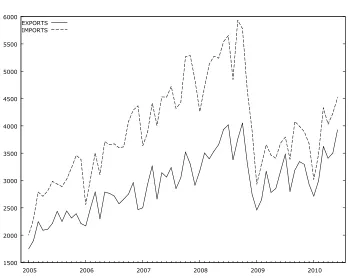
[1]. Aitken (1973) discovered significant effects for the foreign trade of the EFTA members [2]. Bayoumi and Einchengreen (1995) found also important consequences for the countries from the European Economic Community [3]. Frankel and Rose (2002) proved that a currency union boosted the total trade of a country [4]. In case of Romania the quantification of the integration consequences it is very complex. The impact of the global crisis interfered with the effects of the adhesion to the EU. In the most acute stage the global crisis caused an important decline of both exports and imports. After this stage ended a recovery occurred in the Romanian foreign trade (Figure 1). However, in the present time it is very hard to anticipate the future evolution of the crisis and its effects on the international transactions.
organised as follows. The second part describes the data and the methodology, the third part presents the empirical results and the fourth part concludes.
2. Data and Methodology
In this paper we use monthly values of exports and imports provided by the Romanian National Institute of Statistics and by the National Bank of Romania. These time series cover a period from January 2005 to June 2008. These values are seasonally adjusted by ARIMA-X-12. We analyse the impact of integration using real values obtained by deflating the nominal exports and imports with the Consumer Price Index provided by the Romanian National Institute of Statistics. We use the following notations:
- l_REXP_d11 for the natural logarithms of the seasonally adjusted real exports of goods and services;
- l_RIMP_d11 for the natural logarithms of the seasonally adjusted real imports of goods and services.
We employ the unit root test proposed by Saikkonen and Lütkepohl (2002) and
Lanne, et al., (2002) (SLL) to search for
the structural breaks in real exports and
imports [5]. A structural break TB
exhibited by a variable yt is revealed by a
level shift function ft( )’ included in the
model:
yt = 0 + 1t + ft( )’ + xt
(1)
where the error term xt is generated by an
AR(p) process with possible unit root. We use a shift function based on the exponential distribution function in which
ft( ) takes the value {1-exp[- (t- TB +1)]}
if TB and 0 otherwise.
The critical values of SLL test are provided by Lanne et al. (2002), while the Akaike criterion is used for choosing the optimal number of lags [6].
3. Empirical Results
We performed the SLL tests for the two time series. In the Table 1 there are presented the results for l_REXP_d11. For both types of tests, with and without trend, the null hypothesis of a unit root can not be rejected.
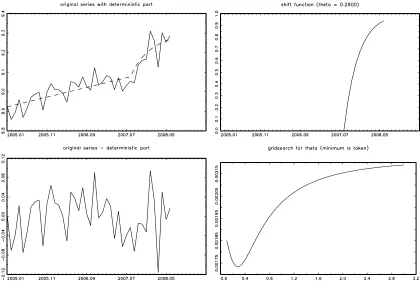
In the case of a trend l_REXP_d11 exhibits a structural break for September 2007. From this month the increase of real exports was accelerated (Figure 2).
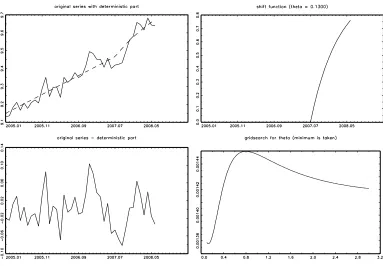
The SLL test without trend revealed a structural break for August 2007. This month marked an intensification of the real exports growth (Figure 3).
The results of the SLS tests for l_RIMP_d11 are presented in the Table 2. With or without trend these tests indicate the non stationarity of the variable.
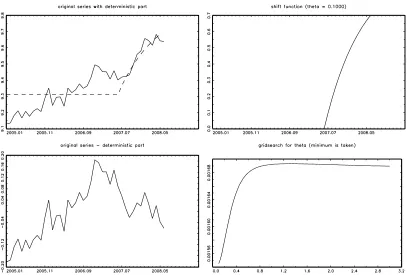
By the SLL test with a trend we found a structural break for August 2007. From this
month it could be observed an
intensification of the real imports growth (Figure 4).
The SLS test without trend revealed a structural break for July 2007. After this month the real imports were accelerated.
4. Conclusions
SLS tests revealed structural breaks during the second semester of 2007 for both Romanian exports and imports. These structural breaks could be connected with the effects of the adhesion to the European Union. The acceleration of growth that followed these structural breaks suggests the trade creation caused by the adhesion was more intense than the trade diversion. Since the second semester of 2008 the Romanian foreign trade was affected by the distinct stages of the global crisis. The interference of the crisis consequences with the integration impact could be a subject for the future researches.
References
[1] Viner, J., The customs union issue, New York, Carnegie Endowment for International
Peace, 1950.
cross-section analysis, The American Economic Review, v. 63, n. 5, p. 881-892, 1973.
[3] Bayoumi, T. and Eichengreen, B., Is regionalism simply a diversion?, Evidence from the
evolution of the EC and the EFTA., National Bureau of Economic Research, Cambridge,
Working paper 5283, 1995.
[4] Frankel, Jeffrey, and Andrew Rose, An Estimate of the Effect of Common Currencies on
Trade and Income, Quarterly Journal of Economics117 (2), 437-466, 2002.
[5] Saikkonen, P. and Lütkepohl, H., Testing for a unit root in a time series with a level shift
at unknown time, Econometric Theory 18, 313-348, 2002.
[6] Lanne, M., Lütkepohl, H. and Saikkonen, P., Comparison of unit root tests for time series
with level shifts, Journal of Time Series Analysis, 2002.
[image:4.612.130.480.244.522.2]Appendix
Figure 1: Evolution of the Romanian Exports and Imports between January 2005 and June 2010
Table 1 The SLL Test with exponential shift for l_REXP_d11
Coefficients Type of
test
Number of lags
Break Date
Value of SLL test statistic
Estimated
theta d(trend) d(const) d(shiftfkt)
with trend
4 2007 M9
-2.8191 0.2800 0.0045 (0.0920)
8.8695 (1183.779)
0.2190 (30.7208) without
trend
2 2007 M8
-2.3871 0.1000 - 8.8957 (1036.775)
0.4084 (50.0279)
Critical values for test statistic
Level 1% 5% 10%
with trend -3.55 -3.03 -2.76
[image:4.612.86.527.578.715.2]Notes: The critical values for SLL test statistic were provided by Lanne et al.(2002). The values from the parentheses are t-statistics associated to the coefficients.
Table 2 The SLL Test with exponential shift for l_RIMP_d11
Coefficients Type of
test
Number of lags
Break Date
Value of SLL test statistic
Estimated
theta d(trend) d(const) d(shiftfkt)
with trend
4 2007
M8
-2.6646 0.1300 0.0097
(0.248)
9.1051 (1508.514)
0.1811 (31.5351) without
trend
4 2007
M7
-1.5244 0.1000 - 9.1147
(1402.343)
0.3507 (56.7216) Critical values for test statistic
Level 1% 5% 10%
with trend -3.55 -3.03 -2.76
without trend -3.48 -2.88 -2.58
Notes: The critical values for SLL test statistic were provided by Lanne et al. (2002). Values
from the parentheses are t-statistics associated to the coefficients.
Figure 3:Graphical Representation of the SLL Test without trend for l_REXP_d11
[image:6.612.113.496.427.693.2]